
The Ultimate Engagement Ring Settings Guide: A Connoisseur’s Roadmap to Bespoke Luxury (2026)
Your center stone might be a masterpiece of GIA certified brilliance, but without the right architecture, its fire remains trapped. Most people spend months obsessing over diamond clarity while treating the metal framework as an afterthought. This engagement ring settings guide is designed to fix that, helping you avoid mistakes that can cost you both brilliance and security. If you're feeling overwhelmed by technical terms or worried that a trendy design will look "dated" a decade from now, you aren't alone.
Choosing the right foundation is where true bespoke luxury begins. We draw on three generations of expertise from Manhattan’s Diamond District to help you master the art of the perfect match. You'll learn exactly how different structures impact light performance and how to balance delicate aesthetics with the durability required for a high-carat stone. We're going to demystify everything from pavé to channel styles, giving you the confidence to collaborate with a jeweler who understands that a ring is a legacy, not just a purchase. By the end of this roadmap, you'll have the expert insights needed to ensure your diamond sits in a setting that's as timeless as the commitment it represents.
Key Takeaways
- Understand that the setting is the architectural soul of your ring, balancing the security of your diamond investment with its ultimate light performance.
- Discover how to choose between the timeless simplicity of a solitaire and the light-amplifying drama of a halo to best reflect your personal aesthetic.
- Use this expert engagement ring settings guide to identify structural designs like bezel and cathedral that offer modern sophistication alongside superior stone protection.
- Learn the professional secrets to matching specific frameworks with your diamond's shape, ensuring vulnerable points on pear or heart cuts remain secure for decades.
- Recognize why bespoke craftsmanship outshines mass-market options by designing a foundation specifically tailored to the unique dimensions of your center stone.
Understanding the Architecture of an Engagement Ring Setting
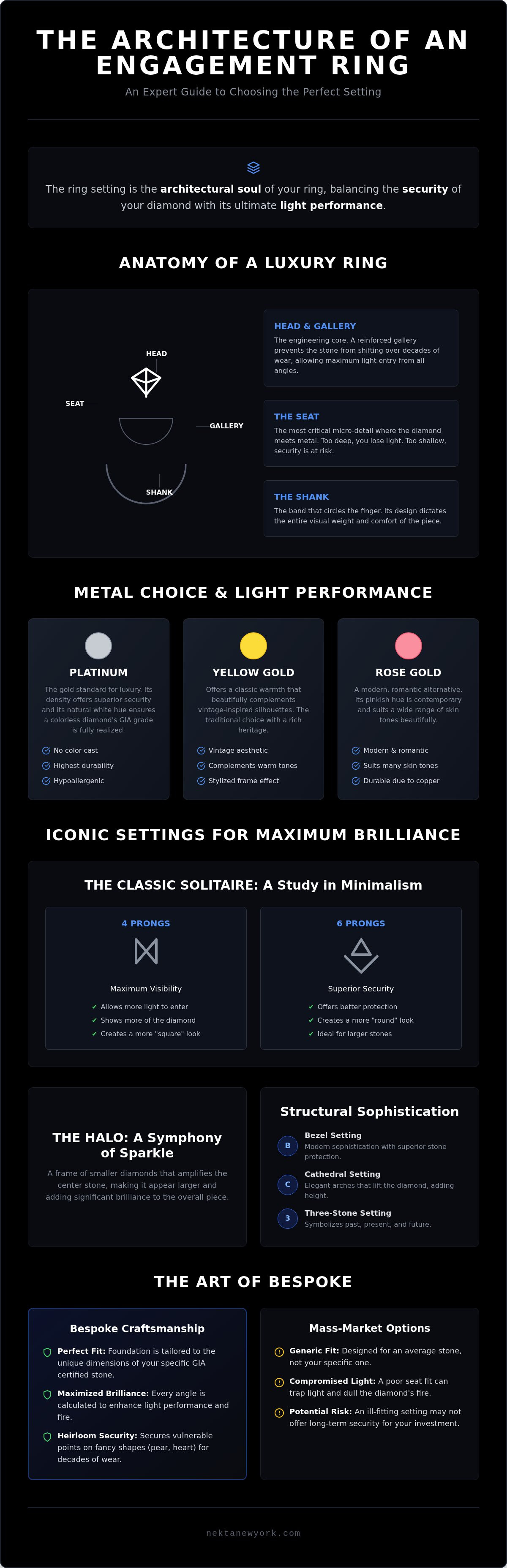
A diamond is a masterpiece of light, but without a precise foundation, its story is never fully told. We view the setting as the architectural soul of the ring. It serves a dual purpose that requires zero compromise; it must secure your significant financial investment while simultaneously enhancing every facet of the diamond's aesthetic. In our Manhattan studio, the Mike Nekta philosophy centers on balancing structural integrity with an "invisible" artistry. We believe the metal should serve the stone, never distract from it. This engagement ring settings guide starts here, at the drafting table, where every millimeter of metal is calculated for performance.
The Anatomy of a Luxury Ring
To appreciate a bespoke piece, you must understand its components. The shank is the band that circles the finger, but the head and gallery are where the true engineering happens. The "seat" is the most critical micro-detail. It's the exact point where the diamond's girdle meets the metal. If the seat is too deep, you lose light. If it's too shallow, the stone's security is at risk. For high-carat GIA certified diamonds, the gallery must be reinforced to prevent shifting over decades of wear. Every curve is designed to allow maximum light entry from the sides and bottom, fueling the diamond's fire. As you move through this engagement ring settings guide, remember that these structural choices dictate the entire visual weight of the piece.
Metal Choice and Light Performance
Your first architectural decision is the metal. Platinum is widely considered the gold standard for luxury settings because of its density and natural white hue. It doesn't cast a yellow tint onto a colorless diamond, ensuring the stone's GIA grade is fully realized. While the history of engagement rings reveals a long tradition of using various precious materials, modern connoisseurs often choose between the cool strength of Platinum and the rich heritage of 18k Gold.
Yellow gold offers a warmth that beautifully complements vintage-inspired silhouettes, while rose gold provides a modern, romantic alternative that suits contemporary skin tones. However, the choice isn't just about color. It's about how the metal interacts with the diamond's light story. Platinum prongs are nearly invisible against a high-quality white diamond, whereas gold prongs can add a deliberate, stylized frame. We help you choose the metal that protects your stone's integrity while amplifying its natural character. This balance ensures your ring remains a timeless heirloom rather than a passing trend.
Solitaire to Halo: Iconic Settings for Maximum Brilliance
While the internal architecture provides the strength, the silhouette defines the ring's personality. This engagement ring settings guide transitions from the hidden engineering to the iconic styles that have defined luxury for generations. We start with the solitaire, the purest expression of a diamond's beauty, before exploring the intricate brilliance of halos and pavé work. Each style offers a different "light story," and choosing between them requires an understanding of how metal interacts with a stone's natural fire.
The Classic Solitaire: Prongs and Light
A solitaire is more than just a single stone; it's a study in minimalism. The choice between 4 and 6 prongs is often a debate of security versus visibility. 6 prongs offer a more rounded look and superior safety, while 4 prongs allow more of the diamond's profile to be seen, letting light enter from more angles. Our specific approach to round brilliant cut engagement rings focuses on "petite" prongs. We hand-file these to be as unobtrusive as possible, ensuring the metal never shadows the stone's fire.
Claw prongs offer a sharp, sophisticated finish that many high-end collectors prefer over standard round prongs. These tapered points draw the eye toward the center stone without adding unnecessary bulk. It's a subtle distinction, but in bespoke jewelry, these millimeter-level choices separate a mass-market piece from a true heirloom. A well-crafted solitaire should feel like the diamond is floating on the finger, held by nothing but light and intention.
The Halo and Pavé: Managing the "Sparkle Factor"
If the solitaire is a solo performance, the halo is a full symphony. A well-executed halo uses a perimeter of smaller diamonds to amplify the center stone's visual footprint. It's a technique often highlighted in The Knot's engagement ring settings guide for its ability to maximize impact. However, the artistry lies in the scale. The side stones shouldn't compete with your center GIA diamond; they should serve as a stage. If the halo diamonds are too large, they blur the edges of the center stone, sacrificing its distinct shape.
Pavé settings take this further by "paving" the band with light. We differentiate between traditional pavé and micro-pavé based on the wearer's lifestyle. Micro-pavé is breathtakingly delicate but requires a gentle hand, whereas traditional pavé offers a bit more metal for durability. For those seeking a modern secret, the hidden halo places diamonds underneath the center stone's head. It's a detail only visible from the side, meant for the wearer's eyes only. When designing a princess cut diamond ring, we use specialized V-shaped prongs or halo corners to protect the stone's vulnerable points. If you're ready to see how these styles look in person, we invite you to explore our handcrafted collections.
Structural Sophistication: Bezel, Cathedral, and Three-Stone Designs
A setting's beauty is only as reliable as its engineering. While previous chapters of this engagement ring settings guide focused on light exposure and classic silhouettes, we now turn to designs that prioritize structural drama and superior protection. For those investing in high-carat stones, specifically 3 carats or larger, the framework's stability becomes a non-negotiable factor. These sophisticated designs offer a unique blend of modern geometric precision and architectural strength that mass-produced rings simply can't replicate.
The Bezel: Modernity Meets Security
The bezel setting is the ultimate choice for the active connoisseur. Instead of prongs, a continuous rim of precious metal surrounds the diamond's perimeter. It's a sleek, modern look that offers the highest level of protection against chips and snags. While fashion publications often label the bezel as a "trend," we've recommended it for decades to clients with high-energy lifestyles. It's a study in balance; a full bezel provides maximum security, while a half bezel exposes more of the stone's profile to allow light entry.
This setting style is particularly stunning when paired with an emerald cut engagement ring. The clean, linear metalwork echoes the step-cut facets of the diamond, creating a cohesive Art Deco aesthetic. It's important to ensure the bezel is handcrafted to the stone's exact dimensions. A poorly fitted bezel can create "dead spots" where light is trapped; a Mike Nekta bespoke bezel is filed to a razor-thin edge to maximize the diamond's face-up brilliance.
The Cathedral and Three-Stone: Architectural Drama
Cathedral settings use graceful arches to elevate the center stone above the band. This added height isn't just for drama; it allows for a more intricate gallery and better light performance from the sides. The arches provide additional structural support, making it an excellent choice for securing significant GIA certified diamonds. It's a profile-focused design that ensures the ring looks as breathtaking from the side as it does from the top.
If you're looking for a design with deep symbolism, the three-stone or "Trinity" setting represents a couple's past, present, and future. The challenge here is proportion. When building a layout for a cushion cut diamond, the side stones must complement the center's soft corners without overwhelming them. We often suggest:
- Pear shapes to create a tapered, finger-flattering flow.
- Baguettes for a sharp, architectural contrast.
- Round brilliants to maximize the overall sparkle factor across the finger.
How to Match Your Setting to Your Diamond Shape and Lifestyle
A diamond's silhouette dictates its needs. While we've explored the structural foundations, the final marriage between shape and setting is where many designs fail. A mismatched pair can lead to visual imbalance or, worse, structural failure. This engagement ring settings guide emphasizes that your lifestyle is the ultimate filter for every aesthetic choice. Whether you're a surgeon who needs a low-profile bezel or a socialite seeking a high-set showstopper, the setting must accommodate your daily rhythm without compromising the stone's security.
Shape-Specific Setting Rules
Elongated shapes like ovals, pears, and marquise cuts demand perfect symmetry to avoid a lopsided appearance. When comparing oval vs pear engagement rings, prong orientation is the deciding factor. Pears require a specialized V-prong at the tip to prevent chipping; a necessity often overlooked in mass-market settings. Similarly, a heart shape needs a V-prong at the cleft and the point to maintain its romantic outline. For those seeking a modern twist, orienting emerald or radiant cuts in an East-West setting offers a bold, contemporary look. Conversely, the traditional North-South orientation remains the gold standard for elongating the finger and providing a classic silhouette.
Lifestyle and Durability
Durability is a function of design height. High-profile settings maximize impact by allowing more light to enter the stone from below, but they are prone to catching on fine fabrics. Your personal engagement ring settings guide should always prioritize the "snag test." If the setting catches on a silk scarf, it's likely too high for a high-activity routine. Healthcare and fitness professionals often find low-profile settings more practical as they won't puncture medical gloves or interfere with gym equipment. These designs keep the diamond closer to the hand, reducing the risk of accidental impact.
When protecting a 4-carat investment or larger, the sheer weight of the stone requires a heavy-duty platinum framework. Platinum's density ensures the prongs won't easily bend, providing the peace of mind necessary for high-value GIA certified diamonds. Pavé-heavy bands are breathtaking but require bi-annual maintenance to check for loose stones. In our Manhattan studio, we treat these checks as a ritual of luxury, ensuring your heirloom remains as secure as the day it was handcrafted in the heart of the Diamond District. Ready to find the perfect foundation for your stone? Consult with Mike Nekta today to design a setting that matches your unique lifestyle.
The Art of Bespoke: Why Custom Craftsmanship Surpasses Mass-Market
Choosing a foundation from a catalog might seem efficient, but it often compromises the diamond's potential. An "off-the-shelf" setting is manufactured to fit a range of stone sizes, which inevitably leaves "dead space" between the diamond and the metal. This engagement ring settings guide advocates for the bespoke path because a luxury diamond deserves a tailored fit. In our Manhattan studio, we don't just pick a setting; we engineer one. We design the architecture around the specific measurements of your stone, ensuring every angle is optimized for light performance. Hand-forged metal is denser and more durable than cast metal, providing a level of security that mass-produced pieces simply cannot match.
The Custom Advantage
The difference is in the micro-details. When a setting is handcrafted, every micro-diamond in a pavé band is hand-set under a microscope. This level of precision ensures maximum security and a seamless surface that feels like silk against the skin. Mass-produced rings often lose side stones because the metal isn't forged for the specific diamonds it holds. A bespoke setting also allows you to incorporate personal symbolism into the gallery, such as a hidden initial or a specific motif in the metalwork. This turns the ring into a private narrative, a secret shared only between the wearer and the craftsman.
Your Journey in the Diamond District
Entering NYC’s Diamond District for a consultation with Mike Nekta is an invitation into a world of 3rd generation expertise. We begin by selecting a GIA certified loose diamond that resonates with your aesthetic and investment goals. From there, the journey from a raw concept to a finished masterpiece is entirely collaborative. You aren't just buying a product; you're witnessing the culmination of decades of technical mastery. This process provides the peace of mind that your investment is structurally sound for a lifetime. Every prong is hand-filed and every seat is custom-cut to ensure your diamond is the star of the show.
Finalizing your look requires a holistic approach to your bridal stack. A bespoke engagement ring deserves a matching foundation that sits flush against its unique architecture. Pairing your setting with custom wedding bands in NYC ensures a unified silhouette that reflects your personal legacy. By choosing bespoke, you're investing in a piece that won't just look beautiful today, but will remain a structurally perfect heirloom for generations to come. Trusting a master jeweler in the heart of Manhattan is the final step in mastering the art of the perfect ring.
Crafting Your Legacy in the Diamond District
Choosing the foundation for your diamond is a decision that bridges high-stakes engineering and deep emotion. You've seen how the right architecture doesn't just hold a stone; it elevates its natural fire. From the minimalist elegance of a solitaire to the structural drama of a cathedral design, your choice dictates exactly how light interacts with your GIA certified investment. This engagement ring settings guide has provided the technical roadmap, but the final step is a personal collaboration with a master craftsman.
Off-the-shelf designs can't offer the precision or structural integrity of a piece handcrafted in NYC. As a 3rd generation diamond expert, I believe every stone requires a seat designed specifically for its unique dimensions. This ensures a lifetime of security and a silhouette that never feels dated. You deserve a ring that reflects your unique story with maximalist brilliance and uncompromising strength.
Ready to begin your journey? Design Your Custom Engagement Ring with Mike Nekta and experience the difference of true Diamond District artistry. Let's build a masterpiece that stands the test of time together.
Frequently Asked Questions
What is the most secure engagement ring setting?
The bezel setting is widely considered the most secure option for any center stone. By encircling the diamond's entire perimeter with a rim of precious metal, it protects the girdle from chips and prevents the stone from snagging. For high-carat investments, we often recommend platinum bezels due to the metal's superior density. This structural choice ensures your stone remains immovable even during rigorous daily activities, providing the ultimate peace of mind for luxury collectors.
Which setting makes a diamond look the largest?
A halo setting is the most effective way to amplify a diamond's visual footprint. By surrounding the center GIA certified diamond with a perimeter of smaller brilliant stones, you create a unified wall of light that makes the center appear significantly larger. Additionally, using a thinner, delicate band can create a forced perspective that further emphasizes the stone's size. This approach is a hallmark of our engagement ring settings guide for those seeking maximum impact.
What is the difference between a prong and a bezel setting?
The fundamental difference lies in how the metal interacts with the diamond’s girdle. Prong settings use small metal claws to lift the stone, allowing light to enter from all angles for maximum fire. A bezel setting wraps a continuous rim of metal around the diamond, offering a sleek, modern look with unmatched protection. While prongs celebrate the stone's profile, bezels prioritize a flush, snag-free silhouette that complements an active, high-end lifestyle.
Can I change the setting of my engagement ring later?
You can absolutely transition your diamond into a new setting as your style evolves or for a milestone anniversary. Many clients start with a classic solitaire and later upgrade to a more intricate halo or three-stone design. Our bespoke process in Manhattan’s Diamond District involves carefully unmounting your stone and engineering a new foundation around its exact dimensions. This ensures that the structural integrity of your GIA certified diamond is never compromised during the transition.
Does the setting affect the price of the engagement ring significantly?
The setting's complexity and metal weight impact the final cost, though the center stone remains the primary investment. Platinum is generally more expensive than 18k gold due to its density and purity requirements. Intricate labor, such as hand-setting hundreds of micro-pavé diamonds, also adds to the craftsmanship fee. While a simple solitaire is more accessible, a bespoke architectural setting ensures your diamond performs at its peak, making the setting a vital part of the ring's overall value.
What are the best settings for active lifestyles?
Low-profile bezel or channel settings are the premier choices for those with high-energy routines. These designs keep the diamond close to the hand, reducing the risk of accidental impact or snagging on clothing. Healthcare and fitness professionals often prefer these flush styles because they don't interfere with gloves or equipment. Avoiding high cathedral arches ensures your ring remains a practical heirloom that you don't have to remove for your daily activities.
How do I choose between a 4-prong and a 6-prong setting?
Choosing between 4 and 6 prongs involves balancing aesthetic preference with structural safety. A 6-prong setting offers superior security and creates a more rounded silhouette, which is ideal for round brilliant diamonds. Conversely, a 4-prong setting allows more of the stone to be visible and is often preferred for square or emerald cuts to emphasize their linear corners. We help you decide based on your stone's shape and the level of metal visibility you desire.
Why should I choose a custom setting over a pre-made one?
Custom settings eliminate the "dead space" found in mass-produced, one-size-fits-all rings. This engagement ring settings guide highlights that bespoke craftsmanship involves hand-forging metal and hand-setting every stone under a microscope. This results in a denser, stronger framework and a more precise fit for your specific diamond's measurements. By choosing a 3rd generation expert in NYC, you ensure your ring is an engineered masterpiece rather than a generic assembly, guaranteeing a lifetime of durability.