
The Connoisseur’s Guide to the Princess Cut Diamond Ring in 2026
A princess cut diamond ring is a high-performance engine of light that most buyers unknowingly starve of its true potential. While the sharp, modern geometry is undeniably striking, the difference between a stone that dances and one that sits flat lies in technical nuances most jewelers never mention. You likely feel the pull of its contemporary lines but worry about those four delicate corners chipping during daily wear. It's a valid concern; a poorly cut square diamond can look dull and remain structurally vulnerable if the setting isn't handled with master-level precision.
I'll help you master these aesthetic and technical details so you can choose a diamond that looks significantly larger than its carat weight. We'll dive into the 2026 GIA grading shifts, including the new premium and standard designations for lab-grown stones and the updated fluorescence reporting. You'll learn how to spot a poorly cut square diamond from across the room and why a handcrafted NYC setting is the only way to truly protect your investment. This guide provides the expert clarity you need to secure a high-performance stone that reflects both your taste and Mike Nekta New York's heritage of luxury craftsmanship.
Key Takeaways
- Learn how chevron patterns on the pavilion dictate whether your diamond exhibits a "crushed ice" sparkle or a sophisticated "broad flash" brilliance.
- Discover why a princess cut diamond ring offers exceptional value, providing a larger visual profile than round counterparts at a similar price point.
- Identify the essential setting techniques, such as V-prongs and bespoke bezel designs, required to safeguard the stone's four vulnerable corners.
- Navigate the 2026 GIA grading updates to confidently distinguish between premium and standard stones in a rapidly shifting diamond market.
- Recognize how the hand-selection process of a third-generation NYC expert ensures your diamond achieves peak light performance and structural integrity.
The Contemporary Allure of the Princess Cut Diamond Ring
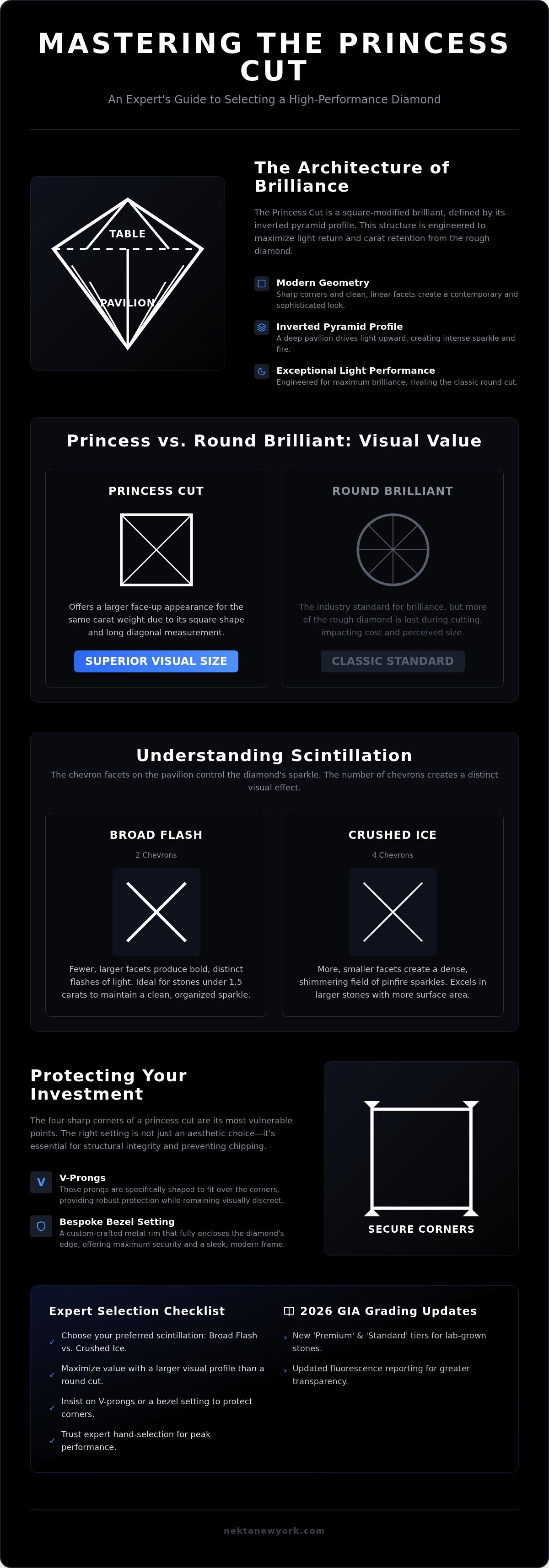
The princess cut is the ultimate expression of geometric precision in the world of high-end jewelry. Defined as a square-modified brilliant cut, it's instantly recognizable by its four sharp corners and its unique, inverted pyramid profile. While the round brilliant focuses on soft curves, the princess cut diamond ring embraces bold, linear energy that feels both powerful and refined. This shape was meticulously developed to maximize light return while retaining more of the original rough diamond's weight than traditional round cuts, making it a masterpiece of efficiency and beauty.
Tracing the history of the princess cut reveals its origins in the 1960s and 70s. It was designed as a sophisticated, modern response to the classic round diamond, offering a fresh aesthetic for a new generation of collectors. By 2026, this allure has only intensified. We're seeing a significant shift toward architectural and minimalist jewelry design in Manhattan and beyond, where the sharp and decisive nature of square cuts perfectly complements contemporary fashion and urban elegance.
The Architecture of a Princess Diamond
Visualizing the stone's profile is key to understanding its unique brilliance. Unlike other fancy shapes, the princess cut features a deep, pyramid-like base that drives light upward through the stone's table with incredible intensity. This depth allows for a complex facet arrangement on the pavilion, which creates the famous "crushed ice" scintillation pattern that many collectors find irresistible. Because the table is square, it maximizes the visible surface area of the diamond. This creates a distinct face-up advantage. Due to the long diagonal measurements from corner to corner, a princess cut often appears larger to the eye than a round diamond of the identical carat weight, offering exceptional visual impact for your investment.
Why Modern Brides Choose Square Brilliance
Choosing this cut is often a statement of personality and confidence. It offers a rare balance, capturing the intense fire and sparkle of a round brilliant while maintaining the clean, sophisticated lines usually associated with an emerald cut. This duality makes it incredibly versatile for custom design. Whether it's set in a minimalist NYC-style solitaire or surrounded by an intricate, handcrafted halo, the shape remains a powerful focal point. Psychologically, the sharp edges suggest a sense of strength and modern elegance. It's a choice for those who appreciate the heritage of a diamond but want a piece that feels firmly rooted in the present day.
Understanding Scintillation: Chevrons and Light Performance
The soul of a princess cut diamond ring lives within its pavilion, specifically in the arrangement of its chevron facets. These V-shaped cuts are the primary drivers of scintillation, the play of light and dark that occurs when the stone or the observer moves. While most buyers focus strictly on the 4Cs, a connoisseur knows that evaluating princess cut diamonds requires a deeper look at how these facets interact. GIA provides grades for symmetry and polish, but the specific 'personality' of the sparkle is determined by the chevron count and the stone's overall depth.
Choosing between 'Crushed Ice' and 'Broad Flash' is an essential decision for any buyer. A broad flash pattern creates larger, more distinct bursts of light, reminiscent of a step-cut’s elegance but with brilliant-cut intensity. Conversely, the crushed ice effect produces a dense, shimmering field of tiny sparkles. This choice is largely influenced by the depth percentage. If a stone is cut too deep, it may hide weight in the pavilion, leading to a duller appearance and significant light leakage through the center.
The Chevron Count: 2, 3, or 4?
The number of chevrons dramatically alters the diamond's visual texture. A stone with two chevrons features larger facets, resulting in bold, chunky flashes of light. These are often the preferred choice for diamonds under 1.5 carats because they maintain a clean, organized sparkle. Four chevrons create a more complex, shimmering effect that excels in larger stones where there is enough surface area to appreciate the intricate pinfire pattern. If you're unsure which scintillation profile suits your style, viewing a curated selection of princess cut engagement rings can help you identify your preference in person.
Avoiding the 'Dark Center' Trap
A common pitfall in selecting square diamonds is the 'dark center' or 'nail head' effect. This occurs when light leaks out the bottom of the stone instead of reflecting back to your eye, often because the pavilion angles are too steep. Achieving a perfect 1:1 length-to-width ratio is the baseline for the geometric symmetry required for optimal performance. Light return in a princess cut is the efficient redirection of light rays back through the table, facilitated by the precise alignment of pavilion angles and chevron facets. Avoid stones with a depth percentage exceeding 75%, as they often suffer from a 'windowing' effect where the center appears empty or dark.
Princess Cut vs. Round Brilliant: A Comparative Analysis
Choosing between a round brilliant and a princess cut diamond ring is often the first major crossroads for any serious collector. While the round cut remains the industry standard for light dispersion, the princess cut offers a distinct, high-performance alternative that challenges the status quo. These two shapes represent different philosophies of light. The round brilliant is designed to maximize fire, those flashes of rainbow color, while the square-modified brilliant focuses on intense white light brilliance and geometric precision. Understanding these differences is the first step in selecting a stone that reflects your personal standard of excellence.
The Value Proposition of Square Cuts
The economic reality of diamond cutting heavily favors the square shape. When a master cutter approaches a rough octahedral stone, they can retain up to 80% of the original material to create a princess cut. In contrast, a round brilliant often requires sacrificing more than half of the rough stone to achieve its circular proportions. This efficiency is a significant win for the buyer. You're able to secure a larger, higher-quality stone for the same investment, effectively maximizing your budget without compromising on the GIA-certified excellence you expect from a luxury piece. It's a rare instance where the more modern, architectural choice is also the more fiscally prudent one.
Visual presence is another area where the princess cut excels. Because of its long diagonal measurements, a 1-carat square diamond often possesses a larger "face-up" appearance than a 1-carat round. It occupies more real estate on the finger, providing a commanding presence that's hard to ignore. However, this architectural beauty comes with a specific responsibility. While a round diamond’s circular edge is naturally resilient, the four sharp corners of a princess cut are points of vulnerability. They require expert, handcrafted settings to prevent chipping, a detail that a third-generation expert never overlooks.
Style Profiles: Classic vs. Architectural
The choice ultimately reflects your personal aesthetic narrative. The round brilliant is the quintessential choice for those seeking soft, traditional lines and maximum fire. It’s a timeless look that complements almost any hand shape. The princess cut is for the individual who prefers an edgy, modern, and architectural look. Its clean lines and sharp angles are particularly flattering on long, slender fingers, where the square shape provides a sophisticated balance. If you're looking for a piece that feels like a handcrafted work of art rather than a standard retail item, the geometric decisiveness of the square cut is unparalleled.
Selecting the Ideal Setting: Protecting Your Investment
When you choose a princess cut diamond ring, you aren't just buying a piece of jewelry; you're acquiring a masterwork of geometry that requires specific structural support. The absolute priority is the protection of the four points. These corners are the thinnest parts of the stone and are prone to chipping if they strike a hard surface. A generic, mass-produced setting often fails to provide the necessary coverage, leaving the diamond vulnerable to the rigors of daily life. Securing these points isn't just about safety; it's about preserving the stone's value for a lifetime.
Platinum stands as the undisputed gold standard for securing these stones. Its density and durability mean it won't wear away over time like gold, ensuring the prongs remain thick and secure for decades. When selecting your band, consider the visual proportions carefully. A stone with a larger face-up profile requires a slightly wider band to provide a balanced aesthetic and a stable foundation on the finger. A band that's too thin can make the stone look top-heavy and increase the risk of the ring spinning, which exposes the corners to accidental knocks.
The V-Prong Advantage
V-prongs are the hallmark of a well-engineered square cut setting. Unlike standard round prongs that only touch a small portion of the stone, V-prongs wrap entirely around the corners. This design distributes pressure evenly and creates a protective shield against snags and impacts. Beyond security, they sharpen the visual silhouette, making the square shape look even more decisive. In our NYC workshop, we ensure these prongs are handcrafted to sit flush against the diamond's table, eliminating gaps where debris can collect or fabric can catch.
Halo vs. Solitaire for Square Diamonds
The choice between a halo and a solitaire often comes down to the desired level of brilliance and security. A halo setting surrounds the center stone with a perimeter of smaller diamonds, effectively acting as a shock absorber. This is an excellent choice for those with active lifestyles who still want an extravagant look. Conversely, a high-set solitaire allows for maximum light entry from all angles, showcasing the stone’s internal fire. By integrating these stones into handcrafted engagement rings, you ensure the setting is built specifically for that individual stone's unique dimensions. If you're ready to see how these technical details come together in a finished piece, explore our custom princess cut settings.
Bespoke Artistry: The Mike Nekta Approach in NYC
Selecting a princess cut diamond ring requires more than a casual glance at a grading report. It demands the discerning eye of a third-generation expert who understands that two stones with identical GIA grades can perform entirely differently. Mike Nekta’s approach is rooted in the belief that a diamond’s beauty isn't just about its technical specifications; it’s about how the stone interacts with the light and the person wearing it. In the heart of Manhattan, this philosophy translates into a rigorous hand-selection process where light return is the ultimate metric of success. While mass-market retailers rely on volume, our focus remains on the individual character of each square-modified brilliant.
The technical nuances we've explored, from chevron counts to pavilion angles, are the baseline for our selection. However, the true mastery lies in the final physical inspection. A personal consultation in the NYC Diamond District allows you to witness this expertise firsthand. You'll see how a master’s eye identifies the subtle differences in scintillation that a certificate simply cannot capture. This level of dedication ensures that your investment isn't just a piece of jewelry, but a high-performance asset that will retain its brilliance for a lifetime.
From Loose GIA Diamond to Finished Masterpiece
The journey begins with the stone itself. Mike Nekta personally evaluates each loose GIA-certified diamond, looking for the specific geometric harmony required for peak performance. This isn't a task for an algorithm. It's a collaboration between the client and a master craftsman. When you begin the process of creating a custom engagement ring NYC, you aren't just choosing a setting. You're ensuring that the precious metal is calibrated to the exact micrometer of your diamond’s unique dimensions. Every ring must pass the 'Nekta Sparkle' test, performing with vibrant intensity in all lighting conditions, from the soft glow of a candlelight dinner to the bright sun of a city morning.
The Heritage of the NYC Diamond District
Buying a princess cut diamond ring in Manhattan offers a level of transparency and trust that digital storefronts cannot replicate. There's a profound sense of heritage in our workshop. Dealing with a boutique that carries decades of Manhattan history means you're part of a legacy of excellence. You aren't just a transaction; you're entering a trusted circle where expertise is shared freely. This personal connection allows for a deeper understanding of GIA-certified luxury. Investing in high end diamond jewelry NYC is a commitment to quality. The bespoke nature of our NYC workshop ensures your square-cut diamond is protected by a setting as resilient and sophisticated as the city where it was crafted.
Master the Art of Geometric Luxury
Choosing a princess cut diamond ring is a decisive move toward a modern, architectural aesthetic that doesn't compromise on brilliance. You now understand that true performance depends on the technical harmony of chevron facets and pavilion angles, rather than just the weight on a scale. By prioritizing a handcrafted setting that safeguards those four vulnerable corners, you ensure your investment remains as resilient as it is radiant. This shape offers a unique value proposition, providing a commanding visual presence that often outshines traditional rounds when selected with an expert eye.
The journey to finding a high-performance square cut shouldn't be a solitary one. Leveraging the heritage of a 3rd-generation diamond expert ensures you navigate the 2026 market with absolute confidence. Our GIA-certified selection is curated for maximum light return, and every piece is meticulously handcrafted in our NYC workshop to meet the highest standards of luxury. Whether you're drawn to a bold solitaire or a protective halo, the right guidance turns a complex technical choice into a seamless, rewarding experience.
Take the next step in your connoisseur’s journey. Book a Private Consultation with Mike Nekta in NYC to experience the unparalleled sparkle of a hand-selected princess cut in person. We look forward to helping you create a masterpiece that reflects your unique vision.
Frequently Asked Questions
Do princess cut diamonds chip easily?
Princess cut diamonds are more vulnerable at their four corners because the stone is thinnest at these points. While the diamond itself is incredibly hard, a sharp blow to an exposed corner can cause a chip. You can easily mitigate this risk by choosing a protective setting like V-prongs or a bezel. A well-engineered, handcrafted setting ensures the stone remains secure and beautiful for a lifetime of daily wear.
Which is more expensive: a round or a princess cut diamond?
Round diamonds are almost always more expensive per carat than princess cuts. This price difference exists because diamond cutters retain up to 80% of the rough stone when creating a square shape, whereas they lose more than half the rough for a round brilliant. Choosing a princess cut diamond ring allows you to secure a larger, higher-quality stone while maximizing your investment without sacrificing luxury or brilliance.
How many chevrons should a princess cut diamond have?
The ideal chevron count depends on your preference for sparkle and the stone's size. Stones under one carat typically perform best with two chevrons to maintain bold, broad flashes of light. Larger diamonds often feature three or four chevrons to create an intricate, shimmering effect known as crushed ice. There isn't a single right answer; it's about matching the facet pattern to the diamond's unique dimensions and your aesthetic taste.
Does a princess cut look bigger than a round brilliant?
Yes, a princess cut diamond often possesses a larger visual footprint than a round brilliant of the same carat weight. This is because the diagonal measurement from corner to corner is significantly longer than the diameter of a round stone. This face-up advantage means the diamond occupies more real estate on your finger, giving it a commanding presence that makes it look heavier and more impressive than it actually is.
What is the best setting for a princess cut diamond ring?
A V-prong setting is widely considered the best choice for this specific shape. These prongs wrap entirely around the corners to provide a shield against impacts and snags. Platinum is the ideal metal for a princess cut diamond ring because its density ensures the prongs won't wear thin over time. For those seeking maximum security, a bezel setting offers a modern, architectural look that completely encircles the diamond’s perimeter.
Can I use a princess cut diamond in a vintage-style setting?
Absolutely, princess cuts are a perfect match for vintage aesthetics, particularly those inspired by the Art Deco movement. The sharp, geometric lines of the stone complement the symmetrical patterns and bold architectural details found in historical designs. We often create bespoke vintage-style rings that incorporate milgrain and filigree while ensuring the modern diamond is supported by contemporary engineering for total security. It's a sophisticated way to blend heritage with modern brilliance.
What GIA clarity grade is best for a princess cut?
We generally recommend a clarity grade of VS2 or higher for a square-modified brilliant. Because this cut features a large, open table, inclusions can be more visible than they are in a round diamond. Aiming for an eye-clean stone ensures that no internal flaws disrupt the light return or the clean geometric lines of the stone. Always have an expert verify that any inclusions are not located near the vulnerable corners.
Is the princess cut still in style for 2026?
The princess cut remains a top choice in 2026, especially as jewelry trends shift toward architectural and minimalist designs. Its sharp, decisive edges appeal to modern buyers who want a sophisticated alternative to traditional round shapes. While trends fluctuate, the geometric precision of the square cut is a timeless staple in high-end jewelry. It continues to be a favorite for its unique ability to balance intense sparkle with clean, contemporary lines.