
The Connoisseur’s Guide to Cushion Cut Diamonds: Vintage Soul Meets Modern Brilliance
Why settle for a diamond that merely sparkles when you can own one that tells a story of three centuries? While many seekers of timeless elegance gravitate toward the linear precision of emerald cut engagement rings, those who crave a softer, more romantic fire often find their heart captured by the cushion cut. It's a shape that bridges the gap between the candlelight glow of the Victorian era and the high-performance brilliance of the modern age. You likely already know that choosing a diamond is a deeply personal investment, yet the fear of making a technical misstep, like choosing a stone with a distracting bow-tie effect or one that appears smaller than its carat weight, can be paralyzing.
This guide will transform that uncertainty into the sophisticated confidence of a true connoisseur. You'll discover the critical differences between "crushed ice" and "chunky" facet patterns, and learn how to navigate the nuances of square versus elongated ratios. We'll provide the expert framework you need to maximize your value for a 2026 proposal, ensuring your selection isn't just a purchase, but a curated masterpiece that radiates brilliance from every angle.
Key Takeaways
- Learn the heritage of the cushion cut, tracing its evolution from the 19th-century 'Old Mine Cut' to the sophisticated brilliance of contemporary designs.
- Distinguish between 'crushed ice' and 'chunky' faceting to choose the specific light performance that matches your personal aesthetic.
- Understand how length-to-width ratios influence the stone's character, whether you prefer a traditional square look or an elongated silhouette similar to certain emerald cut engagement rings.
- Gain technical insight into the 4Cs, specifically why cushion cuts retain more body color and how to evaluate clarity for an eye-clean finish.
- Discover the bespoke process of selecting GIA-certified diamonds and creating a custom, hand-finished setting that reflects your unique legacy.
What is a Cushion Cut Diamond? The Legacy of the 'Old Mine Cut'
A cushion cut diamond is defined by its square or rectangular outline and gently rounded corners, a silhouette that earns its name from its striking resemblance to a plush pillow. For those seeking a romantic alternative to the architectural lines of emerald cut engagement rings, the cushion offers a softer, more organic aesthetic. It's often called the 'bridge' cut because it successfully marries the deep fire of a round brilliant with the unique, vintage-inspired profile of a fancy shape. This combination makes it a versatile choice for a curated investment.
The soul of this stone lies in The Legacy of the 'Old Mine Cut', a 19th-century predecessor that dominated the jewelry world for decades. While modern cutting techniques prioritize maximum light return under LED spotlights, these original stones were crafted to dance under the warm, flickering glow of candlelight. This historical DNA is exactly why the cut is experiencing a massive resurgence in 2026. Modern couples are moving away from cold, clinical precision toward jewelry that feels like a curated heirloom with a 'vintage-modern' soul.
The Evolution of Scintillation
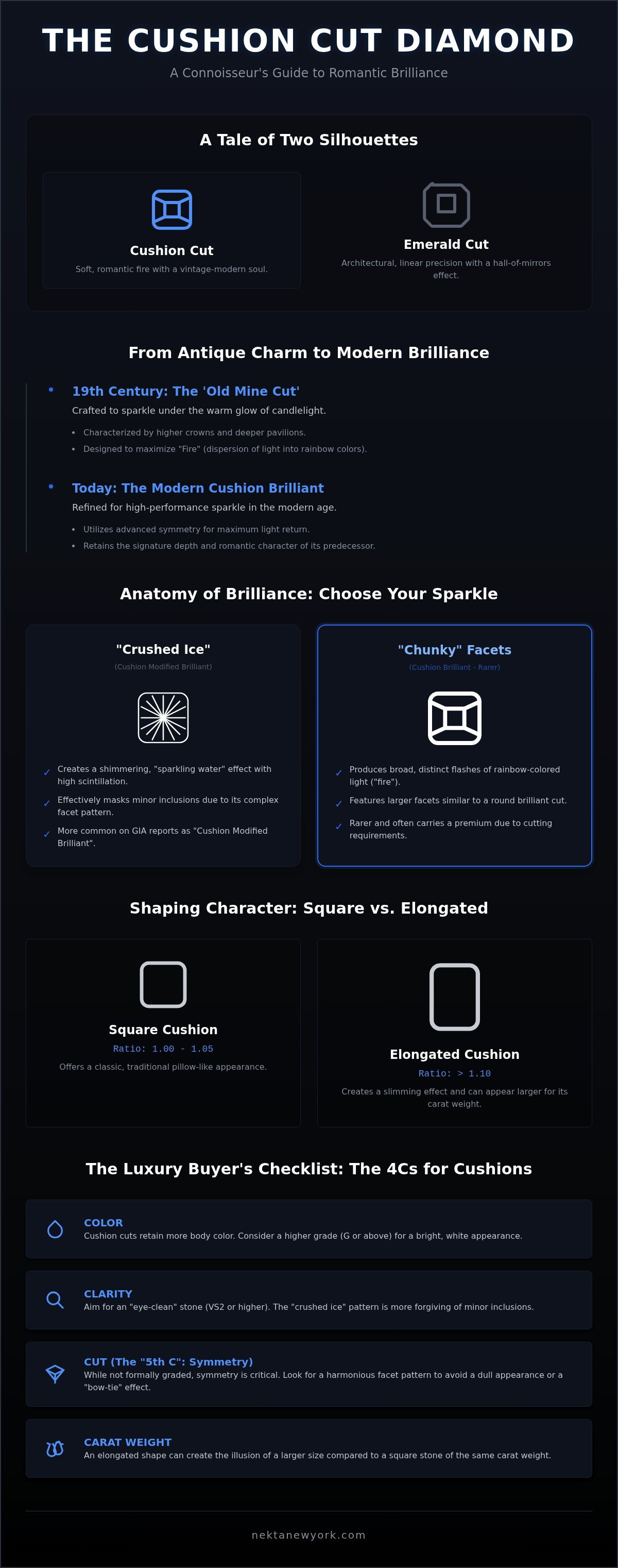
Before the advent of electricity, diamond cutters focused on maximizing 'fire', which is the dispersion of light into rainbow colors. These antique cushions featured higher crowns, deeper pavilions, and smaller tables compared to their modern counterparts. Today, the 'Cushion Brilliant' has been refined to compete with the sparkle of a round cut while retaining that signature depth. The cushion cut stands as the most popular vintage-inspired shape of 2026.
- Antique Cushions: Feature broader facets and a 'chunky' light pattern designed for low-light environments.
- Modern Cushions: Utilize advanced symmetry to create a brilliant, 'crushed ice' effect or a more structured sparkle.
Why Celebrities Choose Cushion Cuts
The red carpet has long been a showcase for this shape's prestige. From the high-clarity stones favored by Kim Kardashian to the classic trilogy setting chosen by Meghan Markle, the cushion cut signals a blend of status and approachability. In a world often dominated by the sharp, geometric silhouettes of emerald cut engagement rings, the cushion provides a psychological sense of 'softness' and 'romance'. Its rounded edges are exceptionally flattering, as they elongate the finger without the severity of more pointed shapes. This makes it a dependable choice for various hand shapes, offering a look that is substantial yet graceful.
Anatomy of Brilliance: Crushed Ice vs. Chunky Cushion Cuts
The choice between a "crushed ice" and a "chunky" cushion cut is a decision of character. While emerald cut engagement rings rely on long, hall-of-mirrors facets to create their clinical elegance, cushions offer a choice between two distinct light personalities. The "crushed ice" look, technically known as the Cushion Modified Brilliant, features a multitude of small, needle-like facets. These create a shimmering effect reminiscent of sparkling water. It's high in scintillation, making it a favorite for those who love a constant, restless sparkle that masks inclusions well.
In contrast, the "chunky" cushion, or the standard Cushion Brilliant, mirrors the faceting style of a round diamond. It produces broad, distinct flashes of light known as "fire." These are the rainbow-colored bursts that command attention from across a room. Understanding What is a Cushion Cut Diamond? requires recognizing that these visual differences aren't just about style; they're rooted in the physical architecture of the stone. Mike Nekta often emphasizes that facet symmetry is the "hidden" 5th C. Without it, even the most expensive stone can appear unbalanced or dull.
Decoding the GIA Certificate for Cushions
When reviewing Loose GIA Certified Diamonds, you'll notice specific nomenclature that impacts both beauty and price. A GIA report labeled "Cushion Brilliant" is significantly rarer than "Cushion Modified Brilliant." This is because the standard brilliant cut requires more rough diamond material to be sacrificed during the cutting process. Consequently, these stones often carry a premium. However, a paper report can't capture the soul of a stone. You must see how the light interacts with the facets in person to judge true performance beyond the grade.
Light Leakage and the 'Pillow' Effect
A common pitfall for the uninitiated is light leakage, which creates "dead zones" or dark spots in the center of the diamond. For a cushion to achieve its legendary glow, it needs a healthy crown height. This elevates the top of the stone, allowing light to enter and refract with maximum intensity. A shallow stone might look larger from the top, but it will lack the "pillow" depth that defines the cut. A connoisseur's tip: always tilt the diamond to a 45-degree angle. This reveals whether the stone has the necessary depth to hold light or if it simply lets it escape through the bottom. To ensure your selection possesses this rare vitality, consider a private consultation with a specialist who can help you compare these nuances side-by-side.
Square vs. Elongated Cushion Cut Engagement Rings
The character of a cushion diamond is often defined by a single numerical value: the length-to-width (L/W) ratio. This ratio dictates whether your stone will possess the symmetrical balance of a classic square or the graceful stretch of a rectangle. A ratio between 1.00 and 1.05 represents the traditional square cushion, a silhouette that mimics the structured poise of an Asscher cut but with the added brilliance of rounded corners. It's a choice that feels grounded, timeless, and exceptionally stable in a variety of settings.
In contrast, the elongated cushion (ratios of 1.15 to 1.30) has become a dominant force in 2026 bridal trends. While connoisseurs who appreciate linear, step-cut symmetry often gravitate toward emerald cut engagement rings, the elongated cushion provides a softer, more radiant alternative for those who want that rectangular presence. One of the most compelling reasons to choose an elongated stone is visual weight. Because the surface area is spread across a longer diagonal, an elongated cushion often looks significantly larger than a square stone of the identical carat weight. It's a strategic way to maximize the impact of your investment.
The Rise of the Elongated Silhouette
Modern brides increasingly favor the elongated silhouette for its ability to create a slimming effect on the finger. This vertical orientation draws the eye upward, providing a sophisticated elegance that feels contemporary yet rooted in luxury. These stones pair beautifully with side stones that emphasize their length, such as tapered baguettes or Cadillac-shaped diamonds. For a deeper dive into this specific aesthetic, explore The Elongated Cushion Cut Guide to understand how to balance these proportions perfectly.
Choosing the Right Ratio for Your Setting
Your choice of setting should harmonize with the diamond's ratio to achieve the desired "vibe." Square cushions are the natural choice for high-impact halo settings, creating a "Power" look that feels substantial and regal. Elongated cushions, however, are the darlings of the "Quiet Luxury" movement. When set in a minimalist solitaire, their unique proportions speak for themselves without the need for additional ornamentation. This versatility is why the cushion remains a staple in Manhattan's most exclusive showrooms.
| Ratio Range | Visual Category | Best Setting Style |
|---|---|---|
| 1.00 - 1.05 | Classic Square | Hidden Halo or Cathedral |
| 1.10 - 1.15 | Slightly Rectangular | Three-Stone or Pave Band |
| 1.20 - 1.30 | Elongated | Minimalist Solitaire |
Ultimately, the "Golden Ratio" is a matter of personal perspective. Whether you prefer the architectural balance of a square or the liquid brilliance of a rectangle, each ratio offers a distinct way to express your individual style. If you're torn between these silhouettes, seeing them side-by-side in a professional environment is often the only way to reach a final, confident decision.
The Luxury Buyer’s Checklist: Evaluating the 4Cs in Cushion Cuts
Selecting a cushion cut diamond requires a departure from the standard logic used for round brilliants. Because the GIA does not assign an official "Cut Grade" to cushion diamonds, the responsibility of evaluating beauty falls on the expertise of the curator. You must look beyond the certificate to understand how the stone's proportions affect its fire and visual scale. While emerald cut engagement rings emphasize clarity through their transparent, step-cut facets, the cushion cut is a master of light dispersion, yet it is far more unforgiving when it comes to color retention.
Cushion diamonds are notoriously "bottom-heavy." This means a significant portion of their carat weight is often hidden in the pavilion, the lower part of the stone, where it cannot be seen once set. Consequently, a 2.00-carat cushion may have a smaller face-up surface area than a 2.00-carat oval or round diamond. To ensure you aren't paying for weight you can't see, look for stones with excellent symmetry that distribute their mass toward the top of the diamond.
The 'Color Trap' in Fancy Shapes
Cushion cuts are deeper than most shapes, which causes them to retain body color more than a round brilliant. If you choose a "J" color stone, the yellow tint will be far more noticeable in a cushion than in other cuts. For a crisp, icy look in a platinum or white gold setting, I recommend aiming for an "H" color or better. However, if you prefer the warmth of yellow gold, you can often "cheat" the system by selecting an "I" or "J" color stone, as the metal will mask the diamond's natural tint. The ideal depth percentage for a high-performing cushion is between 61% and 68%.
Finding the 'Eye-Clean' Sweet Spot
Inclusions located directly under the "table," the flat top facet of the diamond, are the most difficult to hide. While a VS2 clarity grade is often the sweet spot for value, it isn't a guarantee of an eye-clean stone in this cut. Cushion facets are larger than those in Radiant Cut Engagement Rings, meaning they don't hide internal flaws quite as effectively. Mike Nekta strongly recommends a personal, physical inspection for any stone graded below VVS2 to ensure no dark crystals are visible to the naked eye. Inclusions tucked away near the rounded corners or deep in the pavilion are far less concerning, as the diamond's natural sparkle will often camouflage them.
To see these technical nuances in person and find a stone that truly performs, book a private viewing at our Manhattan showroom where we can compare GIA-certified cushions side-by-side.
Designing Your Custom Cushion Cut Ring with Mike Nekta New York
The journey to owning a masterpiece begins in the heart of Manhattan's Diamond District. While mass-market retailers offer "add to cart" convenience, a true connoisseur understands that a high-brilliance diamond deserves a hand-finished home. Designing a custom ring with Mike Nekta New York is a curated investment in your future legacy. Whether you've set your sights on the vintage soul of a cushion or the architectural precision of emerald cut engagement rings, the process is defined by third-generation expertise and an uncompromising eye for detail. We don't just sell diamonds; we curate them to match the unique spirit of the wearer.
Our bespoke journey starts with the selection of a loose GIA-certified diamond. You aren't simply picking a stone from a list; you're evaluating its life and fire in person. In our showroom, we compare the nuances of "crushed ice" scintillation against "chunky" antique patterns previously discussed. Once the perfect stone is secured, we move to the architecture of the ring itself. We specialize in settings that enhance the stone's natural character, such as the Hidden Halo for a touch of modern mystery, the regal Cathedral for structural height, or the 'Nekta Signature' Solitaire for those who want the diamond to stand entirely on its own merit. While some clients arrive seeking the hall-of-mirrors effect of emerald cut engagement rings, they often find the romantic depth of a custom cushion to be an irresistible alternative.
The Mike Nekta Signature Process
We believe that luxury lives at the intersection of technology and tradition. Our process utilizes advanced 3D CAD modeling to ensure mathematical perfection, yet every piece is finished by the hands of master jewelers who respect the metal's integrity. This meticulous approach ensures that your setting is perfectly balanced for your specific diamond's proportions. A critical component of this journey is the GIA appraisal, a rigorous verification that guarantees your investment's quality and authenticity within the competitive Manhattan landscape. To begin this transformative experience, you can book a private consultation in NYC and step into the world of high-end curation.
Choosing Your Metal: Platinum vs. 18k Gold
The choice of metal is the final brushstroke on your custom piece. Platinum is the preferred choice for many because its naturally cool, white tones enhance the "crushed ice" effect of modern cushion cuts. It's also exceptionally durable, making it ideal for the intricate prongs required for larger stones. For those who chose an "antique" style cushion with broader facets, the romantic warmth of 18k Rose Gold can create a stunning, heritage feel that echoes the 19th-century origins of the cut. Regardless of your choice, Mike Nekta New York insists on using only ethically sourced materials for every custom piece. In 2026, the trend has shifted toward the "Personalized Legacy" ring, a piece that reflects your unique story while maintaining the highest standards of global responsibility.
Your Legacy Awaits in the Diamond District
Choosing a diamond is more than a transaction; it's a curated investment in a story that will span generations. You've learned how the cushion cut's rich heritage from the 'Old Mine Cut' provides a romantic alternative to the architectural lines of emerald cut engagement rings. By mastering the nuances of faceting patterns and length-to-width ratios, you're now equipped to select a stone that truly reflects your personal aesthetic. Whether you crave the restless shimmer of "crushed ice" or the bold, rainbow fire of a chunky antique cut, the right choice depends on seeing these technical details in person.
At our Manhattan showroom, Mike Nekta combines third-generation expertise with an exclusive inventory of GIA certified loose diamonds to guide you through this bespoke journey. Every piece is handcrafted in the NYC Diamond District, ensuring your ring is as unique as the bond it represents. Don't leave such a significant milestone to chance. Trust a master craftsman to help you find a diamond that doesn't just sparkle, but speaks.
Discover Your One-of-a-Kind Cushion Cut Engagement Ring at Mike Nekta New York
Frequently Asked Questions
Are cushion cut diamonds more expensive than round diamonds?
Cushion cuts are typically 25% to 40% less expensive than round diamonds of the same carat weight and quality. This price difference exists because diamond cutters retain more of the original rough stone when creating a cushion shape. While round diamonds require significant material loss to achieve their perfect symmetry, cushions follow the natural crystal structure more closely. This makes them an exceptional value for those seeking a high-carat look without the round diamond premium.
Does a cushion cut diamond look smaller than other shapes?
Yes, a cushion cut diamond often appears smaller than a round or oval stone of the same carat weight. This is because cushions are "bottom-heavy," meaning much of their weight is concentrated in the pavilion rather than the surface area. To mitigate this effect, many connoisseurs choose an elongated ratio. These rectangular silhouettes offer a larger visual footprint on the finger, similar to the presence of emerald cut engagement rings.
What is the best ratio for an elongated cushion cut diamond?
The ideal ratio for an elongated cushion cut typically falls between 1.15 and 1.20. This range provides a sophisticated rectangular silhouette that elongates the finger without appearing too narrow. If you prefer a look that mimics the architectural balance found in emerald cut engagement rings, staying within this ratio ensures the stone maintains its classic "pillow" appeal while maximizing its visual length and elegance.
Is 'crushed ice' better than a 'chunky' cushion cut?
Neither is objectively better; the choice depends entirely on your preference for light performance. "Crushed ice" cushions feature a Modified Brilliant facet pattern that produces a restless, shimmering sparkle. "Chunky" cushions utilize a standard Brilliant pattern to create broad, rainbow-colored flashes of fire. If you value a modern, watery scintillation, choose crushed ice. If you prefer a vintage, candlelight glow, the chunky facet pattern is your best selection.
What clarity grade is best for a 2-carat cushion cut ring?
For a 2-carat cushion cut, a VS2 clarity grade usually offers the best balance of beauty and value. However, you must ensure the stone is "eye-clean," as cushion diamonds have relatively large tables that can make inclusions more visible. I recommend a personal inspection to confirm that any internal flaws are tucked away near the corners or deep in the pavilion rather than sitting directly under the center of the table.
Can I use a cushion cut diamond in a halo setting?
Absolutely, cushion cuts are exceptionally well-suited for halo settings. A hidden halo can add subtle brilliance from the profile, while a traditional halo creates a "Power" look that significantly increases the ring's overall surface area. Because cushions have rounded corners, the halo softens the transition between the center stone and the band, creating a cohesive, regal aesthetic that has remained a favorite in our Manhattan showroom for decades.
Why doesn't GIA give a cut grade for cushion cut diamonds?
The GIA doesn't assign a cut grade to cushions because there is no single "ideal" set of proportions for this shape. Unlike round diamonds, which have a standardized mathematical formula for maximum brilliance, cushions come in a vast array of facet patterns and ratios. This lack of a formal grade is why you should rely on a third-generation expert to evaluate the stone's actual light performance rather than just the certificate.
How do I clean and maintain my cushion cut engagement ring?
You should clean your cushion cut ring using warm water, mild dish soap, and a very soft-bristled toothbrush. Gently scrub behind the stone where oils and lotions tend to accumulate and dull the diamond's fire. I also suggest bringing your ring to a professional jeweler twice a year for a deep ultrasonic cleaning and a prong inspection. This ensures your curated investment remains secure and maintains its breathtaking brilliance for a lifetime.