
The Connoisseur’s Guide to Cushion Cut Diamonds: Vintage Soul Meets Modern Brilliance
What if the most sophisticated choice for a 2026 proposal isn't the latest fleeting trend, but a shape that has defined luxury for nearly two centuries? You've likely found yourself torn between the clean, hall-of-mirrors effect of emerald cut engagement rings and the intense fire of a round brilliant. It's a common dilemma for the modern connoisseur: you want a stone with a historical soul, yet you're understandably anxious about technical pitfalls like the "bow-tie" effect or light leakage that can make a premium diamond look dull.
Choosing a cushion cut shouldn't feel like a gamble. We understand the confusion that comes with deciphering complex facet patterns or the fear that a square ratio might make your diamond appear smaller than its actual carat weight. This guide promises to transform that uncertainty into the confidence of an expert. You'll learn the precise technical differences between "crushed ice" and "antique" cushions, how to maximize value in a market where natural cushion prices have seen a significant 36.4% shift over the past year, and why this soft-edged silhouette is the definitive choice for a romantic legacy. We're diving into the nuances of ratios and light performance so you can select a masterpiece that radiates brilliance from every angle.
Key Takeaways
- Understand the evolution of the cushion cut from its 19th-century 'Old Mine' roots to the modern brilliant standards that define today’s most romantic heirlooms.
- Distinguish between the "crushed ice" effect of modified cushions and the "chunky" flashes of classic cushion brilliants to ensure your diamond's light performance matches your personal aesthetic.
- Master the golden ratio to confidently choose between a traditional square silhouette or an elongated form that rivals the finger-lengthening elegance of emerald cut engagement rings.
- Learn why cushions require higher standards for Color and Clarity, specifically why an 'H' color grade or better is essential for maintaining a crisp, white appearance in this specific cut.
- Discover the benefits of a curated diamond selection process in NYC's Diamond District, focusing on hand-picked GIA-certified stones that serve as both a masterpiece and a lasting investment.
What is a Cushion Cut Diamond? The Legacy of the 'Old Mine Cut'
The cushion cut is a masterpiece of geometry, defined as a square or rectangular diamond with softly rounded corners that resemble a plush pillow. This silhouette serves as a sophisticated bridge in the jewelry world. It combines the intense fire and facet depth of a round brilliant with the distinct, non-circular presence of a fancy shape. For many collectors, it represents the perfect middle ground. It offers more brilliance than the architectural, hall-of-mirrors effect found in emerald cut engagement rings while maintaining a unique, vintage-inspired character that stands out in a sea of round stones.
The history of this cut is rooted deeply in the 19th century. Before the advent of modern laser technology, it was known as the "Old Mine Cut." This was the most prevalent diamond cut of the Victorian and Edwardian eras. While emerald cut engagement rings prioritize long, linear facets and structural clarity, the cushion was built for fire. It was the preferred choice for royalty and the elite long before electric lighting became the global standard. Today, we're seeing a massive resurgence in this "vintage-modern" aesthetic. Couples in 2026 are increasingly moving away from mass-produced looks in favor of stones that feel like they have a story to tell.
The Evolution of Scintillation
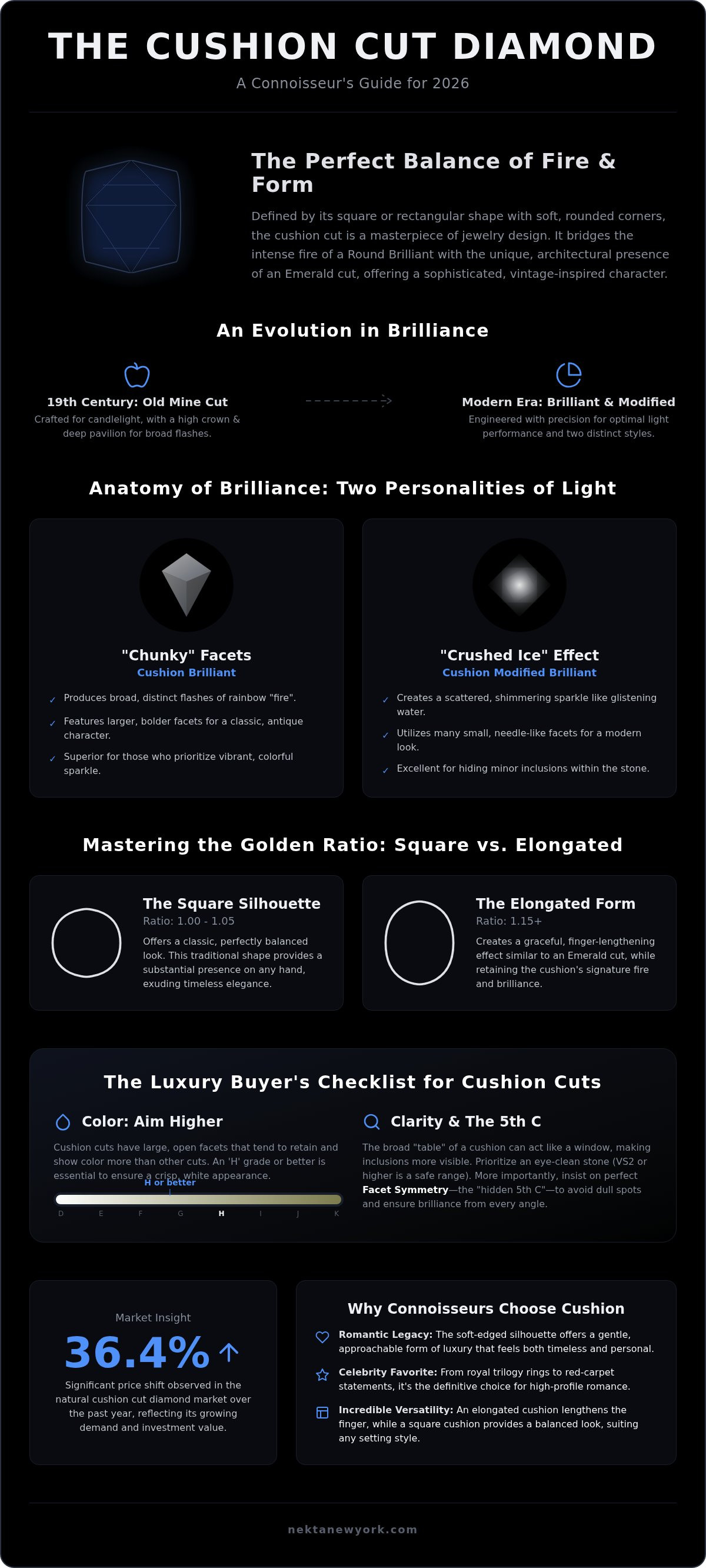
In the 1800s, master craftsmen optimized diamonds for the flicker of candlelight. They created stones with high crowns, small tables, and deep pavilions. These "Antique" cushions don't just sparkle; they glow with broad, chunky flashes of light. Modern cushions have evolved into two primary categories. The "Cushion Brilliant" retains those larger facets, while the "Cushion Modified Brilliant" uses a different facet arrangement to create a "crushed ice" look. The cushion cut stands as the most popular vintage-inspired shape of 2026. It captures a market that values hand-finished heritage over clinical perfection.
Why Celebrities Choose Cushion Cuts
Social proof for this shape is undeniable. From Kim Kardashian’s world-famous 15-carat stone to Meghan Markle’s royal trilogy ring, the cushion cut is the definitive choice for high-profile romance. There’s a psychological softness to this shape. It lacks the sharp, aggressive corners of a princess cut, offering a gentler and more approachable form of luxury. It's also incredibly versatile. An elongated cushion can provide the same finger-lengthening effect as emerald cut engagement rings, while a perfectly square ratio offers a balanced, substantial look on any hand shape. It’s a shape that doesn't just sit on the finger; it belongs there.
Anatomy of Brilliance: Crushed Ice vs. Chunky Cushion Cuts
Cushion cuts are not a monolith. The most significant mistake a buyer can make is assuming every "cushion" will perform the same under light. In reality, you're choosing between two distinct visual personalities: the "Crushed Ice" look and the "Chunky" look. Most high-end diamonds today fall into the Cushion Modified Brilliant category, which produces the crushed ice effect. This style utilizes many small, needle-like facets on the pavilion to create a shimmering, scattered sparkle. It’s a modern, energetic look that hides inclusions well, though it can sometimes sacrifice the distinct "fire" that collectors crave.
In contrast, the "Chunky" look belongs to the classic Cushion Brilliant. These stones feature broader, larger facets that produce distinct flashes of light. If you're looking for "fire"—those vibrant rainbow flashes that dance across the stone—the chunky facet pattern is often superior. While emerald cut engagement rings rely on long, linear step-cuts for their architectural appeal, cushion cuts are all about how the light bounces within these specific facet arrangements. Mike Nekta often emphasizes that facet symmetry is the "hidden" 5th C for cushions. Without perfect alignment, even a stone with high color and clarity can appear "dead" in certain spots. This precision is what separates a generic diamond from a curated investment.
Decoding the GIA Certificate for Cushions
When you're reviewing Loose GIA Certified Diamonds, the technical nomenclature tells a story. The "Cushion Brilliant" label is significantly rarer and typically carries a price premium because it requires more "rough" diamond material to produce. Most stones on the market are "Modified" to retain carat weight. However, true light performance exists beyond the paper report. A modern cushion cut might use proprietary faceting to bridge these two styles, delivering a unique brilliance that a standard GIA report simply cannot quantify. Understanding these nuances allows you to choose a stone that matches your specific aesthetic preference rather than just a grade on a page.
Light Leakage and the 'Pillow' Effect
Light leakage is the silent killer of a diamond's beauty. In poorly cut cushions, you'll often see "dead zones" or dark spots in the center where light falls straight through the stone rather than reflecting back to your eye. This is frequently caused by a shallow crown height or an overly large table. A distinctive cushion "glow" requires a certain depth and crown angle to perform correctly. As a connoisseur's tip, always examine the diamond from a 45-degree angle. This reveals the stone's three-dimensional architecture and ensures it doesn't look flat or "glassy." Much like the structural integrity required for emerald cut engagement rings, a cushion's beauty depends on its internal geometry. If you want to see these differences in person, you can browse our curated cushion collection to find a stone with perfect light return.
Square vs. Elongated Cushion Cut Engagement Rings
The silhouette of a diamond is its most immediate signature. When you're selecting a cushion cut, the length-to-width (L/W) ratio determines whether your stone feels classically balanced or modernly slender. The "Golden Ratio" isn't a fixed number here; it's a matter of personal aesthetic. A classic square cushion typically falls between a 1.00 and 1.05 ratio. It offers a traditional, substantial presence on the hand that mimics the symmetry of an Asscher cut but with significantly more brilliance. It’s a choice that feels grounded and timeless.
In contrast, the elongated cushion cut has become a formidable rival to emerald cut engagement rings for those who want that slender, rectangular look without sacrificing the stone's scintillation. These stones usually feature ratios between 1.15 and 1.30. One of the most compelling reasons to choose an elongated shape is visual weight. Because the surface area is stretched vertically, an elongated cushion often looks larger than a square cushion of the exact same carat weight. It maximizes the "face-up" size, giving you more visual impact for your investment.
The Rise of the Elongated Silhouette
Rectangular cushions are dominating the bridal trends of 2026. This shift is driven by the desire for a slimming effect on the finger. While emerald cut engagement rings offer a clean, linear aesthetic, an elongated cushion provides a similar vertical presence but with far more sparkle. For a truly bespoke look, we often pair these stones with tapered baguette or cadillac side stones. This creates a sophisticated, architectural frame. You can explore the nuances of these proportions in our The Elongated Cushion Cut Guide, which breaks down how to master this modern luxury silhouette.
Choosing the Right Ratio for Your Setting
Your choice of setting should harmonize with the diamond's ratio. Square cushions are the perfect candidates for halo settings. The surrounding diamonds accentuate the "pillow" shape, creating a high-impact "Power" look that commands attention. Elongated cushions, however, truly shine in minimalist solitaire settings. This "Quiet Luxury" aesthetic allows the unique proportions of the stone to be the focal point. To help you visualize the difference, consider this breakdown of common ratios:
- Classic Square (1.00:1): Perfectly symmetrical; maximizes fire and provides a traditional, sturdy appearance.
- Slightly Rectangular (1.10:1): A subtle stretch that offers a unique "soft rectangle" vibe; hides the "bow-tie" effect well.
- Elongated (1.20:1 or higher): Dramatic and slender; offers the most finger-lengthening effect and the largest face-up appearance.
Whether you prefer the balanced weight of a square or the graceful stretch of an elongated cut, the goal is to find a ratio that complements your hand's natural proportions. It's a decision that transforms a beautiful stone into a personalized statement of style.
The Luxury Buyer’s Checklist: Evaluating the 4Cs in Cushion Cuts
Evaluating a cushion cut requires a more nuanced eye than simply reading a GIA report. While the 4Cs are the industry standard, they don't impact every shape equally. The way light interacts with a cushion is vastly different from the clinical, linear clarity required for emerald cut engagement rings. To secure a stone that truly radiates, you must look beyond the grades and understand how this specific silhouette behaves under scrutiny.
Cushions are notorious "color retainers." They show their natural body tint more easily than round diamonds or even most other fancy shapes. If you want a stone that looks icy white, we recommend aiming for an 'H' color or higher. A 'J' color diamond might look perfectly white in a round brilliant, but it can show a distinct yellow tint in a cushion due to the depth of the cut. Your choice of metal is a strategic ally here. Setting a slightly warmer stone in yellow gold can make it appear whiter by comparison, whereas platinum will highlight any hint of warmth. The ideal depth percentage for a high-performing cushion typically falls between 61% and 68%.
Carat weight can also be deceptive. Some cutters produce "bottom-heavy" stones, hiding extra weight in the pavilion where you can't see it. This results in a 2-carat diamond that has the visual "spread" of a 1.75-carat stone. You want a diamond that carries its weight in its measurements, not its belly. Since GIA doesn't provide an official "Cut Grade" for cushions like they do for rounds, you must evaluate the polish and symmetry yourself. Browse our curated selection of GIA cushion cut diamonds to see how expert curation ensures maximum visual impact.
The 'Color Trap' in Fancy Shapes
In the world of luxury diamonds, the "Color Trap" refers to how certain shapes concentrate light. Because cushions are cut deeper than rounds, the light travels through more of the diamond's body, picking up more tint along the way. If you're comparing a cushion to emerald cut engagement rings, remember that the cushion's brilliance can sometimes mask slight inclusions, but it will almost always amplify color. Always check the stone's color against a pure white background in natural light before committing.
Finding the 'Eye-Clean' Sweet Spot
Clarity in a cushion is about location. A VS2 stone with an inclusion hidden near the corners is a bargain; a VS2 with a black crystal right under the "table" (the center) is a deal-breaker. Because the table of a cushion is a broad, open window, inclusions are more visible here than in busier patterns. Mike Nekta recommends a personal, high-magnification inspection for any stone under VVS2 to ensure it's truly eye-clean. If you find that you crave even more intense scintillation and can't find the right cushion, you might consider Radiant Cut Engagement Rings, which offer a similar silhouette with a different facet arrangement.
Designing Your Custom Cushion Cut Ring with Mike Nekta New York
Creating a custom engagement ring is a transition from consumer to creator. At our Manhattan showroom, we don't just present you with a finished product; we invite you into a bespoke journey that begins with the curation of a loose GIA-certified diamond. This process ensures that every facet of the stone aligns with your personal vision. While many of our clients initially explore emerald cut engagement rings for their sophisticated, architectural lines, they often discover that a custom cushion cut provides a more romantic, multi-dimensional brilliance that feels uniquely personal. In 2026, the trend has shifted decisively toward the 'Personalized Legacy' ring. Couples are no longer looking for off-the-shelf solutions; they want a piece that reflects a specific chapter of their story.
The setting you choose serves as the stage for your diamond's performance. Our 'Nekta Signature' Solitaire is designed to let the stone breathe, maximizing light entry from every angle. For those seeking a bit more drama, the Hidden Halo adds a secret layer of brilliance visible only from the profile, while the Cathedral setting provides a regal, elevated structure. Being located in the heart of NYC's Diamond District gives us a distinct advantage. We have immediate access to the world's most exclusive inventory, allowing us to source rare ratios and "chunky" antique styles that are simply unavailable in mainstream retail environments.
The Mike Nekta New York Signature Process
Our methodology blends cutting-edge technology with time-honored techniques. We utilize 3D CAD modeling to perfect the proportions of your ring, ensuring a flush fit with your wedding band. Once the digital blueprint is approved, our master jewelers take over, using old-world hand-craftsmanship to forge the final piece. Every custom creation undergoes a rigorous GIA appraisal process here in the Manhattan Diamond District to verify its quality and investment value. This dual approach guarantees a ring that is both structurally superior and artistically significant. If you're ready to begin your own journey, you can Book a private consultation in NYC to view our curated stones in person.
Choosing Your Metal: Platinum vs. 18k Gold
The choice of metal is the final brushstroke on your masterpiece. Platinum is the perennial favorite for modern cushions because its cool, white luster enhances the 'crushed ice' effect and provides unmatched durability. However, if you've selected an 'Antique' style cushion with broader facets, 18k Rose Gold or Yellow Gold can provide a romantic warmth that heightens the stone's vintage soul. We also recognize that luxury is inseparable from responsibility. Mike Nekta New York insists on using ethically sourced materials for every custom piece, ensuring that your ring's legacy is as pure as its brilliance. Whether you are drawn to the fiery sparkle of a cushion or the understated elegance of emerald cut engagement rings, our team is dedicated to crafting a piece that transcends time.
Begin Your Legacy with a Masterpiece
Choosing the right diamond is about more than just a certificate. It's about finding a stone that speaks to your unique aesthetic. You now understand that while emerald cut engagement rings offer a hall-of-mirrors clarity, the cushion cut provides a romantic fire that bridges the gap between antique charm and modern luxury. From mastering length-to-width ratios to navigating the "color trap" of fancy shapes, you have the tools to make an informed, confident investment.
As a 3rd generation diamond expert, Mike Nekta personally curates every stone to ensure it meets the highest standards of light performance. We work exclusively with GIA certified loose diamonds, ensuring your selection is backed by the world's most trusted laboratory. Every ring is handcrafted right here in the NYC Diamond District, combining state-of-the-art precision with the soul of old-world craftsmanship. Discover Your One-of-a-Kind Cushion Cut Engagement Ring at Mike Nekta New York and let us help you transform a vision into a timeless reality. Your proposal deserves a stone that'll dazzle for generations.
Frequently Asked Questions
Are cushion cut diamonds more expensive than round diamonds?
Cushion cut diamonds are generally 25% to 40% less expensive than round brilliant diamonds of equivalent carat weight and quality. This price difference exists because cutting a cushion retains more of the original rough diamond, whereas round diamonds require the most significant material loss during the polishing process. Choosing a cushion allows you to prioritize a larger stone or a higher color grade while staying within your investment goals.
Does a cushion cut diamond look smaller than other shapes?
Cushion cuts can appear smaller than other shapes of the same carat weight because they are cut deeper and carry more weight in their "belly." While emerald cut engagement rings or ovals have a larger surface area, the cushion's beauty lies in its depth and fire. To maximize visual size, we recommend selecting an elongated cushion ratio, which stretches the surface area vertically to create a larger face-up appearance on the finger.
What is the best ratio for an elongated cushion cut diamond?
The ideal ratio for an elongated cushion typically falls between 1.15 and 1.25. This range provides a sophisticated rectangular silhouette that offers a similar slimming effect to emerald cut engagement rings while maintaining the soft, romantic corners of a cushion. Ratios above 1.30 are rare and can sometimes lead to a "bow-tie" effect, so personal inspection by a diamond expert is essential for these more dramatic proportions.
Is 'crushed ice' better than a 'chunky' cushion cut?
Neither style is superior; the choice depends on whether you prefer modern shimmer or vintage fire. "Crushed ice" cushions feature many small facets that create a scattered, needle-like sparkle, which is excellent for hiding minor inclusions. "Chunky" cushions have larger facets that produce distinct, broad flashes of light and more intense rainbow fire. We find that connoisseurs often prefer the chunky look for its traditional, heirloom-quality brilliance.
What clarity grade is best for a 2-carat cushion cut ring?
A VS2 clarity grade is usually the sweet spot for a 2-carat cushion cut ring. Because cushions have a large, open table, inclusions in the center are more visible than they'd be in a round brilliant. While you can sometimes find an eye-clean SI1, a 2-carat stone has enough surface area that inclusions become harder to hide. We curate each stone to ensure no black crystals or clouds are visible to the naked eye.
Can I use a cushion cut diamond in a halo setting?
Cushions are an exceptional choice for halo settings because the surrounding diamonds accentuate their soft, pillow-like silhouette. This combination creates a "Power" look that significantly increases the ring's overall visual footprint. Whether you choose a classic pave halo or a hidden halo tucked beneath the center stone, the setting style can be tailored to either amplify the diamond's brilliance or offer a more understated, modern elegance.
Why doesn't GIA give a cut grade for cushion cut diamonds?
GIA doesn't provide a cut grade for cushions because the variety in facet patterns and proportions is too vast for a standardized scale. Unlike round diamonds, which have a mathematically "ideal" cut, cushions are valued for their unique character. Instead of a single grade, you must evaluate the stone's Polish, Symmetry, and Light Return. This is why working with a 3rd generation expert is vital to ensure your stone performs beautifully.
How do I clean and maintain my cushion cut engagement ring?
Maintain your cushion cut's brilliance by cleaning it every two weeks with warm water and a few drops of mild dish soap. Use a soft-bristled toothbrush to gently scrub behind the stone, as the depth of a cushion cut can easily trap lotions and oils. We also recommend an annual professional inspection at our NYC showroom to ensure the prongs are secure and the diamond's structural integrity remains perfect for a lifetime of wear.