
Tiffany Setting vs Custom Six-Prong Solitaire: Which to Choose
A custom six-prong platinum knife-edge solitaire suits someone seeking a crisp band and room for personal design choices; a Tiffany-style setting offers a recognizable silhouette. Diamonds larger than 1 carat generally benefit from six prongs. In a Tiffany setting vs. custom six-prong platinum knife-edge solitaire comparison, consider how the diamond’s shape and the setting’s proportions work together.
A prong setting holds a diamond with small metal claws, but the name alone doesn’t tell you how the ring will look or feel on your hand. It’s natural to compare a familiar design with a more personal profile.
This guide explains the differences, how diamond size and shape affect compatibility, and what a knife-edge band brings to a solitaire. The Tiffany setting versus custom six-prong platinum knife-edge solitaire choice becomes clearer when you compare the setting’s silhouette with the details you want to personalize.
Key Takeaways
- Diamonds larger than 1 carat generally benefit from six prongs, while a smaller stone may call for a lighter-looking design.
- Match the prong layout to the diamond shape: square stones use four corner prongs rather than a six-prong Tiffany-style head.
- Compare the band’s knife-edge profile and the setting’s overall silhouette to decide which look feels right for your hand and style.
- Consider how the center stone and setting work together before choosing a solitaire design.
Choosing a setting for diamond size and shape
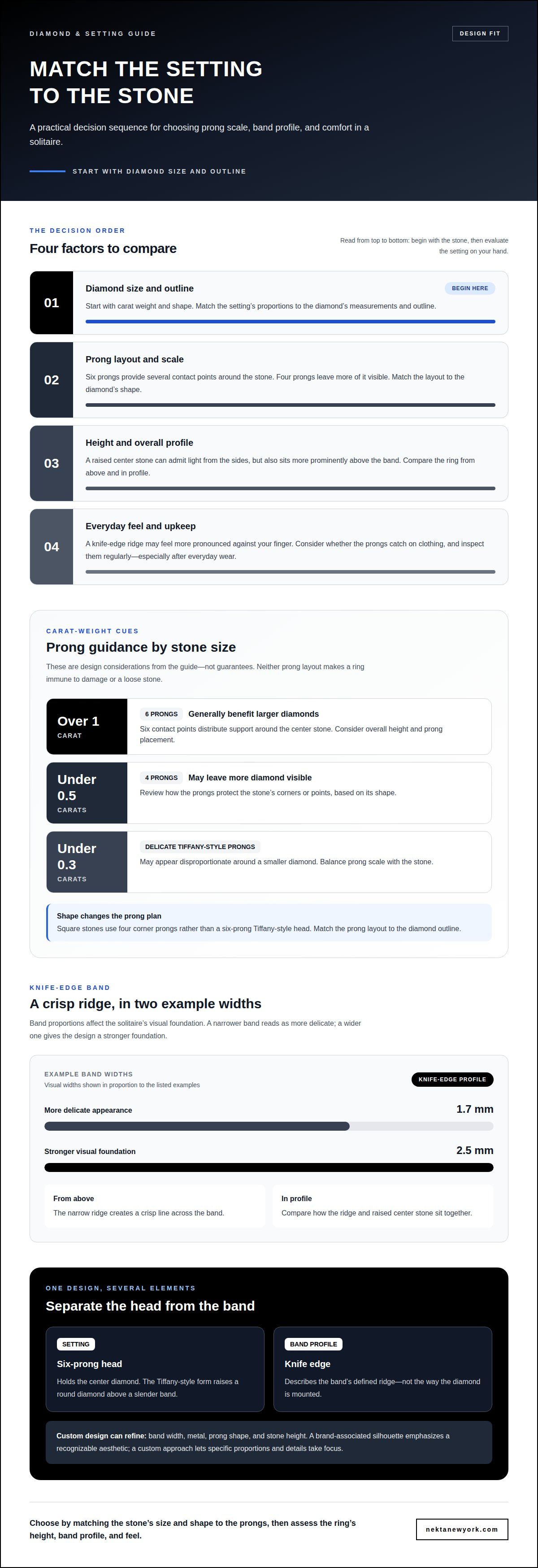
Start with the diamond’s carat weight and outline, then compare how each setting supports its proportions. Diamonds larger than 1 carat generally benefit from six prongs, which distribute support around the center stone. For diamonds under 0.5 carats, four prongs may leave more of the diamond visible. Delicate Tiffany-style prongs may appear disproportionate around diamonds under 0.3 carats.
Prongs hold a diamond at selected points along its girdle. Six prongs provide several contact points, while four prongs leave more of the stone visible. Neither design makes a ring immune to damage or a loose stone, so inspect the prongs regularly, especially after everyday wear.
For daily wear, six prongs offer additional contact around the diamond, while a knife-edge band creates a defined ridge that may feel more pronounced against your finger. Comfort is personal: consider how the ridge feels and whether the prongs catch on clothing during ordinary movement.
A raised center diamond can admit light from the sides, but its height also affects how prominently it sits above the band. Compare the ring from above and in profile. A larger carat weight may call for a setting proportioned to the diamond’s measurements. Carat alone doesn’t determine a surcharge, and no single surcharge applies to every design.
| Setting choice | Diamond size | Visual effect | Practical consideration |
|---|---|---|---|
| Six prongs | Over 1 carat | More metal around the center | Consider overall height and prong placement |
| Four prongs | Under 0.5 carats | More diamond remains visible | Review corner or point protection for the shape |
| Delicate Tiffany-style prongs | Under 0.3 carats | May look disproportionate | Balance prong scale with the stone |
Choose a setting by matching the diamond’s carat weight and outline to the prong scale, then assess the ring’s height and comfort.
Six-prong knife-edge solitaire design
The Tiffany Setting became a defining design after Tiffany & Co. was founded in New York City in 1837. Its recognizable form raises a round diamond above a slender band, using six prongs to hold the center stone. The elevated profile gives the diamond visual prominence, while the open setting keeps the band from competing with it.
A knife-edge band adds a distinct line to that classic arrangement. Its narrow ridge creates a crisp profile, visible from above and in side views. Band proportions vary: examples include widths of 1.7 mm and 2.5 mm. A narrower band reads as more delicate; a wider one gives the solitaire a stronger visual foundation.
Custom design lets you refine details such as band width, metal, prong shape, and stone height. Start with the diamond’s measurements, then align the setting with its outline and your preferred profile. Changing the prong shape, for instance, can alter the ring’s character while preserving the six-prong silhouette. Together, these choices shape how the finished ring looks from every angle.
How do Tiffany and custom rings compare in resale value, certification, and diamond upgrade policies? Brand recognition may influence buyer interest, but resale value also depends on the diamond, its condition, and its documentation. Certification describes the diamond rather than the setting, while upgrade policies depend on the seller’s written terms.
Before choosing, compare the diamond’s grading documentation with the ring’s design details, then decide which features matter most. A brand-associated silhouette offers a recognizable aesthetic; a custom approach makes specific proportions and details the focus. To explore diamond jewelry design, consider how the setting and center stone work together as one composition.
Tiffany-style six-prong knife-edge solitaire
A setting describes how a diamond is mounted; a style describes the ring’s overall design. A solitaire, for example, features one center diamond, while a halo adds a surrounding frame. The Tiffany-style six-prong head is a prong setting, but “knife-edge” describes the band’s profile. These terms refer to different design elements, even when they appear together in one engagement ring.
Together, these elements create a clear visual contrast: six prongs frame the center stone, while a knife-edge band forms a defined ridge beneath it. The Tiffany-style head has a recognizable silhouette; a custom design can adjust details such as the band’s proportions or the prongs’ shape. Compare the ring from above and in profile to see how the head and band work together.
There isn’t one universal term for engagement rings made before a named setting became a design reference. Compare their construction instead. In a bead setting, small round pieces of raised metal secure gemstones. Pavé is a type of bead setting in which adjacent stones share a bead. A channel setting holds diamonds between parallel metal walls, while a cathedral setting raises the center stone on arching shoulders.
These examples show why setting names and style labels aren’t interchangeable. Burnish setting, for instance, describes metal pressed over a gemstone’s girdle, with the stone at or below the metal surface. Solitaire, halo, and three-stone describe broader aesthetics. For a Tiffany-style engagement ring, identify the mounting first, then decide whether a knife-edge band complements its clean lines. This makes comparisons between branded references and custom rings more precise, without assuming every six-prong head has the same band or proportions.
Center-stone size and shape compatibility
A solitaire showcases one diamond, which can have any shape. The outline determines where the prongs should meet it. Round diamonds suit a balanced arrangement around the stone, while square diamonds use four corner prongs rather than a six-prong Tiffany-style head. For the tiffany setting vs. custom six-prong platinum knife-edge solitaire decision, start by matching the setting head to the diamond’s geometry.
Capacity depends on the specific setting, not just its style name. One ring is listed for a center stone up to 2 carats, while another accommodates a round diamond from 0.50 to 5 carats. These figures describe different designs, not a universal range. Compare the stated fit with the center diamond’s measurements before settling on a particular head.
Elongated shapes need careful prong placement at their ends. A 2.57-carat marquise lab-grown diamond example uses six prongs in 14k yellow gold, with prongs guarding both points. For a marquise, examine the point coverage and side profile; for a square diamond, assess how corner prongs align with its geometry.
Carat weight alone doesn’t determine whether a setting will look proportionate. One couple’s personal preference placed diamonds below 1.25 ct outside their desired size, but that preference isn’t a universal standard. Compare the diamond’s face-up outline, prong scale, and finished profile together. A tiffany setting vs. custom six-prong platinum knife-edge solitaire comparison should account for how the stone’s shape and setting work as a composition.
For distinctive outlines, explore pear-shaped engagement rings and compare their pointed silhouette with a heart-shaped center stone.
A cathedral setting elevates the center stone as the ring shank curves upward in arches. The page shows a 1.30-carat I VS2 Brian Gavin Signature Hearts and Arrows diamond in a size 6 ring.
Mike Nekta New York: Round Brilliant Cut Engagement Rings
Mike Nekta New York offers Round Brilliant Cut Engagement Rings for those drawn to the balanced outline of a classic solitaire. If you’re weighing a round center stone against a different silhouette, compare it with Cushion Cut, Oval Cut, and Emerald Cut Engagement Rings. Each cut creates a distinct shape when viewed from above, so your preference can guide the setting choice.
Consider these options once you’ve narrowed your priorities to the diamond’s shape and the visual character you want the engagement ring to express. Assessing the center stone and setting together can help you decide whether a six-prong look works with your chosen cut.
Contact Mike Nekta New York to discuss the engagement ring style you’re considering.
Make the Ring Feel Like Your Own
Let your final decision reflect more than a design reference. Picture the ring as part of your everyday style, then decide which details should remain unmistakably classic and which should feel personal. When choosing a Tiffany setting vs. a custom six-prong platinum knife-edge solitaire, focus on the impression you want the finished piece to make, rather than treating either name as an automatic answer.
A useful next step is to note what matters most to you: a familiar silhouette, a distinctive band profile, or a setting shaped around your preferences. Bring those priorities into a conversation about the ring you have in mind. A thoughtful discussion can turn a broad comparison into a clear, personal direction.
If you’re ready to explore that next step, contact Mike Nekta New York and share the style you’re considering. Your choice can begin with a simple preference and grow into a ring that feels distinctly yours.
Frequently Asked Questions
What is a Prong Setting?
A prong setting holds a diamond with small metal tips that grip its edge, leaving much of the stone visible. A jeweler can shape the tips to suit a round diamond or align them with a stone’s corners. When examining a ring, check that the prongs sit evenly and meet the diamond securely without obscuring its outline.
What are the differences in prong style, band shape, and diamond security?
Prong style affects the ring’s visible details, while the band shape changes its profile against your finger. A six-prong head looks different from a four-prong head, and a knife-edge band adds a defined ridge. Security depends on the setting’s construction and the condition of its prongs, so check their contact with the diamond as well as the overall design.
How do platinum Tiffany and custom solitaire rings compare in price in the United States?
There isn’t one consistent price comparison for platinum Tiffany and custom solitaire rings across the United States. The total depends on the ring’s design, the amount of platinum used, craftsmanship, and whether the center diamond is included. Brand-name and custom designs can also differ in what’s included, so compare complete ring specifications rather than using the setting name alone as a price guide.
How much does a custom platinum six-prong knife-edge solitaire setting cost?
The cost varies with the setting’s platinum weight, band proportions, prong details, and the work needed to fit the center diamond. A setting-only quote isn’t directly comparable to a ring price that includes a diamond. To assess an estimate, identify whether it covers the setting alone, which design details are included, and whether the center stone is priced separately.