
The Ultimate Guide to Cushion Cut Engagement Rings: Romance Meets Brilliance
Most couples believe they must choose between the romantic soul of a vintage heirloom and the intense fire of a modern brilliant, but they're overlooking the one shape that masters both. While it currently accounts for 3.42% of diamond searches, its versatility makes it the premier choice for those who refuse to compromise. You've likely felt the frustration of comparing dozens of cushion cut engagement rings, only to find yourself confused by terms like crushed ice or antique chunky patterns. It's a significant investment, and the fear of choosing a stone that looks smaller than its carat weight is a common concern for many discerning brides.
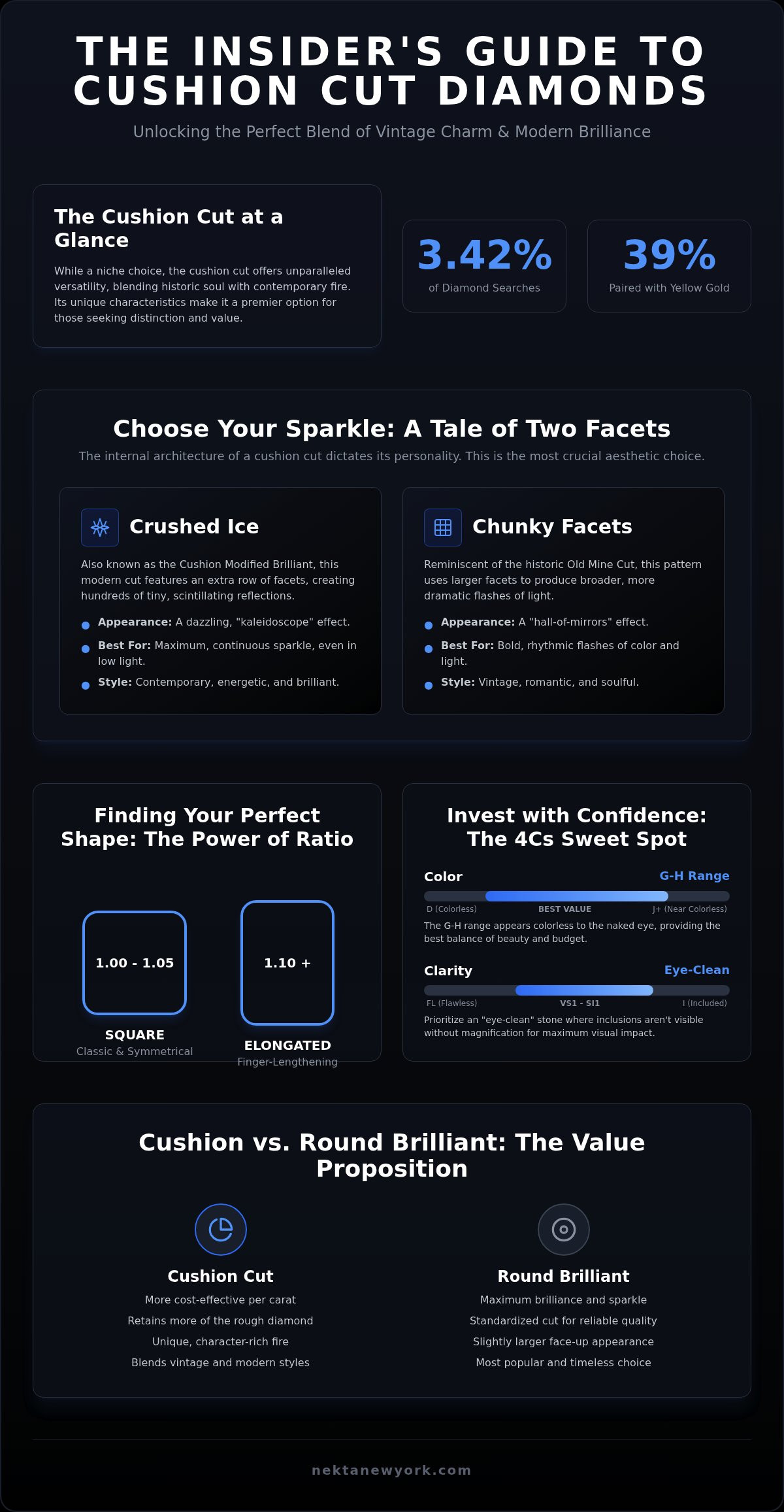
We understand that you're looking for more than just a piece of jewelry; you're seeking a legacy piece that reflects your personal story. This guide provides the clarity you need to evaluate these choices with the confidence of a Diamond District insider. You'll discover how to distinguish between various facet arrangements and why 39% of couples are now pairing these stones with the warmth of yellow gold. We'll break down the science of length to width ratios and show you how to balance sparkle with value. By the end, you'll know exactly how to select a cushion cut that radiates brilliance from every angle.
Key Takeaways
- Explore the transition from the historic "Old Mine Cut" to modern interpretations that offer unparalleled brilliance and a soft, pillow-like silhouette.
- Master the visual differences between "Crushed Ice" and "Chunky" facet patterns to find the specific sparkle that aligns with your personal style.
- Select the ideal length-to-width ratio for your cushion cut engagement rings to achieve either a symmetrical square or a finger-lengthening elongated silhouette.
- Prioritize your investment by focusing on the G-H color range and the "eye-clean" clarity test to maximize the stone’s visual impact and value.
- Learn how an expert consultation can help you source a GIA-certified diamond that balances technical precision with the artistic fire required for a custom masterpiece.
What is a Cushion Cut Engagement Ring? The "Pillow" of the Diamond World
A cushion cut diamond is defined by its square or rectangular outline with gently rounded corners, a silhouette that immediately evokes the comfort and elegance of a plush pillow. Selecting one of the many cushion cut engagement rings available today means embracing a design that has been a cornerstone of high jewelry for over two hundred years. While modern technology has refined its sparkle, the core appeal remains its unique ability to blend the soft, romantic edges of a vintage stone with the intense fire expected of a contemporary masterpiece. It's a shape that doesn't just sit on the finger; it commands attention through a sophisticated interplay of light and form.
The psychological draw of this cut lies in its inherent contradictions. It's the perfect choice for a bride who wants the "soft edges meet hard brilliance" aesthetic. Unlike the sharp, geometric precision of a princess cut or the clinical symmetry of a round stone, the cushion cut feels organic and approachable. This balance is why it remains a staple for celebrities and high-end luxury collectors who seek a look that's both timeless and distinct from the mainstream. It's a connoisseur's choice, signaling an appreciation for diamond history and artistic craftsmanship.
The Evolution from Old Mine Cut to Modern Cushion
The lineage of the cushion cut traces back to the 19th-century "Old Mine Cut," which was once the most prevalent diamond shape in the world. In those days, craftsmen relied on rudimentary tools and candlelight to shape stones, resulting in high crowns, deep pavilions, and large, visible culets. As diamond cutting techniques evolved through the 20th century, lapidaries began to prioritize light return and brilliance over raw weight retention. Modern cushions have discarded the bulky proportions of their ancestors in favor of precise facet arrangements that maximize scintillation. The cushion cut serves as the bridge between antique charm and modern optics.
Cushion Cut vs. Round Brilliant: The Main Differences
When comparing cushions to round brilliant cut engagement rings, the most striking difference is often found in the price-to-value ratio. Because the cushion cut retains more of the original rough diamond during the cutting process, it's typically more cost-effective per carat than a round stone. While a round diamond might offer a slightly larger surface area for the same weight, the cushion cut provides a deeper, more complex fire that many find more captivating. It's a trade-off between the standardized perfection of a round brilliant and the personalized, character-rich glow of a cushion.
Understanding Facet Patterns: "Crushed Ice" vs. "Chunky" Cushions
The allure of cushion cut engagement rings lies in their versatility, but the most profound difference between two stones of the same weight often comes down to their internal architecture. To the untrained eye, all cushions might look similar, yet their facet patterns create two entirely different visual personalities. One offers a modern, scintillating shimmer, while the other provides the bold, dramatic flashes of a bygone era. Choosing between them is a matter of deciding how you want your diamond to speak to the light.
The way a diamond is cut determines how it handles light return, and the cushion shape is unique because it allows for multiple faceting strategies. Whether you prefer a stone that looks like a field of sparkling stars or one that reflects broad, rhythmic beams of light, understanding the technical cause of these effects is essential for making an informed investment. These patterns don't just change the look; they affect how the stone hides inclusions and how it performs in different lighting environments.
Cushion Modified Brilliant: The Modern Sparkler
The "Crushed Ice" effect is the hallmark of the Cushion Modified Brilliant. This pattern is achieved by adding an extra row of facets on the pavilion that extend toward the girdle. These additional facets break up light into hundreds of tiny, twinkling reflections. It resembles a glass bowl filled with crushed ice or a kaleidoscope of microscopic mirrors. This style is exceptionally popular for those who prefer a "busy" sparkle that remains active even in low-light environments. Because the light is bounced around so many small surfaces, this pattern is particularly effective at masking minor inclusions. It often makes a stone with a lower clarity grade appear flawless to the naked eye. When evaluating these stones, many collectors reference the AGS Diamond Grading System to understand how light performance and scintillation are quantified in such complex arrangements.
The Antique/Chunky Cushion: For the Vintage Soul
In contrast, the "Chunky" or Cushion Brilliant cut features larger, broader facets. These stones are designed to mimic the antique aesthetic, where the goal was to produce distinct, powerful flashes of light rather than a wall of tiny twinkles. On a GIA report, these are typically listed simply as "Cushion Brilliant." These stones are prized for their "fire," which is the diamond's ability to break white light into a vivid rainbow of colors. The broader facets act like larger prisms, creating a more dramatic and organized light return. While they don't hide inclusions as easily as the crushed ice variety, their clarity and depth are unparalleled. If you find yourself drawn to a stone that feels substantial and rhythmic in its brilliance, you are likely a candidate for a chunky cushion. To truly appreciate the nuance between these two distinct personalities, it is often best to consult with a diamond expert who can showcase these stones side-by-side under various lighting conditions.
Square vs. Elongated Cushions: The Power of Ratios
The mathematical ratio of a diamond is the silent architect of its visual impact. It dictates the overall silhouette, transforming the stone from a perfectly balanced square into a sophisticated rectangle. When you're curating a selection of cushion cut engagement rings, the length-to-width ratio is the most critical metric for defining the ring's face-up personality. A ratio between 1.00 and 1.05 is considered square, offering the most traditional pillow-like appearance. Ratios exceeding 1.10 lean into the elongated territory, a style that's currently dominating high-end jewelry trends across Manhattan.
Matching the ratio to the hand shape is a nuanced art that requires more than just a glance at a GIA report. Square cushions tend to complement longer fingers or smaller hands, providing a compact and powerful center of brilliance. Elongated stones are the premier choice for those seeking a slimming, finger-lengthening effect. However, as a stone becomes more rectangular, the risk of a bow-tie effect increases. This dark shadow across the center occurs when light leaks through the pavilion rather than reflecting back toward the viewer. Balancing this length without sacrificing the center's fire requires a master's eye for proportion and light performance.
Why Elongated Cushion Cuts are Trending in 2026
The year 2026 has seen a distinct shift toward elongated shapes as couples seek alternatives to the ubiquitous oval. These stones offer a familiar elegance but feel more substantial and unique. Mike Nekta New York often advises clients that sourcing rare, elongated GIA certified diamonds requires patience; these stones are less common because they require specific rough diamond dimensions to maintain brilliance. It's about finding that sweet spot where the stone looks large on the hand but doesn't lose its soul in the center. This ratio provides the perfect canvas for those who want a modern, fashion-forward aesthetic that still honors the heritage of the cushion shape.
The Classic Square Cushion: Timeless Symmetry
For the purist, the square cushion remains the gold standard of diamond design. Its 1:1 symmetry makes it the ideal candidate for halo settings, where an even border of pavé diamonds can enhance its soft corners. Maintaining perfect proportions is vital for maximum scintillation; even a minor deviation can make the stone look off-center to a discerning eye. When designing a square cushion ring, consider pairing it with tapered baguettes or smaller round side stones to frame the center without competing for its light. This symmetrical approach ensures that the pillow effect is maximized, creating a look of effortless, polgári elegancia that never goes out of style.
The 4Cs of Cushion Cuts: Prioritizing Your Investment
Selecting a diamond is a delicate exercise in balancing technical specifications with raw visual beauty. For cushion cut engagement rings, the standard 4Cs (Color, Clarity, Cut, and Carat) apply, but the strategy for prioritizing them differs significantly from other shapes like the round brilliant. You aren't just looking for high grades on a piece of paper; you're looking for a stone that remains vibrant and full of life in every environment. Because of the way cushions are structured, certain grades matter more than others when it comes to the actual appearance on your hand.
Prioritizing clarity is often the first step for many buyers, but the goal should be "eye-clean" rather than technical perfection. A VS2 clarity stone that hides its inclusions under a facet is a much smarter investment than a VVS1 stone with a premium price tag that looks identical to the naked eye. For the cut, since the GIA doesn't provide a standardized "Cut" grade for cushions, you must rely on the Polish and Symmetry grades. For the carat weight, look for the "sweet spot." A 1.90ct stone often looks identical in size to a 2.00ct stone but avoids the significant price jump that occurs at the full carat mark.
Why Color Matters More in a Cushion Cut
Cushion diamonds are "color retainers." Because of their deep pavilions and specific facet arrangements, they tend to trap body color more than a shallow stone would. If you compare an H color cushion to an H color round brilliant side-by-side, the cushion will often appear slightly warmer. This "Ice Bucket" effect means that staying in the G-H range is vital if you want a crisp, white appearance in a platinum or white gold setting. If you're following the trend of choosing yellow gold settings, a slightly warmer I or J color stone can offer incredible value while looking perfectly white against the gold's glow.
Decoding the GIA Report for a Cushion Diamond
Since the GIA doesn't issue a "Cut" grade for fancy shapes, you have to look deeper into the technical data. Polish and Symmetry are your primary quality indicators; aim for "Excellent" in both to ensure the light is reflecting as intended. Table and Depth percentages are your best friends here. A table between 55% and 63% and a depth between 60% and 70% generally yield the best light return and scintillation. You should never finalize a purchase for a high-value cushion diamond without a comprehensive GIA appraisal to ensure the stone's characteristics are accurately documented. To ensure you're getting the best possible light performance, we invite you to view our curated selection of GIA-certified cushion cut diamonds and experience the difference that expert selection makes for cushion cut engagement rings.
Designing Your Custom Cushion Engagement Ring with Mike Nekta New York
The journey of creating cushion cut engagement rings at Mike Nekta New York is an immersive experience in the heart of the Manhattan Diamond District. It moves beyond the technical grading reports discussed earlier and focuses on the artistry of the final piece. Our philosophy is rooted in the belief that a diamond must possess a specific life and fire that can't be captured by a GIA certificate alone. By working with a third generation expert, you gain access to a curated selection of stones that have been vetted for their unique light performance and character. We ensure every ethically sourced diamond we present meets the highest standards of excellence before it ever reaches your hand.
The NYC experience is about the transition from a loose, brilliant stone to a finished masterpiece. While we've explored the technicalities of facet patterns and ratios, the custom design process is where your personal vision takes physical form. It's a collaborative effort where decades of craftsmanship meet modern aesthetic preferences. This process ensures that the final ring isn't just a piece of jewelry, but a legacy item that reflects the specific spirit of your commitment. In a city known for its pace, we take the time to ensure every detail is perfect.
Selecting the Perfect Setting for Your Cushion
The architecture of the setting is what ultimately defines how your diamond interacts with the world. Popular choices like the solitaire, halo, and three-stone designs each offer a different way to frame the center stone's brilliance. A hidden halo is a sophisticated touch, adding a secret layer of sparkle visible only from the side profile. For those who prioritize the security of the stone, double prongs are an elegant solution that protects the rounded corners while highlighting the diamond's unique silhouette. Choosing a hand-crafted setting over a mass-produced one is vital; the metal must be forged to the exact proportions of your specific stone to ensure a seamless, high-end finish that stands the test of time.
The Consultation: Bringing Your Vision to Life
Bringing a custom ring to life requires a personal touch that can't be replicated online. During a private session at Mike Nekta New York, you'll work directly with a specialist to find a diamond that fits your budget and style perfectly. This is the benefit of a third generation diamond expert's eye; we see the nuances in light return and scintillation that others might miss. We guide you through every choice, from the metal type to the prong style, ensuring the final result is a true reflection of your taste. To begin this bespoke journey, Book a private consultation at our Manhattan boutique and experience the pinnacle of NYC diamond craftsmanship.
Embarking on Your Journey to Timeless Elegance
Choosing the perfect diamond is a significant milestone that deserves the guidance of a seasoned expert. You now understand that the true beauty of cushion cut engagement rings lies in the subtle nuances, from the rhythmic fire of a chunky facet pattern to the sophisticated silhouette of an elongated ratio. By prioritizing eye-clean clarity and the ideal color range for your chosen metal, you ensure that your investment translates into a lifetime of brilliance. Every decision you make, from the facet arrangement to the length-to-width ratio, brings you closer to a piece that perfectly mirrors your unique story.
At our Manhattan boutique, we combine third-generation NYC expertise with the rigorous standards of GIA-certified diamonds to bring your vision to life. Our custom designs are meticulously crafted in the heart of the city, ensuring that every detail meets our maximalist standards for quality and beauty. We invite you to Explore our Exclusive Collection of Cushion Cut Engagement Rings and discover a masterpiece that resonates with your personal sense of luxury. Your dream ring is ready to be realized with the professional care and discretion you deserve.
Frequently Asked Questions
Do cushion cut diamonds look smaller than round diamonds?
Yes, cushion diamonds typically appear slightly smaller than round diamonds of the same carat weight because they're cut deeper. Much of the stone's weight is held in the pavilion rather than the surface area. While this depth contributes to the shape's signature fire and complex light return, it means the face-up diameter is often 10% smaller than a round brilliant of equal weight.
Is a cushion cut diamond more expensive than a round cut?
No, cushion cut diamonds are generally more affordable than round cuts, often costing significantly less per carat. The cutting process for round diamonds results in more wasted rough material, which drives up the price premium. This price difference makes cushion cut engagement rings an excellent choice for couples who want to maximize their diamond's size and quality without exceeding their investment goals.
What is the best clarity for a cushion cut engagement ring?
The best clarity for a cushion diamond is typically VS2, as it offers the best balance of beauty and value. While cushions have a large, open table that can reveal inclusions, a VS2 grade is almost always eye-clean to the naked eye. Choosing this grade allows you to allocate more of your budget toward color or carat weight while ensuring the stone remains visually flawless.
Can a cushion cut diamond be elongated?
Yes, cushion cut diamonds can be elongated by selecting a stone with a higher length-to-width ratio. While a 1:1 ratio creates a classic square, ratios of 1.15 or higher result in a sophisticated rectangular silhouette. These elongated versions are currently highly sought after in the NYC Diamond District for their ability to create a slimming and lengthening effect on the wearer's finger.
What is a "Crushed Ice" cushion cut?
"Crushed Ice" refers to a Cushion Modified Brilliant facet pattern that creates hundreds of tiny, needle-like reflections. This scintillating effect is achieved through an extra row of facets on the pavilion that break up the light return into smaller pieces. It's a modern look that provides a constant, shimmering sparkle rather than the broad, rhythmic flashes of light seen in antique-style chunky cushions.
Does a cushion cut diamond need a halo setting?
A halo setting is not a requirement, though it remains a popular choice for enhancing the stone's presence and vintage character. A solitaire setting is equally stunning and allows the unique "pillow" silhouette to take center stage without distraction. The decision ultimately depends on whether you prefer a minimalist, modern aesthetic or a more ornate design that maximizes the ring's overall footprint.
Are cushion cut diamonds good for active lifestyles?
Cushion cuts are exceptionally well-suited for active lifestyles because they lack the sharp, vulnerable corners found in princess or emerald cuts. The gently rounded edges are far less likely to chip or snag on everyday items or clothing. This inherent durability, combined with their timeless beauty, makes cushion cut engagement rings a practical yet luxurious choice for those who lead busy lives.
Why does GIA not give a "Cut" grade for cushion diamonds?
GIA doesn't provide a "Cut" grade for cushions because there's no single industry standard for "ideal" proportions in fancy shapes. Unlike round diamonds, which have a mathematically defined standard for brilliance, cushions are valued for their artistic and historical variety. To judge quality, you must evaluate the Polish and Symmetry grades alongside a physical inspection of the stone's fire and scintillation.