
The Sophisticated Allure of Emerald Cut Engagement Rings: A 2026 Connoisseur’s Guide
An emerald cut diamond is the ultimate truth-teller; it refuses to hide flaws that other shapes mask with ease. When you choose emerald cut engagement rings, you're opting for a sophisticated pedigree that demands an uncompromising eye for clarity and proportion. You likely appreciate the architectural lines and the understated elegance that sets this step-cut apart from the common sparkle of a round brilliant. It's a choice for the connoisseur who values depth over mere flash. While this shape accounts for roughly 8% of the market in 2026, its impact is far greater for those who understand true luxury.
You want a stone that reflects your discerning taste, yet the fear of visible inclusions or choosing the wrong ratio can be daunting. This guide will show you how to master the legendary "Hall of Mirrors" effect and secure a GIA certified stone that remains perfectly eye-clean despite its wide, open table. We'll clarify the persistent confusion between emerald and radiant cuts, define the ideal length-to-width ratios for a modern silhouette, and select the settings that best celebrate this iconic form. From the heritage of a third-generation diamond expert to the latest 2026 trends, your journey to the perfect ring begins with precision and ends with timeless beauty.
Key Takeaways
- Master the "Hall of Mirrors" effect by understanding how step-cut facets create a rhythmic play of light unlike any brilliant-cut diamond.
- Learn why clarity is the non-negotiable factor when selecting emerald cut engagement rings, ensuring your stone remains free of visible inclusions.
- Distinguish between the architectural elegance of the emerald cut and the "crushed ice" brilliance of radiant or square Asscher silhouettes.
- Explore how specific settings, such as tapered baguettes or custom solitaires, can amplify the stone’s sophisticated, elongated profile.
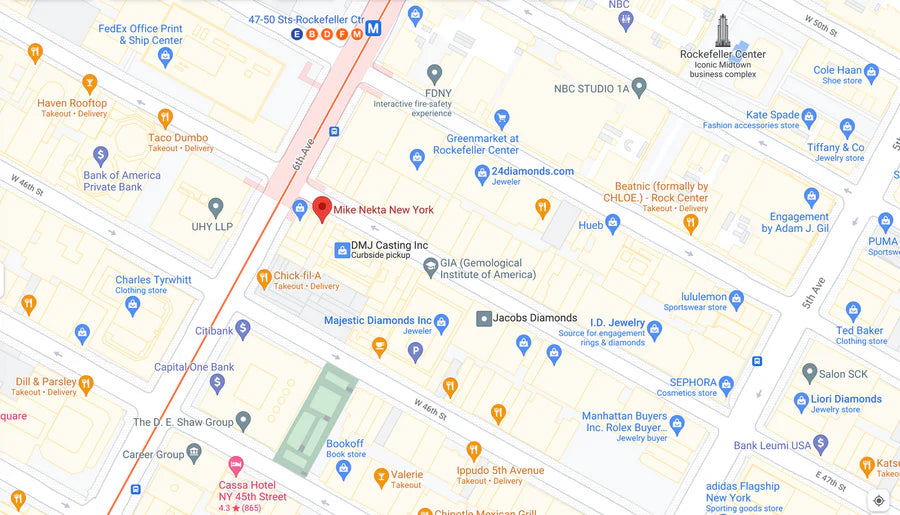
- Gain insights on sourcing rare, GIA certified stones from a master's perspective in the heart of Manhattan’s Diamond District.
What is an Emerald Cut Engagement Ring? Defining the Hall of Mirrors
The emerald cut is a masterclass in geometric precision. Unlike shapes designed to hide flaws through chaotic sparkle, the emerald cut celebrates the diamond's inherent clarity and structural perfection. It's one of the oldest silhouettes in the jeweler’s repertoire. Originally developed in the 1500s to prevent chipping in emerald gemstones, its long, parallel facets were later adapted for diamonds as lapidary techniques advanced. Today, emerald cut engagement rings represent a choice for those who prefer the steady, rhythmic glow of "quiet luxury" over the frantic shimmer of traditional brilliant cuts.
The physics of the "Hall of Mirrors" relies on the interplay of linear facets. When light enters the stone, it reflects off parallel steps, creating a strobe-like effect that feels both hypnotic and organized. It's a sophisticated visual language that appeals to the connoisseur who values the "truth" of a diamond. Because there's no "crushed ice" effect to hide inclusions, every stone must be selected with extreme care. This cut doesn't rely on surface-level flash; it invites the observer to look deep into the heart of the crystal.
The History and Evolution of Step-Cuts
The Art Deco movement of the 1920s transformed this functional cut into a high-fashion icon. Its clean lines and symmetrical balance mirrored the era's obsession with skyscraper architecture and industrial elegance. In the heart of the Manhattan Diamond District, this vintage appeal has evolved into a modern standard for luxury engagement rings NYC. It's a style that bridges the gap between old-world heritage and contemporary policed elegance. It doesn't scream for attention. Instead, it commands it through structural integrity and a refined, elongated silhouette that flatters the hand.
Step-Cut vs. Brilliant-Cut Faceting
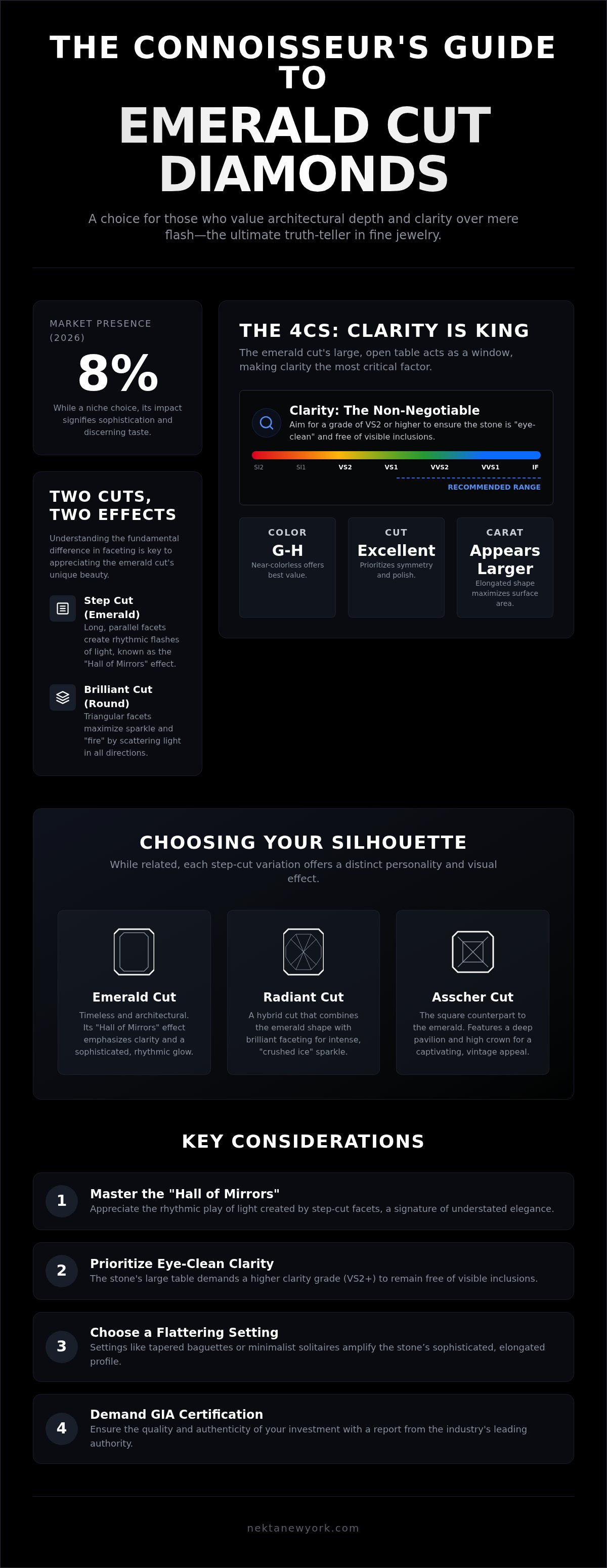
To understand the allure, you must understand the geometry. Most diamonds you see are brilliant cuts, which use triangular facets to bounce light in every direction. In contrast, emerald cuts belong to the family of step- or trap-cut stones. A step-cut is a series of rectangular facets that resemble stairs. This arrangement creates the famous "Hall of Mirrors" effect. Instead of the "fire" or pinpoint sparkle found in a round diamond, an emerald cut produces long, rhythmic flashes of white light. This faceting style prioritizes the diamond's natural luster and transparency over sheer brightness.
- Linear Facets: These parallel lines draw the eye deep into the stone, emphasizing depth.
- Open Table: The large flat top acts as a window, making clarity a non-negotiable factor for emerald cut engagement rings.
- Architectural Appeal: The cropped corners provide durability while maintaining a sleek, rectangular form.
The 4Cs of Emerald Cut Diamonds: Why Clarity is King
The emerald cut is unforgiving. While brilliant cuts hide inclusions behind a chaotic wall of sparkle, the emerald cut's flat top, or table, acts like a clear window. This is the "Open Table" factor. If there's a flaw, you'll see it. This transparency is why emerald cut engagement rings require a much higher standard of clarity than almost any other shape. It's not just about the grade on a paper; it's about the visual purity of the crystal itself.
When evaluating the 4Cs of Diamond Quality, clarity takes center stage. We typically recommend a grade of VS2 or higher. While an SI1 might be eye-clean in a round diamond, that same grade in a step-cut often reveals carbon spots or feathers to the naked eye. Connoisseurs understand that in this specific cut, you're buying a stone for its elegance and transparency, not its ability to mask imperfections.
Interestingly, these stones offer excellent value regarding visual impact. Because of their elongated silhouette, they often look larger than round diamonds of identical weight. A 1.5-carat emerald cut typically has a greater surface area than a 1.5-carat round brilliant. This gives you more finger coverage and a more commanding presence for your investment, provided the stone is cut to ideal proportions.
Evaluating Clarity in Step-Cuts
Avoid inclusions directly under the center table. These are impossible to hide and will disrupt the rhythmic "Hall of Mirrors" effect. A GIA certificate is your first line of defense, but it isn't the only one. You've got to look at the stone from the side. Sometimes, inclusions like clouds or feathers are tucked into the corners, where a clever setting can mask them. This is where a professional eye becomes invaluable. If you're looking for perfection, you can view our hand-selected GIA certified stones to see what true clarity looks like.
Color Retention and Metal Pairings
Emerald cuts tend to hold onto color more than brilliant cuts. The large facets don't break up light as much, so any yellow tint is more noticeable. For platinum or white gold settings, staying in the G or H color range ensures that icy look that many brides crave. It creates a crisp, clean aesthetic that highlights the stone's architectural lines.
If you prefer a vintage aesthetic, an I or J color stone paired with yellow gold can be stunning. The warmth of the metal complements the stone’s slight tint, creating a rich, policed appearance. Mike Nekta’s approach focuses on finding that sweet spot where color and clarity meet without overpaying for grades you won't notice. He personally oversees the selection of every stone to ensure it meets the high-end standards of the Manhattan Diamond District.
Emerald Cut vs. Radiant and Asscher: Choosing Your Silhouette
Selecting the right silhouette is about more than just a shape on a page. It's about how the stone interacts with light and the hand. Emerald cut engagement rings are prized for their elongated form; they create a sophisticated, slimming effect on the finger. This architectural stretch draws the eye upward, providing a grace that shorter cuts often lack. It's a choice that reflects a certain level of policed elegance and a deep appreciation for diamond geometry.
The visual difference between these cuts is profound. An emerald cut provides the "Hall of Mirrors" effect, characterized by broad, rhythmic flashes of light. In contrast, the radiant cut produces a "crushed ice" look, where light is broken into thousands of tiny, glittering pinpoints. The Gemological Institute of America (GIA) notes that these step-cuts emphasize clarity, whereas radiants prioritize brilliance. If you value the "quiet luxury" aesthetic, the emerald cut remains the definitive choice for your collection.
The Radiant Cut: For Those Who Want the Shape Plus Sparkle
The radiant cut was a 1970s innovation designed to marry the elegant silhouette of an emerald cut with the complex faceting of a round brilliant. It features 70 facets, which is significantly more than the emerald cut’s standard 57 or 58. Choose a radiant if you want a stone that hides inclusions better and offers maximum sparkle. If this high-octane brilliance sounds appealing, explore our Radiant Cut Diamond Guide to see how it compares.
The Asscher Cut: The Royal Square Alternative
The Asscher cut is essentially a square emerald cut with higher crowns and a smaller table. Patented in 1902 by the Asscher brothers of Amsterdam, it carries a royal, vintage pedigree that feels right at home in Manhattan. While the emerald cut focuses on length, the Asscher emphasizes a hypnotic "X" pattern visible through its center. It requires perfect symmetry to achieve its famous "windmill" effect. This makes it a favorite for lovers of Art Deco design who prefer a more compact, balanced form.
Choosing between these three silhouettes requires an understanding of your own personality. Do you want the bold, modern flash of an emerald cut, the fiery energy of a radiant, or the vintage symmetry of an Asscher? Each offers a different way to express your commitment. For the bride who wants her ring to stand out through understated power, emerald cut engagement rings offer a timelessness that never goes out of style. It’s about finding the stone that speaks to your personal narrative and your eye for quality.
Selecting the Perfect Setting for an Emerald Cut Ring
The setting you choose for emerald cut engagement rings acts as the frame for a masterpiece. Because the stone is essentially a window, the metal and structure around it will be reflected within its facets. A classic solitaire is the purest expression of this shape. It allows the architectural lines to stand alone without distraction. For a more avant-garde look, the East-West setting, which flips the stone horizontally across the finger, has emerged as a major trend for 2026. It provides a modern, edgy silhouette that still respects the stone's heritage.
Metal color choice is critical for this specific cut. White metals like platinum or 18k white gold amplify the icy, transparent nature of the diamond. However, you must be aware that the wide, open table of an emerald cut can act like a mirror for the metal beneath it. If you choose a yellow gold setting, the stone may pick up a warm tint through its center. This can be a beautiful choice for a vintage aesthetic, but it's a detail you shouldn't overlook during the design process.
Protecting the Corners: Prongs vs. Bezels
The corners of an emerald cut are its most vulnerable points. They're prone to chipping if left exposed to hard knocks. A traditional 4-prong setting is elegant, but many connoisseurs prefer "double prongs" or an 8-prong arrangement. This doesn't just add security; it emphasizes the cropped corners of the stone, highlighting its unique geometry. If you lead an active lifestyle, a bezel setting offers a seamless, architectural frame. It encircles the entire diamond in metal, providing maximum protection while creating a sleek, high-fashion look that feels entirely contemporary.
The Three-Stone Architectural Look
The three-stone setting is where the emerald cut truly finds its voice. Tapered baguettes are the classic choice here. They create a "staircase" of light that leads the eye toward the center stone. This graduated step-cut effect creates a sense of continuous flow across the finger. While round brilliant cut engagement rings often use round side stones for a cluster of sparkle, the emerald cut demands geometric harmony. Trillion cuts or smaller emerald cuts are also excellent companions for those seeking a vintage Art Deco vibe.
Selecting the right mount is a technical decision that requires a master's eye for proportion. You can browse our handcrafted emerald cut settings to find a design that perfectly complements your chosen stone and personal style.
The Mike Nekta Advantage: Custom Emerald Cuts in the NYC Diamond District
The Manhattan Diamond District is the epicenter of global diamond trading, and it's where the third-generation expertise of Mike Nekta comes to life. Selecting emerald cut engagement rings in this environment offers a distinct advantage that online retailers simply can't match. An emerald cut is a "truth-teller," and you need an expert who can see beyond the GIA certificate. Mike personally oversees the selection of every stone, using an eye trained by decades of family heritage to identify "eye-clean" diamonds that possess a superior luster and life.
Sourcing a rare, high-clarity emerald cut requires deep industry connections. Many of the finest stones in 2026 never reach the public market; they stay "off-market" within the private networks of the NYC Diamond District. This access allows us to find stones with the perfect length-to-width ratios and exceptional transparency that define a connoisseur’s choice. When you work with a master jeweler in person, you aren't just choosing from a list. You're participating in a curated selection process where quality always takes precedence over mere carat weight.
The Art of Handcrafting in Manhattan
Precision is the hallmark of a Mike Nekta setting. Most commercial rings are "cast" from mass-produced molds, which often results in a generic fit that doesn't account for the specific dimensions of your diamond. Because every emerald cut has a unique silhouette, a machine-made setting can leave unsightly gaps or cause the stone to sit unnecessarily high. Our handcrafted process ensures the metal is built around the diamond itself. This custom approach allows the stone to sit perfectly low to the finger, creating a sleek, architectural profile that feels like a natural extension of the hand.
Your Journey to a Custom Engagement Ring
The bespoke process begins with a personal consultation, either in our Manhattan showroom or through a private virtual session. We start by educating you on the nuances of loose GIA certified stones, helping you find the "Hall of Mirrors" effect that speaks to your aesthetic. Unlike mass-market jewelers who prioritize quick transactions, we focus on a methodical, well-structured journey. Every detail, from the prong placement to the metal's finish, is discussed and refined to ensure the final piece is a masterpiece of craftsmanship and personal storytelling.
Your search for the ultimate emerald cut diamond deserves the attention of a master. We invite you to experience the precision and passion that defines our work. Visit our Manhattan showroom in the heart of the Diamond District or book a virtual consultation today to begin crafting a ring that will be cherished for generations.
Secure Your Legacy with Architectural Brilliance
Choosing a diamond is a profound decision, but selecting a step-cut requires a higher level of mastery. You now understand that clarity isn't just a grade; it's the foundation of the "Hall of Mirrors" effect that makes emerald cut engagement rings so hypnotic. From the vulnerability of the stone's corners to the necessity of a GIA certified, eye-clean center, every detail demands precision. By moving beyond mass-market casts toward handcrafted artistry in the Manhattan Diamond District, you ensure your ring possesses the structural integrity it deserves.
As a 3rd Generation Diamond Expert, Mike Nekta personally oversees the selection of every stone to guarantee it meets our uncompromising standards. We only offer GIA Certified Diamonds, each meticulously fit into a setting handcrafted in the NYC Diamond District to celebrate its unique proportions. Explore Mike Nekta’s Curated Collection of Emerald Cut Engagement Rings today. Your journey to a timeless masterpiece starts with a single, perfect stone.
Frequently Asked Questions
Do emerald cut diamonds sparkle?
Emerald cuts don't sparkle in the traditional sense; they produce rhythmic flashes of light known as the "Hall of Mirrors" effect. While a round brilliant uses triangular facets to create fire and scintillation, the emerald cut's parallel facets prioritize luster and transparency. It's an understated, sophisticated glow that appeals to those seeking a policed, architectural aesthetic rather than high-intensity brilliance.
What is the best length-to-width ratio for an emerald cut engagement ring?
The classic length-to-width ratio for emerald cut engagement rings typically falls between 1.30 and 1.50. A ratio of 1.40 is widely considered the "golden mean" for a perfectly balanced silhouette. If you prefer a more elongated look that stretches the finger, you might lean toward 1.50. Squarer versions closer to 1.30 offer a sturdier, more compact appearance that feels bold and modern.
Why are emerald cut diamonds more expensive than other shapes?
These stones often carry a premium because they require a much higher quality of diamond rough. Since the open table doesn't hide flaws, we must source high-clarity stones, which are rarer and more costly than those used for brilliant cuts. The precision required to align the parallel facets also demands a master's touch. You're paying for the rarity of a stone clean enough to survive this unforgiving cut.
Can you see inclusions easily in an emerald cut?
Yes, inclusions are significantly more visible in an emerald cut than in almost any other shape. The large, flat table acts like a clear window into the heart of the diamond. While a small inclusion might be lost in the chaotic sparkle of a radiant cut, it'll be glaringly obvious in a step-cut stone. This is why we insist on GIA certified diamonds that are personally verified as eye-clean by an expert.
Is an emerald cut diamond good for a small hand?
An emerald cut is an exceptional choice for smaller hands because its elongated vertical axis creates a slimming effect. This silhouette makes the finger appear longer and more graceful, providing a commanding presence without overwhelming the hand's natural proportions. It's a strategic choice for those who want a ring that feels substantial yet remains elegant and balanced on a smaller frame.
What is the difference between an emerald cut and a baguette?
The primary difference lies in the corners and the facet complexity. Emerald cuts have cropped, beveled corners and multiple tiers of facets, making them durable enough to serve as center stones. Baguettes have sharp, 90-degree corners and fewer facets; they're almost exclusively used as accent stones. While both are step-cuts, the emerald cut has the depth and structural integrity required to stand alone.
Does an emerald cut diamond look bigger or smaller than a round diamond?
An emerald cut diamond typically looks larger than a round brilliant of the same carat weight. Because the cut is shallower and the surface area is more spread out across the top of the stone, it offers a larger "face-up" appearance. A 2-carat emerald cut will often appear to have more finger coverage than a 2-carat round diamond, allowing you to maximize the visual impact of your investment.