
The Connoisseur’s Guide to Big Diamond Jewelry: A 2026 Luxury Buyer’s Manual
Would you trust a seven-figure investment to a grading report alone, or do you require the seasoned eye of a third-generation master? Acquiring big diamond jewelry represents more than a simple purchase. It's a legacy move that often carries as much anxiety as it does prestige. You're likely concerned about hidden inclusions that a standard certificate might gloss over, or perhaps you're questioning if the saturation in a fancy yellow stone truly justifies its premium. It's a valid fear when the difference of a single grade can mean hundreds of thousands of dollars in market value.
We've designed this 2026 manual to strip away the confusion and provide you with the exact evaluative framework used by New York's elite Diamond District experts. You'll gain the confidence to select stones that aren't just large, but truly museum-quality. We'll explore the art of evaluating ultra-rare specimens like the 64ct Treasure, navigate the latest GIA grading shifts, and secure your investment with absolute transparency. By the end of this guide, you'll understand the tactical nuances of high-carat acquisitions and how to ensure your piece remains a timeless, GIA-backed asset for generations to come.
Key Takeaways
- Learn why the 10ct+ threshold defines a unique asset class and the geological rarity required to produce stones of this magnitude.
- Discover why standard 4C grading rules shift for big diamond jewelry, allowing for specialized clarity evaluations in stones exceeding 20 carats.
- Identify the most effective diamond cuts, such as the Asscher or Emerald cut, for maintaining structural integrity and light performance in heavy stones.
- Understand the importance of GIA-backed security and the value of sourcing rare specimens through third-generation experts in New York's Diamond District.
- Gain insight into the bespoke engineering required to create balanced, secure settings for ultra-rare masterpieces like the 64ct Treasure and 40ct Wynn.
Defining Big Diamond Jewelry: The Rarity of the Ultra-Carat Class
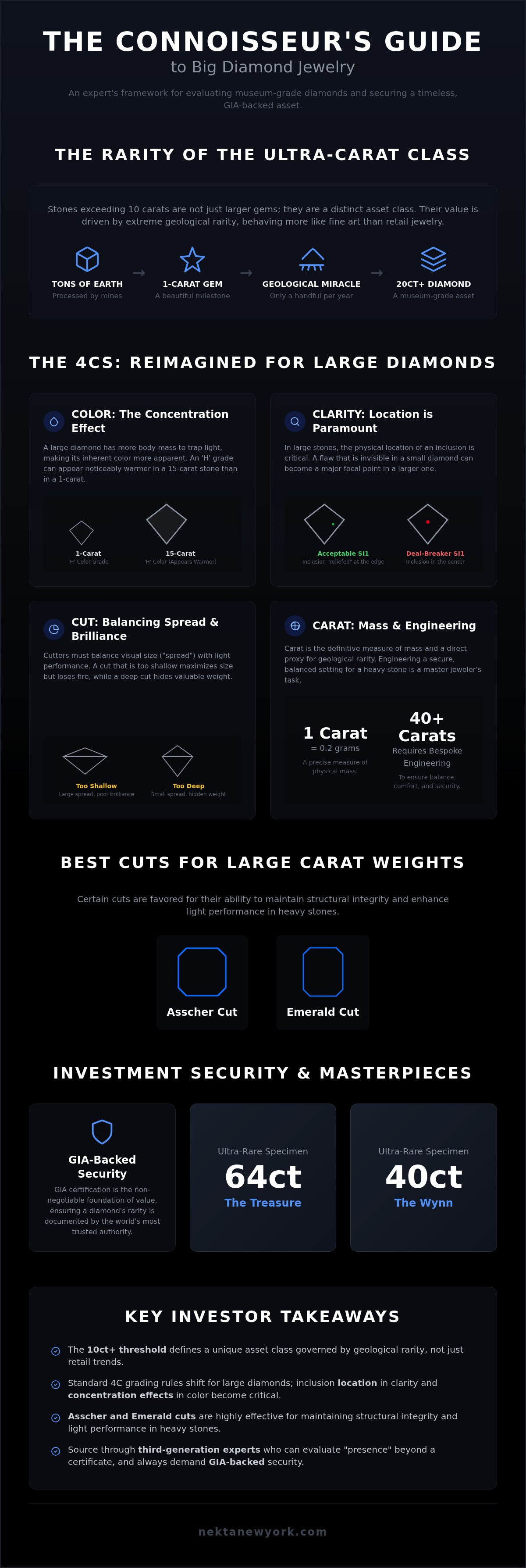
Entering the world of stones exceeding 10 carats requires a shift in perspective. In the luxury market, big diamond jewelry isn't merely a larger version of a bridal accessory; it's a distinct asset class. While a one or two-carat stone is a beautiful milestone, a 10-carat plus diamond represents a statistical anomaly in nature. Most commercial mines process tons of earth to find a single one-carat gem. Finding a rough crystal capable of yielding a 20, 40, or 60-carat polished stone is a geological miracle that happens only a handful of times per year globally.
This extreme scarcity means the "Big Diamond" category behaves more like fine art than retail jewelry. Just as a collector might track a specific Basquiat or Picasso, connoisseurs track the provenance and availability of ultra-rare stones like the 64ct Treasure. Mike Nekta's philosophy, forged through three generations in the NYC Diamond District, centers on this principle of "presence." He doesn't just look for a weight on a scale; he hand-selects stones that possess a singular, commanding character that can't be replicated by smaller, more common gems.
The Carat Weight vs. Physical Dimension
Understanding the relationship between mass and visual size is vital when dealing with high-carat weights. You'll often hear experts discuss "spread," which refers to how a diamond's weight is distributed. Two stones can both weigh 10 carats, yet one might appear significantly larger because of its proportions. However, a stone cut too shallow to maximize spread will lose its fire and brilliance, while a stone cut too deep hides its weight where you can't see it. Carat weight serves as the definitive measure of a diamond's physical mass, acting as a direct proxy for the geological rarity of the rough crystal from which it was born.
Proportions also dictate the structural integrity of the piece. Engineering a secure setting for a stone as massive as the 40ct Wynn requires a master jeweler's touch to ensure the weight is balanced comfortably on the hand or neck. Without this technical precision, a heavy stone can feel cumbersome or, worse, become unsecure in its mounting.
Investment Potential of Museum-Grade Diamonds
Large-scale diamonds have historically shown remarkable price resilience compared to the broader retail market. While standard commercial stones fluctuate with consumer trends, museum-grade diamonds are finite assets. This is particularly true for fancy colored diamonds and D-Flawless colorless stones, which often see intense demand at high-end auctions. GIA certification remains the non-negotiable foundation of this value. By verifying the essential diamond quality characteristics, a GIA report ensures the stone's rarity is documented by the world's most trusted authority. For those beginning their journey with classic shapes, understanding the nuances of Round Brilliant Cut Engagement Rings provides a solid baseline for appreciating the complexity of larger, more rare iterations.
Evaluating the 4Cs for Large-Scale Diamonds
When you move past the five-carat threshold, the traditional 4Cs aren't just guidelines; they're an entirely different language. Technical specifications that matter for a standard engagement ring often become secondary to the visual "presence" of the stone. Conversely, certain flaws that are negligible in small diamonds can become glaring deal-breakers in big diamond jewelry. Understanding these nuances is what separates a lucky buyer from a true connoisseur.
Color behaves uniquely in large-scale stones due to the concentration effect. Because a large diamond has more body mass, it traps more light, making the inherent body color more apparent. A stone graded as "H" might appear noticeably warmer in a 15-carat weight than it would in a 1-carat round brilliant. This makes the selection process for colorless stones significantly more rigorous. Cutters must also balance the desire for a larger "spread" with the need to maintain light return, a challenge that intensifies as the surface area grows. Achieving "Excellent" symmetry on a massive stone is a feat of engineering that requires a master’s touch.
Clarity also requires a tactical approach. While industry standards provide a foundation for diamond clarity grades, the physical location of an inclusion is paramount in large stones. An SI1 grade in a 60-carat stone can be perfectly acceptable if the inclusion is "reliefed" near the girdle where it can be hidden by a prong. However, in a 2-carat Emerald cut, that same inclusion would be magnified by the stone's long, open facets. You can explore how these grades translate to real-world beauty by browsing our curated big diamond jewelry collection.
Color Saturation in Fancy Yellows and Pinks
Large carat weights are a gift to fancy colored diamonds. The extra depth allows for greater light travel, which frequently enhances the perceived saturation of the stone. This often pushes a diamond from "Fancy" into the more coveted "Fancy Intense" or "Fancy Vivid" categories. The ZAR 32 Carat Fancy Yellow Intense Diamond Ring serves as a perfect benchmark for this effect. Its massive size allows the natural yellow hue to radiate with a depth that smaller stones simply cannot achieve. In this ultra-high-end market, we prioritize natural, untreated colors, as they hold their value as true geological rarities.
Clarity and the "Windowing" Effect
For large Oval and Emerald cuts, Internally Flawless (IF) grades are the gold standard. These shapes are prone to "windowing," a phenomenon where light passes directly through the center of the stone rather than reflecting back to the eye. A windowed stone looks flat and lifeless, regardless of its carat weight. The Grace 11 Carat Oval Cut D Color IF Ring exemplifies the importance of clarity and cut precision. At this scale, we also look for inclusions that might threaten structural integrity. A "feather" inclusion near the edge of a 20-carat stone is a risk we don't take, as the internal pressure of such a large crystal can lead to durability issues over time.
Selecting the Best Cuts for Large Carat Weights
When you're investing in big diamond jewelry, the cut isn't just an aesthetic choice; it's a feat of structural engineering. A stone exceeding 10 carats carries immense physical mass, and how that weight is distributed across its silhouette determines its visual impact and light performance. While round brilliant cuts are the standard for smaller stones, the ultra-carat class often demands fancy shapes that can showcase the depth and clarity of such massive crystals without making the piece feel overly bulky.
The Asscher cut stands as a geometric masterclass, perfect for those who appreciate vintage architectural lines. Its step-cut facets create a "hall of mirrors" effect that highlights the internal purity of the stone. For fancy yellow diamonds, Radiant and Cushion cuts remain the preferred silhouettes. These shapes are specifically designed to trap and intensify color by bouncing light through the pavilion multiple times. If your goal is to maximize "face-up" size, Oval and Pear shapes are the strategic choice. Because they are elongated, they cover more of the finger's surface area, creating the illusion of even greater weight than their actual carat count suggests.
The Majestic Asscher: Treasure 64 Carat
Few pieces exemplify the power of the step-cut like the Treasure 64 Carat O-P SI1 Asscher Cut Diamond. In a stone of this magnitude, the Asscher cut provides a window into the very heart of the earth's creation. It's a $3,000,000 statement piece that relies on architectural precision rather than mere glitter. This cut shares a sophisticated lineage with Emerald Cut Engagement Rings, as both styles emphasize clean lines and a dignified presence over the frantic sparkle of modern brilliant cuts.
Elongated Brilliance: Oval and Marquise
Choosing between different elongated silhouettes often comes down to the wearer's personal style and the stone's unique character. Comparing the Valeria 24 Carat Pear Shape to the Zoey 22 Carat Oval reveals how subtle changes in outline alter the ring's presence. The pear shape offers a dramatic, asymmetrical flair, while the oval provides a balanced, classic brilliance. For a deeper dive into which of these silhouettes suits your aesthetic, our guide on the Oval vs Pear Engagement Ring breaks down the visual nuances that matter most in high-carat acquisitions.
Masterpieces of the Collection: Standout Big Diamond Jewelry
Most high-end retailers cap their inventory at five or ten carats. At Mike Nekta New York, our vault begins where others end. We specialize in the ultra-rare 20ct to 60ct+ range, offering specimens that are statistically impossible to find in standard luxury boutiques. These pieces represent the absolute pinnacle of big diamond jewelry. They're geological wonders that require a different level of craftsmanship to house securely. Setting a 40 or 60-carat diamond isn't a standard task. It requires custom-engineered, heavy-gauge prongs and a precision-balanced shank to ensure the stone doesn't rotate on the finger or cause discomfort to the wearer.
Our collection features items that have captured global attention through viral media and high-profile features. These aren't just products; they're cultural landmarks. When you're dealing with stones of this magnitude, you're acquiring a piece of history that has been hand-selected by a third-generation expert. This level of curation ensures that every masterpiece in our vault possesses the "presence" and fire necessary to justify its museum-grade status.
The Wynn: A 40 Carat Fancy Yellow Statement
Radiant cuts are widely considered the gold standard for maximizing fancy yellow saturation. The Fancy Yellow 40 Carat Radiant Cut Diamond Ring, known as the Wynn, is a perfect example of this synergy. Valued at $2.2M, this stone radiates a deep, golden hue that is intensified by its massive surface area. It gained significant cultural traction after being featured in viral MrBeast content, illustrating the modern "MrBeast effect" where ultra-large diamonds become symbols of ultimate luxury. This specific ring demonstrates how a masterfully cut radiant stone can trap light to create an unparalleled glow.
Rare Colors: Fancy Pink and Fancy Blue
While colorless diamonds are exceptional, fancy colored stones like the Regina 5 Carat Marquise Cut Fancy Pink are the ultimate prizes for collectors. Pink and blue diamonds are significantly rarer than their colorless counterparts. This rarity is reflected in the price per carat, which can often be ten times higher for a vivid pink than for a D-Flawless colorless stone of the same weight. These items aren't just jewelry; they're concentrated wealth that fits in the palm of your hand.
Beyond the Ring: Large Diamond Studs and Pendants
The allure of massive carats extends beyond engagement rings. The Hepburn 23 Carat Emerald Cut Diamond Stud Earrings, priced at $610k, redefine the concept of statement earrings. Engineering these pieces requires a delicate balance. We must ensure the setting is robust enough to hold the 11.5-carat stones securely while maintaining a weight that is comfortable for all-day wear. If you're ready to explore these rare acquisitions, you can browse the full Big Diamond Jewelry collection here to find your next legacy piece.
The Mike Nekta Experience: Bespoke Acquisition in NYC
Acquiring a multi-million dollar diamond is a transaction rooted in legacy. While many retailers operate as digital storefronts, the Mike Nekta New York experience is anchored in the historic NYC Diamond District. This Manhattan enclave serves as the epicenter of global trade; it's where Mike Nekta applies three generations of expertise to the curation of big diamond jewelry. Working with a third-generation master ensures your acquisition isn't just a purchase, but a guided journey through the nuances of geological rarity and artisanal craftsmanship that only decades of proximity to the world's finest stones can provide.
The process of creating a setting for a stone exceeding 20 carats is fundamentally different from standard bench work. We view the setting as a "throne" designed to support and elevate the stone. Every curve and prong is custom-engineered to handle the physical weight while ensuring the diamond remains the undisputed protagonist. This architectural approach prevents the stone from rotating on the finger and protects its edges from daily wear. Beyond the initial design, we prioritize the long-term security of your investment. This includes specialized maintenance schedules and expert guidance on high-value insurance policies that provide the specific coverage a museum-grade piece requires.
From Loose Stone to Handcrafted Masterpiece
The journey often begins with selecting a GIA-certified loose diamond. By starting with a loose stone, you have the opportunity to inspect the diamond's character and light performance from every angle before it's set. For stones of significant mass, we exclusively use 18K gold or Platinum. These metals provide the necessary density and structural integrity to secure heavy carats without compromising on elegance. For those seeking a truly unique expression of their personal style, our guide to Custom Bridal Jewelry NYC details how we transform individual visions into bespoke reality.
Trust and Transparency: The GIA Appraisal
Transparency is the only currency that matters in the ultra-high-end market. Every acquisition of big diamond jewelry at Mike Nekta New York includes a comprehensive GIA certificate. This document is your absolute guarantee of quality, providing an objective analysis of the stone's characteristics and origin. We are committed to ethical sourcing, ensuring every stone in our vault meets the highest global standards. To truly appreciate the fire and presence of these rare items, we invite you to schedule a private consultation. This personalized viewing allows you to experience the Mike Nekta New York collection in a secure, discreet environment tailored to your specific needs, ensuring total confidence in your selection.
Securing Your Legacy in the Ultra-Carat Class
Acquiring a stone of significant magnitude is about more than just the 4Cs. It's about recognizing the geological rarity of 10-carat plus specimens and the master craftsmanship required to showcase them. You've seen how large-scale diamonds demand a tactical approach to clarity and a custom-engineered "throne" to ensure structural integrity. These pieces are true assets that behave more like fine art than standard retail items.
Mike Nekta brings three generations of NYC Diamond District expertise to help you navigate this exclusive market. Every stone in our vault is GIA-certified, providing the transparency and security necessary for high-value acquisitions. When you choose big diamond jewelry from our collection, you aren't just buying a ring; you're securing a piece of natural history. We invite you to take the next step in your journey with the confidence that only a seasoned expert can provide. Your legacy piece is waiting to be discovered.
Explore the Exclusive Big Diamond Jewelry Collection
Frequently Asked Questions
Is a 10-carat diamond too big for everyday wear?
A 10-carat diamond isn't inherently too big, but its wearability depends on the craftsmanship of the setting. When big diamond jewelry is custom-engineered with a balanced shank and secure prongs, it can be worn comfortably for special occasions or daily life by those who prefer a bold presence. We focus on creating a throne for the stone that distributes weight evenly, preventing the ring from spinning or feeling cumbersome during wear.
Do large diamonds hold their resale value better than smaller ones?
Large diamonds typically hold their value better than smaller commercial stones because they are significantly rarer assets. While 1-carat diamonds are abundant, stones over 10 carats are geological anomalies. This extreme scarcity ensures that museum-quality pieces remain in high demand among global collectors and investors. Historically, these rare items have shown more price resilience during market fluctuations, a trait shared by the elite timepieces evaluated by Noir Time Group, compared to the broader retail jewelry segment where supply is much higher.
Red diamonds are the rarest in nature, though they almost never appear in large sizes. For those seeking substantial big diamond jewelry, Fancy Pink and Fancy Blue stones are the most coveted rare colors. Finding a vivid pink or blue diamond exceeding five carats is an extraordinary event. These stones often command the highest prices per carat at auction because their combination of intense color and high mass is virtually impossible to replicate.
How do I insure a diamond ring worth over $1 million?
Insuring a seven-figure diamond requires a specialized specie or high-value asset policy rather than a standard homeowners rider. You'll need a current GIA report and a professional retail replacement appraisal from a third-generation expert like Mike Nekta. These policies provide worldwide coverage and protect against loss, theft, or damage. We recommend working with insurers who specialize in the luxury market to ensure your specific stone's rarity is fully documented and protected.
What is the best diamond cut for a 20-carat stone?
The best cut for a 20-carat stone depends on your goal for presence versus brilliance. Elongated shapes like the Oval or Pear cut are excellent for maximizing the physical spread across the finger. If you prefer an architectural, sophisticated look, the Asscher or Emerald cut showcases the stone's internal purity. For fancy colored stones, Radiant and Cushion cuts are superior because their facet patterns are designed to trap and intensify natural color saturation.
Can I customize the setting for a diamond from the Mike Nekta collection?
Bespoke customization is the cornerstone of the Mike Nekta experience. Every stone in our collection can be set into a handcrafted masterpiece designed specifically for the wearer's hand and lifestyle. We utilize heavy-gauge 18K gold or Platinum to provide the structural integrity required for stones as massive as the 64ct Treasure. Our NYC workshop allows you to collaborate directly with master jewelers to ensure the final piece reflects your personal vision.
Why are Fancy Yellow diamonds so popular in large carat weights?
Fancy Yellow diamonds are popular in high carat weights because large stones naturally enhance color saturation. The concentration effect means that a larger diamond body traps more light, often pushing a stone's grade into the more desirable Fancy Intense or Fancy Vivid categories. This makes big diamond jewelry in yellow hues a strategic choice for buyers who want maximum visual impact and vibrant color without the extreme price premiums of rare pinks or blues.
What is the difference between GIA Certified and other diamond appraisals?
A GIA certificate is a scientific grading report that identifies a stone's quality characteristics, while an appraisal assigns a monetary value for insurance. GIA is the world's most trusted authority because they don't sell diamonds; they provide an objective, third-party analysis of the 4Cs. Other appraisals can be subjective or inflated. At Mike Nekta New York, we provide GIA-certified inventory to ensure you have a transparent, internationally recognized baseline for your investment.