
The Art of the Bridal Jewelry Set: How to Match Your Wedding Band and Engagement Ring (2026 Guide)
What if the secret to a breathtaking bridal set isn't finding a carbon copy of your ring, but discovering a band that creates a deliberate, geometric harmony? You've likely spent months perfecting your engagement ring choice, so it's natural to feel a sense of hesitation now. You don't want a band that overshadows your center stone or, even worse, leaves an awkward gap that feels physically uncomfortable on your finger. Finding the perfect matching wedding band and engagement ring is about more than just picking the same metal; it's about understanding the silent dialogue between two pieces of fine jewelry.
We'll help you master this sophisticated pairing through expert jeweler insights on metal profiles, fit, and diamond geometry. You'll learn how to balance proportions so your set looks cohesive and intentional rather than cluttered. This guide previews the technical aspects of ring silhouettes and provides the confidence you need to choose a custom or unique band that sits flush and feels like a natural extension of your story. From the heart of Manhattan's Diamond District to your own hand, let's ensure your rings work in beautiful, lasting unison.
Key Takeaways
- Learn why matching the specific metal alloy is critical for maintaining a consistent patina and how the "Rule of Proportions" ensures your band doesn't overwhelm the center stone.
- Discover how to align the facet patterns of your diamonds, ensuring that step-cut or brilliant-cut stones create a seamless visual flow across your entire set.
- Identify whether your engagement ring has a high-set or low-set "seat" to determine if a traditional straight band will sit flush or create an unwanted gap.
- Master the sophisticated process of creating a matching wedding band and engagement ring by viewing the band as the essential frame for your ring's masterpiece.
- Understand the value of expert consultation at Mike Nekta New York in Manhattan's Diamond District to resolve technical fit issues that mass-market retailers cannot address.
Beyond the Proposal: Why Your Wedding Band Shouldn’t Be an Afterthought
The proposal is a singular moment of high emotion, often defined by the sparkle of a center stone. However, the true artistry of bridal jewelry reveals itself in the months that follow. Many couples treat the wedding band as a secondary purchase, yet it serves as the essential architecture that supports and elevates the engagement ring. Selecting a matching wedding band and engagement ring is an exercise in balance. We define a bridal jewelry set as a curated pairing where every curve, metal weight, and diamond facet works in concert to tell a unified story.
Think of your engagement ring as a masterpiece hanging in a gallery. Without the right frame, even a flawless work of art loses its impact. The wedding band provides that frame. It shouldn't just sit next to the engagement ring; it should enhance its presence. Historically, bridal sets were often sold as identical, pre-matched units. Today, the trend has evolved into a more sophisticated, personalized curation. This modern approach respects the history and symbolism of wedding rings while allowing for a unique stack that reflects your individual style. It's the final piece of an eternal promise, turning a single beautiful ring into a complete, balanced statement.
The Aesthetic Impact of a Cohesive Bridal Jewelry Set
A well-chosen band does more than signify marriage; it creates a visual illusion of grandeur. When you achieve a perfect matching wedding band and engagement ring pairing, the center stone often appears larger and more brilliant. This happens because a cohesive set eliminates visual noise. If the rings are mismatched in height or profile, the eye is drawn to the gap or the uneven metal rather than the diamond. A bridal set is the harmonious union of two distinct pieces that together create a singular, elevated aesthetic. Proper alignment ensures that light travels through both pieces without interruption, maximizing the fire of your stones.
Common Pitfalls: When "Close Enough" Isn’t Enough
Avoid the Afterthought Trap. This occurs when couples wait until weeks before the ceremony to find a band, only to realize their engagement ring has a unique profile that won't accommodate a standard straight band. Beyond aesthetics, there are technical risks. If you pair a heavy platinum band with a delicate gold engagement ring, the harder metal will slowly wear down the softer one over years of daily wear. Similarly, competing sparkles can ruin the look. If the side stones on your band are significantly larger or smaller than those on your engagement ring, the set will feel disjointed. Precision is the difference between a set that looks expensive and one that looks accidental.
The Technical Pillars: Metal, Width, and Profile Alignment
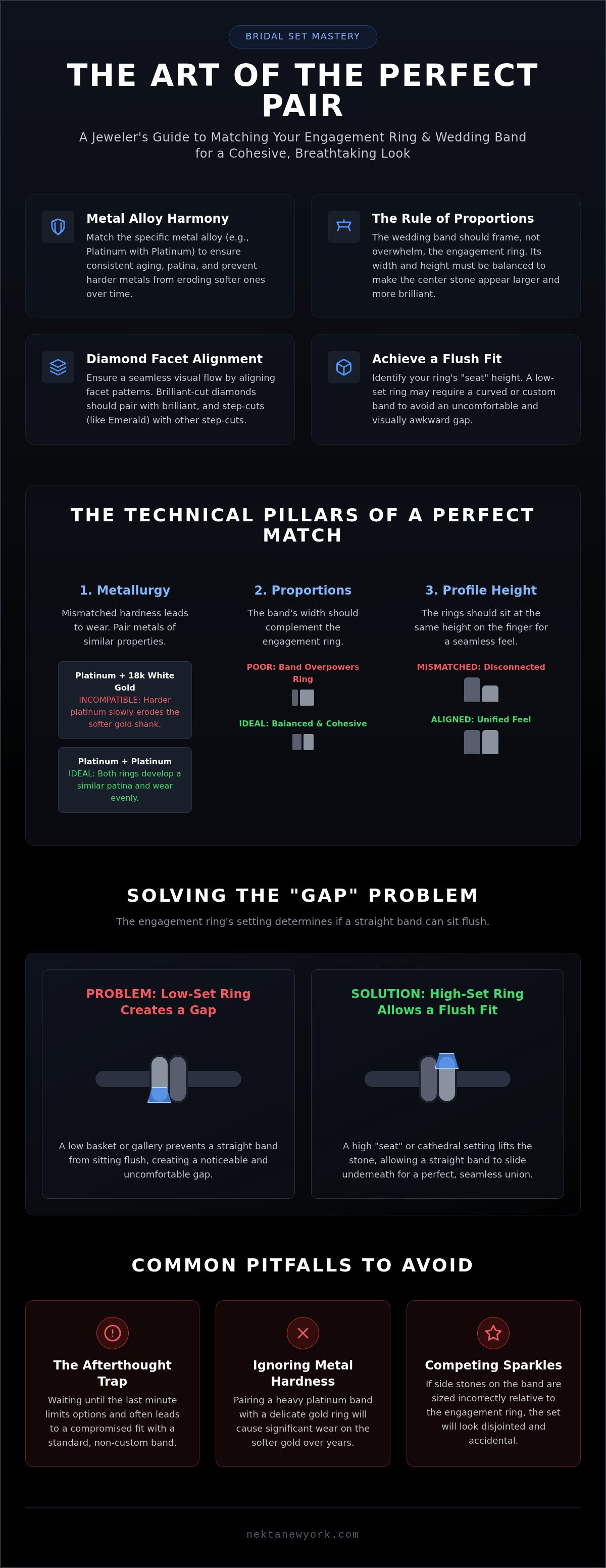
The technical foundation of a bridal set rests on three pillars: metallurgy, proportion, and profile. While a visual match is the goal, the physical interaction between the two rings determines the set's longevity. When crafting a matching wedding band and engagement ring, we look far beyond the surface shine to ensure the pieces don't just look good together, but actually belong together.
Metal alloy choice is critical. Platinum and 18k White Gold may look identical to the untrained eye, but they possess different hardness levels. If you pair a Platinum band with a White Gold engagement ring, the harder Platinum will act like a file; it will slowly erode the Gold shank over years of friction. We also consider the patina. Platinum develops a soft, matte finish over time, while White Gold maintains its bright luster through rhodium plating. Matching the alloy ensures both rings age at the same rate, preserving a unified brilliance that lasts for decades.
Profile height is the next technical hurdle. This refers to how high the ring sits off your finger. If the engagement ring is a high-set solitaire, a thin, low-profile band will look sunken and disconnected. We aim for profile alignment, where the top surfaces of both bands sit at the exact same level. This is often where machine-made rings fail. A hand-forged band, tailored to the specific measurements of your engagement ring, provides a level of precision that ensures the rings feel like a single, solid unit on your hand.
Metal Matching vs. The Mixed Metal Trend of 2026
In 2026, we are seeing a sophisticated shift toward high-contrast pairings. While mixing Platinum and White Gold is a technical mistake due to wear rates, mixing Rose Gold and Platinum is a deliberate style choice that adds modern warmth. Another strong trend is the resurgence of 18k Yellow Gold bands paired with White Gold or Platinum engagement settings. This two-tone aesthetic works best when the metals are clearly distinct rather than slightly off-color, creating a curated, intentional look.
Proportions and Scale: Balancing Band Width
The Rule of Proportions dictates that the band should never compete with the center stone. For high-carat diamonds, such as a 4-carat round brilliant, a tapered shank on the wedding band can make the stone appear even more substantial. Conversely, if you have a simple solitaire, a wider statement band can add necessary weight to the set. Finding this balance requires a professional eye. A consultation in the NYC Diamond District allows you to test these proportions in person, ensuring the scale is perfect for your hand and your diamond.
Matching by Diamond Shape: From Round Brilliant to Elongated Silhouettes
The geometry of your center stone dictates the visual energy of your entire bridal set. It's a dialogue between light and form that requires a deep understanding of facet patterns. When you're selecting a matching wedding band and engagement ring, the most frequent mistake is ignoring the diamond's "cut family." Brilliant-cut stones, such as rounds, cushions, and ovals, create a scattered, high-fire sparkle. Step-cut stones, like emeralds and Asschers, offer long, lean flashes of light. Mixing these two styles without a professional eye often results in visual static; the two rings end up competing for attention rather than working in unison.
To achieve true harmony, you should use side stones in the band to echo the center stone’s unique silhouette. If you have a pear or marquise shape, a band with pointed accents can extend the line of the ring, making your finger appear longer and more elegant. For those with round brilliant cut engagement rings, the focus is almost always on amplifying the existing fire. The goal is to create a seamless ribbon of light where the transition from the engagement ring to the wedding band feels inevitable rather than forced.
Enhancing Sparkle: Pairing Bands with Round and Cushion Cuts
Round Brilliant diamonds are versatile, but they demand a companion that matches their intensity. Pavé bands are the classic choice here because the small, closely set diamonds mirror the circular brilliance of the center stone. For a more modern look, consider a shared-prong setting. This technique uses fewer metal prongs between the diamonds, allowing more light to enter each stone and creating a high-sparkle effect that eliminates the "metal heavy" look. Cushion cuts, with their soft, pillowy corners, benefit from rounded eternity bands. These bands respect the stone's curvature, preventing the set from looking blocky or disjointed.
Geometric Harmony: Bands for Emerald and Radiant Cut Rings
Emerald and Asscher cuts are architectural masterpieces that rely on a "hall of mirrors" effect. To maintain this sophisticated silhouette, a baguette diamond band is often the superior partner. The long, rectangular facets of the baguettes align perfectly with the step-cuts of the center stone, creating a clean, continuous line of light. Radiant cuts present a different challenge. While they share the rectangular shape of an emerald cut, they possess a "crushed ice" brilliance. Because the center stone is so active, a sleek, channel-set band can provide a necessary visual anchor. This grounds the set, allowing the intense sparkle of the radiant cut to remain the focal point while the band provides a modern, polished frame.
Achieving the Perfect Fit: Solving the "Gap" Problem
Achieving a flush fit is where jewelry design meets architectural engineering. For many, the ultimate goal of a matching wedding band and engagement ring is a seamless union where no daylight peeks through the two bands. This starts with identifying the "seat" of your engagement ring. High-set rings, often featuring cathedral shoulders, provide enough clearance for a straight wedding band to slide underneath the center stone's basket. Conversely, low-set rings sit closer to the finger, meaning a standard band will hit the setting and create a noticeable gap. You must decide early if this gap is an aesthetic preference, often called the "Scandi" look, or a design flaw you wish to eliminate.
Once you've identified the setting height, you can select the silhouette that best complements your lifestyle. Beyond the visual appeal, a perfect fit addresses the "spin factor." When rings aren't properly aligned, they tend to rotate independently, causing the center stone to fall toward the pinky while the band stays centered. A custom-fitted set ensures the two pieces move as a singular, ergonomic unit. This level of precision is why we prioritize 3D CAD modeling to map the exact curvature of your engagement ring before a single grain of gold is cast.
Straight vs. Contoured Bands: Which One Suits Your Setting?
Straight bands offer a timeless versatility. They look excellent when worn alone and allow for easy stacking of anniversary bands in the future. However, if you have a large halo or a pear-shaped stone that sits low, a straight band will inevitably create a wide, triangular gap. In these cases, a contoured band is often necessary. These bands are gently curved to "hug" the perimeter of your engagement ring. While they look beautiful as a set, remember that a deeply contoured band may look unusual if worn by itself, so consider your daily habits before choosing this path.
The Notched and Open Band Solution
For settings that require a truly flush fit without a visible curve, the notched band is a masterful solution. We create a small, precise cutout in the wedding band that allows the engagement ring's base to "lock" into place. This creates a secure, seamless unit that won't shift. A more modern 2026 trend is the Open (Cuff) Band. This design features a gap in the band itself, allowing a low-profile center stone to sit directly on the finger while the diamonds of the wedding band frame it on either side. It’s a sophisticated, high-fashion choice for those who want to avoid bulky stacks.
If you're struggling with a setting that feels impossible to pair, you don't have to settle for an awkward fit. Explore our collection of custom wedding bands designed to solve the most complex geometry issues.
Designing Your Eternal Pair: The Mike Nekta New York Custom Advantage
The journey to a perfect matching wedding band and engagement ring often reveals complexities that mass-market retailers simply aren't equipped to handle. While a standard band might look acceptable in a showroom, it rarely accounts for the subtle nuances of a handcrafted engagement setting. Mike Nekta New York's 3rd-generation expertise allows us to identify pairing opportunities that others overlook, ensuring that the two rings don't just sit side-by-side but truly integrate. We view every bridal set as a singular architectural project where the band serves as the final, crowning achievement of the design.
Choosing your band in the heart of the Diamond District NYC provides access to a level of technical mastery that is increasingly rare. Custom bands are particularly essential for unique center stone shapes like Marquise or Heart-shaped rings, which possess aggressive silhouettes that a straight band would only obstruct. By opting for handcrafted luxury over machine-cast, mass-market alternatives, you ensure a level of durability and precision that preserves the integrity of your jewelry for generations. A hand-forged band is denser, stronger, and tailored to the exact micron of your engagement ring's profile.
The Benefits of Custom-Designed Wedding Bands in NYC
When you design a bespoke band at Mike Nekta New York, you gain control over every variable. We utilize loose GIA certified diamonds even for the smallest side stones, ensuring that the color and clarity of your band perfectly match the brilliance of your center stone. This prevents the disjointed look that occurs when a high-quality engagement ring is paired with lower-grade commercial melee. We can also match the exact V-shape or U-shape of your engagement ring’s prongs, creating a mirrored aesthetic across the entire set. Knowing where to buy a proposal ring is only half the journey; the custom band is what completes the visual and emotional promise of the set.
From Vision to Reality: The 2026 Bespoke Experience
Our 2026 bespoke process is designed to be as transparent as it is meticulous. It begins with a detailed consultation, followed by a high-resolution CAD design that maps the interaction between your two rings to ensure a perfect matching wedding band and engagement ring union. We then provide a physical wax model, allowing you to feel the proportions on your hand before the final casting. This is the moment to incorporate personal details, such as hidden gems set inside the shank or intimate engravings. As a final tip, always bring your engagement ring to your fitting. We provide a professional spa treatment for your original ring, so both pieces emerge with a matching, high-carat polish on your wedding day.
Complete Your Bridal Narrative with Expert Precision
Beyond the initial spark of the proposal lies the lasting elegance of a perfectly curated set. We've explored how the technical alignment of metal alloys and the geometric harmony of diamond facets transform two separate rings into a singular, balanced statement. Whether you're navigating the complexities of high-set shanks or seeking to eliminate an unwanted gap with a notched design, your final choice should reflect both technical precision and personal style. Achieving a truly seamless matching wedding band and engagement ring is an art form that requires more than just a retail selection; it demands the eye of a master jeweler.
As a 3rd-Generation Diamond Expert, Mike Nekta New York specializes in creating these eternal pairings using GIA certified diamonds only and traditional hand-forging techniques. Located in the heart of the NYC Diamond District, we ensure that every band is handcrafted to the specific microns of your engagement ring. This commitment to high-end craftsmanship ensures your set remains a flawless symbol of your union for generations to come.
Schedule a Bespoke Design Consultation with Mike Nekta New York today to complete your bridal masterpiece. Let us help you find the perfect frame for your most cherished stone.
Frequently Asked Questions
Does my wedding band have to be the same metal as my engagement ring?
No, you don't have to match metals, but you must consider the hardness of the alloys. While mixing Rose Gold and Platinum is a popular 2026 trend, pairing a Platinum band with an 18k White Gold ring can lead to the harder metal wearing down the softer one over years of friction. If you choose a mixed-metal look, ensure the rings are professionally fitted to minimize direct contact between the shanks.
What is the best wedding band for a round brilliant solitaire?
A pavé or shared-prong diamond band is often the superior choice for a round brilliant solitaire. These settings maximize light entry, mirroring the circular fire of your center stone. For a more minimalist aesthetic, a high-polished plain metal band provides a clean, sophisticated frame that keeps the focus entirely on the diamond's brilliance without adding visual noise.
How do I stop my wedding band and engagement ring from rubbing together?
Ensuring a precise, custom fit is the most effective way to prevent rubbing and metal fatigue. When rings aren't properly aligned, they create constant friction that can thin the shanks or loosen prongs over time. You might consider a notched design or even professionally soldering the rings together into a single unit if you want to eliminate movement and wear entirely.
Is it okay to have a gap between my engagement ring and wedding band?
Yes, a visible gap is a perfectly valid aesthetic choice, often referred to as the "Scandi" look. It allows each ring to maintain its individual identity and prevents the set from feeling too bulky. However, if the gap is unintentional and caused by a low-set diamond, it can feel disjointed. The goal is to ensure the gap looks like a deliberate design element rather than a fitting error.
Should the diamonds in my wedding band match the quality of my engagement ring diamond?
Yes, matching the color and clarity of the side stones to your center stone is critical for a cohesive look. If your engagement ring features a high-grade GIA certified diamond, using lower-quality commercial diamonds in the band will make the set look uneven or "muddy." We recommend using GIA certified melee diamonds to ensure the sparkle remains consistent across the entire set.
Can I wear my wedding band on a different finger if it doesn’t match?
You can certainly wear your wedding band on a different finger or even the opposite hand. This is a common solution for individuals with heirloom engagement rings or exceptionally large center stones that don't accommodate a matching wedding band and engagement ring pairing. It preserves the comfort of your hand while allowing both sentimental pieces to shine independently without competing for space.
What is a "notched" wedding band and when do I need one?
A notched wedding band features a small, custom-carved cutout designed to "lock" around the base of your engagement ring's setting. You need this solution if your center stone is low-set and prevents a standard straight band from sitting flush against the finger. It's a sophisticated way to achieve a gap-free look without resorting to a curved or contoured silhouette that might look unusual when worn alone.
How wide should my wedding band be compared to my engagement ring?
Most brides select a wedding band that is within 0.5mm to 1.0mm of the engagement ring’s shank width. If your engagement ring is 2mm wide, a 2.5mm band provides a balanced, proportional look. However, if you have a high-carat diamond, a thinner, tapered band can make the center stone appear even more substantial by creating a dramatic sense of scale.