
The 2026 Diamond District NYC Buying Guide: Expert Tips from Mike Nekta
What if the secret to finding the perfect engagement ring on 47th Street isn't about having the biggest budget, but knowing which door to walk past? Most visitors arrive in Midtown feeling like they've stepped into a high-stakes arena where the noise of street-level kiosks and aggressive sales tactics can be instantly overwhelming. It's natural to feel a sense of dread about overpaying, which is why a professional diamond district nyc buying guide is the only way to ensure you walk away with a stone that truly matches its grading report.
This guide is designed to strip away that anxiety, offering you the same insider perspective I've honed as a third-generation diamond expert. I'll show you how to bypass the typical tourist traps and secure a world-class, GIA-certified diamond with the confidence of a seasoned collector. We'll explore the nuances of 2026 diamond pricing, the essential questions to ask a custom designer, and why a private appointment at a dedicated studio beats a sidewalk haggle every single time.
Key Takeaways
- Learn to navigate the unique landscape of West 47th Street and why bypassing street-level solicitations is essential for a high-end experience.
- Utilize this diamond district nyc buying guide to master GIA grading standards and discreet sizing methods that ensure your proposal is as perfect as the stone itself.
- Transition from traditional haggling to sophisticated, data-driven negotiation using comparable market listings to secure a fair value.
- Protect your purchase by recognizing red flags like deceptive showroom lighting and ensuring the integrity of your diamond during the setting process.
- Understand why a private appointment with a third-generation expert offers a level of artistry and security that street-level kiosks simply cannot match.
Navigating the NYC Diamond District: Geography and Golden Rules
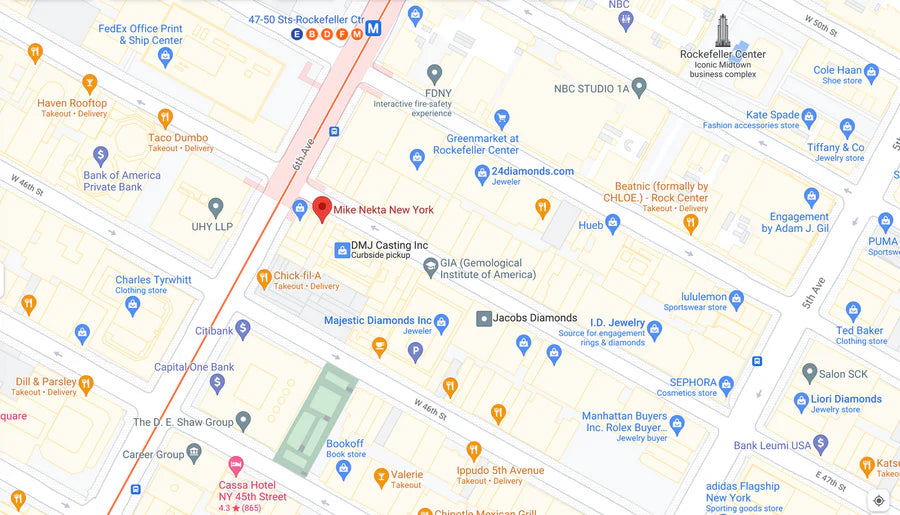
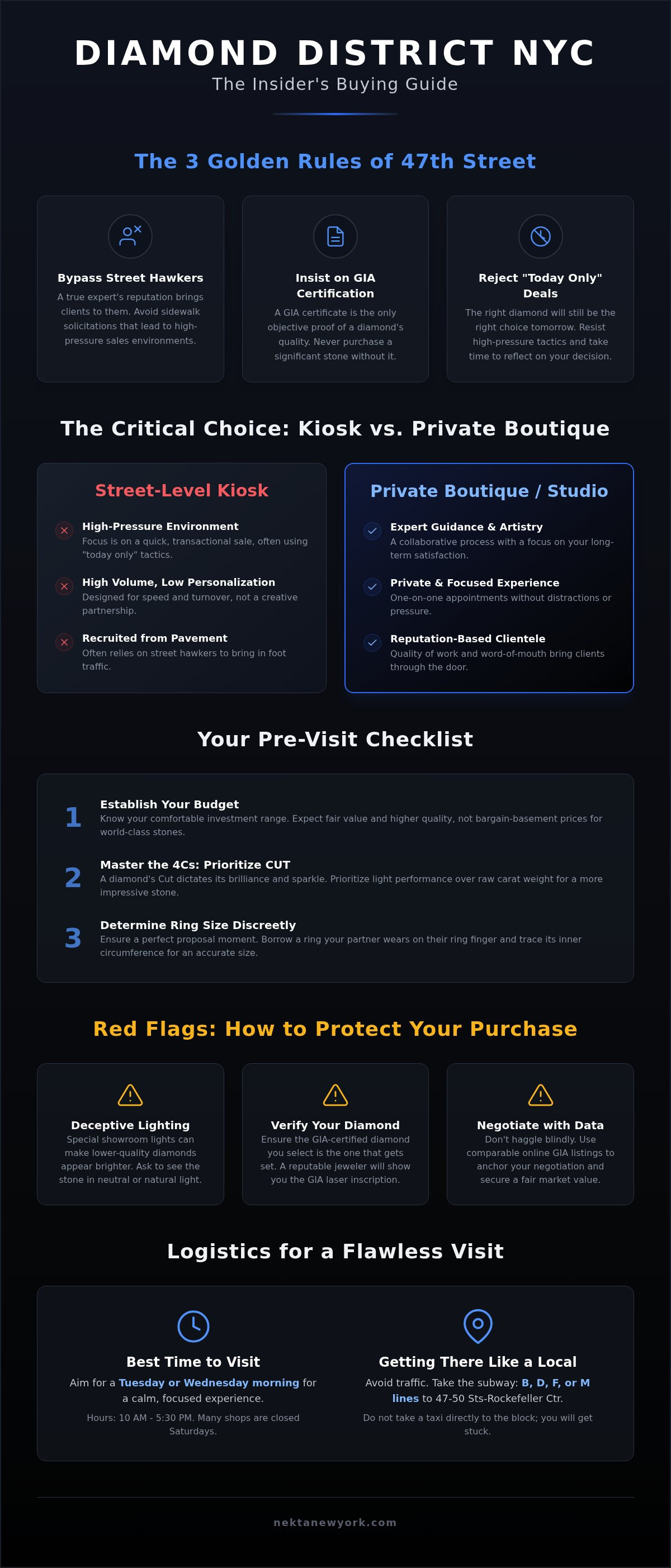
West 47th Street is a single city block that holds the weight of a global industry. Nestled between 5th and 6th Avenues, this stretch of Midtown Manhattan is where a vast majority of the world's most significant gemstones change hands. To the uninitiated, the district is a sensory overload. You'll immediately encounter "Street Hawkers," individuals whose entire job is to pull you into specific jewelry exchanges from the sidewalk. My first piece of advice is simple: keep walking. A true expert doesn't need to recruit clients from the pavement; their reputation and the quality of their work bring people through the door. Stopping for a solicitor often leads to high-pressure environments where the focus is on a quick sale rather than your long-term satisfaction.
Timing your visit is essential for a focused experience. Most establishments operate between 10 AM and 5:30 PM. If you show up at 6 PM, you'll find a ghost town of heavy metal shutters and locked doors. Weekends are particularly tricky. Many traditional dealers observe religious holidays, which means the most reputable shops are often closed on Saturdays and have limited Sunday availability. Beyond the clock, you must understand the "Kiosk vs. Boutique" divide. A kiosk in a shared exchange floor is designed for speed and high-volume turnover. A private boutique, like our third-generation studio, is built for the individual. Where you choose to sit down dictates whether you're treated as a transaction or a partner in a creative process.
Getting to 47th Street Like a Local
New York traffic is legendary for its frustration, and 47th Street is often a bottleneck of armored trucks and delivery vans. Don't take an Uber or taxi directly to the block; you'll likely spend twenty minutes sitting still just three doors down from your destination. Instead, use the subway. The B, D, F, and M lines stop at 47-50 Sts-Rockefeller Ctr, placing you just steps away from the district. For the most serene experience, aim for a Tuesday or Wednesday morning. The mid-week lull allows for a more contemplative environment where you can examine stones without the frantic energy of the lunch hour rush.
The 'Golden Rules' for First-Time Visitors
Walking into this environment without a plan is a mistake. Use this diamond district nyc buying guide to ground your journey in three non-negotiable rules. First, never buy without a GIA certificate in hand. It's the only objective proof of a stone's quality and your only protection against inflated grading. Second, reject the pressure of "today only" deals. A diamond that's right for you today will still be the right choice after a night of reflection. Finally, do your homework. Before you step onto the pavement, research specific round brilliant cut engagement rings so you understand the baseline for light performance and proportions. This preparation transforms you from a target into an informed buyer.
The Diamond District Prep List: GIA Grading and Ring Sizing
Walking onto 47th Street with a vague idea of what you want is a recipe for stress. Preparation is the bridge between being a target for street hawkers and being a respected client. As part of your diamond district nyc buying guide, you must treat the logistical details with as much reverence as the stone itself. This begins with a firm budget. While the "Diamond District Discount" is a real phenomenon due to the proximity of wholesalers, true luxury still commands a premium. Don't expect a world-class stone for a bargain-basement price; instead, expect to get significantly more quality and character for your investment than you would at a traditional mall jeweler.
A designer views the 4Cs (Cut, Color, Clarity, and Carat) differently than a salesperson. While a salesperson might push a higher carat weight to close a deal, a designer focuses on the Cut. The cut determines how the diamond interacts with light, which is what actually catches the eye from across a room. If you prioritize light performance over raw size, you'll end up with a ring that looks far more expensive than its price tag suggests. If you're ready to see how these technical specs translate to real-world brilliance, you can view our curated selection of GIA-certified diamonds to find your perfect starting point.
The Essential Ring Sizing Guide
Accuracy in sizing is the most critical logistical detail of your purchase. A ring that doesn't fit can ruin the momentum of a perfect proposal. I often recommend the Mike Nekta method for determining ring sizes discreetly, which involves borrowing a ring your partner wears on their ring finger and tracing the inner circumference. Keep in mind that wider bands feel tighter on the finger than thin ones, so if you're designing a thick statement piece, you may need to go up a quarter size. Most custom rings can only be resized within a half-size range without compromising the structural integrity of the metal or the security of the side stones.
GIA Certification: Your Only Guarantee
A certificate from the Gemological Institute of America is your only protection against inflated grading. Many shops offer "in-house" appraisals, but these are often biased documents created by the seller to justify a higher price. A GIA report is a strictly unbiased, third-party assessment that protects the buyer's investment by documenting every characteristic of the stone. When reading your report, look closely for fluorescence. While some degrees of fluorescence are harmless, "Strong Blue" can occasionally make a diamond look milky or hazy in natural sunlight. GIA remains the gold standard for diamond verification in 2026 because it provides the most rigorous and consistent grading metrics in the global industry.
Master the Art of Negotiation on 47th Street
Negotiation on 47th Street is an expected part of the culture, but it shouldn't feel like a sidewalk argument. A sophisticated buyer approaches the conversation with data. If you've followed this diamond district nyc buying guide, you already know that price is a reflection of specific GIA metrics. Instead of asking for a random percentage off, present comparable listings for stones with similar cut, clarity, and color. This shifts the dynamic from a contest of wills to a professional evaluation of market value. Reputable dealers respect an informed client who understands that quality has a floor price.
The "cash discount" is a frequent topic of hushed conversation in the District. While some smaller vendors might offer a slight reduction for a wire transfer or cash to avoid credit card processing fees, be cautious. Large transactions in cash can sometimes bypass the formal paperwork that protects you as a consumer. Always prioritize a secure, traceable payment method that ensures your purchase is fully documented and insured. If a price seems impossibly low compared to GIA market averages, the diamond likely suffers from poor cut proportions or "hidden" flaws like cloudiness that don't always show up on a standard report. True value is found in the balance of a fair price and impeccable craftsmanship.
How to Talk to a Diamond Dealer
Your vocabulary signals your level of expertise. Instead of asking "how much is this?", ask to see the diamond under a 10x loupe. Specifically, ask to verify the GIA laser inscription on the girdle. This simple request shows you're looking for authenticity and precision. Inquire about the "make" of the stone, which refers to the overall quality of its proportions and finish. An expert dealer will appreciate your focus on the artistry of the cut rather than just the carat weight. Understanding the origin of the stone can also provide insight into its rarity and ethical journey.
Comparing Quotes Without Losing Your Mind
It's easy to fall victim to "diamond fatigue" after visiting too many exchanges. Limit your search to three or four highly rated shops or private studios. Seeing dozens of stones in one afternoon leads to confusion, making every diamond eventually look the same under the harsh showroom lights. Remember that the cheapest stone is rarely the best value. A slightly more expensive diamond with a superior cut will retain its brilliance for decades, whereas a "bargain" stone often looks dull in natural light. If the rapport with a dealer feels forced or aggressive, trust your instincts and walk away gracefully. The right ring should come from a place of trust, not pressure.
Red Flags and Realities: How to Avoid Common Scams
Protecting your investment is about more than just a good price. It's about ensuring the physical asset matches the documentation. One of the most persistent fears addressed in this diamond district nyc buying guide is the 'Switch'. This occurs when a buyer selects a loose stone, only to have a lower quality diamond substituted during the setting process. To prevent this, you must insist on viewing the diamond's laser inscription through a loupe once the ring is finished. A reputable jeweler will always encourage this verification because they have nothing to hide.
Lighting is another subtle trap. Showroom floors are often bathed in specific LED spectrums designed to mask yellow tints or inclusions. To see the true character of a stone, ask to view it in natural daylight or a neutral lit area of the studio. If a dealer refuses to let you see the diamond away from their specialized lights, consider it a significant warning sign. Similarly, be wary of 'Final Sale' or 'Exchange Only' policies. A confident master craftsman stands behind their work with a transparent return window. If you're looking for a partner who prioritizes transparency over a quick transaction, book a private consultation with Mike Nekta to experience a higher standard of service.
Common Tactics to Watch Out For
Pressure is the enemy of a good decision. If a salesperson claims a diamond will be sold within the hour to another buyer, they're likely using 'Limited Time' tactics to bypass your critical thinking. True luxury takes time. You should also watch for hidden fees for custom work or mounting. These costs should be clearly disclosed upfront. Finally, always verify whether a stone is natural or lab grown. While both have their place, misrepresenting a lab grown diamond as a natural one is a major red flag that signals a lack of professional integrity.
Verification Checklist Before Paying
Before you sign any documents or transfer funds, go through a rigorous physical check. Match the GIA laser inscription on the diamond's girdle directly to the certificate provided. Check the interior of the band for metal hallmarks like 14k, 18k, or Plat to ensure you're getting the gold or platinum you paid for. Your receipt must be more than a total price; it should include the specific GIA report number, the exact carat weight, and a detailed description of the mounting. This document is your legal protection and the basis for your future insurance policy.
Why a Private Boutique Experience Outshines the Street Kiosks
The street-level experience of the NYC Diamond District is often characterized by the frantic energy of shared exchange floors. While these kiosks serve a purpose for wholesale turnover, they rarely offer the quietude necessary for a life-altering decision. Choosing an engagement ring is an intimate act. It requires a setting where you can hear your own thoughts and see the stone without the distraction of a hundred other shoppers. This is where the distinction in this diamond district nyc buying guide becomes clear: the move from the sidewalk to the studio is a move from being a customer to being a patron of the arts.
A third-generation expert like Mike Nekta brings a level of structural intuition that a kiosk salesperson simply hasn't developed. Custom design isn't just about the aesthetics of the metal; it's about the engineering of the ring to ensure the diamond remains secure for decades. When you work with a dedicated designer, you gain a single point of contact for the life of the piece. Whether it's a routine cleaning or a future resizing, your jeweler knows the specific history and craftsmanship of your ring. This transparency turns a complex purchase into a guided education, ensuring you understand every facet of the value you're securing.
The Mike Nekta Design Process
The journey from a loose stone to a finished masterpiece is meticulous. We specialize in the "Big Three" of diamond shapes: Round Brilliant, Oval, and Cushion cuts. The process begins with selecting a loose stone and moves through high-definition 3D CAD modeling to ensure every proportion is mathematically perfect before the final casting. Mike Nekta’s 20 years of expertise in diamond selection ensures that every custom setting is engineered to maximize the specific brilliance and light performance of your chosen stone.
Booking Your Diamond District Appointment
High-carat inventory and rare GIA-certified stones are rarely kept in street-level display cases for security reasons. Booking an appointment ensures that the specific diamonds you wish to view are ready and waiting in a private, secure environment. When you arrive for your consultation, bring inspiration photos and a clear sense of your budget to help us narrow down the perfect options. This preparation allows us to focus entirely on your vision rather than generic inventory. If you're ready to move beyond the noise of the street and create something truly exceptional, schedule your private consultation with Mike Nekta today.
Secure Your Legacy on 47th Street
Success in the heart of Midtown Manhattan requires more than just a discerning eye; it demands a strategy. This diamond district nyc buying guide has provided you with the blueprint to navigate 47th Street with absolute certainty. By prioritizing GIA certified loose diamonds and rejecting the high-pressure tactics of street-level kiosks, you've already separated yourself from the typical tourist pitfalls. You now understand that a world-class ring isn't found by chance, but through data-driven negotiation and a commitment to superior cut quality.
Choosing an engagement ring is the first chapter of a lifelong story. As a third-generation diamond expert specializing in high-carat custom engagement rings, I'm here to ensure that story begins with perfection. You don't have to settle for the chaos of the exchange floor when you can experience the artistry of a private studio. If you're ready to find a stone that reflects your unique standards, Book a Private Consultation with Mike Nekta today. Your journey toward a world-class diamond deserves the attention of a master craftsman. We look forward to welcoming you into our inner circle of excellence.
Frequently Asked Questions
Is the Diamond District in NYC really cheaper than retail stores?
Yes, the concentration of wholesalers on 47th Street often results in lower prices than traditional luxury retail boutiques. This happens because many retailers actually source their inventory from this single block. By purchasing here, you're effectively cutting out the middleman and gaining access to a massive inventory of stones at a competitive value. It's the best way to get more carat weight and quality for your specific budget.
How do I know if a diamond in the Diamond District is GIA certified?
You must ask to see the physical GIA report and then verify the laser inscription on the diamond's girdle using a 10x jeweler's loupe. Every legitimate diamond district nyc buying guide will emphasize that the report number on the paper must match the number etched into the stone. You can also verify the report number on the GIA website's official lookup tool to ensure the document is authentic and current.
Can I get a custom engagement ring made in one day in the Diamond District?
While some kiosks offer "while you wait" settings, a true custom ring usually requires more time for precision casting and finishing. High-quality artistry involves 3D CAD modeling and hand-setting, which typically takes several days to a few weeks. If you're in a rush, we can often set a loose stone into a pre-made mounting within a few hours, but a bespoke design shouldn't be rushed if you want maximum durability.
What is the best way to determine ring sizes for a surprise proposal?
The most reliable method is to borrow a ring your partner currently wears on their ring finger and bring it to your consultation. If that isn't possible, you can trace the inner circumference of the ring on a piece of paper. Remember that the dominant hand is often slightly larger. Try to find a ring they wear on the specific finger where the new ring will sit to ensure the most accurate fit.
Do Diamond District jewelers offer warranties or insurance?
Reputable boutiques provide limited lifetime warranties covering manufacturing defects and routine maintenance like cleaning or prong checking. However, jewelry insurance is a separate product that protects against theft, loss, or accidental damage. We always recommend securing a policy through a specialized provider like Jewelers Mutual immediately after your purchase is finalized. This ensures your investment is protected the moment you leave the studio.
Should I buy a loose diamond first or a complete ring?
Buying a loose diamond is the superior choice for those seeking full transparency and custom design. It allows you to inspect the stone's characteristics without the metal hiding potential flaws or inclusions. Once the stone is selected, you can work with a designer to create a mounting that perfectly complements its unique proportions. This process ensures the diamond's light performance is the primary focus of the finished ring.
How do I avoid street scammers on 47th Street?
The most effective way to avoid scams is to ignore anyone on the sidewalk who tries to lure you into a building. These street hawkers are paid to find targets for specific kiosks and often lead you into high-pressure sales environments. Always have a specific destination or a private appointment in mind before you arrive on the block. This keeps you in control of your shopping experience and avoids unnecessary stress.
What should I do if a jeweler refuses to let me see the GIA inscription?
You should leave the shop immediately if a jeweler makes excuses about why you can't view the laser inscription. There's no technical or professional reason to deny a client the right to verify their stone. This refusal is a significant red flag that suggests the stone might not match the certificate or that it's been misrepresented. Trust is the most important part of this transaction; if it's broken, walk away.