
Radiant Cut Engagement Rings: The 2026 Guide to Brilliance and Style
You shouldn't have to compromise between the sophisticated silhouette of an emerald cut and the legendary fire of a round brilliant. Most couples seeking radiant cut engagement rings are chasing that rare hybrid of structural elegance and maximalist sparkle. It's a choice that reflects a keen eye for architectural beauty. However, the search often leads to frustration when you're faced with technical terms like "crushed ice" or the fear of choosing a ratio that looks unappealingly stubby on the hand.
We understand that selecting a diamond is a landmark decision that requires both an emotional connection and professional precision. This guide empowers you to master the nuances of the 70-facet radiant structure so you can find a stone that balances brilliance with structural integrity. You'll learn how to identify a high-quality GIA certified stone that avoids common "dead spots" seen in lesser cuts. We'll also cover the precise length-to-width ratios that flatter the finger and the specific settings that protect those signature trimmed corners for generations to come.
Key Takeaways
- Master the "scintillating modified brilliant" silhouette to find a stone that pairs the refined frame of an emerald cut with the intense fire of a round diamond.
- Decode the technical 70-facet anatomy that allows these diamonds to outperform standard cuts in both light return and their ability to conceal internal inclusions.
- Navigate the selection process for radiant cut engagement rings by identifying the ideal 1.25 to 1.35 length-to-width ratio for a flattering, elongated look.
- Distinguish between the "explosion of sparkle" found in radiants and the "hall of mirrors" effect of emerald cuts to ensure your choice aligns with your personal aesthetic.
- Learn how bespoke settings and hidden halos are engineered to safeguard the diamond’s unique corners while significantly maximizing its visual presence.
What is a Radiant Cut Engagement Ring? Defining the Hybrid Silhouette
The radiant cut represents a pivotal moment in the history of fine jewelry. It isn't merely a shape; it's a technical masterpiece classified by gemologists as a "scintillating modified brilliant." Before its invention in 1977 by Henry Grossbard, diamond enthusiasts were often forced to choose between the understated, hall-of-mirrors elegance of step-cuts and the intense sparkle of round stones. Grossbard, a master of Diamond cutting, refused to accept this compromise. He engineered a way to apply the complex faceting patterns of a round brilliant to a rectangular silhouette, creating the industry's first true hybrid.
Choosing radiant cut engagement rings means embracing a design that prioritizes both aesthetic drama and structural resilience. The most striking feature of this cut is its trimmed, or "blocked," corners. These aren't just for show. While the sharp points of a princess cut are notoriously vulnerable to chipping, the radiant's beveled edges offer a level of durability that's essential for a piece intended to be worn every day for a lifetime. This fusion of sophisticated geometry and practical engineering defines the Mike Nekta approach to curation, focusing on stones that offer maximum security without sacrificing an ounce of fire.
The Geometry of the Radiant Diamond
The silhouette of a radiant diamond is a study in balance. Whether you prefer a perfectly symmetrical square or a more traditional rectangular outline, the blocked corners remain the constant. This geometry creates a "structured brilliance" that feels more intentional and modern than the softer edges of a cushion cut. For the 2026 bride, this style offers a sense of order and strength. It's a diamond for someone who appreciates the precision of an architect but demands the high-octane fire of a performer. The result is a stone that looks remarkably stable in its setting while performing with restless energy under any light source.
Why Radiant Cuts are Trending in 2026
In 2026, we're seeing a decisive shift toward elongated silhouettes. According to a 2026 study by The Knot, radiant cuts now account for 6% of engagement ring diamonds, reflecting a growing appreciation for their unique light performance. These shapes are prized for their ability to create a flattering, lengthening effect on the finger, a visual trick that adds grace to any hand. This surge in popularity for radiant cut engagement rings is also driven by their versatility. They provide a "big look" because their brilliance extends all the way to the corners, unlike other rectangular cuts that can have "dead spots." While minimalist trends dominated the past decade, today's couples are reclaiming maximalist brilliance, choosing the radiant for its unapologetic sparkle and high-end presence.
The Anatomy of Sparkle: Understanding Radiant Cut Faceting
The technical brilliance of radiant cut engagement rings is rooted in a specific number: 70. This facet count is significantly higher than the 58 found in a traditional round brilliant. These extra facets are strategically placed on the pavilion and crown to break up light into thousands of tiny reflections. This isn't just about brightness; it's about dispersion. Dispersion is the diamond's ability to split white light into a rainbow of colors, and the radiant's unique architecture is specifically tuned to amplify this "fire" effect. When you see a radiant stone, you aren't just seeing light; you're seeing a performance of technical precision.
This complex internal structure provides a significant advantage when it comes to clarity. While step-cuts like the emerald or Asscher are unforgiving, revealing every minor inclusion, the radiant’s faceting acts as a form of visual camouflage. The intense scintillation can make a stone with a lower clarity grade appear eye-clean, offering better value for your investment. This same principle is why radiants are the preferred choice for fancy colored diamonds. The way light bounces within the 70-facet structure deepens the color saturation, making yellows, pinks, and blues appear more vivid. For those starting their search, GIA's guide to selecting a radiant cut diamond is an excellent resource for understanding these professional standards.
Crushed Ice vs. Long Mains: Two Distinct Personalities
Radiant diamonds generally fall into two visual categories. The "crushed ice" look is characterized by a sea of small, rapid-fire sparkles. It’s a high-energy personality that looks like a thousand tiny mirrors reflecting at once. Conversely, some radiants feature "long mains," which produce broader, more rhythmic flashes of light reminiscent of a round brilliant. Neither is objectively better, but they offer very different moods on the hand. Your choice should reflect whether you prefer a modern, twinkling effect or a more classic, bold flash of light.
Managing the Bow-Tie Effect
The bow-tie effect is a dark, butterfly-shaped shadow that appears across the center of the stone when light passes through the diamond rather than reflecting back to the eye. It is essentially a result of light leakage or improper facet angles. While many mass-market stones suffer from prominent shadows, our selection process is ruthless. We prioritize stones that maintain consistent brilliance across the entire table. If you want to see how a perfectly balanced stone performs, you can browse our curated radiant cut engagement rings to find a diamond that remains bright from every angle.
Radiant vs. Emerald and Cushion: Which Elite Cut is Yours?
Selecting a diamond silhouette is often the most challenging stage of the design process. While they may share a similar rectangular footprint, the personality of a radiant diamond is diametrically opposed to its closest rivals. If you're comparing radiant cut engagement rings to other elongated styles, you aren't just choosing a shape; you're choosing how your ring interacts with light. The radiant is the undisputed performance king of rectangular diamonds, engineered specifically to deliver more brilliance than almost any other four-sided cut.
Durability also sets this stone apart. While the sharp, 90-degree corners of a princess cut are prone to chipping if struck, the radiant's beveled edges are a masterclass in protective engineering. These trimmed corners make the stone significantly safer for daily wear while maintaining the clean, geometric lines that modern brides crave. It's a rare instance where the most brilliant option is also one of the most resilient.
The Structural Showdown: Radiant vs. Emerald
The emerald cut is often described as a "Hall of Mirrors." It relies on long, step-cut facets that prioritize clarity and a calm, understated luster. Because these facets are so open, the emerald cut is incredibly honest; it demands a high clarity grade, typically VVS1 or VVS2, because there's nowhere for inclusions to hide. Radiant cut engagement rings offer an "Explosion of Sparkle" instead. Their modified brilliant faceting creates a restless energy that masks imperfections and allows for more flexibility with clarity grades. Choose the emerald for a vintage, quiet luxury feel, but opt for the radiant if you want high-impact fire that commands attention from across the room.
The Silhouette Battle: Radiant vs. Cushion
When you compare the radiant to an elongated cushion cut, the choice comes down to architectural precision versus vintage romanticism. The cushion cut is defined by its soft, pillowy edges and rounded corners, giving it a gentle, classic aesthetic. The radiant, however, maintains straight, clean edges that feel decidedly modern. This structural difference also affects how your ring sits against a wedding band. The straight sides of a radiant allow for a much tighter, more seamless "flush fit" with most bands. Additionally, radiants often boast a larger "face-up" size. Because their brilliance extends all the way to those beveled corners, they frequently appear larger than a cushion cut of the exact same carat weight.

Selection Guide: Finding Your Perfect GIA Certified Radiant
Finding the right stone among the sea of available radiant cut engagement rings requires a disciplined approach to technical specifications. While the emotional connection to a diamond is vital, the technical "engine" of the stone determines whether it will retain its fire for a lifetime. Every stone in our collection undergoes a rigorous vetting process that begins with GIA certification, ensuring that the diamond you choose meets the highest international standards for quality and ethical sourcing.
Your first decision is the length-to-width ratio, which defines the diamond’s footprint on the hand. For the classic elongated look that is trending in 2026, the "golden range" is between 1.25 and 1.35. A ratio below 1.05 results in a square radiant, while anything above 1.40 can look overly stretched and may suffer from light leakage. When evaluating loose GIA certified diamonds, I always tell my clients to prioritize "Cut" above all else. A radiant with a "Good" or "Very Good" polish and symmetry will outperform a stone with higher color or clarity but a poor cut.
The final step involves choosing a metal that complements the stone. Platinum or white gold provides a crisp, modern backdrop that enhances the icy brilliance of D-to-F color stones. However, yellow gold is making a significant comeback in 2026. Because radiant cuts tend to hold onto color, a yellow gold setting can actually make a slightly warmer diamond (in the I-to-J range) look intentional and rich rather than tinted.
The 'Hidden Carat' and Depth Considerations
One of the most common pitfalls when buying radiants is ignoring the depth percentage. Radiant diamonds are naturally cut deeper than many other shapes. This means they often carry a "hidden carat" in the pavilion, where the weight is tucked away beneath the setting. To avoid paying for weight you can't see, look for a depth percentage between 65% and 71%. A stone that is too deep will look smaller than its carat weight suggests, while a stone that is too shallow will lose its signature scintillation and look "glassy."
Curation Secrets: Clarity and Color for Radiants
Because of the intense 70-facet faceting pattern we discussed earlier, you have more flexibility with clarity than you might think. You can often drop to an SI1 or even a high-quality SI2 grade without seeing any visible inclusions. This is a sharp contrast to round brilliant cut engagement rings, where inclusions are more easily spotted. However, be mindful of color. The radiant cut concentrates color more than a round diamond. If you are sensitive to warmth, stay within the G or H range. If you prefer a larger stone, dropping to an "I" color allows you to maximize your budget for a higher carat weight without sacrificing the high-end look.
If you're ready to see these technical principles in practice, you can explore our collection of hand-selected diamonds to find a stone that perfectly balances fire, size, and value.
The Mike Nekta Legacy: Custom Settings for the Radiant Cut
A diamond is only as breathtaking as the architecture that holds it. While the technical selection of the stone is paramount, the final artistry lies in the setting. At our Manhattan boutique, we approach radiant cut engagement rings with the precision of a third-generation legacy. We don't just place a diamond in a mount; we engineer a sanctuary for the stone. This process is vital because the radiant's signature beveled corners require specific prong placement to ensure both security and visual harmony. A poorly designed setting can obscure the diamond's fire or leave its unique geometry vulnerable to the rigors of daily wear.
One of the most effective ways to elevate this cut is through a hidden halo. Unlike a traditional halo that sits around the table, a hidden halo is tucked beneath the center stone. It acts as a secret engine of brilliance, reflecting light back up into the pavilion to enhance the face-up sparkle. For those seeking more drama, pairing the radiant with side stones creates a truly bespoke silhouette. We often recommend Trapezoids or Cadillac-cut side stones to mirror the radiant's angular lines. If you prefer a more classic look, tapered baguettes provide a sleek, sophisticated transition from the center stone to the band.
Minimalist Solitaire vs. Elaborate Halo
The choice of setting defines the ring’s personality. A minimalist solitaire with a thin pavé band is the ultimate choice for the purist. It strips away distractions, allowing the 70-facet brilliance of the radiant to take center stage. If you are exploring various designs, you can discover Javda Jewelry for their extensive range of solitaire, halo, and vintage collections. Conversely, an elaborate halo offers what we call the "Power Look." It expands the visual footprint of the diamond, making a one-carat stone appear significantly more substantial. Regardless of the style, we exclusively use Platinum or 18k Gold. These metals provide the density and durability required to safeguard your investment while maintaining a high-end, lustrous finish that won't fade over time.
Designing for the Future: Heirloom Quality Construction
We build rings for high-activity lifestyles. Your jewelry shouldn't be confined to a safe; it should be part of your story. Our custom-built settings prioritize structural integrity, ensuring that prongs remain tight and bands remain true even after decades of wear. This commitment to craftsmanship is why every piece we create is designed to be an heirloom. Beyond the physical construction, we provide the security of a GIA appraisal, documenting the value and quality of your stone for long-term investment protection.
Choosing the perfect ring is a deeply personal journey that benefits from expert guidance. We invite you to visit our NYC boutique for a private consultation. Together, we can explore our curated selection of radiant cut engagement rings and design a piece that reflects your unique aesthetic and the enduring nature of your commitment.
Secure Your Legacy in Scintillating Light
Choosing between the architectural elegance of a rectangular silhouette and the high-octane fire of a brilliant cut no longer requires a compromise. By mastering the 70-facet anatomy and identifying the ideal 1.25 to 1.35 length-to-width ratio, you've gained the technical insight needed to select a stone that stands apart. Remember that the true beauty of radiant cut engagement rings is unlocked through precision curation and a setting specifically engineered to protect unique geometry for generations.
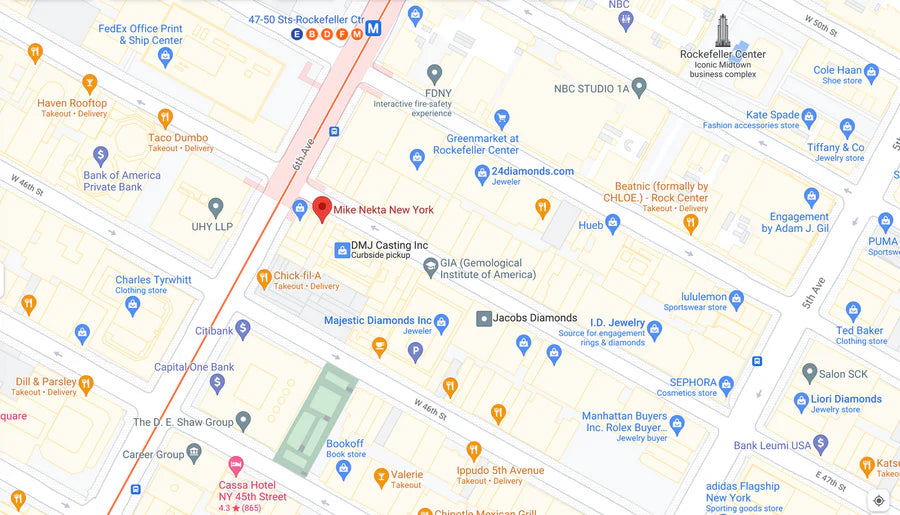
At our boutique in the heart of Manhattan's Diamond District, we combine 3rd generation expertise with a relentless commitment to quality. Every stone in our collection is a hand-selected, GIA certified masterpiece designed to offer maximum scintillation without the common pitfalls of mass-market cuts. Whether you're drawn to a minimalist solitaire or an elaborate custom design, your ring should be as enduring as the commitment it represents.
We invite you to Explore Mike Nekta's Curated Collection of Radiant Cut Engagement Rings and discover the difference that professional artistry makes. Your perfect diamond is waiting to be discovered.
Frequently Asked Questions
Do radiant cut diamonds look bigger than round diamonds?
Yes, radiant diamonds often appear larger than round brilliants of the same carat weight. Because of their elongated silhouette and large table surface, they occupy more space on the finger. The diagonal measurement of a radiant is typically greater than the diameter of a round stone; this creates a more significant visual footprint for your investment.
Is a radiant cut more expensive than an emerald cut?
Radiant cuts are generally more cost-effective than emerald cuts of equivalent quality. While the raw material costs are similar, the radiant's 70-facet structure is much better at concealing internal inclusions. This allows you to select a slightly lower clarity grade while maintaining an eye-clean appearance; whereas emerald cuts usually require a premium VVS clarity to look flawless.
What is the best length-to-width ratio for a radiant cut engagement ring?
The "golden range" for most collectors is between 1.25 and 1.35. This specific ratio provides the elegant, finger-lengthening effect that makes radiant cut engagement rings so desirable in 2026. If you prefer a more compact look, a ratio of 1.15 to 1.20 offers a sturdy, balanced aesthetic that still feels distinct from a square cut.
Are radiant cut diamonds good for active lifestyles?
They're an excellent choice for those with high-activity lifestyles. Unlike the princess cut, which has sharp, vulnerable points, the radiant features beveled, blocked corners. This architectural choice significantly reduces the risk of chipping or snagging on clothing. It's a durable design that doesn't sacrifice any of the "big look" brilliance you expect from a luxury diamond.
Does a radiant cut diamond have a bow-tie effect?
It can, though it's less common than in oval or pear shapes. The bow-tie is a dark shadow across the center caused by improper facet angles. In our NYC boutique, we use a rigorous curation process to filter out stones with prominent shadows. A well-cut radiant should show consistent, restless sparkle across its entire surface without any "dead spots."
Which setting is best for a radiant cut diamond?
A four-prong setting specifically designed to grip the beveled corners is the professional standard for security. To maximize light performance, many 2026 brides are opting for a hidden halo. This adds a layer of fire beneath the stone without distracting from the clean, straight edges of the diamond's silhouette. Platinum is the preferred metal for its strength and neutral color.
Can a radiant cut diamond be square?
Yes, square radiants are a sophisticated and durable alternative to the traditional princess cut. A ratio of 1.00 to 1.05 will give you a perfectly symmetrical look. You'll enjoy the same intense scintillation as the elongated version but in a more compact, architectural frame that fits beautifully in both solitaire and three-stone arrangements.
Why is the radiant cut popular for colored diamonds?
The 70-facet structure is specifically engineered to intensify color saturation. Because light bounces more frequently within the pavilion of a radiant, it deepens the visual hue of fancy colored diamonds. This is why you'll see the world's finest yellow, pink, and blue diamonds finished in this cut; it coaxes the maximum vividness out of the stone's natural tint.