
Oval vs. Pear Engagement Ring: The Connoisseur’s Guide to Elongated Brilliance
A higher carat weight doesn't always equate to a more impressive presence on the hand. You're likely seeking a silhouette that offers both a commanding face-up size and a sophisticated, lengthening effect on the finger. It's a delicate balance between classic prestige and a modern, individual statement that reflects your personal style and discerning taste.
Deciding between an oval vs pear engagement ring requires more than just an eye for beauty; it demands the technical insight of a master jeweler. We'll show you how to navigate the specific challenges of elongated cuts, from neutralizing the dreaded bow-tie shadow to securing the vulnerable tip of a pear shape with a custom-crafted setting. You'll discover why ovals have surged to a 33% market share and how the directional flair of a pear offers a more distinctive look. We'll also provide expert confirmation on which cut maximizes your budget, ensuring you find a GIA-certified stone that radiates brilliance from every angle.
Key Takeaways
- Master the art of "optical elongation" to choose a diamond shape that creates the illusion of longer, more slender fingers.
- Gain the expert knowledge needed to identify and avoid the "bow-tie effect," ensuring your stone retains maximum brilliance across its entire surface.
- Compare the aesthetic impact of an oval vs pear engagement ring to find the perfect balance between classic symmetry and a bold, directional statement.
- Learn the technical requirements for protecting fancy cuts, including the necessity of V-prongs for pear shapes and how metal choice influences diamond color.
- Understand the "Nekta selection process" and why physical curation by a diamond expert is vital for securing a top-tier GIA-certified stone.
The Elongated Allure: Why Oval and Pear are the Modern Choice
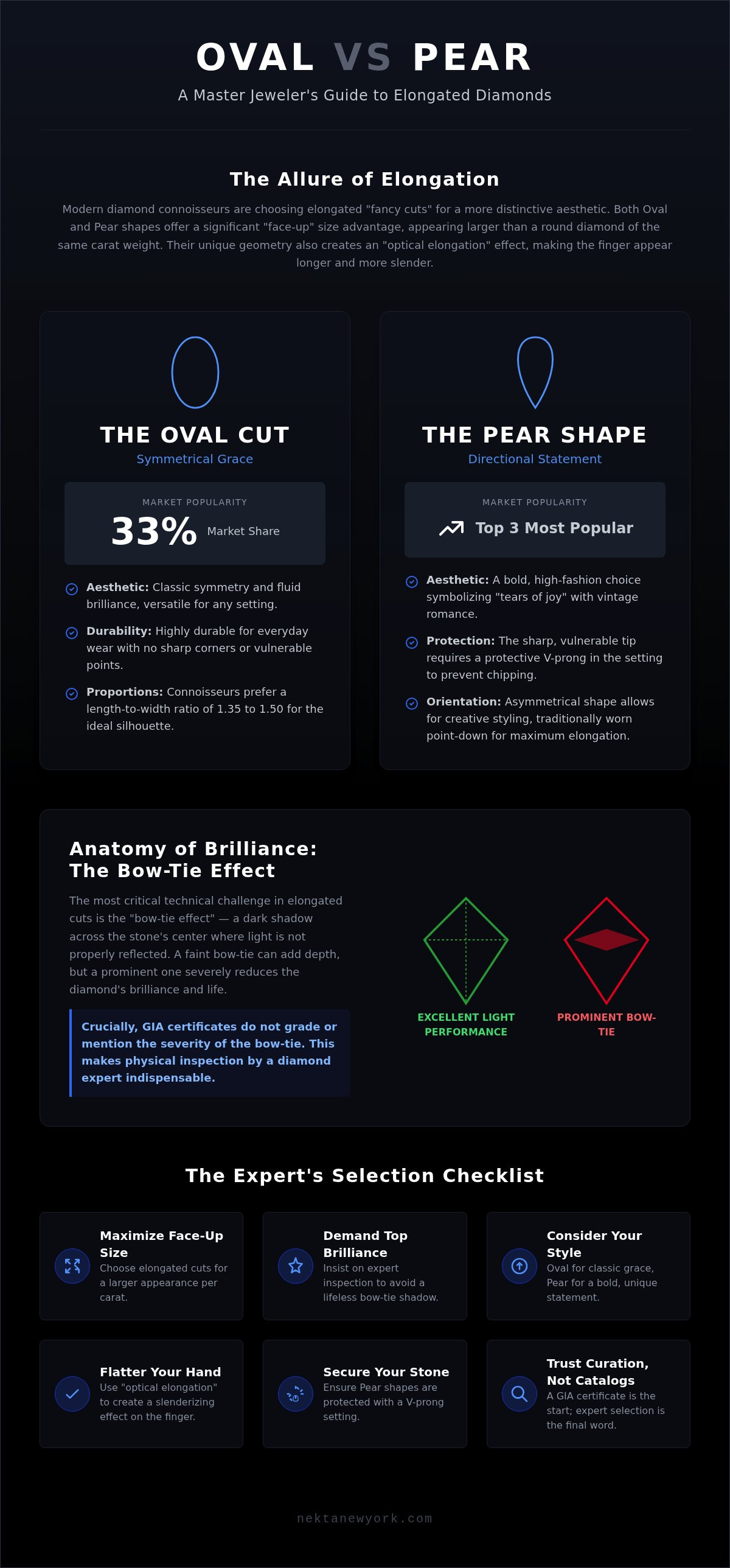
The landscape of luxury bridal jewelry has shifted significantly. While the round brilliant remains a staple, sophisticated brides in 2026 are increasingly drawn to "fancy cuts" that offer a more tailored, individual aesthetic. Choosing between an oval vs pear engagement ring is a decision rooted in both geometry and grace. Unlike rounds, which concentrate their weight in depth, these elongated shapes prioritize surface area. This "face-up" size advantage means your diamond appears larger than a round stone of the identical carat weight, providing exceptional value without compromising on prestige.
Beyond the physical dimensions, these silhouettes possess a unique "optical elongation" effect. By drawing the eye vertically along the finger, they create a slenderizing appearance that flatters every hand type. This isn't just a matter of personal preference; it's a gemological strategy. The evolution of the Diamond cut has allowed modern artisans to refine these shapes, ensuring they capture light with the same intensity as their circular counterparts while offering a much more distinctive profile. Market data from 2026 highlights this shift, with ovals now commanding 33% of the market and pear shapes rising to third place in overall popularity.
The Symmetrical Grace of the Oval Cut
The oval cut is the ideal choice for the bride who appreciates the fire of a round diamond but desires a more elongated, elegant frame. Modern oval faceting was perfected in the late 1950s, creating a stone that's incredibly versatile. It doesn't have sharp corners or points, making it durable for everyday wear. It feels both heritage-inspired and contemporary. For those weighing the oval vs pear engagement ring debate, the oval offers a sense of dependable symmetry and fluid brilliance that fits seamlessly into any setting style, from minimalist solitaires to intricate vintage halos.
The Directional Statement of the Pear Shape
If the oval represents harmony, the pear shape represents a bold, directional statement. Often referred to as a teardrop, this silhouette is a hybrid that marries the soft curves of a round cut with the dramatic point of a marquise. It's a shape that symbolizes "tears of joy" and has long been associated with vintage romance and high-fashion individuality. The pear is the ultimate choice for a woman who wants her ring to be a conversation piece. Its asymmetrical nature allows for creative orientation, though it's most traditionally worn with the point facing the fingernail to maximize the lengthening effect on the hand.
Anatomy of Brilliance: Faceting and the Infamous Bow-Tie Effect
Brilliance isn't accidental. It's the result of precise geometry. When evaluating an oval vs pear engagement ring, the most critical technical hurdle is the "bow-tie effect." This dark, bow-tie-shaped shadow appears across the center of the stone when light isn't reflected back to the eye. It's a common trait in elongated cuts, but its severity varies wildly. A faint shadow adds character and depth; a prominent one kills the diamond's life. GIA certificates won't explicitly mention the bow-tie, which is why a 3rd generation expert's eye is indispensable. Mike Nekta New York personally inspects every stone to ensure light performance isn't compromised by poor facet alignment.
Facet patterns also dictate the visual "texture" of your diamond. You'll often hear terms like "crushed ice" versus "crisp flashes." Crushed ice refers to a multitude of tiny, shimmering reflections, often found in stones with deeper pavilions. Conversely, stones with larger, more distinct facets produce bold flashes of light. Understanding these nuances is a key part of any guide to diamond shapes. While GIA certification provides the baseline for quality, the true "fire" of a fancy cut is found in the proportions that the certificate doesn't fully capture.
Mastering the Oval Proportions
The perfect oval silhouette depends on its length-to-width (L/W) ratio. Most connoisseurs prefer a ratio between 1.35 and 1.50. If the stone is too shallow, it suffers from "windowing," where you see right through the diamond. If it's too deep, the center turns dark. At Mike Nekta New York, we look for stones that avoid "mushy" facets, where the edges of the reflections look blurred rather than sharp. You can explore our curated selection of GIA certified diamonds to see how these proportions translate into real-world brilliance.
The Technical Complexity of a Pear Cut
When comparing the technical merits of an oval vs pear engagement ring, the pear presents a unique set of challenges. The "wings" (the sides) should have a gentle, graceful curve. If they're too flat, the stone looks like a triangle; if they're too bulky, it looks heavy. Another challenge is color consistency. Diamonds tend to trap color at their narrowest points, meaning the tip of a pear might appear more yellow than its rounded "belly." Achieving perfect symmetry in an asymmetrical shape requires a master's touch to ensure the point aligns perfectly with the center of the rounded end.
Symmetry vs. Silhouette: Comparing Hand Aesthetics
The visual impact of a diamond extends far beyond its weight. When choosing between an oval vs pear engagement ring, you're essentially choosing how the stone interacts with the architecture of your hand. Elongated cuts are celebrated for their ability to slenderize the finger, but they achieve this through different optical strategies. The oval relies on a balanced, centered weight that provides a "calmer" aesthetic. In contrast, the pear shape is inherently directional; its asymmetrical point draws the eye toward the nail, creating a more dramatic focal point that feels avant-garde and high-fashion.
Hand shape plays a pivotal role in this decision. For those with shorter fingers or wider knuckles, the continuous curve of an oval can soften the hand's appearance without adding unnecessary bulk. The pear shape, however, offers a sharper "V" silhouette that can provide a more aggressive lengthening effect. The "Point Up" versus "Point Down" debate is a matter of both tradition and physics. While wearing the point toward the fingernail is the standard for maximizing length, some modern brides prefer the point facing the palm, which can sometimes feel more balanced in a heavy-set band.
The Oval: The Safe yet Sophisticated Bet
Ovals are often considered the most versatile of the fancy shapes. They're a "safe" bet only in the sense that they're universally flattering. Whether your fingers are long and thin or short and petite, the oval's lack of sharp corners ensures it never looks "stumpy" or out of place. This shape is also a favorite for those who enjoy a curated, layered look. Many of our clients find that ovals pair beautifully when stacked with emerald cut engagement rings or eternity bands, creating a sophisticated play on light and geometry. Regarding longevity, the oval's rise to a 33% market share in 2026 isn't a passing fad. Its silhouette is rooted in classical proportions that will remain as relevant in 2046 as they are today.
The Pear: For the Bold and Individualistic
The pear shape is for the woman who isn't afraid to stand out. Its asymmetrical nature makes it a statement piece by default. However, this individuality comes with practical lifestyle considerations that generic guides often overlook. The pointed tip of a pear, while stunning, can be prone to snagging on delicate fabrics, lace, or winter gloves. This "snag factor" is why the setting's quality is paramount; a custom-crafted V-prong is essential to protect the stone and the wearer. From a styling perspective, the pear is incredibly flexible. It can anchor an Art Deco vintage design with milgrain details or sit in an ultra-modern, east-west minimalist setting that defies convention. It's a choice that reflects a spirit of independence and a refusal to follow the crowd.
Setting the Stage: Protecting and Enhancing Your Choice
A diamond is only as spectacular as the architecture supporting it. When weighing an oval vs pear engagement ring, you must consider how the metal and prong structure will influence both the stone's color and its long-term integrity. Platinum remains the gold standard for security and maintaining a bright, colorless appearance, especially for higher color grades. Conversely, 18k yellow gold is the most on-trend choice for 2026. It offers a warm, metropolitan elegance that can actually mask slight warmth in a fancy cut stone, allowing you to prioritize size or clarity within your budget.
Enhancing the silhouette without overshadowing it requires a master's touch. Traditional halos can sometimes blur the distinct outline of a pear or oval, making the shape look muddy from a distance. This is why hidden halos have become the preferred choice for the modern connoisseur. They provide a secret layer of sparkle visible from the profile while leaving the top-down view clean and sharp. This ensures the unique elongated silhouette remains the undisputed star of the show.
Matching a wedding band to these shapes presents a unique engineering puzzle. Because these stones extend further along the finger, a standard straight band won't sit flush against the engagement ring. You'll likely need a contoured or chevron-style band that's designed to embrace the curve of the oval or the point of the pear. This creates a cohesive, stacked look that feels intentional rather than forced.
For couples who want to ensure their wedding set is flawlessly integrated, Livia Diamonds provides specialized expertise in designing custom bands that perfectly contour to the unique silhouettes of pear and oval diamonds.
Top Settings for Oval Engagement Rings
For ovals, a thin pavé band is a classic strategy to make the center stone appear even larger. A 4-prong setting allows for maximum light entry, while 6 prongs offer superior security and can make the stone's outline appear slightly more rounded. If you're seeking a truly contemporary vibe, the East-West setting turns the oval 90 degrees. This horizontal orientation creates a bold look that defies tradition while still maintaining the stone's inherent grace.
Engineering the Perfect Pear Setting
The pear shape requires specialized engineering to ensure it sits deep in the basket, preventing it from tilting or rocking. The V-prong is a non-negotiable safety feature; it wraps around the fragile point to prevent chipping and snagging. While a 3-prong design offers a minimalist look, a 5-prong structure provides the asymmetrical stability required for larger, high-carat stones. At Mike Nekta New York, we specialize in bespoke settings that follow the unique, hand-selected curve of your specific diamond. Consult with our master jewelers at Mike Nekta New York today to design your custom setting.
The Mike Nekta New York Standard: Curation Over Catalog
The decision between an oval vs pear engagement ring is too significant to be left to a digital spreadsheet. While online retailers offer vast catalogs, they lack the "eyes-on" curation that defines a true luxury experience. Mike Nekta New York operates on the principle that a diamond’s beauty exists in the nuances that a lab report cannot quantify. In our Manhattan Diamond District studio, we bridge the gap between technical data and visual poetry, ensuring that your selection possesses the rare fire required for a bespoke masterpiece. Buying a fancy cut stone without professional physical inspection is a gamble we don't ask our clients to take.
The Mike Nekta New York curation process is an exercise in extreme selectivity. We filter the top 1% of GIA certified loose diamonds, focusing on light performance and character rather than just the 4Cs. Investing in our craftsmanship means you aren't just purchasing a stone; you're commissioning a work of art. From the initial hand-drawn sketch to the final 3D model and hand-set mounting, every step is executed with a level of precision that honors both the diamond and the wearer. We prioritize the "life" of the stone, ensuring it radiates brilliance from across the room.
Beyond the GIA Certificate
A GIA report is a vital document, but it doesn't tell the whole story. It fails to mention "milkiness," "oiliness," or the specific luster that gives a diamond its soul. Mike Nekta New York rejects approximately 90% of the ovals and pears he inspects because they don't meet our internal standards for brilliance. This rigorous filtering ensures that your diamond remains vibrant in every lighting environment, not just under the controlled lamps of a laboratory. You're benefiting from three generations of expertise that knows exactly what to look for beyond the paper.
Your Journey to the Perfect Ring
The path to the perfect ring is a collaborative consultation designed to align your vision with gemological reality. This is the moment where you can compare the elongated grace of an oval to the romantic, vintage-inspired depth of cushion cut engagement rings side-by-side. Seeing these silhouettes in person allows you to feel their weight and witness their unique light return. Once your stone is selected, Mike Nekta New York guides the creation of a bespoke setting that serves as the perfect pedestal for your legacy.
Defining Your Legacy: The Final Choice in Elongated Brilliance
Choosing between an oval vs pear engagement ring isn't just about selecting a shape; it's about finding the silhouette that resonates with your personal narrative. Whether you're drawn to the harmonious symmetry of the oval or the avant-garde flair of the pear, your choice should be backed by gemological precision. You now understand the importance of managing the bow-tie effect and the necessity of structural protection to ensure your investment remains as timeless as your commitment.
At Mike Nekta New York, we believe every diamond should be a masterpiece of light. As a third-generation diamond expert in the NYC Diamond District, Mike provides exclusive access to the finest GIA certified loose diamonds. Our bespoke craftsmanship is paired with a lifetime warranty, ensuring your ring is built to endure for generations. Book a Private Consultation with Mike Nekta New York in NYC to begin your journey toward a ring that perfectly captures your unique brilliance. We're ready to help you find a stone that exceeds every expectation.
Frequently Asked Questions
Which looks bigger: an oval or a pear shaped diamond of the same carat weight?
Pear shapes generally appear slightly larger than ovals of the identical weight. Their elongated, asymmetrical point creates a more expansive visual footprint on the finger. Both shapes offer a significant face-up size advantage over round cuts, often appearing 15% to 25% larger than a round diamond of equal weight. This visual expansion is a primary reason why many brides now prefer these elongated silhouettes over traditional circular options.
Do oval diamonds have more sparkle than pear shaped diamonds?
They possess comparable brilliance because both use a modified brilliant faceting style. The oval's symmetry often results in a more uniform distribution of light across the stone. A pear shape concentrates its fire in the rounded belly while the point may exhibit different light patterns. The actual sparkle depends entirely on the precision of the cut and the minimization of the bow-tie effect. This requires an expert eye to evaluate during the selection process.
Is the pear shape engagement ring going out of style in 2026?
No, the pear shape is currently experiencing a significant resurgence in luxury bridal jewelry. According to 2026 market trends, it has risen to the third most popular diamond shape. Brides are moving away from traditional rounds in favor of unique, directional silhouettes that offer a distinct sense of individuality. It remains a timeless choice for those seeking a blend of vintage romance and modern flair. It's a staple of sophisticated jewelry design.
What is the best length-to-width ratio for an oval engagement ring?
Most connoisseurs prefer a length-to-width ratio between 1.35 and 1.50 for an ideal silhouette. A ratio within this range ensures the stone looks elegantly elongated without appearing too narrow or squat. When choosing an oval vs pear engagement ring, remember that the perfect ratio is subjective. However, staying within these professional parameters helps maintain optimal light return and structural balance. We prioritize ratios that maximize the stone's natural fire and brilliance.
How do I protect the point of my pear shaped diamond?
A custom-crafted V-prong is the most effective way to secure the fragile tip of a pear. This specialized prong wraps around the point, shielding it from accidental impacts and preventing it from snagging on clothing. At Mike Nekta, we emphasize seating the stone deeply within the setting to ensure asymmetrical stability. This engineering approach protects your investment while maintaining the diamond's graceful silhouette. It's a non-negotiable feature for any high-quality pear shaped engagement ring.
Can I see the bow-tie effect on a GIA certificate?
No, a GIA certificate does not explicitly mention or grade the bow-tie effect. The report provides dimensions and symmetry grades, but the dark shadow is a result of light interference that must be evaluated in person. This is why a physical inspection by a third-generation expert like Mike Nekta is vital. We reject many stones with high technical grades if they exhibit a distracting bow-tie that kills the diamond's inner life and brilliance.
Which cut is more expensive: oval vs pear?
Pricing is generally similar as both are considered fancy cuts. Both shapes typically cost significantly less per carat than a round brilliant diamond. However, finding a perfectly symmetrical pear with consistent color from belly to tip can sometimes command a slight premium. This is due to the rarity of high-quality rough material. Your budget often goes further with an oval vs pear engagement ring compared to traditional circular stones of the same quality.
Should I buy a pear or oval diamond if I have short fingers?
Both shapes are excellent for shorter fingers due to their vertical orientation. An oval provides a softer, more continuous lengthening effect that flatters almost every hand type. A pear shape offers a sharper, more dramatic V that draws the eye upward toward the nail. If you want a calmer, more traditional aesthetic, choose the oval. For a bolder, more individualistic statement, the pear shape is unrivaled in its slenderizing impact.