
Loose GIA Certified Diamonds: The Expert Guide to Curation and Value
What if the most valuable part of your engagement ring isn't the setting, but the invisible data that proves its brilliance? Most people searching for loose gia certified diamonds feel trapped between complex technical jargon and the fear of overpaying for a stone that only looks good on a piece of paper. It's natural to feel a sense of anxiety when trying to balance clarity grades against a budget, especially with the 2026 shifts in how the industry classifies different stone categories. You want more than just a certificate; you want a diamond that commands attention in every light.
As a 3rd-generation expert at Mike Nekta New York, I've seen how the right guidance transforms this stressful process into an empowering experience. I'm here to help you master the nuances of curation so you can select a diamond that offers both undeniable investment value and a breathtaking, eye-clean appearance. This guide breaks down the essential technical specs, explains the latest grading standards, and reveals how to secure a stone that serves as the perfect foundation for a custom masterpiece. By the end, you'll have the confidence to choose a diamond that's as exceptional as the documentation it carries.
Key Takeaways
- Understand why GIA certification remains the non-negotiable global baseline for verifying a diamond’s true identity and long-term value.
- Learn how to look beyond the grading report to distinguish between a stone that is merely "certificate-clean" and one that is truly eye-clean and vibrant.
- Discover why inspecting loose gia certified diamonds offers superior transparency and the creative freedom to design a bespoke masterpiece.
- Master the NYC professional’s checklist for prioritizing the 4Cs based on your personal style and investment goals.
- Explore the curation process that separates the top 1% of GIA-graded stones from the rest of the market.
Why GIA Certification is the Essential Baseline for Loose Diamonds
A diamond's beauty is undeniable, but its value is a matter of cold, hard science. When you begin your search for loose gia certified diamonds, you aren't just buying a gemstone; you're acquiring a documented asset. The Gemological Institute of America (GIA) established the universal language of diamond quality in the 1940s and 1950s by inventing the 4Cs: Color, Clarity, Cut, and Carat weight. Before this, "A" or "AAA" grades were used arbitrarily by jewelers, leaving buyers with no way to compare stones accurately across different sellers.
Today, GIA certification serves as the industry’s most rigorous baseline. Choosing a stone with an "in-house" or unbranded certificate is a significant risk to your investment. These reports are often produced by labs with commercial ties to retailers, leading to "soft grading" where a stone is labeled a higher quality than it truly is. A GIA report ensures global liquidity; should you ever need to sell or upgrade your stone, a GIA grade is accepted by every reputable dealer and auction house in the world. It also provides the precise data required for accurate insurance appraisals, protecting your wealth for generations.
The Non-Profit Advantage in Diamond Grading
GIA operates as a non-profit entity. This status is vital because it removes any commercial bias from the grading process. Unlike for-profit labs that may feel pressured to provide favorable grades to keep their high-volume retail clients happy, GIA's mission is purely educational and protective. They don't sell diamonds; they evaluate them. I've seen countless stones from other labs that claim to be "D Color" but look like a GIA "F" when placed side-by-side. Mike Nekta New York exclusively recommends loose gia certified diamonds for high-end bridal jewelry because our clients deserve the absolute truth about their purchase.
The Security of the GIA Laser Inscription
Modern technology has added a layer of physical security to the grading report. Most GIA stones, especially those over 1.00 carat, feature a microscopic laser inscription on the girdle. This serial number is invisible to the naked eye but easily seen under 10x magnification. It acts as a permanent link between the physical diamond and its digital record. When you receive your stone, we always verify this number with you. This process ensures that the diamond you've fallen in love with is the exact stone described on the certificate, providing total peace of mind during the custom design journey.
Beyond the 4Cs: What Your GIA Report Doesn’t Tell You
While the history of the 4Cs illustrates how grading revolutionized the industry, relying solely on a digital report is a mistake many modern buyers make. A GIA certificate is a map, not the scenery itself. Two loose gia certified diamonds can share identical grades on paper, yet one might be a "lazy" diamond, dull and lifeless, while the other radiates fire. I've spent over 20 years in the NYC Diamond District at Mike Nekta New York filtering out these underperformers. A certificate tells you the weight and the purity, but it cannot measure the "life" of the stone; the way it handles light, fire, and scintillation. My role is to look beyond the numbers to find the soul of the diamond.
We often distinguish between "eye-clean" and "certificate-clean." A stone might technically be a VS2, but if the inclusions are positioned poorly, they can disrupt the light path. We prioritize diamonds that command attention through superior light performance. If you want to see how these professional standards translate to real beauty, you can explore our curated selection of stones that have passed this rigorous visual test.
The Nuance of Diamond Inclusions
The location of an inclusion is often more critical than the grade itself. A VS2 diamond with a tiny crystal near the edge is usually a better buy than an SI1 with a dark "table inclusion" right in the center. Table inclusions act like a blockage, preventing light from reflecting back to your eye and dulling the sparkle. We often debate the merits of a "Crystal" versus a "Cloud." A small crystal is frequently just a pinpoint that remains invisible to the naked eye. Conversely, a heavy cloud can make a stone appear hazy or "sleepy" even if the clarity grade is high. Choosing a well-placed inclusion allows you to maximize your budget without sacrificing the stone's brilliance.
Fluorescence: The Secret Value-Killer or Budget-Saver?
Fluorescence is a polarizing topic in the 2026 market. Some "Strong Blue" stones look milky or oily in natural sunlight, which is why they often trade at a discount. However, in lower color grades like J or K, fluorescence can actually make the diamond look whiter and more vibrant. It's a secret budget-saver if you have an expert eye to guide you. As of mid-2026, the price gap between fluorescent and non-fluorescent stones remains significant. This creates a strategic opportunity for savvy buyers to secure a larger, whiter-looking stone for a fraction of the cost, provided the fluorescence doesn't impact the diamond's transparency.
Strategic Advantages of Buying Loose Diamonds vs. Pre-Set Rings
Selecting loose gia certified diamonds is the hallmark of a sophisticated buyer. When a diamond is already fixed in a mounting, the metal prongs or a bezel can conveniently mask imperfections. A strategic placement of a prong might hide a significant feather inclusion or a chip on the girdle. By viewing the stone loose, you achieve total transparency. You're seeing the structural foundation of your investment without any distractions or clever camouflage. This approach also allows you to allocate your budget with surgical precision. You can invest more heavily in the quality of the stone itself; where the true long-term value resides; rather than paying a premium for a pre-made setting that may not perfectly suit your aesthetic.
There is a profound psychological shift when you participate in the curation process. You aren't just picking a product off a shelf. You're building a legacy. Starting with a loose stone gives you the freedom to match a world-class diamond with a bespoke Mike Nekta setting, ensuring the final piece is a unique reflection of your story. This journey transforms a simple transaction into a meaningful experience, connecting you directly to the craftsmanship and heritage of the NYC Diamond District. It's the difference between buying jewelry and creating a masterpiece.
Inspecting the Girdle and Culet
A loose diamond invites a 360-degree inspection that is impossible with a pre-set ring. Using a jeweler’s loupe like a professional, you can examine the girdle for "naturals" or small chips that a setting would otherwise obscure. It's about verifying the physical integrity of the stone from every angle. We encourage our clients to look for the GIA laser inscription we discussed earlier, ensuring the stone’s identity is confirmed before it ever touches a setting. This level of scrutiny ensures that no hidden flaws compromise the stone's durability or brilliance over time.
Matching the Stone to the Metal
The choice of setting material should never be an afterthought. Mike Nekta’s professional advice is to balance the diamond’s natural tint with the right alloy to maximize visual impact. For instance, selecting a J or K color grade allows you to maximize carat weight while saving on cost, as these stones look remarkably white and warm when set in 18k yellow or rose gold. Conversely, D through F colorless stones are rare and prestigious; they demand the icy precision of platinum or white gold to showcase their lack of color. This strategic pairing ensures your loose gia certified diamonds look their absolute best while optimizing every dollar of your investment.

The NYC Diamond District Professional’s Buying Checklist
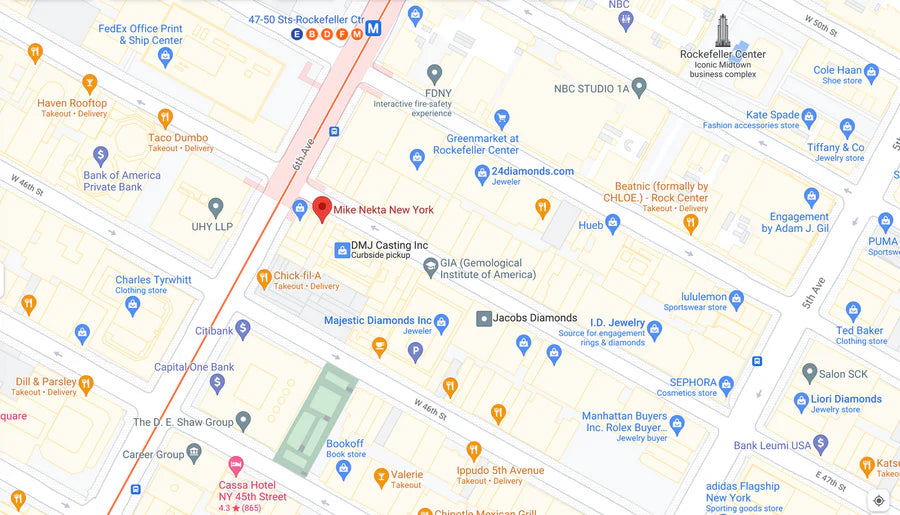
Success in the Manhattan Diamond District requires a blend of intuition and data. While many people believe a certificate is the end of the conversation, for a professional, it's just the beginning. To secure the finest loose gia certified diamonds, you must approach the counter with a structured plan. This checklist ensures you leave 47th Street with a stone that holds its value and its beauty. Buying a diamond in the heart of NYC is an experience unlike any other; it's a metropolitan rite of passage that demands a focused strategy.
- Step 1: Define your "Priority C". You can't always have the absolute best of everything within a fixed budget. Decide if you crave massive size, blinding sparkle, or microscopic purity. Knowing your priority prevents you from being overwhelmed by the thousands of options available.
- Step 2: Cross-reference the GIA report. Never buy based on the numbers alone. Request a live video or, better yet, an in-person viewing. You need to see how the facets interact with the environment.
- Step 3: Evaluate the lighting. Jewelers use specialized LEDs designed to make even mediocre stones pop. Take the stone to a window. Look at it under natural sunlight or standard office lighting to see its true character.
- Step 4: Verify the security. Ensure there is a robust return policy and a lifetime upgrade program. A reputable expert stands behind their curation long after the transaction is complete.
Avoiding "Tourist Traps" in Manhattan
The NYC Diamond District is a world of its own. It's easy to get distracted by flashy signs and aggressive sales pitches that promise "wholesale" prices to the public. Avoiding these traps starts with choosing an established, multi-generational boutique like Mike Nekta. If a price seems too good to be true, the stone is likely clarity-enhanced or lacks a genuine GIA report. A personal relationship with your jeweler is your greatest asset. You aren't just buying a stone; you're gaining a consultant who values their family's reputation over a quick sale. This trust is the foundation of a high-end purchase.
Questions to Ask Your Diamond Expert
Don't be afraid to get technical. Ask your expert if the stone has any BGM (Brown, Green, Milky) undertones. These subtle tints can ruin a diamond's brilliance, even if the GIA color grade is high. Inquire about the location of the most significant inclusion. If it's positioned near the girdle, it can often be hidden by a prong, effectively giving you a "cleaner" look for a lower price. Finally, ask about the diamond’s spread. A well-cut stone might look significantly larger than its carat weight suggests, giving you better visual value. If you're ready to start this process with a trusted guide, you can view our curated collection of stones hand-selected for their exceptional brilliance and make.
The Mike Nekta Curation: GIA Certified Excellence
Curation is the ultimate expression of expertise. While the GIA report provides the necessary data, it's the master’s eye that identifies a stone’s true potential. At Mike Nekta New York, we reject the vast majority of stones that come across our benches. We hand-select only the top 1% of loose gia certified diamonds, focusing on those rare specimens that exhibit extraordinary light performance and structural integrity. This rigorous filtering process ensures that every diamond we offer isn't just a high-quality asset on paper, but a breathtaking masterpiece in reality. Our family's reputation in the NYC Diamond District was built on this maximalist approach to quality.
The Custom Design Journey
The transition from a loose stone to a finished masterpiece is a collaborative art form. Once you've selected your diamond, our team begins the custom design process. We use advanced CAD rendering technology to show you exactly how the setting will maximize your diamond's specific GIA specs. In 2026, our custom timeline typically spans three to five weeks from the initial concept to the final polish. This ensures that every prong is placed with precision, allowing the maximum amount of light to enter the stone and reflect back with unparalleled fire. We don't use mass-produced settings; every piece is handcrafted in NYC to fit your specific diamond perfectly.
This dedication to bespoke excellence is a trait shared by other premier New York artisans; for those looking to bring that same level of custom craftsmanship into their living spaces, NY Cabinets offers high-end solutions that complement a luxury lifestyle.
Ethics and Sourcing at Mike Nekta New York
We understand that the beauty of a diamond is diminished if its origins are in question. Every stone in our collection is an ethically sourced, conflict-free natural diamond. We strictly adhere to the Kimberley Process, ensuring that our trade supports legitimate economies and fair labor practices. This commitment to transparency allows you to enjoy your jewelry with absolute peace of mind, knowing that your investment supports a responsible global industry. If you're ready to find a stone that meets these elite standards, you can View the Mike Nekta New York Loose Diamond Collection and begin your bespoke journey today.
Begin Your Bespoke Journey in the Diamond District
Selecting a diamond is more than a technical evaluation; it's the first step in creating a legacy. You've learned that while a certificate provides the baseline, true brilliance lies in the nuances of light performance and expert curation. By focusing on loose gia certified diamonds, you've chosen a path of total transparency and creative freedom. This approach ensures your investment is both physically sound and visually breathtaking. You're no longer just a buyer; you're a curator of your own history.
As a 3rd generation diamond expert with over 20 years in the NYC Diamond District, I'm here to help you navigate these choices with confidence. We specialize in GIA certified natural diamonds that represent the absolute pinnacle of their grade. It's time to move beyond the numbers and see the fire for yourself. Whether you're visiting our Manhattan boutique or consulting from afar, our commitment to excellence remains the same.
Schedule a Private Diamond Consultation with Mike Nekta today and let's find the stone that will define your story. Your journey toward a perfect, handcrafted masterpiece starts right here in the heart of Manhattan. We look forward to welcoming you into our world of timeless luxury.
Expert Insights: Frequently Asked Questions
Is a GIA certified diamond more expensive than other certifications?
The stone itself isn't more expensive because of the paper, but GIA certified diamonds often command a higher market price due to their grading accuracy. Other laboratories frequently "soft grade" stones, giving a diamond a higher color or clarity rating than it deserves. When you buy a GIA stone, you're paying for the security of an honest assessment, which protects your investment's long-term resale value and liquidity.
Can I buy a loose diamond and have it set later?
Securing loose gia certified diamonds before choosing a setting is a brilliant strategy. It allows you to focus your entire budget on the quality of the stone first. You can take your time to appreciate the diamond's fire and then collaborate with us to design a bespoke setting that perfectly complements its unique dimensions and light performance.
What is the best diamond cut for maximum sparkle in 2026?
The Round Brilliant cut remains the undisputed king of scintillation and fire. However, the 2026 market has seen a surge in high-performance ovals and radiant cuts. With GIA's recent initiative to expand cut grading standards for fancy shapes, buyers can now find pear and marquise stones with verified light performance that rivals the classic round brilliant.
Should I buy a loose diamond online or in a physical store?
While online research is a vital starting point, a physical viewing in a Manhattan boutique is superior for assessing a diamond's "life." Digital images often fail to capture how a stone dances in natural light. Visiting an expert in the NYC Diamond District allows you to compare multiple loose gia certified diamonds side-by-side under professional guidance to ensure the stone exceeds its paper specifications.
Is a 1 carat GIA diamond a good investment?
A 1-carat natural diamond is a prestigious benchmark that consistently maintains high demand and liquidity. As of July 2026, the natural diamond market has stabilized with modest price gains in specific categories. Choosing a GIA-certified stone of this weight ensures you have a globally recognized asset that retains its value far better than non-certified or poorly graded alternatives.
How do I read a GIA diamond grading report?
Start with the 4Cs section to understand the stone's basic identity. Then, look at the clarity plot to see where inclusions are located; avoiding those in the center of the table is vital. Finally, check the comments section for mentions of fluorescence or graining, and always verify that the laser inscription on the stone's girdle matches the report number.
What does "eye-clean" mean for a GIA certified diamond?
"Eye-clean" is a professional trade term that means no inclusions are visible to the naked eye when the stone is viewed from a standard distance. GIA doesn't use this term on reports, as they grade under 10x magnification. An expert's role is to bridge this gap, helping you find a VS2 or SI1 stone that looks perfectly pure without the price tag of a Flawless grade.
Does Mike Nekta offer GIA certified lab-grown diamonds?
Our curation exclusively focuses on the timeless luxury and enduring value of natural, earth-mined diamonds. While GIA provides assessments for laboratory-grown stones, we believe the unique heritage and market stability of natural diamonds make them the superior choice for bespoke engagement rings. We specialize in high-carat, ethically sourced natural stones that serve as true family heirlooms.