
Heirloom Jewelry: How Timeless Design and Secure Settings Help It Last
A jewel’s legacy comes from the people who wear and pass it on, not its price tag. What makes a piece of jewelry an heirloom is the meaning attached to it and the intention to carry its story into another generation. It may be an antique, a treasured gift, or a piece made meaningful through years of wear.
That meaning makes heirloom jewelry deeply personal. A wedding ring may hold memories of a milestone, while another piece may be cherished because of the person who first wore it. Age and monetary value can matter, but neither alone gives jewelry lasting significance.
Learn how timeless design, durable settings, and secure gemstones can help jewelry stay wearable and meaningful over time. We’ll also explore why engagement rings and wedding bands often become family heirlooms, and how thoughtful choices can help preserve both a piece and the story it carries.
Key Takeaways
- Preserve a piece’s story alongside the jewelry itself: details about its original owner and important moments can deepen its meaning for future generations.
- Recognize design details that reflect a particular era, and consider whether a style will remain appealing beyond current trends.
- Learn how the setting’s construction and the condition of its prongs, clasps, and gemstone placement affect long-term wearability.
- See why engagement rings and wedding bands can carry family milestones forward, and how thoughtful design choices help them remain treasured.
What is Heirloom Jewelry?
Heirloom jewelry is valued for its personal meaning and passed through generations, whether it is antique or newly made. Its legacy may lie in a family milestone, its craftsmanship, or the story attached to its stones.
Family Meaning and Personal History
Sentimental, Historical, and Cultural Value
Sentimental value comes from the people and milestones a piece represents; historical value can also appear in its materials and techniques. The Victorian era spanned 1837-1901, while the Art Nouveau period ran from 1890-1910 and the Edwardian era from 1901-1915. Guilloché, a decorative technique originating in 18th-century France, offers one example of skilled workmanship. Jewelry can also carry cultural heritage through designs, motifs, and traditions meaningful to a family or community. These details help explain why a necklace or ring can be valuable beyond its price.
Creating and Documenting Family Heirlooms
New jewelry can become an heirloom when it is given with purpose and meaning, then passed on with its story. A gift for a wedding or graduation can mark the occasion for future generations. Record the original owner, relevant dates, photographs, receipts, and family memories. A handwritten note can accompany the piece, preserving its provenance and explaining what it represents. This context helps relatives connect the jewelry’s beginnings with the legacy it gains over time.
Passing On and Caring for Heirlooms
A will can name the family member intended to receive a piece; estate-transfer requirements depend on jurisdiction, so follow local rules. In broader estate or family planning, documenting specific gifts helps make sure treasured belongings pass smoothly to the next generation. For an appraisal, document the jewelry’s age, condition, and distinctive design. Before selling, have its metal and gemstones evaluated for authentication, and request a fair-market or resale appraisal. Keep appraisal records and photographs with insurance documents, and review policy terms to understand coverage. Preserve original engravings, hallmarks, and maker’s marks whenever possible. If restoration is needed, prioritize the piece’s integrity and history so it remains wearable and meaningful.
Timeless design
A timeless design feels considered beyond the fashions of its moment. Balanced proportions, enduring materials, and precise craftsmanship can help jewelry remain appealing across generations. A piece need not be plain: distinctive details can reflect an era while still feeling elegant in everyday life.
Vintage jewelry is roughly 10 to 100 years old, and hallmarks can offer clues about its maker, metal, or origin. Read them alongside the setting and construction rather than treating one mark as a complete history. Cut and material can also help place a piece: old mine-cut diamonds often indicate 19th-century origins, while old European cuts are common in late Victorian and Edwardian jewelry. Platinum settings frequently appear in Edwardian and Art Deco pieces; yellow-gold filigree is often associated with Victorian designs.
These details provide context, but do not guarantee a piece’s exact date. Compare several features, including gemstone cuts, metalwork, and any surviving maker’s marks. A design shaped by a short-lived trend may look dated within five years, while balanced proportions and skilled workmanship can outlast changing tastes. That distinction matters when choosing jewelry to wear and pass on.
Personal touches make a lasting design more intimate. An engraved date or message can connect a pendant to a wedding, graduation, or family milestone. A mother might give a piece to her daughter, who later adds her own memory before passing it to a granddaughter. Custom design can reflect the wearer’s preferences while incorporating a meaningful motif or stone. The aim is to make the piece personal without relying only on passing fashion.
If you’re considering a meaningful gift, explore diamond pendants as a form that can carry a personal engraving or milestone story. A thoughtful choice pairs enduring design with details that reflect the wearer, giving the piece room to gather meaning over time.
Durable settings and secure gemstone placement
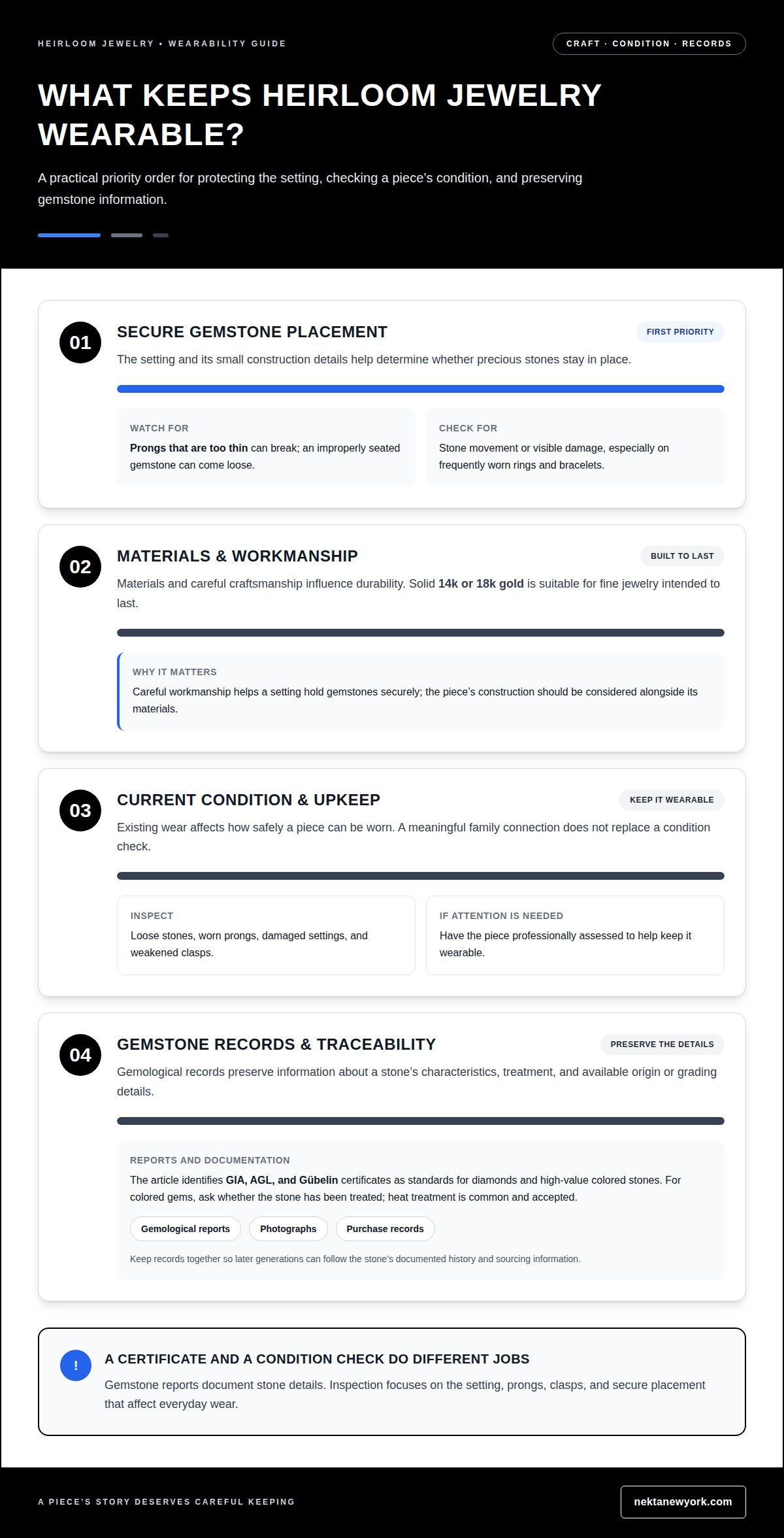
Materials, craftsmanship, and condition influence an heirloom’s durability and how its quality is assessed. Solid 14k or 18k gold is suitable for fine jewelry intended to last, while careful workmanship helps a setting hold gemstones securely. Existing wear matters too: loose stones, worn prongs, damaged settings, and weakened clasps need professional attention to keep a piece wearable.
Small construction details can determine whether precious stones stay in place. Prongs that are too thin can break, and an improperly seated gemstone can come loose. Examine a setting for movement or visible damage, especially on a frequently worn bracelet or a ring passed down for everyday use. A wedding piece may carry a deep family connection, but its condition still affects how safely it can be worn.
Gemstone records help preserve information about a stone’s characteristics and treatment. GIA, AGL, and Gübelin certificates are identified as standards for diamonds and high-value colored stones. For a colored gemstone, a gemological certificate can document its grading details; ask whether it has been treated, since heat treatment is common and accepted. Keep reports with photographs and purchase records so later generations can follow the stone’s documented history and sourcing information.
Traceability adds context to gemstone selection by linking a stone to available origin and grading records. Diamonds and sapphires, for example, may feature in heirloom rings, while other gemstones can distinguish pendants and bracelets. Compare documented characteristics with the piece’s condition and workmanship rather than treating a certificate as a measure of family significance. Secure settings, durable metals, and clear records help jewelry remain presentable and wearable as it passes between owners.
Heirloom engagement rings and wedding bands
An engagement ring or wedding band can carry a marriage milestone forward through a family. Its heirloom significance grows from the people who wore it, the commitment it represents, and the story shared with each new wearer. A ring passed down intact preserves one kind of history; a thoughtfully adapted ring can keep its meaning while reflecting a new wearer’s life. Its lasting value lies in both the object and the connection it records.
Princess Diana’s engagement ring offers a widely recognized example of a ring linked with family history. It featured an 18-karat oval sapphire surrounded by 14 round diamonds. Prince William proposed to Kate Middleton with his mother’s ring in 2010, connecting a new wedding milestone to an earlier generation. The detail matters: the ring’s continued story came from its passage between family members, not simply its gemstones or design.
Wedding bands can carry a quiet record of shared life. An inscription, date, or family story helps explain why a particular band was chosen and what it represents. If an inherited engagement ring needs redesign, preserve distinctive elements, such as its center stone or recognizable setting, while adapting its form for the wearer. This balance keeps the piece connected to its past without making it feel out of place in modern life.
For a new ring intended to become part of a family collection, consider how its shape, details, and story will speak beyond the wedding day. Compare engagement ring designs by cut and consider which style feels personal rather than tied only to a passing trend. Then record who gave the ring, the occasion, and the meaning behind the choice. A clear account gives future generations a way to discover the milestone and understand the care behind it.
Mike Nekta New York: Round Brilliant Cut Engagement Rings
Mike Nekta New York offers engagement rings that can carry personal meaning into the future. A Round Brilliant Cut may suit someone drawn to a classic look, while Cushion, Oval, and Emerald cuts offer distinct ways to express individual taste. The right choice is the one that feels meaningful to its wearer and fits the story they hope to pass on.
As you consider a ring, look beyond the occasion: think about the design, the person who will wear it, and the memories it may come to represent. These choices can make a wedding milestone part of a lasting family story.
Explore engagement ring styles with Mike Nekta New York.
Choose a Piece With a Story to Carry Forward
The next step is to choose jewelry that feels meaningful to the person who will wear it, not simply impressive on the day it’s given. Ask what makes a piece of jewelry an heirloom, and the answer returns to personal connection: the memories it gathers and the story shared with its next wearer.
For an engagement ring, consider how its shape reflects the wearer’s taste and the milestone it marks. Mike Nekta New York offers Round Brilliant Cut, Cushion Cut, and Oval Cut Engagement Rings, with distinct styles to consider as you make your choice. Let the design begin a story future generations can understand and value.
If you’re ready to explore a ring for a meaningful milestone, contact Mike Nekta New York. Choose with care, and let the memories grow around it.
Frequently Asked Questions
What Makes a Piece an Heirloom?
A piece becomes an heirloom when people give it lasting personal or family significance and preserve or pass it on. Material, craftsmanship, and age may add interest, but none alone creates heirloom status. Understanding what makes a piece of jewelry an heirloom starts with the connection people preserve, not its price. A modest pendant kept to mark a family’s migration, for example, may carry more meaning than a costly piece without a personal story.
What qualifies a piece of jewelry as an heirloom?
Jewelry becomes an heirloom through a meaningful story, an enduring connection, and deliberate care across generations. A family can clarify that connection by recording who wore the piece, why it mattered, and who received it next. A bracelet given to recognize a relative’s achievement could become a family heirloom if relatives treasure it and preserve its story, even before it has a long history.
Does heirloom jewelry have to be antique or passed down through generations?
No. A piece need not be antique or have passed through several generations to hold heirloom meaning. Its significance and the intention behind it matter more than how long it has existed. A newly given ring, for instance, can mark the start of a family tradition when its recipient chooses to keep and eventually pass it on. Its story can grow with each owner.
What historical, sentimental, or family significance makes jewelry an heirloom?
Significance can come from a family event, a personal relationship, or a connection to cultural heritage. A brooch featuring a motif meaningful to a family’s cultural tradition, for example, can preserve identity as well as personal memory. Historical design details may also reveal how a piece reflects its period. Together, the object and its story explain why relatives value it beyond its appearance or resale potential.
How old does jewelry need to be to be considered an heirloom?
An heirloom has no required age; its status comes from meaning and family stewardship, not a birthday. Antique jewelry is generally at least 100 years old, while vintage jewelry is roughly 10 to 100 years old. Those terms describe age categories, whereas “heirloom” describes a relationship to a piece. A recent gift can therefore be an heirloom without being vintage or antique.
What is the difference between heirloom, vintage, and antique jewelry?
“Heirloom” describes personal or family significance and a piece’s place in a family story; “vintage” and “antique” describe age or period. A vintage necklace may have no family history, while a newer ring can be an heirloom. One piece may fit both descriptions if it is old enough and cherished by its family. Provenance helps explain its story; age and design details help identify its period.