
Expert Diamond Jeweler: Why Authority Can’t Be Rushed
I’m Mike Nekta, a third-generation jeweler and a GIA-certified gemologist. I’ve spent more than 20 years in the diamond industry, and I’ve learned something that sounds simple but takes a lifetime to fully understand.
Real authority cannot be rushed.
You can buy a loupe. You can buy a showroom. You can buy a nice website and run ads. You can even buy a big diamond, if your budget is strong enough.
But you cannot buy the kind of judgment that comes from thousands of stones examined, hundreds of client conversations, years of custom work, and a long list of decisions made when no one is watching. In high-end diamond jewelry, authority is not a label you print. It’s a reputation you earn.

This matters because diamonds are not just beautiful objects. They are also high-stakes purchases. They carry meaning, money, memories, and sometimes family history. When you’re choosing a large-carat diamond, building a custom engagement ring, or considering a luxury investment piece, you don’t need noise. You need clarity. You need someone who can look at the whole picture, including the science, the craftsmanship, the market, and your personal priorities.
In this article, I want to explain what “expert” should actually mean in a diamond jeweler, why authority takes time, and how you can tell the difference between real experience and polished marketing.
The Real Meaning Of “Expert” In Diamond Jewelry
The word “expert” gets used casually. In my world, it should be used carefully.
An expert diamond jeweler is not just someone who can show you a diamond and repeat the 4Cs. A true expert should be able to do at least five things consistently.
First, interpret what you’re actually buying.
Two diamonds with the same lab grade can look noticeably different. A report is a starting point, not a finish line. You need someone who can read beyond the grades and evaluate what matters in real life.
Second, protect you from expensive mistakes.
Not every “great deal” is a great deal. Not every big diamond is a good diamond. A jeweler with real authority can spot issues that don’t show up clearly on paper, or that are easy to overlook when you’re excited.
Third, translate your taste into a design that works.
A custom ring is not a sketch. It’s engineering, proportion, and comfort. It’s how the diamond sits, how it performs in light, how the prongs frame it, how it feels on the hand every single day.
Fourth, understand long-term value.
If you’re buying a luxury investment piece, you need a jeweler who understands liquidity, rarity, and the realities of resale markets. A “statement piece” and an “investment-grade diamond” are not always the same thing.
Fifth, deliver consistently.
Expertise must show up in the finished product. Clean setting work, symmetry, finishing, security, and details that don’t photograph well but absolutely matter when you wear the piece.
That’s what I mean when I say authority can’t be rushed. This level of competence is built slowly, and it’s tested constantly.
Why Authority Takes Decades, Not Months
A lot of industries reward speed. Diamond jewelry punishes it.
Authority in this field comes from accumulated pattern recognition. It’s the ability to see a diamond and know, almost immediately, where the beauty is coming from and where the weaknesses might be hiding. It’s the ability to look at a design and know if it will wear well, if it will catch, if it will loosen, if it will feel too high, if it will look smaller than it should, or if it will outshine everything else in the right way.
You only get that by doing the work, year after year.
Over time, you see:
- How certain shapes behave in certain settings
- How different fluorescence levels actually look in real lighting
- How inclusions that seem minor can become obvious after setting
- How a slightly different ratio can change the “personality” of an oval or emerald cut
- How a client’s lifestyle changes what “perfect” should mean for them
- How craftsmanship can elevate a diamond, or quietly diminish it
Authority is also knowing what not to do, even if it sells faster. Especially if it sells faster.
In the high-end world, the fastest sale is not the goal. The goal is the piece you still love ten years later.
The Diamond Industry Has More Marketing Than Ever

I’ve watched the market change. There’s more information available to buyers than ever, which is good. But there is also more performance.
People can build credibility online quickly. A sharp brand, a confident tone, a few impressive photos, and suddenly it looks like expertise.
The problem is that diamonds don’t care how good the marketing looks.
A diamond either performs or it doesn’t. A setting is either secure or it isn’t. A “custom” ring is either built with intention or it’s a template with minor changes.
This is where clients get disappointed. They did the research. They bought the story. Then they see the ring in person and something feels off. It might not be easy to name, but the feeling is real.
A rushed authority focuses on what’s easy to sell. A real authority focuses on what will hold up under scrutiny.
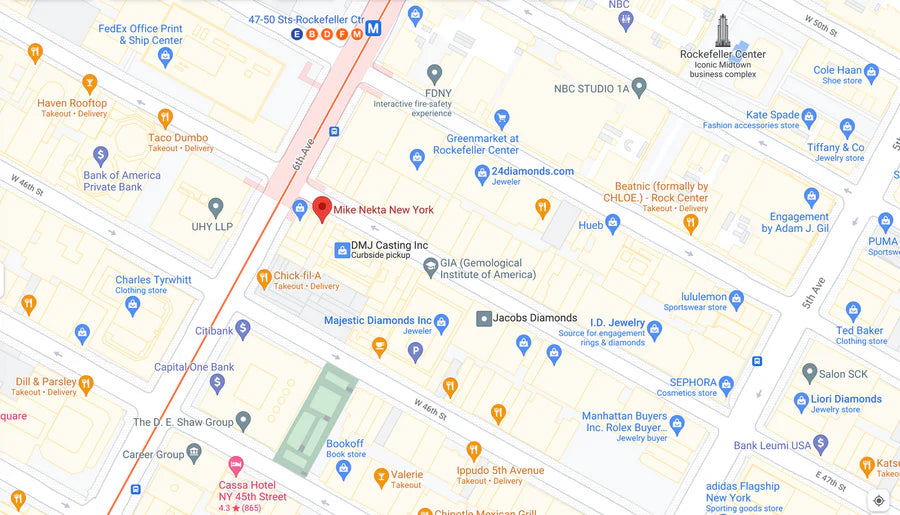
If you want that level of scrutiny, I do that work with my clients every day at Mike Nekta New York. It’s private, measured, and focused on the details that make the difference.
The 4Cs Are Not Enough (And They Never Were)
The 4Cs are important. I use them. Every professional uses them. But the 4Cs are a framework, not a full picture.
If you want to choose a diamond like an expert, you need to go beyond the basics.
Here are a few areas where real-world judgment matters.
Cut Quality Is The Main Event
When people ask me what matters most, I almost always come back to cut.
Cut is the reason a diamond looks alive. It controls brightness, fire, scintillation, and the way the stone handles light in different environments.
Two diamonds with the same carat, color, and clarity can look dramatically different if the cut quality is different.
This is also where buyers can be misled. A “triple excellent” on a report is a helpful sign, but it doesn’t automatically mean the diamond will be exceptional. There are ranges, and there are nuances. Proportions, angles, symmetry, polish, and how those characteristics work together matter.
In the appointment setting, I like to show diamonds side by side because your eye learns quickly when the comparison is real.
Color Is Personal, But It’s Not Random
Color is one of the most misunderstood categories.
Some clients want icy and crisp, and that’s completely valid. Others prefer a warmer stone that feels romantic and substantial. What matters is choosing intentionally and understanding what you’re seeing.
Mounting style also affects perceived color. White metal, yellow gold, platinum, certain settings, and even how open the basket is can all influence how the diamond presents.
If you’re buying a larger stone, color decisions become more noticeable. That doesn’t mean you always need the highest color grade. It means you need a jeweler who can help you pick the right balance for your taste and budget.
Clarity Is About What You See, Not Just The Grade

Clarity grading is essential. But a clarity grade is still a summary, not the full experience.
Two VS2 diamonds can be very different. One can look perfectly clean. Another can have an inclusion positioned in a way that catches your eye.
And once you go into larger-carat territory, clarity becomes even more personal. The diamond has more surface area. The inclusions have more “real estate” to show up. The type, position, and character of inclusions matter.
Authority means knowing how to find a diamond that looks clean to the eye while still being a smart buy.
Carat Weight Is Not The Same As Size
Carat is a weight measurement. Visual size depends on how the diamond is cut.
A diamond can carry weight in depth and face up smaller than it should. Another diamond can be cut to present larger without losing beauty.
This is where clients can unknowingly overpay. If you are shopping for a large-carat diamond, you want a stone that faces up the way it should, with presence and proportion.
When clients come to Mike Nekta New York, this is one of the first things I demonstrate. We don’t just talk about “carats.” We look at how the diamond actually presents.
Large-Carat Diamonds Demand A Different Level Of Judgment
When you get into higher carat weights, everything becomes more sensitive.
- Inclusions are easier to see
- Color nuance becomes more apparent
- Cut performance becomes more obvious
- Proportions impact presence more dramatically
- Setting work becomes more critical because the stakes are higher
A large-carat diamond also changes the design conversation. The ring has to balance the stone. The profile has to be comfortable. The setting must be secure without looking heavy. The craftsmanship cannot be average.
This is where authority really shows. It’s easy to sell “big.” It’s harder to deliver “big, beautiful, and refined.”
That’s the standard I hold myself to, because a large diamond should feel effortless, not loud in the wrong way.
Custom Engagement Rings Are Where Expertise Becomes Visible
Anyone can say “custom.” True custom means the ring is built around your diamond, your hand, your lifestyle, and your aesthetic.
In my process, custom is not about endless options. It’s about narrowing down to what’s right.
Here are the details that separate a high-end custom engagement ring from a rushed one.
Proportion And Architecture
The ring should have structure, not just decoration.
The height of the setting, the width of the shank, the way the gallery is built, the placement of the prongs, and the way the diamond is framed all matter. A ring can look beautiful in a rendering and still feel wrong when it’s worn.
Authority is being able to anticipate that before anything is made.
Comfort And Wearability
A ring is not a sculpture. It’s something you live with.
Edges, thickness, profile, and balance affect how it feels on the hand. A slightly adjusted shank or a refined taper can change everything.
If someone is proposing, I also consider daily lifestyle. Hands-on work, travel, gloves, gym habits, and personal style should all influence the build.
Setting Quality And Security
Prongs should be elegant and secure. The diamond should sit confidently, not precariously. The craftsmanship should be clean under magnification and beautiful to the naked eye.
Rushed work often shows up in tiny asymmetries, inconsistent prongs, rough finishing, or a ring that “feels” sharp when you touch it.
The client may not know exactly what they’re seeing, but they know when something looks and feels expensive.
The Final Look In Real Light
A custom ring should be evaluated in real lighting, not just showroom lighting.
I want you to see the diamond in conditions that match your life. Daylight, softer indoor light, and everything in between. That’s where you learn if the diamond has the personality you want.
Luxury Investment Pieces Require More Than A Good Eye

I work with clients who love diamonds for romance, and I also work with clients who love diamonds as assets.
Luxury investment pieces can be meaningful and financially intelligent, but you need to be realistic about what makes a diamond investment-grade.
In my experience, the diamonds that hold long-term desirability tend to share a few characteristics:
- Strong cut performance and overall beauty
- Rarity factors that are actually recognized by the market
- Clean, credible documentation and provenance where relevant
- A category that maintains buyer demand over time
- A purchase price that makes sense relative to comparable stones
I’m careful with the word “investment” because not every diamond is liquid in the way people imagine. If your goal includes long-term value, you need a strategy, not just a purchase.
This is another reason authority can’t be rushed. You only learn the market by living through cycles, seeing what sells, seeing what sits, and understanding how preferences change.
How I Think About Trust, Transparency, And Proof
I’m a third-generation jeweler, and I take that seriously. Family legacy doesn’t replace performance, but it does create a responsibility. I’m also GIA-certified, which means I was trained to evaluate diamonds with discipline, not guesswork.
Still, the most important “credential” is how you behave with clients.
For me, trust looks like this:
- I explain trade-offs clearly, without pressure
- I don’t pretend every option is perfect
- I show comparisons so you can see what I’m seeing
- I focus on your priorities, not my inventory
- I stand behind the finished work, because my name is on it
In high-end jewelry, trust is not a vibe. It’s a system. It’s how the work is done when no one is trying to impress anyone.
How To Spot Rushed Authority When You’re Shopping
If you’re trying to protect yourself, here are a few signs you might be dealing with expertise that is more presentation than substance.
Everything Is “The Best” With No Nuance
If every diamond is “perfect,” you’re not getting a professional opinion. You’re getting a sales pitch.
Real experts can tell you what is great and what is not, sometimes in the same stone. That nuance is a good sign.
You’re Pushed To Decide Quickly
Some diamonds are competitive, and I’m honest about that. But pressure is different from clarity.
A jeweler with authority can give you context, help you decide, and still respect your pace. If you feel rushed, you’re not being served.
The Conversation Never Gets Specific
Specificity is where the truth is.
An expert can explain why one diamond outperforms another in simple language. They can point to the exact factors, not just repeat “excellent cut” and move on.
The Finished Work Is Treated Like An Afterthought
A diamond is only part of the story. Setting quality, craftsmanship, and design execution are the other half.
If the conversation is all about the stone and not about how the piece will be built, you’re missing something important.
What A High-End Appointment Should Feel Like

When someone books an appointment with me, I want it to feel calm and focused.
Not rushed. Not overwhelming. Not performative.
Here’s what I aim for:
- We clarify your goals first, including budget and non-negotiables
- We look at diamonds in a way that teaches your eye quickly
- We talk through design with real proportions, not vague inspiration
- We make decisions step by step, so you feel confident
- We confirm details that matter for long-term wear and beauty
If that sounds like what you want, I invite you to book an appointment with me at Mike Nekta New York. Whether you’re choosing a large-carat diamond, creating a custom engagement ring, or building a luxury piece meant to last, I’ll guide the process with the level of care it deserves.
Why Craftsmanship Is The Quiet Part Of Authority
Craftsmanship is not always obvious in a photo. That’s why it’s often underappreciated.
But craftsmanship is the reason a ring feels refined when you hold it. It’s the reason prongs look delicate but stay secure. It’s the reason the underside of the ring is finished cleanly, even though most people will never look there.
It’s also the reason the piece ages well.
When craftsmanship is rushed, you’ll often see it later:
- A snagging prong
- A diamond that feels less stable than it should
- A ring that doesn’t sit correctly
- A finish that dulls quickly
- Small asymmetries that start to bother you once the excitement fades
True authority includes patience in the build. It’s the willingness to take the extra steps, to refine instead of just complete.
I’ve built my reputation on that patience, and that’s exactly why I say authority can’t be rushed.
The Client Experience Matters More Than Most People Admit
Luxury is not only the product. It’s also how the process feels.
Buying a diamond should feel exciting, but it should also feel safe. You should feel understood. You should feel like you can ask anything. You should feel like the person guiding you is calm, experienced, and honest.
A lot of clients come to me after a frustrating experience elsewhere, and the story is usually the same. Too many options, too much pressure, too little explanation, and not enough confidence.
The best compliment I hear is: “This finally makes sense.”
That’s the goal.
The Simple Truth: Authority Is Proven Over Time
If you remember one thing from this, let it be this.
In diamond jewelry, authority is not a claim. It’s a track record.
It’s built through years of studying stones, making pieces, learning from mistakes, and holding yourself to a high standard even when it would be easier not to.
As a third-generation jeweler and GIA-certified gemologist with over 20 years in the diamond industry, I’ve dedicated my career to doing this the right way. My focus is high-end diamond jewelry, large-carat diamonds, custom engagement rings, and luxury investment pieces. That focus is intentional because depth matters more than breadth in this business.
If you’re ready to explore something exceptional, I’d love to help you do it with confidence. Book an appointment with me, Mike Nekta, at Mike Nekta New York, and we’ll take the time to get the diamond and the design exactly right.