
Diamond District Independent Jeweler vs. Tiffany & Co.: A 2026 Quality Comparison
The iconic blue box is often seen as the gold standard for engagement, but the most recognizable packaging in the world might actually be the biggest barrier between you and your perfect diamond. When you dive into a diamond district independent jeweler vs tiffany and co quality comparison, you quickly realize that prestige and performance aren't always the same thing. You've likely felt that pull between the safety of a global brand and the nagging suspicion that you're paying a significant premium for a name rather than the stone itself. It's a common crossroads for anyone seeking a ring that balances high-end luxury with actual material value.
I understand the hesitation. The Diamond District can feel overwhelming compared to the controlled elegance of a Fifth Avenue showroom. However, choosing a third-generation expert like Mike Nekta means prioritizing the science of sparkle over retail marketing. In this guide, we'll provide objective proof of diamond quality to help you decide if the Tiffany Gemological Laboratory standards truly hold up against GIA certification. You'll learn how to maximize your budget for both size and light performance, ensuring your investment results in a masterpiece that outshines the corporate competition. We're pulling back the curtain on trade secrets to give you the confidence to choose a ring based on brilliance, not just a label.
Key Takeaways
- Understand why GIA certification remains the objective gold standard for transparency compared to the in-house grading reports used by corporate retailers.
- Explore a diamond district independent jeweler vs tiffany and co quality comparison to see how the "Value Gap" allows for significantly larger carat weights within the same budget.
- Learn the technical secrets behind "maximum sparkle" and why expert hand-selection of stones outperforms machine-driven retail inventories.
- Discover how to bypass the high overhead of Fifth Avenue branding to prioritize the material performance and rarity of your diamond.
- Identify the benefits of a private, expert-led buying experience that transforms the purchase into a bespoke journey of diamond connoisseurship.
Tiffany & Co. vs. Diamond District Independents: The Prestige vs. Performance Debate
The allure of the little blue box is undeniable. For over a century, it's served as a universal symbol of status and romantic success. However, a modern diamond district independent jeweler vs tiffany and co quality comparison reveals that savvy buyers are shifting their focus from the box to the brilliance of the stone itself. While Tiffany & Co. offers the comfort of a global brand, independent experts like Mike Nekta provide an uncompromising dedication to raw material excellence that retail giants can't match at the same scale. The core trade-off is simple: are you investing in a marketing legacy or the physical performance of the diamond?
The Retail Giant: Tiffany’s Legacy of Standardisation
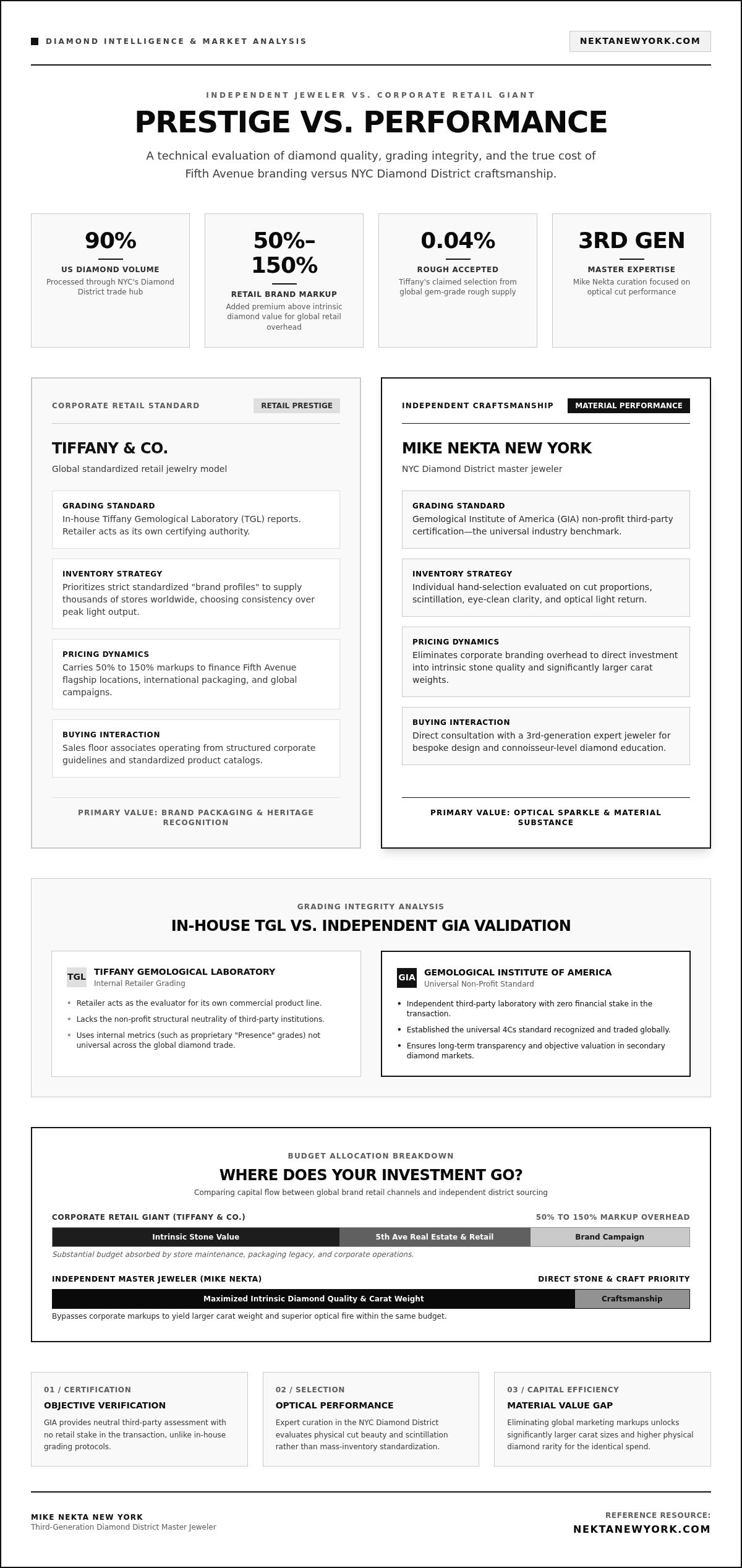
Tiffany & Co. has mastered the art of the "safe" purchase. They famously claim to accept only 0.04% of the world's gem-grade rough diamonds, creating a highly curated environment for the masses. This peace of mind comes at a significant cost. Maintaining flagship stores on Fifth Avenue and funding global marketing campaigns requires a massive retail markup, often reaching 50% to 150% above the diamond's intrinsic value. You're paying for the security of the name and the consistency of the experience.
Standardization also has a hidden downside. To maintain a consistent global inventory, Tiffany often prioritizes diamonds that meet their "brand profile" rather than searching for the absolute peak of light performance. When a brand must stock thousands of stores, they cannot always wait for the rarest, most vibrant stones. They choose consistency over the extraordinary. This means your ring is guaranteed to be high quality, but it may not be the most brilliant stone available for your investment.
The Independent Expert: Mike Nekta’s Bespoke Philosophy
The NYC Diamond District is the heartbeat of the global trade, handling nearly 90% of diamonds entering the United States. Operating from this hub, Mike Nekta leverages third-generation expertise to hand-select stones based on their physical beauty, not just their paper grade. This approach focuses on diamond cut proportions and optical performance to ensure every facet contributes to "maximum sparkle."
Working with an independent master jeweler transforms the buying process. You aren't speaking to a sales associate following a corporate script; you're consulting with a craftsman who understands the nuances of "eye-clean" clarity and superior scintillation. This bespoke philosophy allows for a level of customization and stone quality that retail giants often overlook. It's the difference between buying a luxury product and commissioning a legacy piece that prioritizes material excellence over retail prestige.
Diamond Grading Standards: Tiffany’s In-House Reports vs. GIA Certification
Choosing between a global brand and an independent master jeweler often starts with who you trust to verify the stone's quality. In a diamond district independent jeweler vs tiffany and co quality comparison, the most significant distinction isn't just the diamond itself, but the laboratory report that accompanies it. While Tiffany & Co. uses its own Tiffany Gemological Laboratory (TGL), independent experts like Mike Nekta rely on the Gemological Institute of America (GIA), the world’s most respected third-party authority. This difference in certification impacts everything from the price you pay to the long-term resale value of your investment.
The Transparency Gap: Why Third-Party Validation Matters
Objectivity is the cornerstone of diamond buying. Tiffany’s in-house grading means the retailer is effectively grading its own inventory. While TGL maintains strict internal protocols, this model lacks the inherent neutrality of a third-party lab. GIA is a non-profit institution with no financial stake in the sale of the diamond. Their reports are based on the GIA diamond quality factors, which serve as a universal language for the entire industry. Unlike Tiffany’s proprietary "Presence" grade, a GIA report provides specific, individual ratings for Cut, Polish, and Symmetry, allowing you to see exactly where the stone excels.
This transparency extends to financial security. A GIA certificate is a "diamond passport" recognized by insurers and secondary markets globally. TGL reports often lack an inclusion plot, the visual map of a diamond’s internal characteristics. Without this map, verifying the stone’s identity for insurance or resale outside of the Tiffany ecosystem can be challenging. An independent GIA report ensures your investment is protected by a scientific standard that doesn't rely on a brand’s marketing claims.
Nekta’s Selection: Beyond the Certificate
A GIA "Excellent" grade is a range, not a single point of perfection. Two diamonds can share the same paper grades but look completely different when viewed side-by-side. This is where the expertise of a third-generation jeweler becomes invaluable. Mike Nekta uses GIA data as a baseline, then applies a rigorous personal filter to find stones with exceptional fire and scintillation. He rejects stones that meet the technical requirements of an "Excellent" grade but lack the visual "life" required for a high-end custom piece.
This curation process ensures that every stone in the inventory is selected for maximum light return. Mike focuses on finding "eye-clean" GIA certified loose diamonds, where inclusions are positioned so they don't interfere with the diamond's brilliance. By prioritizing optical performance over mere paper grades, you receive a stone that truly performs under any lighting condition. If you are ready to move beyond corporate standards, you can browse our collection of hand-selected diamonds to see the difference that expert curation makes.
The Art of the Cut: Comparing Machine-Made Precision with Expert Hand-Selection
While certification establishes the rules of the game, the cut provides the soul of the diamond. A diamond district independent jeweler vs tiffany and co quality comparison hinges largely on how a stone interacts with light. Tiffany & Co. produces thousands of rings annually, relying on standardized machine-cutting to meet their vast global inventory needs. In contrast, an independent master jeweler like Mike Nekta hand-selects every stone, looking for the specific geometry that allows a diamond to "explode" with light. The goal isn't just to meet a corporate standard; it's to find the rare stone that outperforms its paper grade.
Light Performance: Fire, Scintillation, and Brilliance
Mike Nekta evaluates diamonds using both modern scanning technology and a trained eye that spans three generations. Even within the GIA "Triple Excellent" category, subtle variations in table percentage and crown angles can drastically change how a stone reacts to light. It's helpful to review Federal Trade Commission diamond buying advice to understand how retail descriptions and cut quality impact overall value. Mike focuses on stones that maximize fire, the flashes of color, and scintillation, the sparkle when the stone moves. For those seeking the pinnacle of this craft, The Ultimate Guide to Round Brilliant Cut Engagement Rings in 2026 provides a deeper dive into these technical nuances.
The difference between a "good" cut and an elite cut is often invisible on a spreadsheet. A machine-cut diamond might satisfy the technical requirements for an Excellent grade while still appearing "sleepy" or dull in certain lighting. By hand-selecting stones, an independent expert ensures that every facet is positioned to reflect the maximum amount of light back to the eye. This meticulous selection process is what separates a mass-market luxury item from a true masterpiece of light performance.
Custom Artistry vs. Mass Production
Tiffany’s inventory is largely pre-set, designed to fit a wide range of hands but tailored to none. This mass-production model can sometimes result in a setting that feels bulky or fails to complement the specific finger shape of the wearer. In the Diamond District, the setting is engineered around the stone, not the other way around. Mike Nekta optimizes the "face-up" size of a diamond by selecting stones with slightly shallower depths that still maintain perfect light return. This technique makes a diamond appear larger than its carat weight suggests. This level of detail is the hallmark of custom bridal jewelry NYC, where every prong and shank is hand-finished to create a silhouette that is both elegant and unique.
Unboxing the Price Tag: Calculating the Blue Box Premium
The "Blue Box" premium is one of the most successful marketing triumphs in history. When you perform a diamond district independent jeweler vs tiffany and co quality comparison, you're essentially looking at two different financial philosophies. Tiffany’s pricing must account for global advertising, celebrity endorsements, and the staggering rent of Fifth Avenue flagships. Independent jewelers like Mike Nekta operate within the concentrated ecosystem of the NYC Diamond District. This proximity to the world's diamond bourses eliminates multiple retail layers, allowing your investment to go directly into the stone's physical attributes rather than a corporate marketing machine.
Ethical integrity remains a shared standard in this comparison. Tiffany is well-known for its traceability initiatives for diamonds over 0.18 carats. Mike Nekta matches this commitment by sourcing ethically mined, conflict-free stones from trusted global suppliers. The difference isn't the provenance, but the "Value Gap." By choosing an independent expert, you ensure that the maximum percentage of your budget is spent on the actual rarity and brilliance of the diamond.
The Carat Opportunity Cost
The "Value Gap" often translates into a significant difference in visual impact. For the same investment required for a 1.5-carat Tiffany solitaire, a master jeweler in the Diamond District can frequently source a 2.5-carat or larger GIA-certified stone of equal or superior quality. This is the carat opportunity cost. If your goal is a high-impact piece, such as a 4 carat diamond ring, an independent expert provides access to rare, high-carat inventory that retail chains rarely stock. You aren't just getting more for your money; you're gaining access to a tier of diamond rarity that is often unavailable in a standard retail environment.
Investment and Longevity
Resale value is a common point of confusion for luxury buyers. While Tiffany rings have brand recognition on the secondary market, their resale price is still dictated by the intrinsic value of the diamond. The "brand premium" you pay at retail often evaporates the moment you leave the store. A high-carat, GIA-certified diamond is a globally recognized asset with its value rooted in scientific grading. This independent certification ensures liquidity and value retention far more effectively than a retail label.
Choosing a custom-designed piece also offers a more meaningful legacy. Instead of a mass-produced model found in every mall, a bespoke ring is a unique expression of your personal story. It’s a collaboration with a master craftsman that results in a one-of-a-kind heirloom. If you're ready to see how your investment can be transformed into a masterpiece of light and scale, you can view our custom engagement ring designs.
Choosing Your Legacy: Why the Mike Nekta Experience Outperforms Retail Luxury
The final decision in a diamond district independent jeweler vs tiffany and co quality comparison often comes down to how you want to feel during the process. Walking into a global retail store is a transaction with a brand. Entering Mike Nekta’s private NYC showroom is an invitation into a legacy of craftsmanship. In a retail environment, you are often one of many customers being served by a salesperson following a corporate script. In the Diamond District, you are sitting across from a third-generation master who has spent a lifetime studying the physics of light. The privacy and exclusivity of this setting allow for a focused, high-end experience that retail counters simply cannot replicate.
From Retail Buyer to Diamond Connoisseur
Mike Nekta believes that every client should transition from a buyer to a connoisseur. This means looking beyond the basic grading reports to understand the "soul" of a diamond. It's about seeing how a stone behaves in natural light and understanding why one GIA Excellent cut outshines another. This education ensures you aren't just trusting a label; you're trusting your own eyes and a deeper understanding of material excellence. You become part of the process, learning to identify the fire and scintillation that define a world-class stone.
The collaborative design process is where your personal story takes physical form. Whether you are selecting a center stone or designing custom wedding bands NYC, the journey is entirely bespoke. You see the sketches, you participate in the selection, and you witness the creation of a true heirloom. Unlike a retail purchase that ends at the register, this relationship is built for the long term. A family jeweler provides a lifetime of maintenance, professional cleaning, and potential upgrades as your family legacy grows over the decades.
The Final Verdict: Brand vs. Brilliance
Ultimately, Tiffany & Co. is a choice for those who value the psychological comfort and social signaling of a famous brand name. If the blue box is the most important part of the proposal, the retail premium might be a justified investment for your specific needs. However, for the diamond-conscious buyer, the advantages of an independent expert are overwhelming.
Mike Nekta offers superior diamond performance, significantly larger carat weights for the same budget, and a level of custom artistry that mass production cannot match. By choosing an independent expert in the heart of Manhattan, you're prioritizing the brilliance of the stone over the marketing of the box. You're choosing a ring that will be remembered for its extraordinary fire, not just its packaging. If you're ready to experience the pinnacle of NYC diamond expertise, schedule your private consultation with Mike Nekta today.
Defining Your Legacy Beyond the Blue Box
Choosing between a global retail giant and a master craftsman is a decision that defines the legacy of your investment. This diamond district independent jeweler vs tiffany and co quality comparison highlights that while a brand name offers social recognition, true brilliance is found in the stone's physical performance. You've discovered how GIA certified transparency ensures objective value, protecting your assets in a way that in-house grading reports cannot match. By prioritizing the "maximum sparkle" of a hand-selected diamond over the overhead of Fifth Avenue marketing, you gain access to superior carat weights and artisanal precision.
The journey from a retail buyer to a diamond connoisseur starts with expert guidance. Mike Nekta brings third-generation expertise to every consultation, ensuring your ring isn't just a product, but a masterpiece of light and fire. It's time to move beyond the constraints of mass production and embrace a bespoke experience tailored to your unique story. Your perfect diamond is waiting in the heart of Manhattan. We're ready to help you find the brilliance you deserve.
Design Your Masterpiece with Mike Nekta
Frequently Asked Questions
Is Tiffany & Co. diamond quality actually higher than GIA Excellent?
Not necessarily. While Tiffany maintains high standards, "Excellent" is a technical grade range defined by GIA. A diamond district independent jeweler vs tiffany and co quality comparison shows that independent experts often source stones that sit at the absolute top of the GIA scale. Mike Nekta hand-selects diamonds for fire and scintillation that may actually outperform standardized retail inventory. The brilliance of a stone depends on its specific geometry, not just the brand name.
Why are diamonds in the NYC Diamond District so much cheaper than Tiffany?
The price difference is primarily driven by overhead and retail markup rather than material quality. Tiffany & Co. must fund global marketing campaigns and maintain prestigious Fifth Avenue real estate. Independent jewelers like Mike Nekta operate with direct access to diamond bourses, eliminating multiple layers of middlemen. This allows the investment to go entirely into the rarity of the diamond itself, often resulting in significant savings compared to luxury retail prices.
Does Tiffany use GIA for their diamond grading?
No, Tiffany & Co. uses its own in-house laboratory, the Tiffany Gemological Laboratory (TGL). While they follow strict protocols, this creates a conflict of interest because the retailer is grading its own products. Independent jewelers like Mike Nekta provide GIA certification, which is the globally recognized gold standard for unbiased, third-party diamond grading. GIA reports ensure that the stone's quality is verified by a non-profit organization with no financial stake in the sale.
Can an independent jeweler like Mike Nekta recreate a Tiffany setting?
Yes, the classic six-prong setting introduced by Charles Lewis Tiffany in 1886 is now in the public domain. Master jewelers in the Diamond District can recreate this iconic silhouette with even greater precision. Mike Nekta specializes in bespoke settings that are hand-finished to fit the specific dimensions of your chosen diamond. This results in a more secure and elegant fit than mass-produced retail settings designed for standardized stone sizes and shapes.
What is the resale value of a Tiffany ring vs. a GIA certified ring?
Resale value is always tied to the intrinsic quality of the diamond. While Tiffany rings carry brand recognition, the high initial markup often makes it difficult to recoup the investment. A GIA certified diamond is a liquid asset recognized by every diamond bourse and insurer worldwide. Because you pay a fair market price at an independent jeweler, the gap between your purchase price and the diamond's intrinsic value is significantly smaller over time.
How do I know if a Diamond District jeweler is reputable?
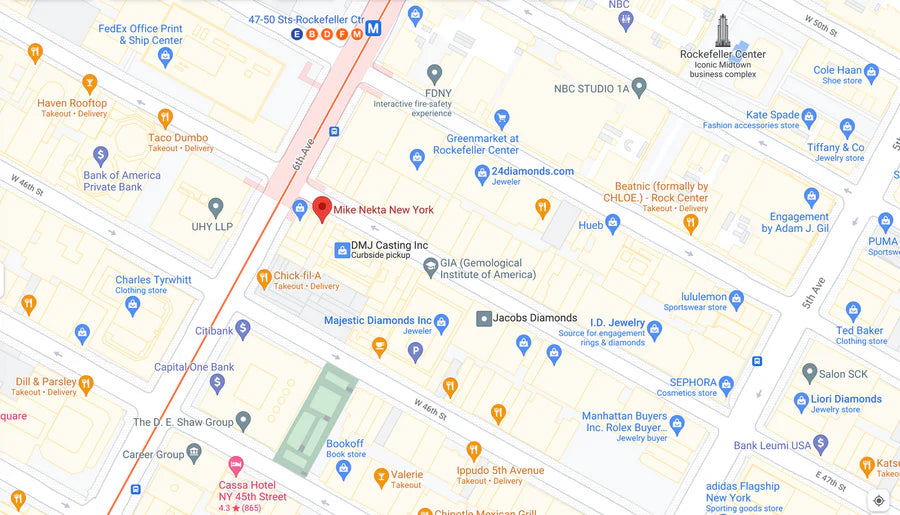
Look for established, multi-generational expertise and a focus on transparency. A reputable jeweler will always provide GIA certification for their loose diamonds and offer a private, professional showroom environment. Mike Nekta is a third-generation expert who prioritizes client education and long-term relationships. Checking for a physical presence at a verified address and reading detailed client testimonials are essential steps in confirming a jeweler's standing within the NYC diamond community.
Does Tiffany offer custom-designed engagement rings?
Tiffany & Co. primarily offers a fixed inventory of pre-set rings or allows you to choose a stone from their collection to fit a standard setting. They don't offer the same level of bespoke artistry found at independent NYC boutiques. Mike Nekta provides a truly collaborative design process where every element, from the shank profile to the prong style, is custom-crafted to reflect your personal vision and the unique character of your diamond.
Is it safe to buy a high-carat diamond in the NYC Diamond District?
It's very safe if you choose an expert who provides full documentation and private consultations. The NYC Diamond District handles roughly 90% of diamonds entering the United States, making it a highly professional hub. Mike Nekta offers a secure, high-end environment where you can examine 4-carat+ GIA certified diamonds under professional lighting. This transparency ensures you know exactly what you are purchasing before the transaction occurs, providing total peace of mind.