
Cushion Cut Diamond: A Connoisseur’s Guide to Shape, Sparkle, and Selection
What if the cushion cut diamond that looks brightest in a photograph feels less compelling in person? This shape has a distinctive softness, but its facet pattern can create very different impressions, from crisp flashes of light to a finer, “crushed ice” sparkle. Online images and carat weight alone rarely show enough to judge which one suits you.
Look beyond the numbers. This guide explains how to recognize common cushion-cut appearances, use the 4Cs as a framework, and compare proportions and sparkle. You’ll also learn why GIA doesn’t assign cushion diamonds an official cut grade, and what to consider when pairing a stone with a setting.
From the character of a cushion brilliant to the softer, antique-inspired appeal of an old mine cut, small differences can shape the entire ring. Mike Nekta’s third-generation diamond expertise can help you assess those details and choose a cushion that feels distinctive, balanced, and suited to your vision.
Key Takeaways
- Recognize how softened corners create the cushion’s signature silhouette, while square and elongated outlines offer distinct looks.
- Compare facet patterns under similar lighting and from different angles, since viewing conditions can change how a cushion cut diamond appears to sparkle.
- Use the 4Cs as a starting framework, then judge each stone’s individual appearance rather than relying on carat weight alone.
- Choose your preferred outline first, then consider how the stone’s proportions and ring setting work together.
- Explore how selecting a loose diamond can guide a custom ring design, with ethical sourcing and fine craftsmanship in mind.
What Is a Cushion Cut Diamond, and What Makes Its Shape Distinctive?
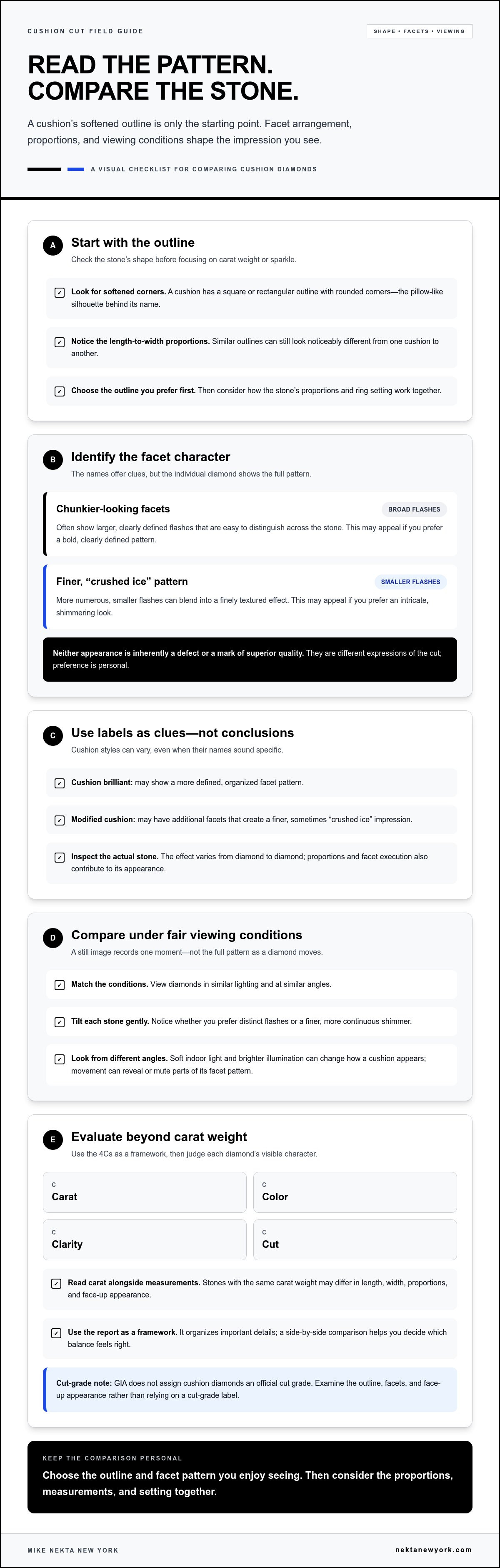
A cushion cut has a square or rectangular outline with softened, rounded corners, creating the pillow-like silhouette that gives the shape its name. But the outline is only one part of its appearance. Length-to-width proportions and facet arrangement affect how each stone looks, so two cushions with similar outlines can show noticeably different patterns and sparkle.
A cushion cut diamond is defined by its softened square or rectangular outline; its facet arrangement gives the individual stone much of its visual character. This distinction helps separate shape from cutting style. The broader practice of shaping a diamond involves arranging facets to influence its appearance. Within the cushion shape, those arrangements can vary considerably. Don’t assume every cushion has the same proportions, facet pattern, or light performance.
How did the cushion cut develop from earlier diamond styles?
The cushion shape is associated with antique diamonds, including old mine cuts, whose softly rounded outlines continue to inspire vintage-style designs. Modern cushions may echo that heritage, but historical inspiration doesn’t mean they reproduce an antique cut. Contemporary cutting interprets the outline in different ways, creating distinct facet layouts and visual effects. Think of “cushion” as a family of appearances, not a single historical blueprint.
What do cushion-brilliant and modified cushion mean?
These terms offer a first clue about facet arrangement, but they don’t guarantee how a particular stone will look. A cushion brilliant may show a more defined, organized facet pattern, while a modified cushion can have additional facets that create a finer, sometimes “crushed ice” impression. The effect varies from diamond to diamond.
Compare the actual stones rather than relying on the label alone. Look for broad, distinct facets or a pattern of smaller, more numerous flashes. Notice how the pattern changes as the diamond moves under different lighting. Terminology can’t tell the whole story: proportions and the execution of the facets also contribute to the appearance. Looking closely at those details gives you a more useful sense of a cushion’s character than its outline alone.
How Cushion Diamond Facets Shape Sparkle, Pattern, and Personality
A cushion’s sparkle isn’t one fixed effect. Some stones show large, clearly defined flashes; others display a finer, more fragmented pattern. These differences come from the facet arrangement and how the individual diamond interacts with light. Labels can help you know what to look for, but they can’t show exactly how a stone will appear in person.
What is the difference between chunky and crushed-ice appearances?
Chunkier-looking facets tend to produce broad flashes that are easy to distinguish across the stone. A crushed-ice appearance is generally more finely patterned, with numerous smaller flashes that can blend together visually. Neither look is inherently a defect or a mark of superior quality. They’re different expressions of the cut, and preference is personal.
Use this comparison as a starting point, then view actual diamonds in similar lighting and at similar angles. A still image captures one moment of sparkle, not the full pattern as the stone moves. When comparing, tilt each diamond gently and note whether you prefer distinct flashes or a finer, more continuous shimmer.
| Appearance | Visual impression | May appeal to buyers who prefer |
|---|---|---|
| Chunkier facets | Broader, more distinct flashes | A bold, clearly defined pattern |
| Finer, crushed-ice pattern | Smaller flashes with a more finely textured effect | A more intricate, shimmering look |
Does a cushion cut sparkle like a round brilliant?
Both shapes can return light, but their facet patterns create different visual signatures. A round brilliant has a different outline and facet arrangement, while cushions vary in their own patterns and proportions. Rather than expecting one shape to match the other, compare the rhythm of the flashes, the pattern across the face, and the impression each stone makes as it moves. For a shape-specific comparison, explore this round brilliant engagement ring guide.
A cushion cut diamond can look different under soft indoor light than under brighter illumination. Changing the viewing angle can also reveal or mute parts of its facet pattern. Compare stones under similar conditions, and look beyond labels such as “brilliant” or “modified.” The American Gem Society’s overview discusses the enduring popularity of the cushion cut, but your own preference should guide the final choice.
If you’re considering how a preferred facet pattern might complement a ring design, explore cushion engagement rings as you refine your selection.
How to Evaluate a Cushion Cut Diamond Beyond Carat Weight
Carat, color, clarity, and cut are most useful when considered together. They describe different aspects of a diamond, but they can’t replace examining its face-up appearance: how the outline reads, how the facets look, and what catches your eye. A report organizes important details, while a side-by-side comparison helps you decide which balance feels right.
Carat weight alone can’t predict how large a diamond will look face-up, because measurements and proportions also shape its visible presence. Two stones with the same weight may differ in length, width, and overall outline. Use the measurements alongside a clear face-up view, rather than treating carat as a guarantee of visual size.
Which cushion diamond proportions should buyers compare?
Start with the length and width measurements, then compare how each stone’s outline looks from above. A closer-to-square cushion and a more elongated cushion create different impressions; neither is automatically better. There’s no single length-to-width proportion that suits everyone. Consider which outline appeals to you, then assess it alongside the diamond’s facet pattern and face-up presence.
How should the 4Cs guide a cushion diamond decision?
Think of the 4Cs as a connected framework, not a ranking system. Carat is weight, while color and clarity describe characteristics you can weigh against your priorities and the stone’s visible appearance. Cushion cut diamonds don’t receive an official GIA cut grade, so don’t mistake a seller’s “ideal” or “excellent” label for a GIA grade. For a loose diamond with a GIA grading report, review the characteristics documented in the report, then assess the diamond itself.
A simple comparison record can help you keep several candidates distinct. Note the same details for each stone:
| Candidate | Shape and measurements | Color | Clarity | Visual impression |
|---|---|---|---|---|
| A | Square or elongated; record measurements | Record report grade | Record report grade | Note outline and face-up presence |
| B | Square or elongated; record measurements | Record report grade | Record report grade | Note outline and face-up presence |
Keep viewing conditions consistent as you compare. Make brief notes on which outline feels balanced, what you notice first, and whether the diamond’s visual character suits your taste. This makes the 4Cs a practical decision aid while leaving room for the quality that matters most: how the individual stone looks to you.
How to Choose a Cushion Shape and Setting That Feel Right Together
A successful ring design starts with the diamond’s outline, then brings the setting into the picture. Follow a deliberate sequence: decide whether you prefer a squarer or more elongated shape, compare individual stones, consider how the setting frames the outline, and review the complete design together. This keeps the focus on the finished ring, not just the loose stone.
Should you choose a square or elongated cushion diamond?
A near-square cushion can create a compact, balanced impression on the hand. A rectangular outline draws the eye along the finger and gives the ring a more lengthened appearance. Neither proportion is a quality ranking; the right choice depends on your preferred silhouette and how it looks on your hand. If you’re drawn to a longer outline, consider the emerald-cut engagement ring guide for a contrasting, more linear geometry.
Compare each stone’s measurements with its face-up appearance rather than relying on a label alone. A small shift in proportion can change the character of the outline. View the stone in a ring-shaped frame or against your hand, then consider whether its shape feels balanced with the scale and style you have in mind.
What should you consider when pairing a cushion with a setting?
Prong placement affects how the corners are framed and how much of the outline remains visible. The setting’s overall design changes the ring’s character, too: a restrained band can keep attention on the cushion, while more detailed metalwork can create a richer, more ornate impression. These are aesthetic choices, so assess the complete composition rather than treating one setting as universally best.
Metal color and band proportions contribute to the finished effect. Consider whether you want the metal to blend quietly with the diamond or create a more noticeable contrast, and whether the band’s visual weight feels balanced with the stone. Review the ring from above and from the side, noting how the center stone, setting, and band work together.
A custom design can bring your chosen outline and setting into a coherent whole. Explore this custom bridal jewelry guide for more on the design process, then explore cushion engagement rings as you consider the combination that feels distinctly yours.
From Loose Cushion Diamond to Bespoke Engagement Ring
Choosing a loose stone before settling on a ring design gives you a clear starting point. First, focus on the cushion’s outline, facet pattern, and face-up presence. Then shape the setting around the qualities you value. This approach lets you consider the diamond and finished ring as a whole, rather than treating the setting as an afterthought.
What does a bespoke cushion-cut ring design involve?
Begin with the appearance you prefer, whether that’s a near-square outline, a more elongated silhouette, or a particular facet character. Next, consider how you want the setting to frame the stone: prong placement, the band’s visual weight, and the overall balance of the design. Metal color and decorative details can refine the mood, from understated to more expressive. Each choice can reflect your preferences without relying on a preset formula.
Selecting the stone first can make design decisions more concrete. Its shape and measurements inform how it sits within the ring’s proportions, while your priorities guide the details around it. For a cushion cut diamond, the connection between the individual stone and its setting is central to creating a ring that feels personal and cohesive.
How can expert guidance make the decision clearer?
Comparing diamonds involves more than reading specifications. Expert guidance can help you weigh report details against what you see in the stone, clarify which visual qualities matter most to you, and carry those preferences through to the ring design. A loose GIA-certified diamond offers documented grading information to consider alongside its individual appearance.
At Mike Nekta New York, diamond expertise is rooted in third-generation knowledge and more than 20 years of operation in Manhattan’s Diamond District. The boutique specializes in ethically sourced diamonds and fine craftsmanship, bringing care to stone selection and the finished piece. These considerations can add meaning to a purchase beyond appearance alone.
Identify what matters most to you: the stone’s outline, the way its facets read, the character of the setting, or the values behind its sourcing. Then explore a custom cushion-cut engagement ring, with your preferred diamond and design priorities guiding the process.
Choose a Cushion Ring That Feels Distinctly Yours
The right cushion cut diamond is more than a carat weight or a photograph. Its outline, facet pattern, and proportions shape its character, while the setting brings that character into focus. Compare stones closely, consider how they look with different designs, and let your own preferences guide the choice.
A loose stone can be a thoughtful starting point for a custom-designed engagement ring, allowing its distinctive qualities to inform the setting and finished design. Ethical sourcing and fine craftsmanship can add meaning to the decision, too. At Mike Nekta New York, third-generation diamond expertise and more than 20 years of operation inform the selection of loose GIA-certified diamonds and the creation of engagement rings.
Explore a design that brings your preferred stone and setting together. Explore custom cushion-cut engagement rings with Mike Nekta New York, and take the next step toward a ring that reflects your vision.
Frequently Asked Questions
What is a cushion cut diamond?
A cushion cut diamond has a square or rectangular outline with softened, rounded corners and a pillow-like silhouette. The shape describes the stone’s perimeter, not one fixed facet arrangement. Depending on its proportions and facets, a cushion can look nearly square or more elongated, with a pattern ranging from broad, distinct flashes to finer sparkle. Compare individual stones face-up rather than assuming every cushion looks the same.
Are cushion cut diamonds more affordable than round diamonds?
Sometimes, but there’s no fixed price advantage for every cushion over every round. Price depends on factors such as carat weight, color, clarity, the individual stone’s appearance, and market conditions. For a useful comparison, look at diamonds with similar documented characteristics and compare their face-up presence and visual appeal. A lower price alone doesn’t tell you whether a particular stone is the right choice.
Do cushion cut diamonds sparkle as much as round diamonds?
A cushion can return light beautifully, but its sparkle has a different visual character from a round brilliant because the shapes and facet patterns differ. Some cushions show broad, defined flashes; others have a finer, more fragmented pattern. The effect also changes with lighting, movement, and viewing angle. Compare actual stones under similar conditions and choose the pattern you enjoy, rather than expecting one shape to imitate the other.
What is the difference between a cushion brilliant and a modified cushion cut?
The terms refer to different facet arrangements and can suggest the pattern you might see, but they don’t guarantee how a particular diamond will look. A cushion brilliant may show a more organized pattern, while a modified cushion can have a finer, sometimes “crushed ice” appearance. Look closely at the individual stone, since proportions and facet execution also affect its visual character. Neither label alone establishes which diamond is better.
Is a square or elongated cushion cut better for an engagement ring?
Neither is inherently better; the right choice comes down to your preferred outline and how it looks on your hand. A square cushion can feel compact and balanced, while an elongated one creates a more rectangular impression. Compare the stones from above and in a ring setting, paying attention to how their proportions feel with the band. Choose the shape that suits your style, not a supposed universal ideal.
How do you choose the best color and clarity for a cushion cut diamond?
Choose color and clarity by balancing the grading information with what you can see and what matters to you. Review a GIA grading report for a loose diamond’s documented characteristics, then examine the stone face-up to see whether its color or inclusions are noticeable to you. Cushion diamonds don’t receive an official GIA cut grade, so assess their appearance directly. There’s no single color or clarity choice that’s best for every buyer.
Can a cushion cut diamond be set in a halo or solitaire engagement ring?
Yes. A cushion can be the center stone in either a halo or a solitaire design. A halo frames the outline with surrounding accents, while a solitaire keeps attention on the center diamond and its setting. Consider how the prongs, band, and overall proportions complement the stone’s shape and facet pattern. The best pairing reflects the look you want for the complete ring, rather than following a fixed rule.