
The Insider’s Guide to Buying Diamond District Loose Diamonds in 2026
A GIA certificate tells you the technical history of a stone, but it can never describe its soul or how it captures the light of a Manhattan sunset. You've likely felt the high-pressure hum of 47th Street and wondered if those paper specifications actually match the diamond district loose diamonds in front of you. It's a common fear to worry about overpaying for a stone that looks perfect on a report but lacks life in person. I understand that anxiety because I've spent my life behind the jeweler’s loupe, watching how the light interacts with every facet.
Selecting the perfect stone requires more than just reading a chart; it demands an eye for the exceptional. This guide will teach you how to master the art of selection with the confidence of a third-generation master jeweler. You'll learn to identify stones that exceed their paper specs, understand the nuanced value of unheated sapphires versus treated rubies, and manage the latest 2026 GIA grading shifts. We're going to ensure you secure a piece of New York’s jewelry heritage that offers both unmatched visual sparkle and long-term prestige.
Key Takeaways
- Discover why selecting loose stones offers superior control over your ring's design and budget compared to pre-set options.
- Learn how to navigate the competitive world of diamond district loose diamonds by prioritizing visual brilliance over technical certificate data.
- Master the nuances of colored gemstones, including how heat treatments impact the long-term value of investment-grade sapphires and rubies.
- Protect your investment by learning to use a 10x loupe to identify "mall-grade" stones that masquerade as high-end luxury pieces.
- Understand the seamless transition from sourcing a raw, certified gem to crafting a bespoke piece of New York jewelry heritage.
Why Choose Diamond District Loose Diamonds for Your Custom Ring?
A loose diamond is a gem that has been cut and polished but hasn't yet been secured into a metal setting. It represents the raw material of a future masterpiece. By focusing your search on diamond district loose diamonds, you gain direct access to the most competitive and diverse inventory on the planet. Most shoppers settle for the pre-set rings they see in a display case; however, choosing a stone independently ensures you aren't paying for a setting that doesn't perfectly match your vision.
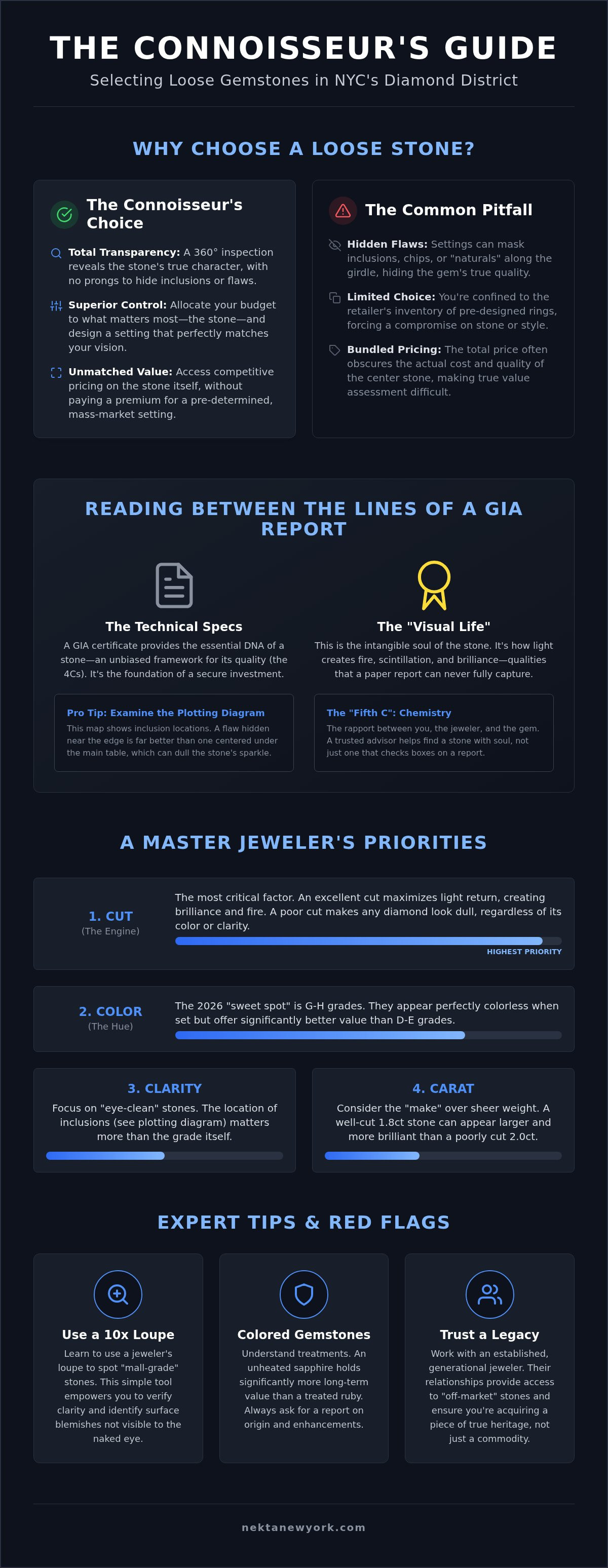
Transparency is the hallmark of a true luxury experience. When a stone is already set, the prongs or the bezel can hide inclusions or "naturals" along the girdle. A loose stone allows for a complete, 360-degree inspection. You can view the pavilion, the crown, and the table without any obstruction. It's the only way to truly verify the "visual life" and light performance of the gem before you commit to the purchase. You're seeing the diamond in its most honest state.
A master jeweler acts as your ultimate filter in this high-pressure environment. Thousands of stones pass through the Diamond District every day, but only a small fraction meet the standards of a true connoisseur. We look for stones that "talk" to us. This means evaluating the "make" of the diamond, ensuring the proportions create maximum light return rather than just hitting a specific carat weight. It's the difference between a stone that looks good on a certificate and one that commands attention from across the room.
The Customization Advantage
Pairing a high-end stone with custom wedding bands NYC creates a cohesive, signature look that feels personal. You have the freedom to allocate your budget precisely where it matters most to you. Perhaps you prefer a flawless center stone with a minimalist band, or maybe you want a unique, non-traditional shape like an elongated cushion or a sharp-cornered radiant. Buying loose gives you the creative control to build a piece that reflects your individual story.
The Heritage of 47th Street
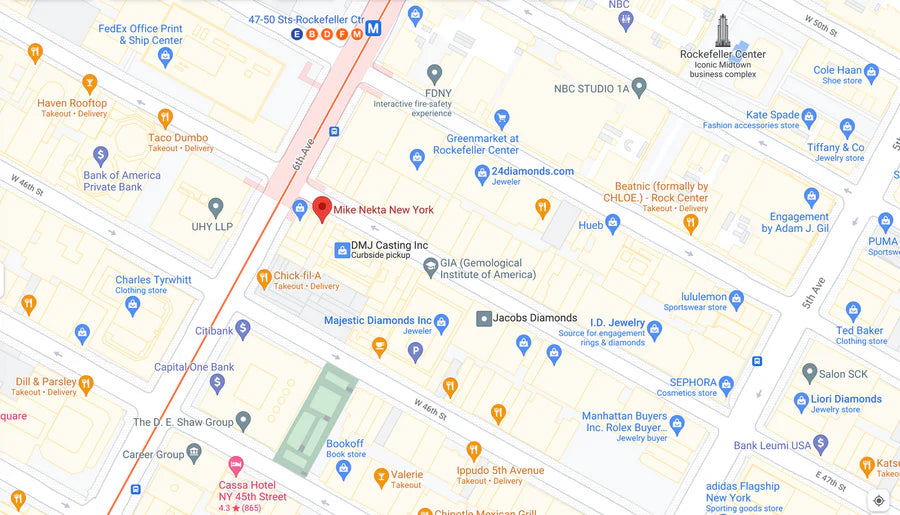
The history of Manhattan's jewelry trade is built on trust and generational expertise. As a third-generation jeweler, Mike Nekta New York utilizes decades of established relationships to source stones that never even reach the public market. These "off-market" gems often possess superior fire and scintillation. Visiting our physical boutique provides a level of security and personal consultation that online algorithms simply can't replicate. You aren't just buying a stone; you're securing a piece of New York’s rich jewelry heritage.
The Connoisseur’s Criteria: Evaluating GIA Certified Stones
A GIA certificate is your entry ticket to a secure investment, but it isn't the final word on a stone's beauty. While the 4Cs provide a technical framework, a true connoisseur looks for "visual life." This is the intangible way a diamond interacts with light to produce fire and scintillation. When you're comparing diamond district loose diamonds, you'll find that two stones with identical grades on paper can appear vastly different in person. One might feel flat, while the other radiates energy. GIA certification remains the gold standard because it offers an unbiased, third-party verification of a stone's DNA, ensuring you aren't overpaying for perceived quality.
Reading a GIA report like a professional means looking beyond the letter grades. I always advise my clients to examine the "plotting diagram" first. This map shows exactly where inclusions are located. A small crystal hidden under the crown facets is often invisible to the naked eye, whereas the same inclusion directly under the table can dull the stone's brilliance. This level of scrutiny is what I call the "Fifth C": Chemistry. It's the rapport between the buyer, the jeweler, and the gem itself. You need a trusted advisor who will tell you to pass on a stone that meets every technical requirement but lacks the soul required for a legacy piece.
Prioritizing Cut and Color in 2026
In the current market, the cut grade is the most critical factor for round brilliant cut engagement rings. It acts as the engine of the diamond. If the cut is poor, the stone will look dark regardless of its color or clarity. For color, we're seeing a trend toward the "sweet spot" of G and H grades. These stones look perfectly colorless to the eye when set in precious metals but offer significantly better value than D or E grades. Be mindful of fluorescence; in natural New York light, a strong blue fluorescence can sometimes make a diamond look oily or hazy, though in lower color grades, it can actually help the stone look whiter.
Shape-Specific Selection Tips
Fancy shapes require a specialized eye for proportions. For emerald cut engagement rings, the length-to-width ratio is paramount to achieving that sophisticated "hall of mirrors" effect. When you're debating an oval vs pear engagement ring, you must check for the "bow-tie effect." This is a dark shadow that can stretch across the center of elongated cuts. A master jeweler helps you find the rare stones where the facets are aligned so precisely that this shadow is virtually eliminated. You can begin your search by exploring our curated loose stones to find a gem that truly speaks to you.
Standout Sapphires and Rubies: The New Luxury Standard
While many visitors to 47th Street focus solely on traditional diamond district loose diamonds, the 2026 market shows a sophisticated shift toward high-carat colored gemstones. Sapphires and rubies are no longer merely "alternatives" to diamonds; they've become the primary choice for connoisseurs seeking a unique legacy piece. The allure lies in the depth of color and the rarity of large, investment-grade stones that command attention in any room. Selecting these gems requires a different set of skills than grading a diamond. While diamonds are judged on their lack of color, sapphires and rubies are valued for the intensity, hue, and saturation of their primary shade.
Understanding heat treatment is vital for any serious buyer. Most colored stones undergo standard heating to enhance their natural color and clarity. It's a stable and accepted process. However, "no-heat" stones are geological miracles that possess their vivid color naturally. These untreated gems command a significant premium because of their extreme rarity. When evaluating clarity, we don't look for the microscopic perfection required in diamonds. Instead, we look for "eye-clean" stones where inclusions don't interfere with the gem's brilliance or structural integrity. Origin also plays a pivotal role in value. Mozambique rubies are currently prized for their vibrant, consistent red, while Madagascar has emerged as a premier source for velvety blue sapphires that rival the historic Kashmir mines.
Featured Loose Sapphires from the Nekta Collection
Our current inventory features stones that define the 2026 luxury standard. The 7.95 Carat Oval Cut Heat Blue Sapphire is a masterclass in scale and color intensity, perfect for a center stone that requires no further embellishment. For those who appreciate the geometric precision of step cuts, we often compare our 4.29 Carat and 7.31 Carat Octagonal Blue Sapphires. The larger stone offers a deep, architectural presence, while the 4.29 Carat gem provides a concentrated burst of brilliance. If you prefer a more graceful, elongated silhouette, the 4.43 Carat Pear Cut Heat Blue Sapphire offers a unique aesthetic for a custom-designed pendant or a signature engagement ring.
Exquisite Loose Rubies for Custom Creations
Rubies represent the pinnacle of passion and prestige. The 4.33 Carats Oval Cut Heat Red Ruby from Madagascar is AGL certified, providing the peace of mind that comes with elite laboratory verification. For a vintage-inspired setting, the 2.68 Carats Heat Red Ruby in a cushion cut offers a soft, romantic glow that pairs beautifully with yellow gold. If your goal is a high-impact statement piece, the 6.18 Carats Oval Cut Red Ruby stands as one of the most impressive stones in the district. Its sheer size and fire make it a rare find even among the most competitive diamond district loose diamonds and gemstones.
Avoiding Common Pitfalls in the NYC Diamond District
The Diamond District is a theater of light and high-pressure sales. It's easy to get swept up in the excitement of 47th Street. However, many "deals" found in this square block involve "mall-grade" stones masquerading as luxury items. These diamonds might have technical grades that look acceptable on paper but lack the fire and scintillation that define a true investment. You shouldn't purchase diamond district loose diamonds without seeing them under a 10x loupe. This tool reveals the truth that a certificate can't capture. It allows you to see if an inclusion is a tiny, harmless crystal or a structural feather that could compromise the stone's longevity over time.
Beyond the physical stone, you must evaluate the business behind the counter. Ask about the return policy and the long-term upgrade path. A reputable jeweler who believes in the value of their inventory will offer a clear way to trade up in the future. For those investing in custom bridal jewelry NYC, an independent appraisal is a vital step. It confirms that the stone you've selected matches the value stated on your invoice. This provides necessary documentation for insurance and peace of mind for your legacy piece.
Questions to Ask Your Jeweler
To separate the exceptional from the average, you need to ask the right questions. Start by asking if the stone is truly "eye-clean." A certificate might list a VS2 grade, but the location of the inclusion matters. If it's visible to the naked eye, it shouldn't command a luxury price. Inquire how the cut grade affects the stone's scintillation. A diamond with a "Good" cut grade will never sparkle like one with an "Excellent" grade, even if the carat weight is identical. Finally, always ask to see the stone next to higher and lower color grades. This comparison reveals the subtle yellow or brown tints that might otherwise go unnoticed.
The Importance of Lighting
Jewelers use specific "spotlights" designed to make every stone dance. While beautiful, this lighting can mask flaws. Always evaluate your potential purchase in both the showroom light and natural daylight. This is especially true for colored stones. For example, the blue in our 4.85 Carat Oval Blue Sapphire will shift from a deep, velvety navy in soft light to a vibrant electric blue under the sun. Similarly, the primary red hue of a 3.22 Carats Oval Ruby should be tested for intensity. If the stone looks pink or purple in certain lights, it's not a true red. You can browse our verified loose gemstones to see how we prioritize color consistency across all environments.
Start Your Custom Journey with a Mike Nekta Loose Stone
The search for diamond district loose diamonds often begins with a focus on technical data, but it ends with a vision of a finished masterpiece. Once you've secured a stone that possesses the right visual life and provenance, the next stage is the transition to handcrafted jewelry. This is where Mike Nekta’s third-generation expertise truly shines. We don't just place a gem in a stock setting; we engineer a home for it that enhances its unique dimensions. Our artistry elevates a loose gem into a legacy piece that will be cherished for generations, ensuring the metalwork is as exceptional as the stone it holds.
In 2026, we're seeing a distinct move toward settings that offer subtle, architectural interest. Hidden halos, which provide a secret sparkle visible only to the wearer, are increasingly popular for those who appreciate "quiet luxury." We're also seeing a surge in mixed metal designs, such as pairing a platinum head with a rose gold band to emphasize the warmth of a specific ruby or the crispness of a high-color diamond. These details ensure your ring is a reflection of modern elegance while respecting classical proportions. It's about creating a balance where the setting supports the gem without overshadowing its natural fire.
From Loose Gemstone to Bespoke Masterpiece
Visualizing how a stone will sit on the hand is a skill honed over decades. Whether you're considering a princess cut diamond ring or an avant-garde pear shape, the setting must provide both security and maximum light exposure. Our custom design process in the heart of Manhattan typically spans three to six weeks, allowing for meticulous hand-casting and stone-setting. To ensure the longevity of your investment, we provide professional maintenance schedules, including biannual prong inspections and ultrasonic cleanings. This care preserves the structural integrity of the metalwork and the brilliance of the gem for a lifetime of wear.
Browse the Exclusive Collection
You don't need to be physically present on 47th Street to begin your selection process. Our digital gallery allows you to explore over 280 unique loose gemstones currently in stock. Every stone is accompanied by high-resolution imagery and its original GIA or AGL certification, providing total transparency before you even step into our boutique. Once you've identified a few stones that resonate with your style, we invite you to book a private consultation. This allows us to present the gems in person, under varying light conditions, ensuring your final choice is one of absolute confidence. View the Mike Nekta Loose Gemstone Collection to find the foundation of your next signature piece.
For those interested in how technology and digital platforms are reshaping these high-end shopping experiences, you can learn more about Jewelry eCommerce to explore the latest industry strategies.
Secure Your Legacy in the Heart of Manhattan
Finding the perfect gem requires more than a technical report; it demands a connection with a stone that possesses true visual life. You now have the tools to navigate the competitive world of diamond district loose diamonds with the confidence of an insider. By prioritizing cut quality, understanding the nuances of unheated colored gemstones, and utilizing a 10x loupe, you've moved beyond the average shopper to become a true connoisseur. The journey from a certified loose stone to a handcrafted heirloom is a path paved with precision and heritage—and for those looking to create a diamond from the ashes or hair of a loved one, you can click here to learn about Diamond Cremations.
At our boutique in NYC’s iconic Diamond District, we blend third-generation family expertise with a strictly GIA and AGL certified inventory to ensure your investment is sound. We invite you to Browse GIA Certified Loose Diamonds & Gemstones to discover a piece that speaks to your unique story. Whether you're seeking a rare ruby or a brilliant round diamond, the right stone is waiting to be the foundation of your next signature piece. Your custom journey starts with a single, exceptional spark.
Frequently Asked Questions
Is it cheaper to buy loose diamonds in the NYC Diamond District?
Yes, buying here is typically more cost-effective because the concentration of direct importers and wholesalers on 47th Street eliminates many middleman markups. Purchasing diamond district loose diamonds allows you to separate the price of the gem from the setting. This transparency often results in significant savings compared to traditional luxury retail boutiques where the total price is bundled and less flexible.
What is the difference between a GIA and an AGL certificate for loose stones?
GIA is the premier global authority for diamond grading, focusing on the technical 4Cs. AGL specializes in colored gemstones, offering deeper insights into origin and specific heat treatment details. While a GIA report is the gold standard for diamonds, an AGL certificate is often preferred for high-end rubies and sapphires to verify their natural color intensity and geographical provenance.
Can I bring my own setting if I buy a loose diamond from Mike Nekta?
We usually recommend against using outside settings to maintain our strict standards of craftsmanship. Our bespoke settings are engineered precisely for the unique girdle thickness and depth of the stones we source. Using a pre-existing setting can compromise the security of the stone or result in poor light performance. We prefer to build a custom home for your gem from the ground up.
How do I know if a loose sapphire has been heat-treated?
You must verify the treatment status through a laboratory report from a reputable body like GIA or AGL. These documents will explicitly state if a stone is "unheated" or has undergone standard thermal enhancement. While heat treatment is common and stable, unheated stones are geological rarities that command a much higher premium due to their natural purity and color saturation.
What is the most important "C" when buying a loose diamond for an engagement ring?
Cut is the most critical factor because it serves as the engine of the stone’s brilliance. A diamond with perfect color and clarity will still look dark or "dead" if the cut is poor. Prioritizing an "Excellent" cut ensures the facets are aligned to maximize light return. This creates the fire and scintillation that most people associate with a high-quality luxury diamond.
Do loose gemstones come with a warranty or guarantee?
Authenticity is guaranteed by the independent laboratory certification that accompanies every stone. While a raw gem doesn't have a "warranty," we provide a lifetime guarantee on the craftsmanship of the custom setting we create for it. We always advise our clients to have their stones independently appraised and insured immediately to protect against loss, theft, or accidental damage during daily wear.
How can I verify that the diamond I receive is the one on the GIA report?
Most GIA-certified diamonds feature a microscopic laser inscription on the girdle that matches the report number. You can easily view this using a 10x jeweler’s loupe during your consultation. Additionally, we match the unique "plotting diagram" of internal inclusions to the physical stone. This ensures the diamond’s DNA perfectly aligns with the documentation provided at the time of sale.
What should I look for when buying a loose ruby for a custom ring?
Prioritize the primary red hue and ensure the stone doesn't have strong secondary tints of purple or orange. When you are sourcing diamond district loose diamonds or rubies, the intensity of the color is the primary driver of value. You should also check the AGL report for origin and heat treatment status; rubies from specific regions like Mozambique are currently highly prized for their vibrant saturation.