
The Connoisseur’s Guide to Cushion Cut Diamonds: Vintage Soul Meets Modern Brilliance
What if the most romantic diamond in the vault isn't the one currently dominating your social media feed? While many couples begin their journey admiring the architectural lines of emerald cut engagement rings, they often discover a longing for something with more internal fire and a softer, pillowy silhouette. You want a stone that feels like a storied heirloom but performs with the brilliance of a modern masterpiece. It's natural to feel anxious about technical pitfalls like light leakage or to worry that a particular cut might look smaller than its actual carat weight. You deserve a diamond that looks as substantial as it feels.
This guide will transform you from a curious shopper into a true connoisseur. We'll demystify the complex world of cushion facet patterns, from "crushed ice" to "chunky" antique styles, so you can choose with absolute certainty. You'll learn how to master elongated ratios and understand the 2026 market shifts to ensure your proposal is backed by both beauty and value. By the end, you'll understand exactly why the cushion cut remains the ultimate choice for those who refuse to compromise on character or sparkle.
Key Takeaways
- Trace the lineage of the cushion cut from its 19th-century "Old Mine" origins to the high-brilliance masterpieces of today.
- Identify the technical differences between "crushed ice" and "chunky" faceting to ensure your diamond reflects your personal aesthetic.
- Compare the architectural appeal of emerald cut engagement rings with the soft, romantic silhouette of square and elongated cushion ratios.
- Learn how to evaluate the 4Cs specifically for cushion shapes, focusing on why "eye-clean" clarity and higher color grades are essential for this cut.
- Gain the confidence to select a GIA certified loose stone and collaborate on a custom setting that honors your unique investment.
What is a Cushion Cut Diamond? The Legacy of the 'Old Mine Cut'
The cushion cut is a masterpiece of architectural balance. It's defined by a square or rectangular silhouette with rounded corners, creating the soft, pillow-like appearance that gives the cut its name. For over two centuries, this shape has represented the pinnacle of diamond artistry. While many sophisticated buyers visit our Manhattan showroom looking for the hall-of-mirrors effect found in emerald cut engagement rings, they often pivot to the cushion when they see its superior fire. It acts as a bridge between two worlds. You get the intense light performance of a modern round brilliant, but you keep the distinct, non-circular character of a fancy shape.
Today, the cushion cut is experiencing a massive resurgence. In 2026, we're seeing a definitive shift toward vintage-modern aesthetics. Couples want jewelry that feels substantial and grounded in history, yet performs perfectly under modern LED lighting. The cushion cut satisfies this craving for "soul" without sacrificing the precision of 21st-century diamond cutting. It's a curated choice for those who view their engagement ring as both a romantic symbol and a lasting investment.
The Evolution of Scintillation
Before the advent of electric light, diamonds were cut to perform in the shadows. The 19th-century "Old Mine Cut" was the predecessor to today's cushion, characterized by a chunky look that caught the low, warm frequency of candlelight. These antique stones featured high crowns and deep pavilions that created broad, dramatic flashes of light. Modern cushions have refined this heritage into the "Cushion Brilliant" style, which typically features 58 facets designed for maximum scintillation. The cushion cut is the most popular vintage-inspired shape of 2026.
Why Celebrities Choose Cushion Cuts
Social proof for this cut is undeniable. From the massive 15-carat stone worn by Kim Kardashian to the classic trilogy design chosen by Meghan Markle, the cushion cut is the preferred choice for those who want their jewelry to tell a story. There's a psychological comfort in its soft edges. It doesn't feel aggressive or overly industrial. Instead, it offers a romantic, approachable elegance that complements almost any hand shape.
The versatility of the cushion is its greatest strength. If you have shorter fingers, an elongated cushion can provide a lengthening effect similar to emerald cut engagement rings. If you prefer a more traditional look, the square 1:1 ratio offers a balanced, centered presence on the hand. It's a choice that honors the past while looking firmly toward the future, making it an ideal centerpiece for a custom-designed ring.
Anatomy of Brilliance: Crushed Ice vs. Chunky Cushion Cuts
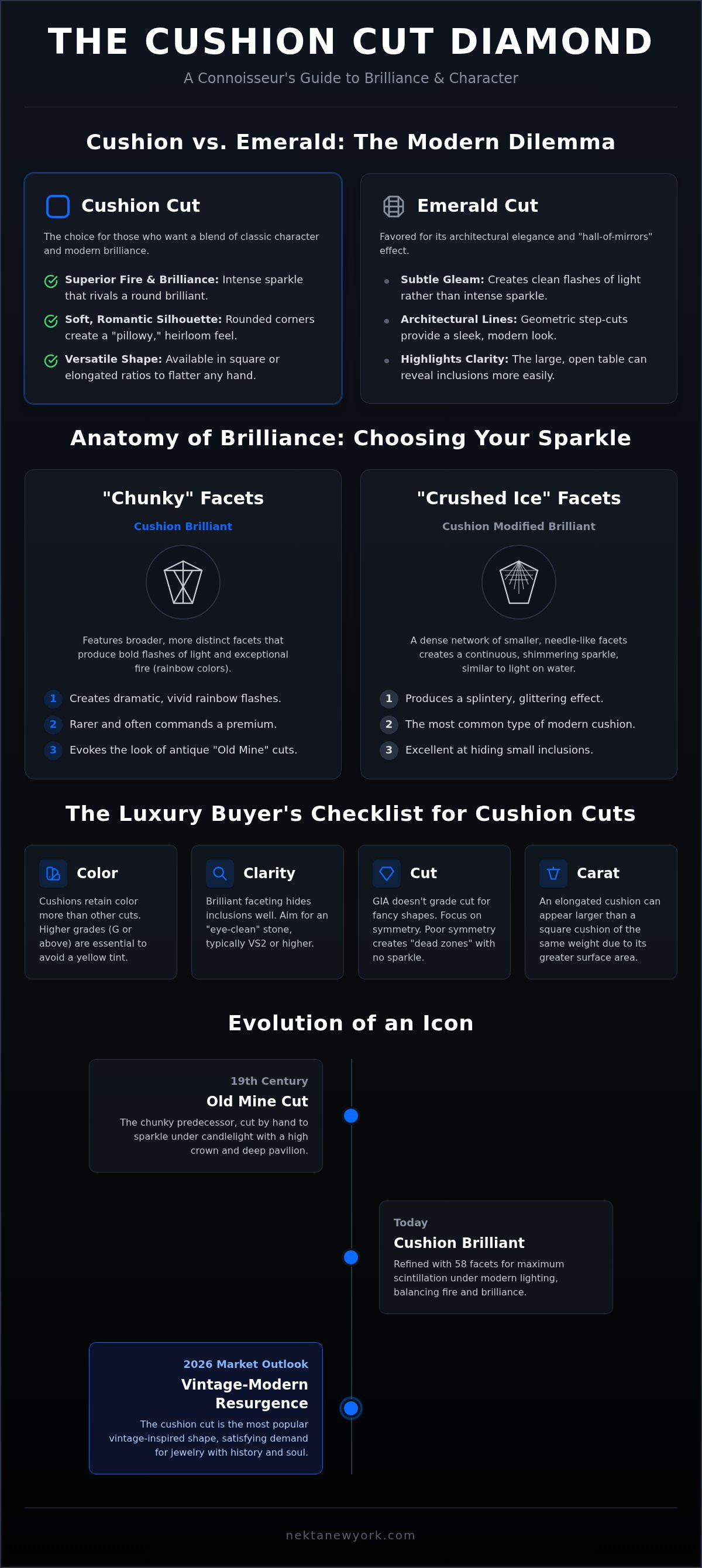
Choosing a cushion cut isn't as simple as picking a carat weight. You're actually deciding between two entirely different visual personalities. The "Crushed Ice" look, technically known as the Cushion Modified Brilliant, features a dense network of needle-like facets. It creates a shimmering, splintery sparkle that resembles light reflecting off a frozen lake. Conversely, the "Chunky" look, or the standard Cushion Brilliant, relies on broader, more distinct facets. These larger windows of light produce exceptional fire, those vivid rainbow flashes that dance across the stone's surface. While emerald cut engagement rings prioritize a clean, hall-of-mirrors effect, the cushion is all about how you want the light to play.
The experts at Mike Nekta New York treat facet symmetry as the "hidden" 5th C. A cushion can have perfect color and clarity, but if the symmetry is off, the light won't return to your eye. It results in a stone that looks dull or lopsided. A cushion requires a master's eye to ensure the rounded corners don't create "dead zones" where light simply disappears. We curate our selection to ensure every facet serves a purpose, maximizing the stone's natural energy and ensuring a life-long brilliance.
Decoding the GIA Certificate for Cushions
When you examine Loose GIA Certified Diamonds, pay close attention to the nomenclature. The "Cushion Brilliant" label is rarer and typically commands a premium because it requires more rough diamond to produce those chunky facets. Most stones on the market are "Modified," which allows cutters to save weight while still achieving high brilliance. However, a paper report can't capture the soul of the stone. You have to see how the light moves through the specific facet pattern to know if it's the right one for you.
Light Leakage and the 'Pillow' Effect
Light leakage is the enemy of the cushion cut. It happens when light passes through the bottom of the diamond instead of reflecting back up. You'll see this as a dark spot or a "leaky" center. To avoid this, check the crown height. A higher crown often leads to a more distinctive cushion "glow." A seasoned connoisseur's tip is to tilt the diamond to a 45-degree angle. If the stone maintains its depth and doesn't look "flat" or hollow from the side, you've found a winner. If you want to see these differences under a loupe, book a private consultation at our Manhattan office to compare these patterns side-by-side.
Square vs. Elongated Cushion Cut Engagement Rings
The silhouette of a cushion cut is determined by its length-to-width (L/W) ratio, a mathematical detail that defines the stone's entire personality. For the purist, the classic square cushion (ratio 1.00 to 1.05) offers a balanced, centered presence. It mimics the structural symmetry of an Asscher cut but replaces those sharp corners with a soft, pillowy embrace. However, as we move through 2026, the market is decisively shifting toward the elongated cushion. With ratios ranging from 1.15 to 1.30, these rectangular variations provide a modern twist on a vintage soul. While emerald cut engagement rings are celebrated for their clean, linear rectangularity, an elongated cushion offers a similar profile but with far more internal fire and brilliance.
One of the most compelling reasons to choose an elongated silhouette is the "visual weight" it carries. Carat weight is a measure of mass, not size. A square cushion often carries much of its weight in its depth, or "belly," which remains hidden once set. An elongated cushion spreads that same carat weight across a larger surface area. This results in a diamond that looks significantly larger than a square stone of the identical weight. It's a strategic way to maximize your investment while achieving a high-impact look on the hand.
The Rise of the Elongated Silhouette
The elongated cushion is dominating 2026 trends because of its exceptional ability to create a slimming, lengthening effect on the finger. This silhouette works beautifully in a minimalist solitaire setting, but it truly shines when paired with architectural side stones. We often recommend pairing these stones with tapered baguettes or cadillac side stones to enhance the rectangular geometry. For a deeper dive into these proportions, explore The Elongated Cushion Cut Guide to see how these masterclass silhouettes are redefining modern luxury.
Choosing the Right Ratio for Your Setting
Your choice of ratio should be influenced by your desired setting style. Square cushions are the foundation of the "Power" look, especially when encased in a shimmering halo. This combination creates a grand, cohesive sparkle that feels both regal and traditional. Elongated cushions, conversely, are the hallmarks of the "Quiet Luxury" aesthetic. They look most sophisticated in a delicate four-prong solitaire, allowing the unique length of the stone to take center stage.
- Square (1:1): The traditional choice. Balanced, symmetrical, and perfect for halos.
- Slightly Rectangular (1.1:1): A subtle departure from square. Offers a hint of length without losing the classic feel.
- Elongated (1.2:1+): The modern favorite. Maximizes finger coverage and mimics the elegance of emerald cut engagement rings while retaining superior scintillation.
The Luxury Buyer’s Checklist: Evaluating the 4Cs in Cushion Cuts
Mastering the 4Cs for a cushion cut requires a different lens than evaluating a standard round brilliant. While the step-cuts of emerald cut engagement rings are legendary for showing off clarity, the cushion's large table presents its own set of challenges. Because cushions are often cut deeper to maximize weight, they tend to retain more body color than other shapes. You can't simply rely on a GIA certificate to tell the whole story. You need to understand how these technical specs translate into the physical beauty of the stone when it's sitting on a finger in Manhattan's natural light.
One of the most common pitfalls for luxury buyers is the "bottom-heavy" cushion. Many stones carry significant carat weight in their pavilion, the bottom portion of the diamond, which remains hidden once the stone is set. This means you might pay for a 2-carat diamond that has the visual "spread" of a 1.75-carat stone. We prioritize stones with a balanced distribution of weight, ensuring that the value you invest is visible on the surface. Unlike round diamonds, GIA doesn't provide a "Cut Grade" for cushions. You must evaluate the polish and symmetry yourself, looking for a harmonious flow of light rather than a standardized rating.
The 'Color Trap' in Fancy Shapes
Cushion cuts are notorious for concentrating color. A 'J' color diamond that looks perfectly white in a round brilliant will often show a visible yellow tint when cut into a cushion. For a crisp, icy look in a platinum or white gold setting, we strongly recommend staying at an 'H' color or better. If you prefer the warmth of a yellow gold band, you can occasionally "cheat" the grade and opt for an 'I' or 'J' stone, as the metal's reflection masks the diamond's natural tint. The ideal depth percentage for a high-performing cushion is between 61% and 68%.
Finding the 'Eye-Clean' Sweet Spot
Clarity in a cushion is about placement. A VS2 grade might be "eye-clean" in a round stone, but if the inclusion is located directly under the large, open table of a cushion, it will be visible to the naked eye. We categorize inclusions as either "Table Inclusions" or "Pavilion Inclusions." The latter are often masked by the stone's natural scintillation, while the former are deal-breakers. Because of these nuances, Mike Nekta New York recommends a personal inspection or high-definition video for any stone graded under VVS2. For those who prioritize maximum sparkle and find the cushion's glow too soft, exploring Radiant Cut Engagement Rings may offer the intensified brilliance you desire.
Selecting the perfect stone is a curated process that goes beyond the paper report. To see how these 4Cs interact in person, book a private viewing at our NYC showroom and let us help you find a diamond that exceeds every technical standard.
Designing Your Custom Cushion Cut Ring with Mike Nekta New York
The transition from selecting a loose stone to wearing a finished masterpiece is where your personal story truly begins. In 2026, the "Personalized Legacy" ring has become the standard for the discerning buyer. You aren't just looking for a piece of jewelry; you're commissioning a work of art that reflects a shared history. While the architectural appeal of emerald cut engagement rings is undeniable, a custom cushion setting offers a softer, more fluid narrative for the wearer. At our Manhattan showroom, we guide you through this transition with the precision that only third-generation expertise can provide.
A custom setting is the architectural frame for your diamond. We offer several curated styles to suit your aesthetic:
- The Hidden Halo: Adds a secret layer of brilliance visible only from the side profile, perfect for those who appreciate subtle details.
- The Cathedral Setting: Provides a dramatic lift, elevating the cushion cut to its rightful place of prominence on the hand.
- The 'Nekta Signature' Solitaire: A minimalist design engineered to let the stone breathe, maximizing light entry from every angle.
Being located in the heart of the Manhattan Diamond District gives us unparalleled access to the world's finest inventory, ensuring your setting is as elite as the stone it holds.
The Mike Nekta New York Signature Process
Our process is a marriage of high-tech precision and old-world artistry. We use advanced 3D CAD modeling to allow you to visualize every millimeter of your ring before we touch the metal. Once the design is perfected, our master craftsmen hand-finish the piece to ensure it meets our exacting standards. Every custom creation is backed by a rigorous GIA appraisal process, providing you with the ultimate peace of mind regarding your investment. To begin your journey, book a private consultation in NYC and experience the difference of a curated selection process.
Choosing Your Metal: Platinum vs. 18k Gold
The metal you choose acts as the backdrop for your diamond's performance. Platinum is the preferred choice for stones with a "crushed ice" effect, as its naturally cool, white tones enhance the stone's icy scintillation. If you've selected an antique-style cushion, 18k Rose Gold or Yellow Gold can provide a romantic warmth that honors the stone's 19th-century heritage. Regardless of the aesthetic, we insist on using ethically sourced materials for every custom piece. We believe that a ring representing a lifelong commitment should be built on a foundation of integrity and craftsmanship, ensuring it remains a cherished heirloom for generations.
Securing Your Legacy with a Masterpiece
Choosing a cushion cut is an exercise in discerning taste. It represents a rare intersection where romantic "Old Mine" heritage meets the precision of 21st-century engineering. While many are initially drawn to the linear clarity of emerald cut engagement rings, the cushion cut offers a unique warmth and fire that creates a more personal connection. You've learned how to navigate the technical nuances of facet patterns and why the "hidden" 5th C of symmetry is vital for a stone that truly glows.
Your journey shouldn't end with technical knowledge. It culminates in the hands of a craftsman who understands that a diamond is a curated investment. As a 3rd generation diamond expert, I focus on GIA certified loose diamonds that meet the highest standards of light performance. Every piece we create is handcrafted right here in the NYC Diamond District to ensure your ring is as unique as your story. Discover Your One-of-a-Kind Cushion Cut Engagement Ring at Mike Nekta New York. Your perfect diamond is waiting to be found; let's make it a reality together.
Frequently Asked Questions
Are cushion cut diamonds more expensive than round diamonds?
Cushion cut diamonds are generally 25% to 40% less expensive than round brilliant diamonds of the same carat weight and quality. This price gap exists because cutting a round stone results in significantly more raw diamond waste. Choosing a cushion allows you to invest more in a higher color grade or a larger center stone while maintaining incredible fire and a unique, vintage-inspired silhouette.
Does a cushion cut diamond look smaller than other shapes?
Cushion cuts can appear slightly smaller than other shapes because they are often cut deeper to maximize weight. Much of the diamond's mass sits in the "belly" rather than the surface. If you want more visual spread, consider an elongated ratio. While emerald cut engagement rings are famous for their large tables, a rectangular cushion provides similar finger coverage with far more internal sparkle.
What is the best ratio for an elongated cushion cut diamond?
The ideal ratio for an elongated cushion typically falls between 1.15 and 1.25 for a balanced look. This range provides a sophisticated rectangular silhouette without appearing too narrow on the finger. A ratio of 1.10 offers a subtle hint of length; anything above 1.30 begins to mimic the dramatic proportions of an oval, though it retains the classic, soft rounded corners of the cushion family.
Is 'crushed ice' better than a 'chunky' cushion cut?
Neither style is objectively better; the choice depends on your personal aesthetic preference. Crushed ice cushions feature smaller, needle-like facets that produce a shimmering, splintered sparkle similar to a radiant cut. Chunky cushions, or antique styles, have larger facets that create broad, distinct flashes of light. Most of our NYC clients prefer the chunky look for its vintage soul and superior performance in low-light environments.
What clarity grade is best for a 2-carat cushion cut ring?
For a 2-carat cushion, a VS2 clarity grade is typically the best balance of value and beauty. You must ensure the stone is eye-clean; inclusions under the large table are more visible than in round stones. If you prefer the architectural clarity of emerald cut engagement rings, you might find the cushion's facets too busy, but for most, a VS2 provides a flawless look to the naked eye.
Can I use a cushion cut diamond in a halo setting?
Cushion cuts are an exceptional choice for halo settings because their soft edges create a seamless transition to the surrounding diamonds. This combination is particularly effective for square cushions, as it emphasizes the pillowy silhouette while adding a layer of modern brilliance. A halo can make a 1.5-carat stone have the visual impact of a 2-carat diamond, making it a strategic choice for those seeking maximum presence.
Why doesn't GIA give a cut grade for cushion cut diamonds?
GIA doesn't provide a formal cut grade for cushion diamonds because their facet patterns vary too much for standardized scaling. Unlike round diamonds, which have a strict mathematical ideal, cushions are cut for character and individual light performance. You should instead evaluate the polish and symmetry grades on the report; then use your own eye to judge the stone's brilliance and ensure there are no dark zones.
How do I clean and maintain my cushion cut engagement ring?
Maintain your ring's brilliance by soaking it in warm water mixed with mild dish soap once a week. Use a soft-bristled toothbrush to gently clean behind the stone where oils and lotions accumulate. For professional care, visit our Manhattan showroom twice a year for a deep ultrasonic cleaning and a prong inspection. This ensures your diamond remains securely set and continues to sparkle with its original fire.