
Eye-Clean Diamonds: What the Term Means and How to Check
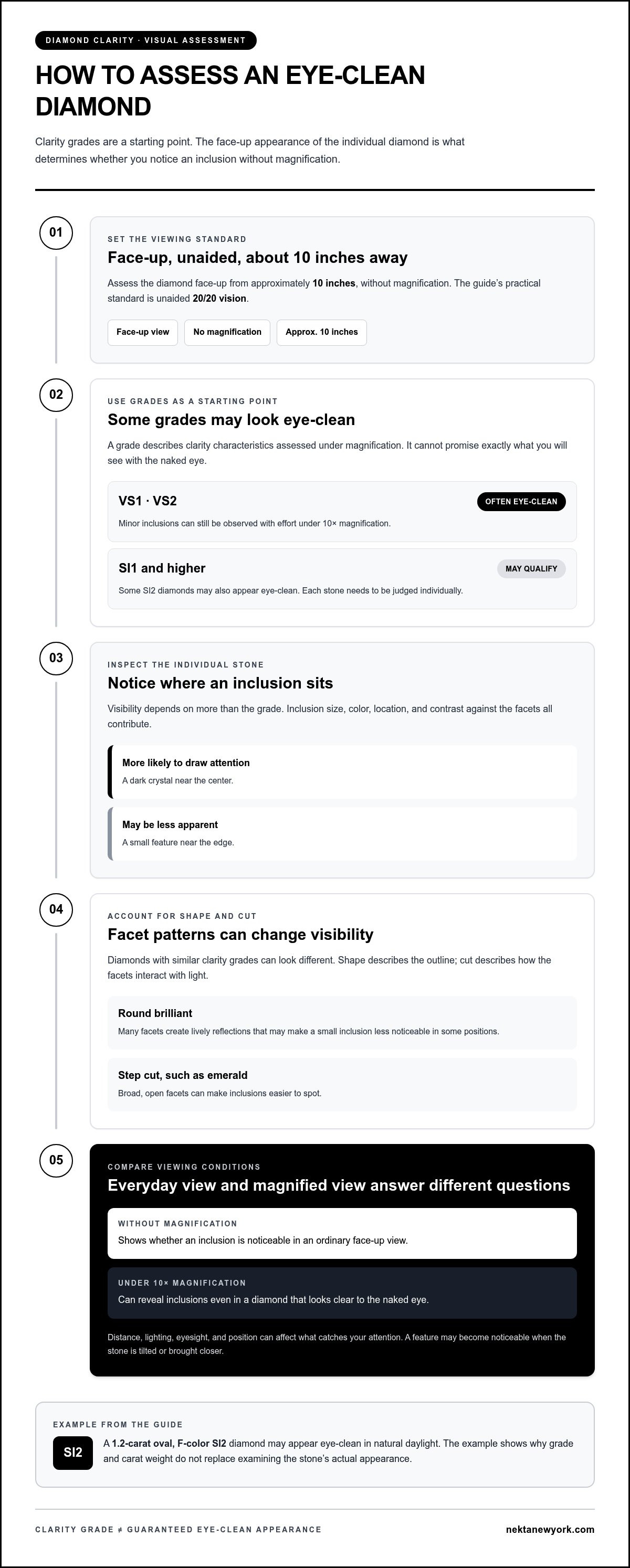
A diamond can be eye-clean without being flawless. If you’re asking what an eye-clean diamond really means, it’s a stone whose imperfections aren’t detectable with normal vision when viewed face-up from about 10 inches away, without magnification. The inclusions may still be visible under 10x magnification.
It’s natural to assume that a higher clarity grade guarantees a cleaner-looking diamond, but the grade alone can’t tell you exactly what you’ll see with the naked eye. This guide explains which clarity grades may qualify as eye-clean and why size, inclusion placement, and the individual stone matter. You’ll also learn how to assess a diamond online, including what to look for in a face-up 360° video, so you can judge its appearance with greater confidence.
Key Takeaways
- Learn how natural inclusions differ from surface blemishes, and why that distinction matters when assessing a stone.
- See why clarity grades can guide your search but can’t replace evaluating each diamond’s appearance.
- Understand how viewing distance, lighting, and magnification affect an eye-clean assessment.
- Find out what a grading report can tell you about clarity, and what it can’t determine about your naked-eye view.
- Use face-up 360° video to inspect an online diamond for visible inclusions before making a decision.
What is an Eye Clean Diamond?
To understand what an eye-clean diamond really means, focus on how it looks without magnification, not just its clarity grade. Its imperfections aren’t noticeable to the naked eye when viewed face-up from a few inches away, though a loupe may reveal them.
Inclusions and Blemishes
Inclusions are features inside a diamond; blemishes are marks on its surface. The distinction matters: inclusions form within the stone, while blemishes can develop after cutting and polishing.
Common natural inclusions include crystals, feathers, clouds, twinning wisps, and pinpoints. They may be visible under 10x magnification even when the diamond looks clear in ordinary viewing. Surface blemishes can include marks introduced during cutting or polishing. An eye-clean assessment concerns what you see without magnification, not whether a loupe reveals any feature.
Shape, Cut, and Inclusion Visibility
Shape describes a diamond’s outline, while cut describes how its facets interact with light. Both can affect how noticeable an inclusion is, so diamonds with similar clarity grades may look different.
A round brilliant’s many facets create lively reflections that may make a small inclusion less noticeable in some positions. Step cuts, such as emerald cuts, have broad, open facets that can make inclusions easier to spot. Placement matters, too: a dark crystal near the center may draw attention, while a small feature near the edge may be less apparent. Examine the face-up view rather than relying on shape or grade alone.
Diamond Size and Inclusion Visibility
A larger diamond can make inclusions easier to see because it has more surface area. For example, inclusions in a 1-carat diamond may be more visible than in a smaller stone.
Carat weight alone doesn’t reveal how noticeable a feature will be. Its size, color, location, and contrast against the facets all contribute to visibility. A 1.2-carat oval F-color SI2 diamond, for example, may appear eye-clean in natural daylight. That example shows why the grade and carat weight need to be considered alongside the diamond’s actual appearance.
SI1 and SI2 diamonds can contain inclusions noticeable under 10x magnification, yet often invisible to the naked eye. A clarity label such as “slightly included” describes the grade, not a promise that every stone looks identical. Inspect the stone face-up in ordinary viewing conditions, then consider how its inclusions appear under magnification. Those views answer different questions.
How much less do eye-clean diamonds cost than diamonds with higher clarity grades? The difference depends on the individual stone and its other characteristics, so there’s no single amount that applies to every diamond. A lower clarity grade may offer value when its inclusions don’t distract in ordinary viewing.
Ask the jeweler where the inclusions sit, what type they are, and whether they’re visible face-up without magnification. Also ask what the stone looks like under 10x magnification and in natural daylight. These specific questions help distinguish an eye-clean appearance from a grade that simply sounds favorable.
Definition of an eye-clean diamond
An eye-clean diamond is one whose imperfections aren’t noticeable to the naked eye, without magnification, when viewed face-up from a few inches away. The description refers to appearance under ordinary viewing conditions, not the absence of internal features. A diamond can look clear in an engagement ring while still showing inclusions under a jeweler’s loupe.
Viewing conditions matter. Distance, lighting, eyesight, and the diamond’s position can affect whether a feature catches your attention. A tiny mark that disappears in a face-up view may become noticeable when the stone is tilted or brought closer. That’s why “eye-clean” describes an appearance under particular conditions, not a fixed clarity grade shared by every natural diamond.
Diamond clarity and eye-clean appearance answer different questions. A clarity grade reflects characteristics assessed under 10x magnification, while an eye-clean judgment considers what someone can see without magnification. SI1 and SI2 stones, for example, can have inclusions noticeable under 10x magnification yet often invisible to the naked eye. The grade alone doesn’t show how prominent a particular inclusion looks face-up.
A GIA report can provide clarity information alongside an eye-clean assessment, which is subjective. The report gives a clarity grade, but “eye-clean” doesn’t guarantee that every viewer will see the stone the same way. Consider a round brilliant and an emerald cut with similar grades: their facet patterns differ, which can affect how an inclusion appears to the eye.
For a consistent assessment, view the diamond face-up at a natural distance without magnification, then compare it with the stone under magnification. The first view shows everyday visibility; the second helps explain the clarity grade. Clarity grading and an individual viewer’s eye-clean impression address different aspects of a diamond’s appearance.
Use the term as a practical visual description, not as a substitute for examining the stone. For a purchase decision, match the report’s clarity details with the diamond’s face-up appearance and the way you expect to view it. Exploring GIA-certified loose diamonds can be a useful next step when comparing documented clarity with visible appearance.
Which Clarity Grades are Eye Clean?
Clarity grades offer a useful starting point, but viewing conditions determine whether inclusions are visible without magnification. An eye-clean assessment typically means viewing the diamond face-up from approximately 10 inches, with unaided 20/20 vision. This gives you a practical standard for comparing stones, rather than judging from a close-up photograph or a jeweler’s loupe.
SI1 and higher grades may qualify as eye-clean, including some SI2 diamonds. VS1 and VS2 diamonds are often eye-clean, while their minor inclusions can be observed with effort under 10x magnification. The grade describes what an examiner sees under magnification, not exactly what every viewer will notice at ordinary distance. A clarity label alone can’t show an inclusion’s precise position, contrast, or visibility in a particular stone.
Included grades I1, I2, and I3 have inclusions noticeable to the naked eye. By contrast, inclusions in VS1 and higher grades are visible only under 10x magnification. These distinctions help narrow a search, but the face-up appearance still matters. A small, pale feature near a facet edge may draw less attention than a darker inclusion near the center.
Lighting can change what you see. View a diamond in natural daylight, then in bright indoor lighting, keeping it face-up and at a consistent distance. Don’t judge it only under a spotlight, where concentrated reflections can compete with inclusions for your attention. An emerald cut’s broad facets may make an inclusion easier to spot than a brilliant cut’s lively pattern, even when both diamonds share a clarity grade.
Use the same conditions when comparing grades. Hold each diamond about 10 inches away, look without magnification, and note whether a feature catches your eye immediately. Then view it under 10x magnification to understand what the clarity grade reflects. A flawless diamond has no inclusions or blemishes visible under 10x magnification, but an eye-clean stone needn’t be flawless. The distinction matters: you’re assessing visible appearance, not searching for a diamond with no inclusions at all.
For diamonds under one carat, VS or SI1 clarity may be suitable starting grades for an eye-clean search. Diamonds under 1.5 carats are also prime candidates for eye-clean VS2 and SI1 grades. Above 2.0 carats, give VS2 stones extra visual inspection; the larger surface can make inclusions easier to notice, and VS1 may be a useful grade to consider. A beautiful diamond is judged by its face-up appearance under ordinary viewing conditions, not its grade in isolation.
What is diamond clarity?
Diamond clarity describes the features a grader observes inside a stone and on its surface. According to GIA, its clarity scale contains 11 grades across six categories, from Flawless (FL) to Included (I3). The grade reflects how inclusions and blemishes appear under examination, not whether the naked eye sees them during everyday viewing.
According to GIA, graders assess clarity using a jeweler’s loupe at 10× magnification. They consider five factors when assigning a grade, and the final assessment depends on the diamond’s appearance under that loupe. This differs from an eye-clean judgment, which describes what someone sees without magnification. A stone can therefore have a clarity grade with visible features under magnification, yet look clean face-up.
GIA’s six categories make the scale easier to interpret. Flawless and Internally Flawless sit at the top; VVS and VS describe progressively more apparent inclusions, followed by SI and Included. The Included category comprises I1, I2, and I3. According to GIA, an FL diamond has no inclusions or blemishes visible under 10× magnification. An internally flawless diamond has no inclusions visible at that magnification, though surface blemishes may remain.
GIA developed standard clarity-grading terminology in the 1950s. Today, a GIA grading report can support transparency by recording a diamond’s assessed clarity, but it doesn’t turn “eye-clean” into a standardized grade. That description remains subjective because eyesight, viewing distance, lighting, and inclusion placement affect what a person notices. A report can help you understand the grade; the naked-eye appearance answers a different question.
Other grading laboratories also issue diamond reports. Read the issuing laboratory’s name alongside the clarity information, rather than treating “certified” as a clarity grade or a guarantee of a particular appearance. Compare the stated grade with the diamond itself, especially if an inclusion is near the center or contrasts strongly against the facets. Natural diamonds have individual clarity characteristics, so two stones with the same grade may not look identical.
For a useful comparison, first note the report’s exact grade and issuing laboratory. Then view the diamond face-up without magnification under ordinary lighting, and observe whether any feature draws your attention. Finally, use 10× magnification to connect the report’s grading language with the stone’s inclusions or surface blemishes. A slightly included grade may still look eye-clean, while a report alone cannot determine your personal impression.
Checking whether a diamond is eye-clean online
Online, a clarity grade can’t show precisely what your unaided eye will notice. Use the grading report and the diamond’s face-up images together, then study how inclusions appear as the stone moves. A 360° video is especially useful because it rotates the diamond while keeping its face-up view available for inspection.
Start with the report. Note the clarity grade and any plotted inclusions, then compare those details with the actual stone in the listing. A GIA report supports transparency around grading, but it doesn’t certify that every viewer will see the diamond as eye-clean. An internally flawless grade also doesn’t mean the diamond has no surface blemishes.
Next, inspect the image and video in a deliberate sequence:
- Begin face-up: Look at the diamond without zooming, as you would view jewelry during ordinary wear.
- Watch the full 360° rotation: Check whether a crystal, feather, or cloud becomes apparent as facets catch the light.
- Enlarge the high-definition loop: Inspect the diamond under 10x magnification to locate inclusions and compare them with report details.
- Return to the face-up view: Decide whether those features remain noticeable without magnification.
That final comparison matters. A close-up or microscope-style image can make tiny features look prominent, while a small screen can make details hard to distinguish. Neither view alone shows whether a stone looks eye-clean at a natural viewing distance. Look at the unzoomed image first, then enlarge it to understand what you’re seeing.
Pay particular attention to placement and contrast. A dark inclusion near the center may stand out more than a pale feature near the edge. In a larger diamond, inclusions may also be easier to notice because of the greater surface area. For example, compare a centered mark in the still image with its visibility in the rotating video.
Use the report and video as complementary evidence, not competing verdicts. If an SI1 or SI2 stone looks clear in the face-up view, magnified details may still explain its grade. Conversely, a VS2 label doesn’t establish that every individual diamond looks eye-clean. The stone’s position, inclusion pattern, and visible contrast matter more than the grade alone.
For a considered comparison, examine each candidate with the same viewing sequence and screen settings. Focus on whether an inclusion catches your attention before zooming, then check its location under 10x magnification. Compare GIA-certified loose diamonds with their grading details and face-up appearance before choosing a stone for jewelry.
Mike Nekta New York: Round Brilliant Cut Engagement Rings
Mike Nekta New York offers Round Brilliant Cut Engagement Rings for readers weighing a diamond’s visible clarity alongside its shape and setting. If you’re comparing eye-clean appearance with the character of different cuts, consider how a round brilliant’s facets look beside the broader lines of an emerald cut. Cushion and oval cuts offer further options to explore.
Use the clarity report and face-up appearance as guides, then focus on the cut that suits your preferences. Mike Nekta New York’s engagement ring selection includes these distinct shapes, making it a natural next step when you’re ready to consider the complete ring.
Contact Mike Nekta New York to continue your search.
Choose the Ring That Feels Like Yours
Understanding what an eye-clean diamond really means is one part of a personal decision. Next, choose a ring whose shape and presence feel right for the person who’ll wear it. A Round Brilliant Cut Engagement Ring makes a different impression from a Cushion Cut or Oval Cut design, so let your preferences guide the comparison.
Mike Nekta New York offers Round Brilliant Cut, Cushion Cut, and Oval Cut Engagement Rings. When you’re ready to consider how your diamond choice comes together in a ring, explore these designs and decide which direction reflects your taste.
Contact Mike Nekta New York to discuss your engagement ring search. Take the next step at your own pace, with a clearer sense of what matters to you.
Frequently Asked Questions
“Eye Clean” - What Does It Really Mean?
“Eye-clean” describes a diamond’s appearance to the unaided eye, not a special clarity grade. Use the phrase as a starting point when comparing stones, then consider what you notice in the face-up view. For example, an inclusion visible only in a magnified image may not affect the diamond’s appearance in jewelry. This distinction separates a grading label from your visual preference.
Should I look for a flawless diamond?
No, a flawless grade isn’t necessary for a diamond to look clear without magnification. A Flawless (FL) diamond has no inclusions or blemishes visible under 10x magnification, but lower clarity grades can also appear eye-clean. Consider whether you value the highest clarity grade or prefer to assess the stone’s visible appearance directly. The right balance depends on your priorities for the diamond, not the word “flawless” alone.
What are inclusions?
Inclusions are features inside a diamond, such as crystals, feathers, clouds, twinning wisps, or pinpoints. They form as natural diamonds develop, and their appearance varies from stone to stone. A crystal may look like a small point, while a feather can appear as a fine line. When evaluating a diamond, consider how its inclusions affect its appearance.
What are surface blemishes?
Surface blemishes are marks on a diamond’s exterior, not features inside it. They can occur after cutting and polishing. Depending on the severity, polishing or recutting may address a blemish. Polishing typically removes minimal weight, while recutting can reduce a diamond’s weight dramatically. This distinction matters when reading a clarity report: an external mark and an internal inclusion are different characteristics, though both contribute to clarity grading.
What does “eye-clean” mean for a diamond?
It means the diamond appears free of noticeable imperfections to the naked eye under ordinary viewing, even though magnification may reveal features. The phrase doesn’t mean the stone has no inclusions or that every viewer will see it identically. For example, a pale inclusion near the edge may be less distracting than a contrasting feature near the center. Focus on the appearance that matters to you, not just the label.
Is “eye-clean” an official GIA or industry grading term?
No. “Eye-clean” is a descriptive phrase, not a formal grade on the GIA clarity scale. A GIA report records a clarity grade based on examination, while eye-clean describes a stone’s appearance without magnification. GIA’s scale has 11 grades, from FL to I3, and does not include an SI3 grade. Use the report to understand clarity, then assess visible appearance separately.
How is eye-clean judged by viewing distance, lighting, and eyesight?
A common reference is face-up viewing from approximately 10 inches, with normal 20/20 vision and no magnification. Lighting affects contrast, so compare the diamond in natural daylight and ordinary indoor light rather than relying on a single dramatic spotlight. Keep the viewing distance consistent between stones. If a feature draws attention in one setting but not another, note which conditions best reflect how you expect to wear the jewelry.
What clarity grades are usually considered eye-clean, such as VS2 or SI1?
VS1 and VS2 diamonds are often eye-clean, and some SI1 or SI2 stones can be as well. A grade describes clarity under magnification, so it doesn’t determine naked-eye appearance by itself. For instance, two SI1 diamonds may differ because one has a pale inclusion near an edge and the other has a darker feature near its center. Compare each stone’s visible appearance with its report.