
Best Diamond Shape for Small Fingers: Buying Guide
Could the best diamond shape for small fingers be the one you least expected? Elongated silhouettes such as oval, pear, and marquise can draw the eye along the finger, but no shape is universally flattering. Orientation, band width, and the way the setting frames the stone all affect how balanced a ring looks and feels on your hand.
Online photos can make the choice harder: a ring may look elegant in a close-up but feel different when you consider your own finger proportions. Rather than follow a rigid size rule, compare the silhouette, setting, and band together, then consider how the ring feels when worn.
This guide compares popular diamond shapes and explains how orientation and setting details affect their appearance. Use the practical comparisons to narrow your choices, then consider how custom design can bring your preferred silhouette to life. Mike Nekta brings three generations of diamond expertise to a personal, collaborative approach to ring design.
Key Takeaways
- The best diamond shape for small fingers depends on how the complete ring looks and feels, not a fixed petite-hand rule.
- Compare oval, pear, and marquise outlines by their visual effect and style to find a silhouette that feels right for you.
- Consider how the setting, band, and center diamond work together to create the ring’s overall balance.
- Shortlist shapes, compare settings, and assess comfort. View rings from above and at natural angles when possible.
- Mike Nekta’s GIA-certified diamond expertise can help you turn your preferences into a considered custom design.
What makes a diamond shape flattering on small fingers?
Small fingers don’t rule out any particular diamond shape. A flattering choice is one that feels balanced on your hand, and balance depends on more than matching a stone to finger size. Consider how the diamond’s outline relates to your finger, how the band supports that outline, and whether the setting feels in scale with the whole ring.
It also helps to distinguish shape from cut quality. Shape describes a diamond’s face-up outline, such as oval, pear, round, or emerald. Cut quality describes how its facets and proportions are arranged and finished, influencing how light interacts with the stone. The terms are sometimes used interchangeably in everyday conversation, but they describe different things. This overview of diamond cut styles and history offers context on how diamond forms have developed.
A ring’s appearance depends on the relationship between its proportions and the wearer’s hand, so the same design can feel different from one finger to another. Universal rules about which shapes are flattering or unsuitable can overlook what matters most: your own sense of proportion and style.
How diamond proportions affect the hand’s appearance
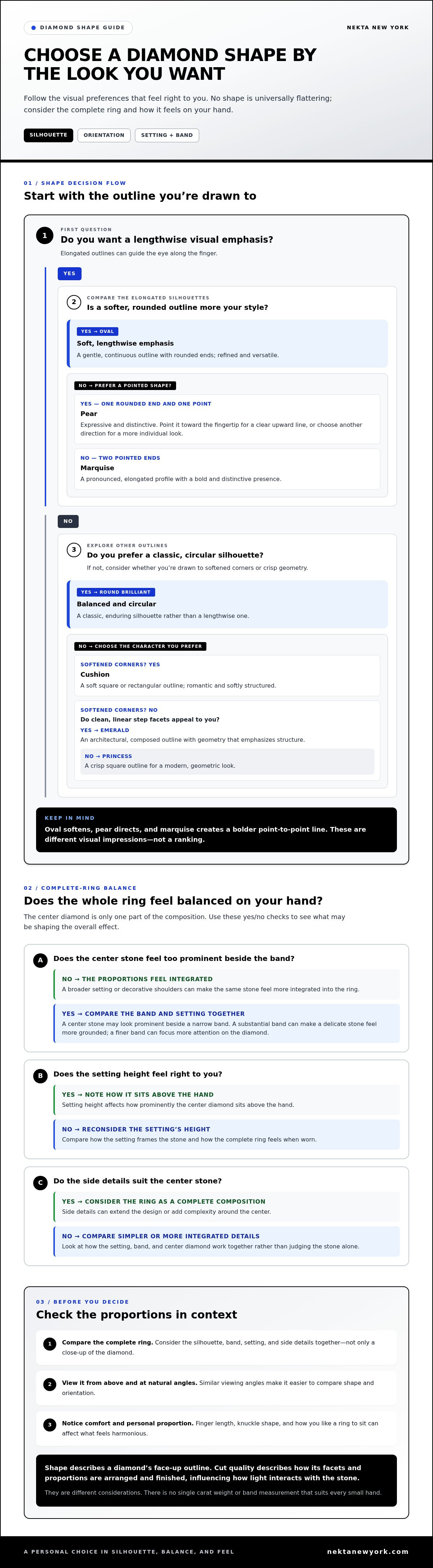
Elongated outlines can guide the eye along the finger. A marquise creates a pronounced tapered line, while an oval has a softer, continuous outline. A pear’s rounded end and pointed tip create a distinct direction, which changes with its orientation. Wider outlines draw attention across the finger instead. Neither effect is automatically better. Finger length, knuckle shape, and the way you like a ring to sit all influence what looks harmonious to you.
Why the whole ring matters as much as the center stone
The center diamond is only one part of the composition. Setting height affects how prominently it sits above the hand; band width contributes to the ring’s visual weight; and side details can extend the design or add complexity around the center. A substantial band can make a delicate stone feel more grounded, while a finer band can focus more attention on the diamond. The result depends on how these elements work together.
Overall scale matters, too. A center stone may look prominent beside a narrow band, while a broader setting or decorative shoulders can make the same stone feel more integrated into the ring. There’s no single carat weight or band measurement that suits every small hand. Compare the complete ring, not just a close-up of the diamond, and notice whether its proportions feel comfortable and personal when worn.
Which diamond shapes create the look you want on small fingers?
Elongated shapes often appeal to shoppers who want a lengthwise effect, but they aren’t the only graceful choice. To compare them, look beyond a simple “flattering” label. Consider the outline you’re drawn to, the direction it leads the eye, and the character you want your ring to express. The best choice is the shape whose proportions and style feel right to you.
Oval, pear, and marquise: comparing elongated silhouettes
An oval has a softly rounded outline, combining lengthwise emphasis with a gentle, familiar appearance. A pear pairs a rounded end with a tapered point, so its orientation changes the effect: point it toward the fingertip for a clear upward line, or choose another direction for a more individual look. A marquise has two pointed ends and a distinctive elongated profile. Its dramatic outline may appeal if you want a more pronounced silhouette.
| Shape | Visual impression | Style character | Details to consider |
|---|---|---|---|
| Oval | Soft, lengthwise emphasis | Refined and versatile | Its rounded ends create a gentler effect than pointed shapes. |
| Pear | A rounded end paired with a directional point | Expressive and distinctive | Orientation changes where the eye travels; the GIA discusses the pear cut diamond for finger elongation. |
| Marquise | A long outline with pointed ends | Bold and distinctive | Its pronounced shape has a strong presence, so consider how that suits your taste. |
| Round brilliant | A balanced, circular outline | Classic and enduring | It offers a traditional silhouette rather than a lengthwise one. |
| Cushion | A soft square or rectangular outline with rounded corners | Romantic and softly structured | Its softened edges temper the shape’s broader appearance. |
| Emerald | A linear outline with step-cut facets | Architectural and composed | Its clean geometry emphasizes structure over a tapered profile. |
| Princess | A crisp square outline | Modern and geometric | Consider it if sharp lines appeal more than an elongated shape. |
Oval softens, pear directs, and marquise creates a bolder point-to-point line. These are different visual impressions, not a ranking. Compare them from similar angles and notice which feels most harmonious with your hand and personal style.
Round, cushion, emerald, and princess: alternatives to consider
An elongated outline isn’t a requirement. Round brilliant diamonds offer a familiar, balanced shape if you value classic appeal. Cushion cuts pair softened corners with a square or rectangular form, while emerald cuts bring long, linear step facets and an architectural mood. Princess cuts suit those who prefer crisp geometry. Their effects differ, but no outline is automatically wrong for a petite hand.
When choosing between silhouettes, compare complete ring designs rather than treating shape as a rule. Mike Nekta creates custom engagement rings, bringing a preferred outline into a setting designed around your taste.
Can setting, band, and diamond size change the result?
Yes. A center diamond’s outline is only one part of the ring’s visual effect. The setting frames the stone, the band establishes the design’s visual weight, and the diamond’s face-up appearance affects how prominent it feels. A shape you love can look quite different in a delicate solitaire than in a design with a halo or decorative shoulders.
Fixed carat or band-width recommendations are best treated as examples, not rules. A petite hand doesn’t automatically call for a particular stone size or narrow band. Consider how the complete design looks and feels on your hand, including whether its scale suits your taste and everyday comfort.
Choosing a setting that supports the diamond’s silhouette
Prongs can leave much of the diamond’s outline visible, while a halo adds a border around the center and may make it appear more substantial. Side stones add width or movement, changing the ring’s overall shape. These details can complement a silhouette or shift attention away from it, so consider the setting as part of the composition, not just a finishing touch.
Setting height matters, too. A higher profile can give the diamond a more prominent presence, while a lower one may feel more discreet. Think about how the ring feels as you move your hand and whether you prefer a noticeable profile or a closer-to-the-hand look.
Balancing band width and center-stone presence
A delicate band leaves more visual emphasis on the center diamond and can make the design feel airy. A more substantial band adds visual weight and gives the ring a bolder, grounded character. Neither approach is inherently more flattering. The relationship between the band, setting, and center stone determines whether the finished ring feels cohesive.
Carat weight measures a diamond’s weight, not a guaranteed face-up size. Shape and proportions influence how much of the stone is visible from above, so diamonds of the same carat weight can have different visual presence. Compare complete rings side by side rather than choosing by carat number or band width alone.
As you compare, notice whether the band supports the center stone, whether side details create the balance you want, and whether the setting feels comfortable. A custom engagement ring design can bring those preferences together, so the finished proportions reflect your style rather than a generic measurement guide.
How can you compare diamond shapes before choosing a ring?
Online images can help you identify what you like, but they rarely show how a ring’s proportions relate to your own hand. Use a simple comparison process to turn general inspiration into a shortlist. When viewing rings, look at each from above and at natural viewing angles. Consider the complete ring, not just the center stone.
- Shortlist silhouettes you genuinely like. Choose two or three shapes that reflect your taste, such as oval, pear, round, or emerald. If you’re weighing two elongated options, this oval versus pear engagement ring guide can help you compare their character.
- Compare settings around those shapes. Notice how the band, prongs, and side details change the overall balance. If possible, keep the center shape consistent while comparing settings so you can see what the design contributes.
- Assess comfort as you move. Notice how the ring feels when your hand relaxes, curls, or reaches. A ring should feel at ease during ordinary movements, not only look appealing in a still image.
- Reflect on your personal style. Ask whether you’d choose the design even if it weren’t currently popular. Your own lasting preference is more useful than a trend when selecting a ring to wear.
Build a shortlist around the silhouette you love
Let your aesthetic preferences lead. A classic round outline may feel familiar and balanced; compare its character with the round brilliant engagement ring guide. If clean lines and step-cut facets appeal to you, the emerald cut engagement ring guide offers a different point of comparison. Keep your shortlist focused so you can assess each design on its own merits.
Assess comfort, proportion, and personal style together
As you compare, check whether the diamond feels visually balanced with the band and setting, and whether the ring remains comfortable during natural hand movements. Look at it from above, then from the angles you’d naturally see while wearing it. A photograph can’t fully convey that experience, so use images as references rather than a final verdict. Ask yourself: does the ring feel elegant, wearable, and like something you would choose for yourself?
There’s no need to force a decision from a checklist. Use the comparisons to clarify what you value, then let those preferences guide the design. Explore your shortlist with a personal design perspective.
How does Nekta New York help you choose a diamond shape?
You’ve considered silhouettes, settings, and how a complete ring might feel on your hand. The next step is to turn your shortlist into a design direction that reflects your preferences, rather than applying a fixed rule about what suits small fingers. Mike Nekta brings three generations of diamond expertise to this conversation as a GIA-certified diamond expert in Manhattan’s 47th Street district in New York City.
A collaborative consultation shaped around your preferences
A private in-store or virtual consultation gives you space to discuss the shapes you’re drawn to, the proportions you prefer, and the details that feel personal. You might explain what appeals to you about an oval’s softness, a pear’s distinctive point, or another silhouette, then consider how those preferences can guide the ring’s overall design. The conversation is collaborative, not a formula that treats every hand alike.
Mike Nekta New York has served New York City for over 50 years, with diamond expertise and design knowledge passed through three generations. Your questions, tastes, and priorities guide the discussion. If you’re still deciding which is the best diamond shape for small fingers, bring your shortlist and the qualities you want the ring to express. A focused conversation can help clarify which direction feels most like you.
From a favored diamond shape to a considered ring design
Once you have a favored outline, it can become the starting point for a custom engagement-ring design. Your preferred silhouette can inform the setting and the ring’s broader visual character, bringing the diamond and its design together as one considered piece. All center diamonds are GIA-certified.
You don’t need to arrive with every detail decided. A clear sense of what you like, along with the questions you still have, is enough to begin a collaborative design conversation. Whether your shortlist is decisive or still taking shape, personal guidance can help you refine it at your own pace.
Arrange a private consultation to discuss your preferred diamond shape and explore a custom engagement-ring design.
Let your favorite silhouette guide the next step
The right ring should feel like a natural expression of the person who will wear it, not a design chosen to satisfy a rule about hand size. Treat your shortlist as a starting point, and stay open to the details that make a favorite shape feel personal. The best diamond shape for small fingers isn’t a universal answer; it’s the one that feels balanced, comfortable, and meaningful to you.
Bring your ideas, questions, or saved designs to a private conversation with Mike Nekta. With third-generation diamond expertise, custom design guidance, and GIA-certified center diamonds, Nekta New York can help you explore a ring that reflects your preferences. Choose an in-store or virtual consultation and take the next step at a pace that feels right.
Arrange a private consultation with Mike Nekta and begin shaping a ring that feels unmistakably yours.
Frequently Asked Questions
Is there one best diamond shape for small fingers?
No, there isn’t one universal winner for the best diamond shape for small fingers. Oval, pear, and marquise shapes are often considered for their elongated outlines, while round, cushion, emerald, or princess shapes may better suit another aesthetic. Finger proportions, setting, comfort, and personal taste all matter. Compare complete rings rather than shape names alone, and choose a design you enjoy seeing on your hand.
Can a larger diamond look balanced on small fingers?
Yes, a larger diamond can look balanced if its overall design feels harmonious on the hand. Carat weight alone doesn’t determine prominence: the diamond’s outline, face-up dimensions, setting, and band all contribute. Rather than applying a universal carat limit, compare the complete ring on your hand. Notice whether it feels comfortable as you move and whether its presence matches the look you want, from discreet to eye-catching.
Do oval diamonds make fingers look longer?
An oval’s lengthwise outline can lead the eye along the finger, creating a possible impression of added length. It’s a visual effect, not a guarantee, and the result varies with hand proportions, setting, orientation, and personal taste. For a useful comparison, look at an oval beside another shape in similarly styled rings. This helps you decide whether you prefer the oval’s soft continuity or another outline’s character.
Are pear-shaped diamonds comfortable for everyday wear?
They can be comfortable, but the experience depends on the ring’s construction and how you wear it. Consider whether the setting protects the pointed tip, as well as your usual activities, such as putting on gloves or working with your hands. Pear diamonds can be oriented in different directions, changing their appearance. Consider both the chosen orientation and how the complete ring feels during ordinary movement.
Does diamond carat weight determine how large a stone looks?
No. Carat measures a diamond’s weight, not a guaranteed visible diameter or surface area. Different shapes and proportions can look different from above even at the same carat weight. If visual presence matters to you, compare stones face-up and view them in their intended settings. This gives a more practical impression than relying on carat weight alone, especially when comparing distinct outlines.
Can an engagement ring be adjusted to fit a small finger?
Yes. Ring sizing is separate from choosing a shape that feels visually balanced. Mike Nekta New York states that its listed rings can be adjusted to any size on request. As you plan a design, consider fit alongside the center diamond and setting: the ring should sit comfortably while its proportions reflect the look you prefer. A well-fitting ring makes it easier to appreciate the design in everyday wear.