
Are Diamonds a Good Investment in 2026? A Clear-Eyed Guide
What if a diamond’s most enduring value isn’t a financial return? If you’re searching “are diamonds a good investment 2026,” the answer depends on what you mean by investment. A diamond may hold personal significance and retain some value, but that doesn’t make it a predictable asset or an easy one to resell.
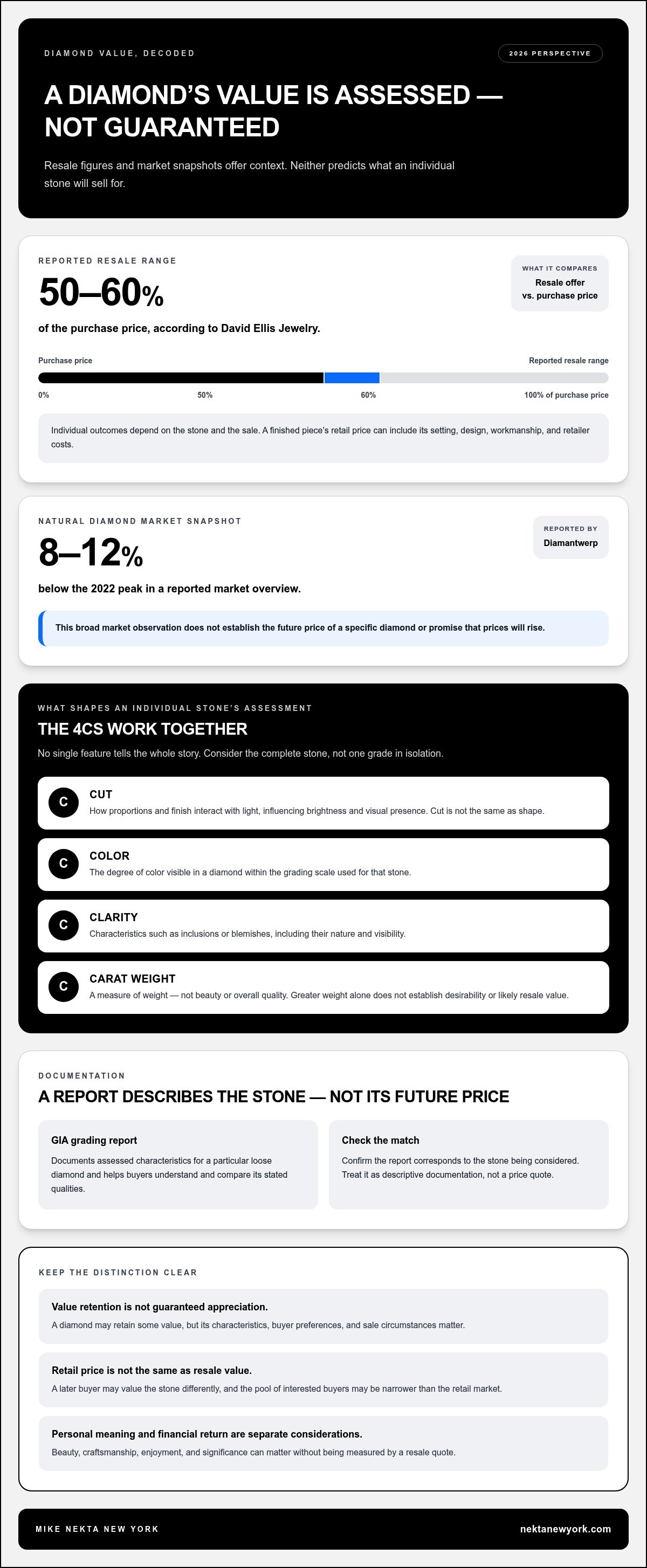
It’s understandable to be drawn to claims that rare stones appreciate, while wondering why resale offers can fall well below retail. David Ellis Jewelry reports that natural diamonds typically resell for 50% to 60% of their purchase price, though individual outcomes depend on the stone and the sale. The gap is a useful reminder that a purchase price and a resale value aren’t the same thing.
This guide separates potential value retention from promised returns. You’ll learn how cut, color, clarity, carat weight, rarity, and certification shape a diamond’s worth, and why natural and lab-grown diamonds have different market dynamics. Mike Nekta New York brings third-generation diamond expertise to the subject: a diamond can be a considered luxury purchase, but its financial case should be weighed separately from its beauty and personal meaning.
Key Takeaways
- When considering whether diamonds are a good investment in 2026, separate the possibility of retaining value from any expectation of financial returns.
- Learn how cut, color, clarity, carat weight, rarity, and buyer demand work together to shape a diamond’s appeal and value.
- Compare natural and lab-grown diamonds by origin, documentation, buyer priorities, and resale considerations. Don’t assume they follow the same market path.
- Use a practical purchase framework to clarify your purpose, review documentation, research resale, and keep essential financial goals in view.
- See how expert guidance, custom design, and loose GIA-certified diamonds can help align a jewelry choice with personal meaning and informed selection.
Are Diamonds a Good Investment in 2026? Start with the Meaning of “Investment”
Diamonds can carry personal and material value, but no return is assured. Whether are diamonds a good investment 2026 is the right question depends on what you expect an “investment” to do. A diamond may be treasured for its beauty, craftsmanship, or role in a meaningful occasion. Those qualities matter, but they’re different from financial appreciation.
Consider the difference between the price paid for a finished piece and a future offer for its diamond. Retail pricing reflects more than the stone alone. It can include the setting, design, workmanship, and retailer costs. A later buyer may value the stone differently, and the pool of interested buyers may be narrower than the retail market. Documentation can make a diamond’s characteristics easier to assess, but it doesn’t set a future sale price.
What does “a good investment” mean when the asset is a diamond?
Start by separating four possible reasons to buy: potential appreciation, preservation of value, enjoyment, and personal significance. These aims can overlap, but they aren’t interchangeable. Appreciation means an asset becomes more valuable; preservation means it may retain some value over time. Enjoyment and significance are real benefits, too, even though they can’t be measured by a resale quote.
Liquidity describes how readily an asset can be sold for a fair price. A diamond is not as straightforward to sell as cash or a widely traded security. Its individual qualities need assessment, and finding a suitable buyer may take time. Exceptional auction results can attract attention, but they reflect particular stones and circumstances. Don’t treat them as evidence of what an ordinary diamond will sell for. The Diamond overview offers useful context on the stone’s properties and history, while a specific purchase still needs individual evaluation.
A diamond can be a meaningful luxury purchase, but it isn’t a predictable, liquid investment. This distinction lets you value the pleasure and artistry of a piece without relying on an uncertain future sale to justify the decision. Much like acquiring rare decorative pieces or English country house furnishings through nwtiques.com, tangible luxury is often best approached for craftsmanship and personal enjoyment rather than speculative returns.
Why a 2026 outlook should not promise a return
Market observations describe a period; they don’t forecast the fate of a particular stone. For example, Diamantwerp reported on August 12, 2026, that natural diamond prices had stabilized after a correction and remained about 8-12% below their 2022 peak. That broad snapshot doesn’t promise prices will rise or establish what a specific diamond could sell for.
Diamonds differ in cut, color, clarity, carat weight, origin, documentation, and desirability. Buyer preferences and market conditions can change, too. A movement in an overall market measure may not apply equally to every combination of characteristics. No general outlook can reliably predict an individual stone’s future price.
Set expectations accordingly: choose with informed ownership in mind, not guaranteed profit or easy resale. If financial growth is your priority, assess a diamond differently from a piece chosen for its design or personal meaning. That distinction is a useful starting point for considering quality, rarity, and documentation.
What Determines a Diamond’s Value? Quality, Rarity, and Documentation
A diamond’s value isn’t captured by one feature or a simple formula. The 4Cs, rarity, buyer preferences, and reliable documentation all help describe and assess an individual stone. They can support an informed decision, but they can’t guarantee a future resale price. If you’re asking are diamonds a good investment 2026, understanding these factors is a more useful starting point than focusing on a single market headline.
How the 4Cs inform an individual diamond’s assessment
The 4Cs are cut, color, clarity, and carat weight. Each describes a different aspect of a diamond, and their combined effect matters more than any one grade in isolation.
- Cut describes how well a diamond’s proportions and finish interact with light, influencing its brightness and visual presence. Cut quality is not the same as shape: round, oval, and emerald are shapes.
- Color describes the degree of color visible in a diamond within the grading scale used for that stone.
- Clarity records characteristics such as inclusions or blemishes, including their nature and visibility.
- Carat weight measures weight, not beauty or overall quality. A higher carat weight alone doesn’t establish desirability or likely resale value.
Imagine two diamonds of equal carat weight. One may have a cut that produces lively brilliance, while the other may appear less bright. Their color, clarity, and overall appearance may also differ. Which is more appealing depends on the observer and intended use. A thoughtful assessment considers the complete stone rather than assuming that greater weight automatically means greater value.
Why provenance and certification matter, and where their limits are
A GIA grading report documents the characteristics assessed for a particular loose diamond, helping buyers understand and compare its stated qualities. Check that the report corresponds to the stone under consideration, and treat it as descriptive documentation, not a price quote.
A GIA grading report describes a diamond’s assessed characteristics; it cannot guarantee its market value, a future purchase offer, appreciation, or investment return. It is distinct from an appraisal, which estimates value for a specified purpose, and from an offer to purchase, which reflects a buyer’s decision at a particular time. Documentation makes a stone’s qualities more legible, not its future price certain.
Rarity also needs context. A combination of characteristics may be less common, but rarity alone doesn’t prove buyers will seek it out. Demand matters. Grand View Research’s Diamond Market Analysis provides broad industry context, but market-wide analysis cannot price an individual stone. Responsible-sourcing claims should also be supported by specific, reliable documentation; a grading report describes a diamond, not necessarily its supply chain.
For a careful review of a loose diamond’s qualities and documentation, expert diamond guidance can help turn technical details into a considered jewelry decision.
Natural vs. Lab-Grown Diamonds: Compare Value Without Assuming Returns
Natural and lab-grown diamonds differ in origin, but that distinction isn’t a shortcut to predicting financial performance. Both can be assessed for their characteristics and documented, while their market dynamics and buyer audiences may differ. If you’re asking are diamonds a good investment 2026, compare them as distinct purchases rather than assuming either category will appreciate.
What differs between natural and lab-grown diamonds?
A natural diamond forms through geological processes; a lab-grown diamond is created using technological processes. Origin doesn’t, on its own, determine how a stone looks. Appearance depends on the individual diamond’s characteristics, and grading documentation describes specified qualities rather than future financial performance. Review the report for the stone in question and note how it identifies the diamond’s origin.
| Consideration | Natural diamond | Lab-grown diamond |
|---|---|---|
| Origin | Formed through geological processes. | Created through technological processes. |
| Buyer priorities | May appeal to buyers who prefer geological origin or a particular stone’s individual characteristics. | May appeal to buyers whose priorities include lab-grown origin, appearance, or how the purchase fits their budget. |
| Documentation | Review the grading report and confirm it describes the diamond being considered. | Review the report and its description of origin and assessed characteristics. |
| Resale considerations | Potential offers depend on the individual stone, documentation, buyer demand, and sale channel. | Potential offers also depend on the stone, documentation, buyer demand, and sale channel. |
Market behavior changes, and a broad trend can’t predict a specific diamond’s future price. Faruzo reported on October 5, 2026, that lab-grown diamonds accounted for 51% of center stones in new U.S. engagement rings during the first half of 2026. That figure describes a segment of new engagement-ring purchases; it doesn’t establish resale demand or future returns for every lab-grown stone.
How to compare the categories as a purchase
Start with what matters to you. Decide how much the diamond’s origin matters, what appearance you prefer, and how the purchase fits your budget. Then compare the actual stones and their documentation, rather than relying on category labels alone. A GIA-graded loose diamond can be assessed through its report and individual qualities. The report is useful evidence, not a resale promise.
Think about your expected ownership period, too. If you expect to keep and wear the piece for many years, personal enjoyment may be central to the decision. If resale is a possibility, research likely sale channels and how they assess comparable stones before committing. Liquidity is not assured for either category, and a future offer can depend on timing, buyer interest, and the individual diamond’s details.
Choose natural or lab-grown according to your priorities, not an assumption that one origin guarantees stronger financial performance. This GIA-certified loose diamond guide explains what to examine in a grading report when comparing documented stones.
How to Assess a Diamond Purchase Before You Commit
A careful decision starts with your purpose, not a carat number or a prediction about future prices. Use the steps below to review a specific diamond, understand what its documents do and don’t establish, and decide whether the purchase fits your priorities. This framework can help answer “are diamonds a good investment 2026” without treating uncertain resale as a financial plan.
A practical checklist for reviewing a specific diamond
- Clarify your purpose. Decide whether you’re buying for personal significance, design, long-term enjoyment, or potential resale. If resale is central to your decision, recognize that the outcome is uncertain before you commit.
- Inspect the documentation. Match the grading report to the diamond and review its identifying details alongside the purchase documents. Keep copies together so you can refer to them later.
- Assess the full quality profile. Consider cut, color, clarity, and carat weight as a whole, and view the stone rather than relying on one grade. For a round brilliant, cut and design preferences can influence the look you value. This round brilliant engagement ring guide can help you understand the style’s visual considerations.
- Research resale realistically. Look for current, relevant information about comparable stones and possible sale channels. Treat asking prices as sellers’ stated expectations, not proof of completed sales or the amount you could receive.
- Make the financial decision. Set a personal spending limit that doesn’t draw on money needed for essential goals or near-term obligations. Buy only if the purchase still makes sense without assuming a future profit.
How to think about liquidity and resale before buying
A resale outcome depends on more than a diamond’s documented characteristics. The buyer, sale channel, timing, and transaction terms can all affect what you ultimately receive. Finding an interested buyer may take time, and transaction costs can reduce proceeds. Before purchasing, consider whether you’d be comfortable owning the piece if selling it proved slower or less favorable than expected.
For research, compare like with like: match relevant characteristics and documentation, and distinguish completed transactions from listings that remain unsold. If comparable sale evidence is limited, treat that uncertainty as part of your decision rather than filling the gap with an assumed resale price.
An appraisal or grading report describes a diamond or estimates value for a stated purpose; neither establishes the price a future buyer will pay. Preserve your purchase records and report so the diamond’s details remain accessible if you later need to reassess it.
For a considered selection grounded in quality and documentation, explore loose GIA-certified diamonds with Mike Nekta New York.
A Diamond’s Lasting Value: Choosing with Expert Guidance at Mike Nekta New York
A diamond may be worth considering for its beauty, craftsmanship, and personal meaning, but those qualities don’t promise financial appreciation. “Are diamonds a good investment 2026?” has no universal yes-or-no answer: a diamond’s future sale price depends on the individual stone and the market when it’s offered. A considered purchase starts with clarity about what you value and recognition that any possible resale is uncertain.
What expert guidance can contribute to a diamond purchase
Diamond expertise can make technical details easier to interpret. A knowledgeable specialist can explain grading, proportions, and how a particular stone’s characteristics relate to its appearance. That makes it easier to compare options against your priorities rather than relying on a single grade. Documentation also deserves careful attention: understand what it records and how it relates to the diamond being considered.
At Mike Nekta New York, a Manhattan Diamond District jewelry boutique led by a third-generation diamond expert, guidance connects those details with the intended piece. A buyer choosing a diamond for an engagement ring may prioritize a different look or setting from someone selecting a loose stone for another purpose. Custom design and loose GIA-certified diamond selection let you consider both the stone and how it will be worn.
Expertise can inform the decision; it cannot determine future demand. A specialist’s assessment doesn’t guarantee that a diamond will be easy to sell, appreciate, or produce a particular offer. Keep that distinction in view. The value of guidance is clarity about the choice in front of you, not certainty about a future transaction.
Choose a diamond for the value that matters to you
Financial return, assessed quality, craftsmanship, and personal significance are different measures. A grading report can help describe a diamond’s characteristics, while design choices shape how the finished piece feels and looks. Neither document nor design can promise appreciation. If the meaning of the piece is central, let that guide your preferences while keeping financial expectations realistic.
For buyers considering a bespoke piece, custom bridal jewelry in New York offers a design-led perspective on shaping a personal choice. Think about the details you want to live with: the diamond’s appearance, the setting, and how the finished jewelry will suit its purpose. A well-considered selection brings these elements together without confusing emotional value with a guaranteed financial return.
Mike Nekta New York brings third-generation diamond expertise to conversations about loose GIA-certified diamonds and custom-designed jewelry. Explore loose diamonds and custom jewelry at Mike Nekta New York with your priorities in mind, and choose for the lasting value that matters most to you.
Make Your Next Diamond Decision with Confidence
Before you buy, ask yourself one clear question: would this diamond still feel worthwhile if its future resale value were uncertain? If the answer is yes, your decision can rest on the qualities you appreciate and the meaning you attach to the piece, rather than a return you can’t count on.
So, are diamonds a good investment 2026? They may suit someone who values a carefully chosen, wearable possession, but they shouldn’t replace a financial plan built around predictable growth or access to cash. Keep those expectations distinct. Consider the purchase on its own merits, choose a design you’ll be glad to own, and allow for the possibility that the market may behave differently than you hope.
Explore loose GIA-certified diamonds and custom jewelry with Mike Nekta New York, a Manhattan Diamond District boutique shaped by third-generation diamond expertise. Explore loose GIA-certified diamonds and custom jewelry at Mike Nekta New York, and take the next step with your priorities in mind.
Frequently Asked Questions
Are diamonds a good investment in 2026?
Diamonds aren’t a dependable investment if you need predictable returns or quick access to your money. The answer to “are diamonds a good investment 2026” depends on your purpose: a carefully chosen stone may offer beauty and personal meaning, while any financial return remains uncertain. Before buying, decide whether you’d still value the diamond if its resale price didn’t meet your expectations.
Do diamonds increase in value over time?
Some diamonds may rise in value, but you shouldn’t assume yours will. Price changes depend on the specific stone and the market at the time of sale, so a general industry trend can’t establish what an individual diamond will be worth later. For example, a change in demand for a particular style may affect buyer interest without changing the stone’s documented characteristics.
Can you resell a diamond for the price you paid?
It’s possible, but you shouldn’t count on receiving your original purchase price. The amount offered can depend on the buyer, sale channel, timing, and the diamond’s characteristics. A ring’s retail price may also reflect design and setting work that a buyer of the loose stone doesn’t value in the same way. Keep your report and purchase records, and treat resale estimates as uncertain.
Are natural diamonds a better investment than lab-grown diamonds?
Neither origin guarantees better financial performance. Natural and lab-grown diamonds have distinct origins and may attract different buyers, but resale depends on the particular stone and market conditions when you sell. Choose based on your preferences, budget, and intended use. If future resale matters, look for current evidence about comparable stones in the relevant market rather than relying on broad claims about either category.
Does a GIA certificate guarantee a diamond’s value?
No. A GIA grading report documents assessed characteristics, helping you identify and understand a diamond, but it doesn’t promise a market price or future offer. Two stones with reports may still draw different buyer interest because their complete qualities and appearance differ. Keep the report with your purchase documents, and don’t treat it as an appraisal, buyback offer, or assurance of investment performance.
Which diamond characteristics matter most for resale?
There’s no single characteristic that determines resale appeal. Buyers may consider cut quality, color, clarity, carat weight, shape, appearance, and whether documentation clearly matches the stone. Condition and the context of the sale can matter as well. Compare the complete profile of a diamond, not just its weight or one grade, and remember that buyer preferences can change over time.
Are diamonds a safer investment than gold?
Neither is universally safer; the answer depends on what risk you’re trying to manage. Gold is commonly traded and assessed by weight and purity, while each diamond requires consideration of its individual characteristics and documentation. That can make a diamond less straightforward to price or sell quickly. Compare how each asset fits your time horizon, need for liquidity, and tolerance for changing market value.