
The Connoisseur’s Guide to the Radiant Cut Diamond in 2026
Most shoppers believe they must choose between the architectural elegance of an emerald cut and the explosive fire of a round brilliant; however, the radiant cut diamond proves that compromise is unnecessary. It's a technical masterpiece that blends a modern, clipped-corner silhouette with seventy facets designed for maximum light return. You likely want a stone that feels both contemporary and timeless, but you're probably worried about the "crushed ice" effect or the dark shadows of a bow-tie ruining the sparkle.
I understand that selecting a diamond is about more than just reading a grading report. This guide will help you master the nuances of fire and silhouette so you can find a stone that outshines the ordinary. We'll explore which GIA specs actually impact beauty in 2026, how to visualize the perfect length-to-width ratio, and the process of creating a custom NYC-crafted ring. You don't have to be an expert to buy like one; you just need to know which details truly define a world-class diamond and how our third-generation expertise in Manhattan's Diamond District can bring that vision to life.
Key Takeaways
- Discover why the 70-facet architecture of a radiant cut diamond provides the ultimate bridge between architectural elegance and explosive fire.
- Learn how to distinguish between "crushed ice" and "brilliant" faceting styles to find the specific light performance that speaks to your personal style.
- Master the technical nuances of length-to-width ratios and the "Color Trap" to select a stone that remains vibrant and white in any setting.
- Understand why GIA-certified polish and symmetry are the non-negotiable standards for ensuring your diamond outshines the ordinary in 2026.
- Gain insight into the custom NYC design process where we prioritize sourcing a superior loose diamond before crafting its bespoke, handcrafted throne.
The Architecture of the Radiant Cut Diamond
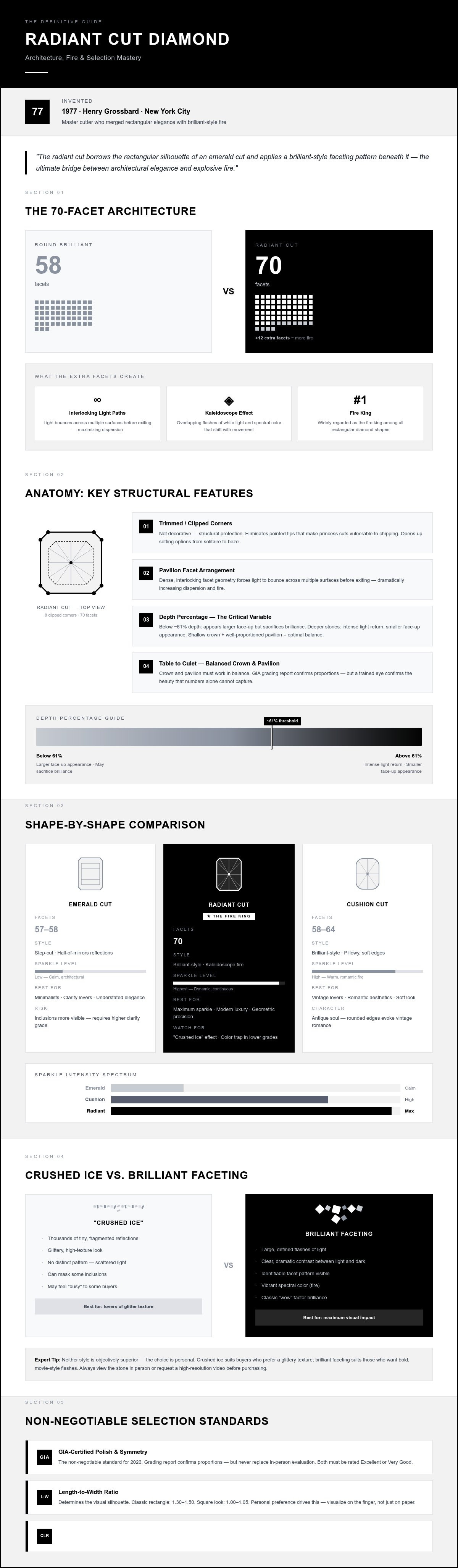
Before 1977, diamond cutters faced an unresolved tension: the elegance of step-cut geometry versus the explosive brilliance of a round brilliant. Henry Grossbard, a master cutter working in New York, resolved that tension by inventing a shape that borrowed the rectangular silhouette of an emerald cut and applied a brilliant-style faceting pattern beneath it. The result was the radiant cut diamond, a genuinely original design that has only grown in relevance as modern buyers demand stones that are both architecturally striking and visually alive.
What Grossbard understood was that facet count alone doesn't create fire; it's the geometry of those facets that determines how light fractures and returns to the eye. His design specified a pavilion arrangement that forces incoming light to bounce across multiple surfaces before exiting, dramatically increasing dispersion. That's the technical foundation behind everything a radiant cut delivers.
The 70-Facet Brilliance Explained
A standard radiant cut carries 70 facets, compared to the 58 of a round brilliant. Those additional facets aren't decorative; they're structural. The pavilion facets are arranged in a pattern that creates a dense, interlocking light path, producing what cutters describe as a "kaleidoscope" effect: overlapping flashes of white light and spectral color that shift continuously with movement. This is precisely why the radiant is widely regarded as the fire king among rectangular diamond shapes. Where an emerald cut offers broad, mirror-like reflections, a radiant offers constant, dynamic scintillation.
Anatomy of a Radiant: From Table to Culet
The radiant's trimmed corners are not a stylistic afterthought. They serve a critical structural purpose: eliminating the pointed tips that make princess cuts vulnerable to chipping during everyday wear. Those clipped corners also open up setting options considerably, accommodating everything from four-prong solitaires to bezel settings with equal security.
Depth percentage is the other variable worth understanding at this stage. A radiant cut with a depth below approximately 61% will often appear larger face-up relative to its carat weight, but may sacrifice some brilliance. Conversely, a deeper stone concentrates light return more intensely but can look smaller in the finger. The crown and pavilion must work in balance: a shallow crown paired with a well-proportioned pavilion is the configuration that maximizes both perceived size and optical performance. This is the kind of nuanced sourcing decision that benefits from expert guidance, particularly when selecting a GIA certified loose diamond where the grading report confirms the proportions but a trained eye confirms the beauty.
Radiant vs. Emerald and Cushion: Choosing Your Silhouette
Selecting a diamond silhouette is an exercise in defining your aesthetic priorities. While the radiant cut diamond shares a rectangular boundary with the emerald cut, their internal lives are entirely different. One acts as a quiet lake; the other is a storm of light. In 2026, the choice usually comes down to whether you value the rhythmic patterns of a step-cut or the chaotic, high-energy brilliance of a radiant.
The Mirror Effect vs. The Fire Effect
Minimalists often gravitate toward emerald cut engagement rings for their understated, "hall of mirrors" effect. These step-cuts favor clarity and long, rhythmic reflections that feel architectural and calm. However, if you crave maximum sparkle, the radiant is the superior choice. It replaces those long steps with seventy brilliant facets that shatter light into thousands of tiny sparks. If your sparkle profile is high-intensity, the radiant cut is your definitive match.
Radiant vs. Cushion Cut: Modern vs. Vintage
The cushion cut diamond is the radiant's closest rival for fire, yet it carries a vintage soul. Cushions feature rounded, pillowy edges that evoke a romantic, antique feel. In contrast, the radiant cut offers geometric precision. Its straight sides and clipped corners provide a cleaner, more architectural look that fits perfectly into the 2026 landscape of modern luxury. It's a stone for the woman who wants the fire of a cushion but the crisp lines of a contemporary design.
There is also a functional difference in how these shapes handle color. Both radiants and cushions tend to hold body color more intensely than a round brilliant. This makes them excellent for fancy yellow diamonds, but it means you should prioritize a higher color grade if you want a stone that appears icy white. When we source GIA certified loose diamonds for our NYC clients, we look for that specific tipping point where the cut's brilliance masks the natural warmth of the stone.
The final decision often rests on elongation. A square radiant offers a concentrated, powerful presence. An elongated rectangular radiant (typically a 1.30 to 1.45 ratio) creates a slimming effect, drawing the eye down the finger and making the stone appear larger than its actual carat weight. It's about finding the balance between the stone's physical dimensions and the wearer's unique hand shape.
The Connoisseur’s Guide to Radiant Cut Proportions and Clarity
A GIA report is a map, but it isn't the territory. When you're selecting a high-end radiant cut diamond, the technical data on the certificate must translate into visual fire. While a round brilliant has a standardized "Ideal" cut grade, the GIA doesn't assign a cut grade to radiants. This leaves the burden of discernment on you and your consultant. To find a stone that truly belongs in a luxury setting, "Excellent" grades for polish and symmetry are non-negotiable. Anything less disrupts the precise path of light, turning what should be a kaleidoscope into a dull window.
One nuance every buyer must understand is the "Color Trap." Because of their depth and complex facet arrangement, radiants tend to hold body color more intensely than round diamonds. A stone that would look icy white as a round brilliant might show a hint of warmth as a radiant. For those seeking a colorless look, we typically recommend staying within the D to F range. However, the intense scintillation of this cut is also its greatest strength when navigating clarity. Those 70 facets act as a natural camouflage, often hiding SI1 or SI2 inclusions that would be glaringly obvious in an emerald cut.
At our Manhattan workshop, we follow the "Mike Nekta Rule": prioritize an eye-clean stone over high-tier paper specs. You don't wear a certificate on your finger; you wear a diamond. If a stone is GIA certified and eye-clean, the "savings" from a slightly lower clarity grade should be reinvested into a better color or a larger carat weight.
Length-to-Width (L/W) Ratios for the Perfect Silhouette
The silhouette of your radiant cut diamond defines the ring's character. Most connoisseurs prefer the classic elongated rectangular look, which typically falls between a 1.25 and 1.35 ratio. This proportion creates a slimming effect on the finger and provides a majestic presence. Square radiants, with ratios between 1.00 and 1.05, are rarer and offer a bold, concentrated burst of light. Choosing the right ratio is a personal decision, but it should always complement the wearer's finger shape; longer fingers often carry elongated stones with more grace, while square proportions suit smaller hands.
Depth and Table Percentages: The 'Sweet Spot'
To avoid a "dead" center where light leaks out the bottom, look for a depth percentage between 61% and 69%. Stones that are too deep hide their carat weight in the pavilion where it can't be seen, making a 2-carat stone look like a 1.5-carat stone from the top. Similarly, the table percentage should stay within the 61% to 69% range. This balance ensures the stone has enough "crown" to disperse light into spectral colors while maintaining a large enough surface to showcase its brilliance. When we source GIA certified loose diamonds, we reject any stone that falls outside these parameters, as they rarely meet our standards for life and fire.
Identifying 'Crushed Ice' vs. Brilliant Faceting Styles
Two diamonds can share identical GIA grades yet possess entirely different souls. When you look at a radiant cut diamond, the first thing you'll notice is the texture of its sparkle. This visual personality isn't recorded on a grading report; it's a result of how the cutter shaped the pavilion facets. In 2026, the market is divided between two distinct aesthetics: the "Crushed Ice" look and the "Brilliant" or "Long Facet" style. Understanding which one resonates with you is the most important step in moving beyond basic specs to find a stone with true character.
Before choosing a style, you must also be aware of the "bow-tie" effect. This is a dark shadow resembling a necktie that stretches across the center of some elongated stones. A faint bow-tie is often a sign of good contrast, but a heavy, black shadow indicates poor light return. We meticulously screen our inventory in the Diamond District to ensure that any bow-tie present is a subtle, structural element rather than a distracting void.
The Allure of the Crushed Ice Effect
The "Crushed Ice" style is the most common faceting pattern for modern radiants. It's achieved by using shorter, more numerous facets on the pavilion, which break light into tiny, twinkling pinpoints. To the eye, it looks like sunlight hitting a tray of shattered glass or a turbulent pool of water. This style is particularly popular for two reasons:
- Glitter Factor: It provides a constant, high-frequency "glitter" even with minimal movement.
- Color Masking: The dense, chaotic light path helps mask the body color of the stone, making it a strategic choice for diamonds in the G to I color range.
You can often identify this style on a GIA report by looking at the pavilion diagram; if the facets don't reach all the way from the culet to the girdle, you're likely looking at a crushed ice stone.
The Brilliant/Long Facet Alternative
For connoisseurs who prefer a more organized, "chunky" flash of light, the Brilliant or Long Facet style is the definitive choice. This pattern uses longer facets that extend from the center to the edges, creating larger and more distinct flashes of spectral color. The light performance is much closer to what you'd see in round brilliant cut engagement rings, offering a more traditional "diamond" sparkle rather than a glittery shimmer.
Distinguishing between these styles requires more than a static photo. High-resolution video is essential, but nothing replaces an in-person viewing where you can see how the stone reacts to the natural light of a room. If you want to see these differences side-by-side, I invite you to view our curated radiant cut engagement rings and experience how facet length dictates a diamond's life.
Crafting Your Custom Radiant Cut Engagement Ring in NYC
Manhattan’s Diamond District isn't just a location; it's a legacy of artistry where the world’s most demanding collectors come to realize their vision. At our Manhattan workshop, we believe a radiant cut diamond deserves more than a mass-produced, off-the-shelf mounting. We employ a "stone-first" philosophy. This means we source the center diamond based on its unique personality and light performance before we ever touch a jeweler's bench. We call the final setting the "throne," and it is engineered specifically to support the exact dimensions of your chosen stone.
Setting a radiant requires a specific technical understanding of its clipped corners. Unlike a princess cut, which needs V-prongs for protection, the radiant’s corners allow for delicate, handcrafted claw prongs. These prongs must be positioned with surgical precision to maximize light entry while securing the diamond's architectural frame. Whether you prefer a minimalist solitaire that celebrates the stone’s geometry or a three-stone design featuring trapezoid side stones, the goal is always to elevate, never to overshadow. In the heart of NYC, custom bridal art is about finding that perfect equilibrium between structural integrity and visual weightlessness.
Metal Choices: Platinum vs. 18K Gold
The choice of metal is a strategic decision that affects the perceived color of your radiant cut diamond. Platinum remains the gold standard for D to F colorless stones; its natural white luster ensures that no warmth is reflected into the diamond. However, 18K yellow gold is experiencing a significant resurgence in 2026. It provides a rich contrast that can actually make a slightly warmer stone look intentionally creamy and classic. A sophisticated trend we are seeing this year is the "hidden basket" in rose gold. In this design, the prongs are platinum to keep the diamond appearing icy white, but the underlying structure is rose gold for a private, romantic detail visible only to the wearer.
The Mike Nekta Private Consultation Experience
Working with a third-generation diamond expert is a process of education as much as acquisition. During a private consultation in our NYC office, you won’t just look at rings; you will dive into the microscopic world of loose GIA certified diamonds. We use the loupe together to identify the specific faceting styles we discussed earlier, ensuring the "fire" meets your personal sparkle profile. This collaborative artistry is what separates a piece of jewelry from an heirloom. By the time we finalize the design and move to the casting phase, you’ll have the confidence that your ring is a unique reflection of your standards, crafted in the heart of the world’s diamond capital.
Secure Your Legacy with a Radiant Masterpiece
Selecting a stone that balances architectural precision with explosive brilliance requires more than just a glance at a certificate. You now understand how the 70-facet architecture and specific length-to-width ratios define the presence of a radiant cut diamond. Whether you gravitate toward the twinkling glitter of crushed ice or the bold flashes of long facets, your choice should reflect a personal sparkle profile that outshines the ordinary. It's about finding that rare equilibrium between technical perfection and emotional resonance.
As a 3rd-generation diamond expert in the NYC Diamond District, I've spent decades refining the art of the custom "throne." We curate a GIA certified selection of the world's finest stones and house them in handcrafted settings designed for generations. This is where technical mastery meets your unique story. If you're ready to move beyond standard retail, I invite you to take the next step. Design Your Custom Radiant Cut Ring with Mike Nekta today and begin creating an heirloom as radiant as the life it celebrates. Your vision deserves nothing less than perfection.
Frequently Asked Questions
Is a radiant cut diamond more expensive than a round brilliant?
No; a radiant cut diamond is typically more cost-effective than a round brilliant of the same carat weight. Round diamonds require more raw diamond material to be removed during the cutting process, which increases the price per carat. By choosing a radiant, you can often secure a larger stone or a higher color grade for the same investment, making it a strategic choice for those who value visual impact and fire.
Does a radiant cut diamond look bigger than a cushion cut?
Yes; radiants generally have a larger face-up surface area than cushion cuts of the same weight. While cushions feature rounded, pillowy edges that "tuck in" the dimensions, the radiant's straight sides and geometric corners maximize the stone's diagonal measurements. Elongated radiants also create a slimming effect on the finger, which often makes the diamond appear more significant and majestic compared to the softer, more compact silhouette of a cushion.
What is the best length-to-width ratio for a radiant cut?
The ideal ratio depends on your aesthetic goal; however, the 1.25 to 1.35 range is the standard for a classic rectangular silhouette. This proportion provides the elongation that many modern brides crave. If you prefer a square look, target a ratio between 1.00 and 1.05. We often help clients visualize these differences in our NYC workshop to ensure the stone's dimensions perfectly complement the wearer's hand and finger shape.
Do radiant cut diamonds have a bow-tie effect?
Like many elongated shapes, some radiants can exhibit a bow-tie effect, which appears as a dark shadow across the center. A faint bow-tie is a natural result of facet alignment and can actually add depth to the stone. However, a prominent, black bow-tie indicates poor light performance. We curate our GIA certified loose diamonds to ensure any shadow is subtle and doesn't detract from the stone's overall brilliance.
Can you put a radiant cut diamond in a halo setting?
Absolutely; a halo setting is an exceptional way to frame the geometric precision of this cut. A delicate row of pavé diamonds can accentuate the radiant’s clipped corners and significantly amplify its perceived size. For a more modern look, we often recommend a hidden halo, which adds a secret layer of sparkle visible from the side profile while maintaining a clean, architectural silhouette from the top view.
Are radiant cut diamonds good for active lifestyles?
This cut is one of the most durable choices for an active lifestyle. Unlike the sharp, vulnerable points of a princess cut, the radiant's trimmed corners are far less likely to chip or snag on clothing. When set properly with handcrafted claw prongs in a secure mounting, a radiant cut diamond offers the perfect combination of high-intensity fire and structural resilience for daily wear in any environment.
How do I know if my radiant cut diamond is 'eye-clean'?
An "eye-clean" stone has no inclusions visible to the naked eye at a distance of about six to eight inches. Because of its 70 facets and complex light path, this cut is excellent at camouflaging internal characteristics. We recommend reviewing high-resolution videos or visiting our Manhattan office to inspect stones in person. We prioritize stones that look flawless to the eye, regardless of what the clarity grade says on paper.
Why should I choose a GIA certified radiant over an uncertified one?
A GIA report is the only non-negotiable trust factor when purchasing a luxury diamond. It provides an unbiased, third-party verification of the stone's 4Cs and ensures you aren't paying for a quality level the diamond doesn't actually possess. At Mike Nekta New York, we only deal in GIA certified loose diamonds because they offer our clients the security of a globally recognized standard for grading accuracy and long-term value.