
The Connoisseur’s Guide to Princess Cut Engagement Rings in 2026
The true brilliance of a diamond isn't found on a grading report; it's engineered within the stone's hidden geometric architecture. While many are drawn to the bold, architectural lines of princess cut engagement rings, few understand the delicate balance of facet patterns required to achieve world-class scintillation. You've likely felt the pull of this modern classic but found yourself hesitating over technical jargon like chevron counts or the fear of a chipped corner. It's natural to want a piece that radiates luxury without compromising on the security of the stone.
I've spent decades refining the Nekta way of diamond selection, focusing on how a stone actually performs in the light rather than just its paper grades. This guide promises to transform you into a connoisseur. You'll learn to navigate color balancing in square cuts and identify the precise settings that guard those sharp points while maximizing fire. We'll examine the specific technical nuances of the 2026 market, from light performance secrets to bespoke design trends, so your choice becomes a timeless investment in artistry.
Key Takeaways
- Understand why the inverted pyramid architecture of princess cut engagement rings makes them the premier choice for those seeking a balance of modern geometry and intense brilliance.
- Learn how to decipher "chevron" counts to choose the specific type of sparkle you prefer, from bold flashes of fire to a delicate "crushed ice" effect.
- Master the 2026 selection framework to prioritize cut quality over paper grades, ensuring your diamond remains vibrant rather than appearing "dead" or dull.
- Discover the technical nuances of color balancing in square cuts and why choosing the right grade is essential for keeping the stone's corners bright.
- Identify the critical role of bespoke NYC settings in protecting vulnerable sharp corners while allowing the diamond to seemingly float for maximum light performance.
The Connoisseur’s Definition of the Princess Cut
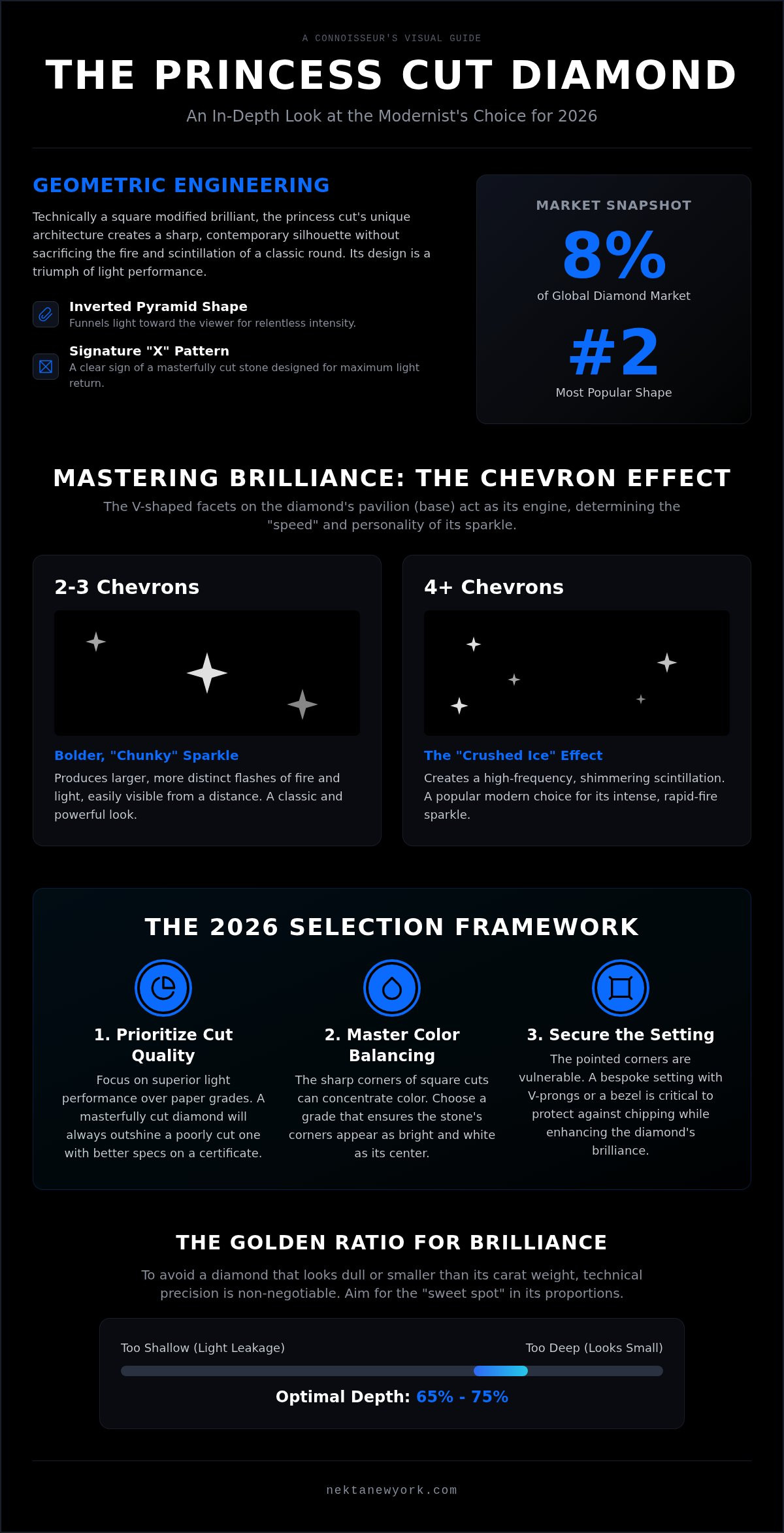
The princess cut is a masterpiece of geometric engineering. Technically classified as a square or rectangular modified brilliant cut, its most striking feature is the inverted pyramid shape that funnels light toward the viewer with relentless intensity. It's the modernist's answer to the classic round brilliant, offering a sharp, contemporary silhouette without sacrificing the fire and scintillation expected of high-end jewelry. While round diamonds focus on soft symmetry, the princess cut celebrates the power of the right angle.
This shape currently holds approximately 8% of the global diamond market, securing its position as the second most popular choice for princess cut engagement rings. This status is the result of decades of refinement. The Princess Cut History reveals a calculated evolution from earlier designs like the Barion cut of the 1960s and the Quadrillion of the 1970s. These predecessors paved the way for the refined facet arrangement we see today. When you look directly through the table of a masterfully cut princess diamond, you'll see a distinct X pattern. This isn't just an aesthetic detail; it's the signature of a stone designed for maximum light return.
Modern vs. Traditional Square Cuts
Traditional square diamonds, such as the Asscher or Emerald cut, rely on a step-cut facet arrangement. These create a hall-of-mirrors effect with long, quiet flashes of light. In contrast, the princess cut is a brilliant style. It utilizes triangular and kite-shaped facets to break light into thousands of tiny sparkles. It represents a modernist shift in bridal design, favoring clean, architectural lines over the soft, rounded silhouettes of vintage cushions. For the connoisseur, this choice signals a preference for precision and high-impact brilliance.
Why 2026 is the Year of Geometric Brilliance
Current luxury trends have moved away from excessive ornamentation toward bold, structural integrity. The princess cut fits perfectly within the Quiet Luxury movement of 2026, where the quality of the material and the mastery of the cut speak louder than the setting itself. Mike Nekta sources stones that meet these elevated 2026 standards, ensuring every diamond offers not just visual perfection but also ethical transparency. This focus on provenance and light performance defines the new era of princess cut engagement rings, where the beauty of the stone is backed by the integrity of its journey.
Mastering the Brilliance: Chevrons and Light Performance
The brilliance of a diamond isn't accidental; it's the result of how light interacts with specific facet arrangements. For those exploring princess cut engagement rings, the term "chevrons" is the most important technical detail you've likely never heard of. These are the V-shaped facets located on the pavilion, the bottom portion of the stone. They act as the diamond's engine, determining the "speed" and rhythm of its sparkle.
When light enters the stone, these chevrons reflect it back through the table. If the cut is too shallow or too deep, you encounter "windowing," a phenomenon where light leaks out the bottom, leaving the center of the diamond looking dull or transparent. Achieving maximum fire requires a master's eye for light return. As noted by the GIA on Princess Cut Quality, the complexity of this facet arrangement is what gives the shape its unique modern appeal.
The Chevron Count Dilemma
The number of chevrons carved into the pavilion fundamentally changes the diamond's personality. Stones with 2 or 3 chevrons produce larger, bolder flashes of light. These are often preferred by collectors who want a "chunky" sparkle that is visible from across a room. Conversely, opting for 4 chevrons creates a high-frequency, shimmering effect often described as "crushed ice." This style is incredibly popular in 2026 for its intense, rapid-fire scintillation.
Mike Nekta evaluates these stones far beyond what a GIA certificate can show. A report might list a grade, but it won't describe the personality of the sparkle. If you're looking for a stone that truly dances, you might want to browse these custom-selected diamonds to see how different facet counts perform in person.
Table and Depth: The Golden Ratios
Technical precision is non-negotiable for a square cut. The "sweet spot" for a princess cut's depth typically falls between 65% and 75%. If the stone is too deep, it will look smaller than its actual carat weight; if it's too shallow, it loses its soul. The table percentage, the size of the top flat facet, also plays a critical role in balancing brilliance (white light) and fire (colored flashes).
Finding the right balance ensures your diamond doesn't just sit on the finger but actively commands attention. Light performance is the synergy between facet alignment and polish. When these ratios are perfected, princess cut engagement rings achieve a level of radiance that rivals any round brilliant, proving that geometric perfection is the ultimate luxury.
Geometric Rivalry: Princess vs. Asscher and Cushion Cuts
Selecting the perfect center stone for princess cut engagement rings often involves a process of elimination. While several shapes share a square footprint, the way they handle light is vastly different. The princess cut stands alone as the "purest" square; unlike the Radiant cut, which features cropped corners, the princess maintains sharp 90-degree angles. This structural purity offers a more architectural look that appeals to those who value modern precision over rounded silhouettes.
When comparing face-up size, a princess cut diamond often appears slightly smaller than a round brilliant of the same carat weight because it carries more weight in its depth. However, its diagonal measurement is roughly 15% longer than the diameter of a round stone of equal weight, giving it a striking presence on the finger. To truly understand these technical differences, this Guide to Princess Cut Brilliance provides an excellent breakdown of how facet patterns impact visual scale and brilliance.
The Sophisticated Choice: Princess or Asscher?
The choice between a princess and an Asscher cut is a choice between two different philosophies of light. An Asscher cut is a step-cut diamond, creating a "hall of mirrors" effect with long, quiet flashes. It's a choice defined by architectural clarity rather than raw sparkle. If you find yourself drawn to this understated elegance, you might also appreciate the emerald cut engagement rings that offer a similar vintage alternative. While the princess cut uses modified brilliant facets to maximize fire, the Asscher focuses on the internal purity of the diamond.
Cushion Cut: The Softer Alternative
Many clients find themselves torn between the sharp edges of a princess and the "pillowy" aesthetic of a cushion cut. The cushion cut features rounded corners and larger facets, often resulting in what experts call the "crushed ice" look or "chunky" vintage flashes. Comparing the cushion cut's vintage soul to the princess cut's edge reveals a clear divide in personality. Beyond aesthetics, durability is a factor. The sharp corners of princess cut engagement rings require protective settings, whereas the rounded corners of a cushion are naturally more resistant to chipping during daily wear.
The 2026 Selection Framework: Balancing Carat and Quality
Choosing a diamond in NYC's Diamond District requires more than a glance at a certificate. It demands an understanding of how technical specs translate into visual fire. For princess cut engagement rings, the selection process is a series of calculated trade-offs designed to maximize beauty while ensuring the stone's longevity. My family has spent three generations refining this framework, prioritizing the Nekta way of selecting for life and light rather than just paper grades. Cut is king.
Your first priority must always be cut quality. A princess cut with poor proportions will look dark or "dead" in the center, regardless of its carat weight. Next, you must evaluate color with a critical eye. Unlike round diamonds, princess cuts tend to concentrate color in their four sharp corners. While an I color grade might look perfectly white in a round stone, it may show a hint of warmth in the tips of a square cut. Finally, always look at the dimensions in millimeters. Carat is merely a measure of weight. A stone that is too deep hides its value where you can't see it. You want a diamond that carries its weight across its face-up surface to ensure it looks as large as its weight suggests.
The Color and Clarity Sweet Spots
Finding the sweet spot means securing a diamond that looks flawless to the naked eye without paying for invisible grades. For most princess cut engagement rings, an H or I color grade provides exceptional value. When set in platinum or white gold, these stones appear icy white to most observers. For clarity, VS2 is the professional's choice. It ensures an eye-clean appearance while avoiding the steep premiums of VVS grades. Crucially, you must ensure no inclusions are located near the corners. A feather or crystal in these areas acts like a fault line; this makes the diamond susceptible to chipping during the setting process or from a sharp knock during daily wear.
Structural Integrity and Corner Protection
The geometric beauty of a princess cut comes with a specific vulnerability: those four sharp points. You must never leave these corners exposed. V-prong settings are the gold standard because they wrap around the points, providing a shield against daily impact. At Mike Nekta, our handcrafted settings are engineered to make the metal vanish while providing absolute security for the stone. If you're ready to find a stone that balances these technical demands perfectly, work with a GIA certified expert to select a diamond with maximum fire and structural integrity.
Bespoke Artistry: Crafting Your Princess Ring in NYC
The diamond may be the soul of the piece, but the setting is its stage. For princess cut engagement rings, the architecture of the ring must do more than just hold the stone; it must elevate its geometric brilliance while providing a shield for its vulnerable corners. A mass-produced setting rarely respects the unique depth and facet rhythm of a high-quality square cut. This is where bespoke artistry becomes a necessity rather than a luxury. In the heart of Manhattan, we treat every ring as a structural masterpiece designed to highlight the specific fire of your chosen diamond.
My philosophy is simple: the ring should vanish. When a setting is engineered with precision, the metal serves only to support the stone, leaving nothing but the diamond's brilliance to meet the eye. Whether you prefer a sleek, high-polish platinum band that emphasizes clean lines or a delicate pavé diamond band for added scintillation, the goal is a seamless integration of form and function. This level of detail is only achievable through a personal consultation in Manhattan's Diamond District, where the light of the city meets the expertise of a master craftsman.
The Mike Nekta Custom Process
Every bespoke journey begins with transparency. We start by selecting a GIA certified loose diamond, ensuring you see the stone's true performance before it's ever touched by metal. As a third-generation designer, I collaborate with you to refine every facet of the setting. There's a profound difference between machine-made castings found in big-box retailers and our artisanal hand-forged rings. A hand-forged piece is denser, more durable, and possesses a refined finish that mass production simply cannot replicate. It's the difference between a suit off the rack and one tailored on Savile Row.
NYC Artistry: A Global Standard
New York City is the epicenter of jewelry innovation. The trends for luxury engagement rings in NYC set the standard for the rest of the world, blending high-fashion sensibilities with traditional craftsmanship. Beyond the aesthetic, a personal relationship with your jeweler ensures you receive a proper GIA appraisal and lifelong support for your investment. This trust is the foundation of a piece that will be cherished for generations. If you're ready to create a legacy, book a consultation with Mike Nekta to find your perfect princess cut and begin your custom design journey today.
Secure Your Legacy in Light
Mastering the nuances of the princess cut is about more than just aesthetics; it's an investment in geometric perfection and technical mastery. You now understand how chevron counts dictate the rhythm of a diamond's sparkle and why protecting those sharp corners with expert NYC settings is non-negotiable. Choosing the right piece requires a delicate balance of technical knowledge and an eye for fire that transcends standard grading reports. Princess cut engagement rings should never be a compromise between beauty and durability.
Backed by three generations of family expertise in Manhattan's Diamond District, we specialize in GIA certified diamonds that are curated for light performance, not just weight. Every piece is handcrafted in NYC to ensure your diamond remains the focal point while staying perfectly secure for a lifetime. It's time to find a stone that reflects your unique standard of excellence. Explore Mike Nekta's Exclusive Princess Cut Collection and begin the journey toward a bespoke masterpiece. Your perfect diamond is waiting to be discovered.
Frequently Asked Questions
Is a princess cut more expensive than a round brilliant?
A princess cut is typically 25% to 30% less expensive than a round brilliant diamond of equivalent quality. This price advantage exists because the square shape allows diamond cutters to retain more of the rough stone during the process. While a round cut wastes a significant portion of the rough; the princess cut's inverted pyramid shape follows the natural crystal structure of the diamond, offering better value for your investment.
Do princess cut diamonds chip easily at the corners?
The sharp, 90-degree corners of a princess cut are its most vulnerable points and can chip if they aren't properly protected. These corners are thin and susceptible to impact during daily wear. To mitigate this risk, it's essential to select a setting that fully encloses the points. Custom-built settings designed by an experienced craftsman ensure that these delicate areas are shielded from accidental knocks while maintaining the stone's architectural beauty.
What is the best setting for a princess cut engagement ring?
The most secure and aesthetically pleasing choice for princess cut engagement rings is the V-prong setting. These specialized prongs wrap around the sharp corners, providing a metal shield that prevents chipping. Bezel settings are another excellent modern alternative, offering a continuous frame of metal around the entire stone. Both options ensure the diamond remains secure while highlighting the clean, geometric lines that define this contemporary style.
Does a princess cut diamond look smaller than a round diamond?
A princess cut diamond often has a smaller face-up surface area than a round brilliant of the same carat weight. This is because square shapes carry more weight in their depth. However, the diagonal measurement of a princess cut is roughly 15% longer than the diameter of a round stone. This creates a striking visual impact on the finger, making the diamond appear bold and substantial despite the technical difference in surface area.
What is a 'crushed ice' look in a princess cut?
The "crushed ice" look refers to a high-frequency sparkle pattern where the diamond reflects light in thousands of tiny, rapid-fire flashes. This effect is achieved by increasing the number of chevrons on the pavilion, typically four or more. While some connoisseurs prefer broader, chunky flashes of light, the crushed ice look offers an intense shimmer that is particularly popular for modern princess cut engagement rings seeking maximum scintillation.
How many chevrons should a 2-carat princess cut diamond have?
For a 2-carat princess cut diamond, most experts recommend three or four chevrons to balance sparkle speed and light return. A two-chevron arrangement on a stone of this size creates very large, broad flashes of light. Conversely, four chevrons will produce a tighter, more shimmering effect. The choice depends on whether you prefer the bold fire of larger facets or the intricate, busy scintillation of a higher facet count.
Can I use a princess cut diamond in a halo setting?
Yes, halo settings are a major trend for 2026 and work beautifully with square cuts. A halo of smaller diamonds surrounding the center stone can make the princess cut appear significantly larger while providing an extra layer of protection for the corners. Whether you choose a classic square halo or a more intricate vintage-inspired design, this setting adds a layer of brilliance that complements the geometric precision of the center diamond.
What color grade is best for a princess cut diamond?
An H or I color grade is often the sweet spot for a princess cut diamond, providing a white appearance without the premium cost of D-F grades. It's important to remember that square cuts tend to show more color in their corners than round stones do. If you're setting the diamond in platinum or white gold, staying within the G to H range ensures the stone looks icy and colorless to the naked eye.