
The Connoisseur’s Guide to Princess Cut Engagement Rings in 2026
A diamond's certificate tells you its history, but the hidden architecture of its facets determines how it will actually perform on her hand. You've likely felt the frustration of comparing two stones with identical grades, only to find one radiates fire while the other looks strangely dull. Selecting princess cut engagement rings in 2026 requires looking past the four Cs and into the "Nekta way" of prioritizing raw light performance over simple paper statistics.
We know you want a piece that feels both contemporary and timeless without the constant fear of chipping a sharp corner or overpaying for a grade you can't see. This guide ensures you master the technical nuances of chevron counts and light scintillation to select a diamond that defines modern luxury. We'll explore the most secure, high-end settings and explain how to balance color grades in square cuts. By the end, you'll have the confidence of a seasoned collector and the clarity to choose a stone that truly sparkles.
Key Takeaways
- Understand how chevron facet counts dictate the "speed" of a diamond's sparkle, allowing you to choose between broad flashes of light or a modern "crushed ice" effect.
- Learn to distinguish the geometric perfection of the princess cut from its closest rivals, the vintage-inspired cushion and the architectural Asscher cut.
- Apply our 2026 selection framework to prioritize cut quality and navigate color retention when investing in princess cut engagement rings.
- Discover the "Nekta way" of choosing stones based on actual fire and scintillation rather than solely relying on the grades listed on a GIA certificate.
- Identify why bespoke, custom-built settings are critical for protecting vulnerable square corners while ensuring the metal "vanishes" to highlight the stone’s brilliance.
The Connoisseur’s Definition of the Princess Cut
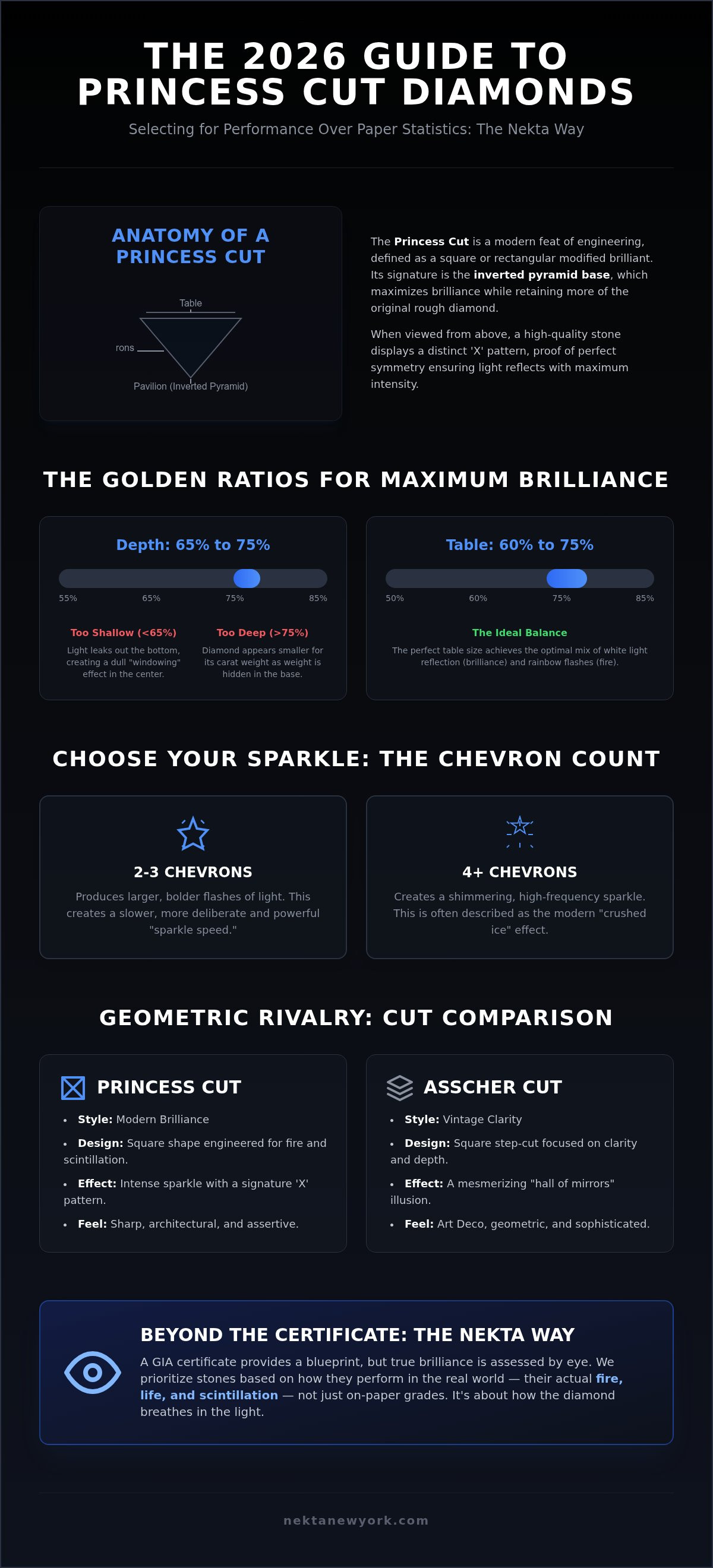
The princess cut isn't just a diamond shape; it's a feat of modern engineering. Technically defined as a square or rectangular modified brilliant, its signature is the inverted pyramid base. This specific structure allows the stone to retain more of its original rough weight compared to other shapes while rivaling the light performance of a round brilliant. It's no surprise that it remains the second most popular choice globally. For those who find the round cut too traditional, the princess offers a sharper, more assertive alternative that commands attention.
The history of the princess cut reveals a fascinating evolution that didn't happen overnight. It was born from a desire to combine the fire of a brilliant cut with the clean lines of a square. The development built upon the technical breakthroughs of the Barion and Quadrillion cuts from the 1960s and 70s. These predecessors paved the way for the precise facet arrangement we see today. When you look through the table of a high-quality stone, you'll see a distinct 'X' pattern. This isn't just an aesthetic detail. It's the visual proof of a perfectly symmetrical pavilion, ensuring light bounces through the diamond with maximum intensity.
Modern vs. Traditional Square Cuts
The princess cut represents a significant departure from the vintage "step-cut" approach found in Asscher or Emerald shapes. While step cuts focus on clarity and a "hall of mirrors" effect, the princess cut is a brilliant cut. It's designed for fire and scintillation. This makes it the ultimate modernist choice for princess cut engagement rings. The sharp, clean lines provide a visual impact that rounded silhouettes simply can't match. It’s a bold statement of precision and contemporary elegance that appeals to those who value architectural purity.
Why 2026 is the Year of Geometric Brilliance
The 2026 jewelry market has shifted toward architectural and bold designs. We're seeing a move away from delicate, hidden details toward structures that celebrate geometry and strength. The princess cut fits perfectly within the "Quiet Luxury" movement. It's sophisticated without being flashy, offering a look that feels both grounded and ethereal. At Mike Nekta, we prioritize diamonds that meet the highest standards of light performance and ethical transparency. Every stone is sourced to ensure it possesses the life and fire that 2026 connoisseurs demand. We don't just look at the certificate; we look at how the diamond breathes in the light of Manhattan's Diamond District, ensuring it meets our rigorous standards for brilliance.
Mastering the Brilliance: Chevrons and Light Performance
The brilliance of princess cut engagement rings is not a matter of chance. It's a result of precise facet geometry. On the pavilion, or the bottom of the stone, you'll find V-shaped facets known as chevrons. These are the engines of the diamond's sparkle. They determine the "speed" at which light returns to your eye. When you look at a princess cut, you're seeing a complex interplay of light that requires expert selection to truly master. A stone's performance is dictated by how these chevrons are stacked and polished.
The Chevron Count Dilemma
Choosing between two or four chevrons is a matter of personal aesthetic preference. Stones with 2 to 3 chevrons produce larger, bolder flashes of light. These have a slower "sparkle speed" that feels deliberate and powerful. Conversely, opting for 4 chevrons creates a shimmering, high-frequency effect often described as "crushed ice." Mike Nekta evaluates these nuances by hand. He looks for fire and scintillation that a GIA certificate simply can't describe. It's about how the stone performs in the real world, not just how it looks under a lab microscope. We prioritize stones that exhibit a balanced "X" pattern, ensuring the brilliance is distributed evenly across the entire table.
Table and Depth: The Golden Ratios
Technical specifications provide the blueprint for beauty. For a princess cut, a depth of 65% to 75% is the recognized sweet spot. If the stone is too shallow, light leaks through the bottom, creating a dull "windowing" effect. This makes the center of the diamond look empty or see-through. If it's too deep, the diamond looks smaller than its carat weight suggests because the weight is hidden in the base. The table percentage also plays a vital role in producing fire, which are those vibrant colored light flashes. We look for a table between 60% and 75% to achieve the perfect balance of white light reflection and rainbow dispersion.
Light performance is the synergy between facet alignment and polish. To see this brilliance in person, you can explore our collection of GIA certified princess cut diamonds at our NYC showroom. We ensure every stone avoids the common pitfalls of poor light return, focusing instead on maximum fire. By selecting a stone with the right depth and table ratios, you secure a diamond that remains vibrant in any lighting environment, from a candlelit dinner to the bright Manhattan sun.
Geometric Rivalry: Princess vs. Asscher and Cushion Cuts
When you walk through Manhattan's Diamond District, you'll notice that square-shaped diamonds dominate the windows of the most prestigious boutiques. However, not all squares are created equal. The rivalry between the princess, Asscher, and cushion cuts is one of the most frequent debates we host in our showroom. Each shape represents a different era of design and a unique way of handling light. Choosing princess cut engagement rings means you're prioritizing a modern, high-energy sparkle that simply didn't exist in the jewelry world a century ago.
The radiant cut is often the closest competitor to the princess, but there's a fundamental difference in their silhouettes. A princess cut is a "true" square with sharp, 90-degree corners. Radiants have truncated, or clipped, corners. While those clipped corners offer a bit more durability, they sacrifice the architectural purity of the square. If you want that crisp, clean "X" pattern and a perfectly square footprint, the princess is the only choice. In terms of face-up size, the princess cut often provides a superior visual footprint. Because it isn't as bottom-heavy as a cushion cut, more of its carat weight is concentrated in the table, making the diamond look larger than other shapes of the same weight.
The Sophisticated Choice: Princess or Asscher?
Deciding between a princess and an Asscher cut is a choice between two different philosophies of light. The princess cut uses modified brilliant facets to maximize fire and scintillation. It's designed to be noticed from across a room. The Asscher cut, however, relies on step-cut facets. This creates a "hall of mirrors" effect that emphasizes the diamond's clarity and internal depth rather than its outward sparkle. It's a quieter, more architectural look. If you find yourself drawn to this vintage clarity but want a more elongated silhouette, you might prefer emerald cut engagement rings as a sophisticated alternative. The Asscher is essentially a square version of that classic step-cut style.
Cushion Cut: The Softer Alternative
The cushion cut serves as the "pillowy" rival to the princess. It features rounded corners and a softer, more romantic aesthetic. Many of our clients explore the cushion cut's vintage soul when they want something that feels like an heirloom from the start. However, the cushion cut can't match the modern edge of princess cut engagement rings. There’s also a practical trade-off. While the rounded corners of a cushion are less prone to chipping, the sharp points of a princess cut offer a bold, geometric look that defines contemporary luxury. We solve the durability concern by custom-building settings that wrap those corners in protective gold or platinum, ensuring your modern masterpiece remains secure for a lifetime.
The 2026 Selection Framework: Balancing Carat and Quality
Buying a diamond in the heart of Manhattan's Diamond District requires more than just a passing knowledge of the 4Cs. In 2026, the most discerning buyers follow a refined framework that prioritizes visual impact over simple paper grades. When selecting princess cut engagement rings, your first priority must always be cut quality. A poorly cut stone looks "dead" or "glassy," regardless of its size. We look for stones that exhibit high light return across the entire surface. This ensures the diamond remains vibrant even in low-light settings, reflecting the "Nekta way" of choosing for fire first.
Next, we address the unique way this shape handles color. Unlike round diamonds, princess cuts tend to concentrate color in their four sharp corners. If you choose a lower color grade, the yellow or brown tints will be most visible at those points. However, you can often find a "sweet spot" with specific grades. In a well-engineered setting, these stones appear perfectly white to the naked eye, allowing you to allocate more of your budget toward a larger carat weight. It's about finding the balance that provides the most impressive face-up appearance.
Don't ignore the physical dimensions. Two diamonds might both weigh 1.50 carats, but one could have a significantly larger "face-up" size in millimeters. We encourage our clients to focus on the mm measurements. This ensures you're paying for the diamond you see, not just the number on the scale. A stone that's too deep hides its weight where nobody can see it, while a stone cut to the right proportions maximizes its presence on the hand.
The Color and Clarity 'Sweet Spots'
Achieving the look of a three-carat masterpiece without the equivalent price tag requires strategic choices in clarity. A VS2 clarity grade is often the professional's secret. It offers an "eye-clean" appearance, meaning no inclusions are visible without magnification. You must be vigilant about the placement of these inclusions. We strictly avoid stones with crystals or feathers near the corners. These flaws can act as stress points, making the diamond susceptible to chipping during the setting process or through daily wear. By selecting a clean VS2 stone with an H color grade, you maximize your investment without sacrificing the high-end aesthetic.
Structural Integrity and Corner Protection
The sharp corners that give the princess cut its modern edge are also its most vulnerable feature. You must never leave these corners exposed. The gold standard for protection is the V-prong setting. These specialized prongs wrap around the points, shielding them from impact while accentuating the square silhouette. At Mike Nekta, we don't use mass-produced heads. Our handcrafted settings are custom-built for each specific stone, ensuring the metal "vanishes" to let the diamond's brilliance take center stage. This bespoke approach guarantees that your ring is as durable as it is beautiful. If you're ready to find a stone that meets these rigorous standards, you can browse our GIA certified princess cut diamonds and experience the Nekta difference in person.
Bespoke Artistry: Crafting Your Princess Ring in NYC
A diamond without the right setting is like a masterpiece without a gallery. For princess cut engagement rings, the architecture of the band is just as vital as the stone itself. It's the difference between a ring that feels heavy and dated and one that feels like a natural extension of her hand. My philosophy is simple: the ring should vanish. We design every piece to ensure the metal serves only to elevate the diamond's brilliance, never to distract from it. This minimalist approach requires a level of precision that machine-made rings simply can't achieve.
You have the freedom to customize every detail of your piece. Some clients prefer the continuous sparkle of a pavé-set band, where tiny diamonds echo the fire of the center stone. Others choose the sleek, high-polish finish of solid platinum to emphasize the sharp, modern lines of the princess cut. Visiting Manhattan's Diamond District for a personal consultation allows you to feel these differences. You'll see how light interacts with different metals and band widths in real-time, guided by expertise that spans three generations.
The Mike Nekta Custom Process
We believe transparency is the foundation of true luxury. That’s why our process always begins by selecting a GIA certified loose diamond. This allows you to inspect the stone from every angle before it's ever placed in a setting. You'll collaborate directly with me to refine the design. We don't use generic, machine-made castings. Instead, we favor artisanal, hand-forged rings. This traditional method results in a denser, more durable piece of jewelry that holds its shape and finish for decades. It's the difference between a mass-produced product and a unique work of art.
NYC Artistry: A Global Standard
Manhattan remains the epicenter of the jewelry world. The standards for luxury engagement rings in NYC set the trend for the rest of the globe. When you work with a local expert, you aren't just buying a ring; you're building a relationship. We provide a full GIA appraisal and ongoing care to ensure your investment remains as stunning as the day you proposed. This level of personal service is the hallmark of our workshop. It's time to create something that reflects your unique story. Book a consultation with Mike Nekta to find your perfect princess cut.
Securing Your Future Heirloom in the Heart of Manhattan
Choosing a diamond that balances modern geometry with timeless brilliance requires an eye for detail that transcends the standard grading report. You now understand how chevron counts dictate the rhythm of a sparkle and why a bespoke setting is essential for protecting those vulnerable square corners. Investing in princess cut engagement rings is about more than just a purchase; it's about selecting a stone that will radiate fire for generations. By prioritizing light performance and structural integrity, you ensure your choice remains as striking in decades as it is today.
At Mike Nekta New York, we combine 3rd generation expertise with GIA certified diamonds to ensure your ring is a masterpiece of light. Every piece is handcrafted in NYC to meet the highest standards of the 2026 luxury market. We invite you to move beyond the certificate and experience the true brilliance of a diamond selected for its soul rather than just its stats. Explore Mike Nekta New York's Exclusive Princess Cut Collection and begin your journey toward a ring that defines modern luxury. Your perfect diamond is waiting in the Diamond District, ready to become part of your story.
Frequently Asked Questions
Is a princess cut more expensive than a round brilliant?
A princess cut is generally less expensive than a round brilliant of the same carat weight. This price difference exists because diamond cutters retain about 80% of the original rough stone when creating a square shape; compared to only 40% to 50% for a round diamond. You essentially get a larger-looking stone for a lower investment. It's a strategic choice for those who value both geometric beauty and financial efficiency in their jewelry.
Do princess cut diamonds chip easily at the corners?
These diamonds are more susceptible to chipping at their four sharp corners if they aren't protected. The 90-degree points are thin and can break if they strike a hard surface. However; this risk is almost entirely mitigated by professional craftsmanship. When we design princess cut engagement rings, we ensure the setting fully shields these points. A well-secured stone is perfectly safe for daily wear in any high-end lifestyle.
What is the best setting for a princess cut engagement ring?
The V-prong setting is widely considered the gold standard for this specific shape. These specialized prongs wrap around the corners in a protective "V" shape, securing the stone's most vulnerable areas while highlighting its clean, architectural lines. Bezel settings are another excellent choice for maximum security. We recommend avoiding standard round prongs, as they don't provide the necessary coverage to prevent the corners from catching or chipping over time.
Does a princess cut diamond look smaller than a round diamond?
A princess cut diamond often has a slightly smaller surface area, or "face-up" size, than a round brilliant of equal weight. Because round diamonds are shallower, their diameter is usually larger. However, the diagonal measurement of a square cut can create a powerful visual illusion of size. It's important to look at the millimeter dimensions rather than just the carat weight to understand how the stone will actually appear on the hand.
What is a 'crushed ice' look in a princess cut?
The "crushed ice" look refers to a diamond that exhibits hundreds of tiny, needle-like flashes of light rather than broad reflections. This effect is created by a high chevron count on the pavilion, typically four or more. While some collectors prefer the bold, distinct "X" pattern of traditional cuts, others are drawn to this high-frequency shimmer. It’s a modern aesthetic that makes the diamond look like it's filled with sparkling water.
How many chevrons should a 2-carat princess cut diamond have?
For a 2-carat stone, we typically recommend three to four chevrons depending on your desired sparkle "speed." Three chevrons will produce larger, more distinct flashes of fire that feel traditional and powerful. Four chevrons will lean toward that shimmering crushed ice effect. There isn't a single "correct" number; it’s a personal choice that we help you navigate during a private consultation in our Manhattan showroom.
Can I use a princess cut diamond in a halo setting?
You can absolutely use this shape in a halo setting to create a bold, high-brilliance look. A halo of smaller round diamonds provides a soft contrast to the sharp lines of the center stone while offering an extra layer of physical protection for the corners. This combination is a favorite for princess cut engagement rings because it significantly increases the overall light return. It makes the center stone appear much larger than its actual carat weight.
What color grade is best for a princess cut diamond?
We usually suggest a color grade of G or H as the optimal sweet spot for value and beauty. Princess cuts tend to show more color in their corners than round diamonds do, so going below an I grade might reveal a slight yellowish tint. By staying in the G-H range, the diamond looks perfectly white to the naked eye. This allows you to prioritize cut quality and fire, which are the true hallmarks of a luxury piece.