
The Connoisseur’s Guide to Emerald Cut Engagement Rings: A 2026 Masterclass
While the world chases the chaotic sparkle of a round brilliant, the true connoisseur understands that silence is often more captivating. Choosing emerald cut engagement rings isn't just a purchase; it's an investment in architectural grace and a refusal to follow the crowd. You likely recognize the sophisticated allure of these step-cut stones, yet you might feel a lingering hesitation. It's common to worry that those wide, open facets will act as windows to every tiny inclusion or that the stone won't have the presence you expect on your finger.
I've spent my life in Manhattan’s Diamond District as a third-generation expert, and I can tell you that these fears shouldn't stop you from owning a masterpiece. In this 2026 masterclass, I'm pulling back the curtain on the industry to help you master the legendary hall-of-mirrors effect. You'll gain a definitive checklist for selecting a GIA certified stone with the perfect length-to-width ratio. We'll also explore the latest design trends, from East-West orientations to minimalist metalwork, ensuring you choose a setting that celebrates the elongated elegance of your diamond with total confidence.
Key Takeaways
- Understand why clarity is the non-negotiable priority for emerald cut engagement rings to avoid visible inclusions in the diamond's open table.
- Master the ideal proportions and ratios that create the most flattering, elongated silhouette for your hand.
- Learn to spot "windowing" and "extinction," two common visual flaws that standard grading reports don't always highlight.
- Gain confidence in choosing between minimalist solitaires and architectural three-stone settings to frame your stone’s unique geometry.
- Discover the advantages of partnering with a third-generation New York expert for a bespoke, handcrafted design process.
The Architectural Allure of Emerald Cut Engagement Rings
Emerald cut engagement rings represent a departure from the traditional desire for maximum sparkle. Instead of the chaotic, multi-directional light play found in round diamonds, the emerald cut offers a rhythmic, organized brilliance. It's a choice rooted in transparency. Because the facets are large and open, there's nowhere for inclusions to hide. This creates a psychological sense of honesty and confidence. In 2026, as the "Quiet Luxury" trend matures into a permanent lifestyle, this cut has become the ultimate symbol of understated wealth. It doesn't scream for attention; it commands it through perfect symmetry and geometric precision.
The History of the Step-Cut
The journey of this silhouette began long before it was used for diamonds. Originally, stone cutters developed this style for emerald gemstones to prevent chipping, as the step-cut facets provided more structural integrity. To understand the broader history of diamond cuts, one must look back to the 16th-century table cuts which served as the primitive ancestors of today's sophisticated designs. However, it was the Art Deco movement of the 1920s that truly cemented its status in the bridal world. Mike Nekta often observes that the era's obsession with skyscrapers and clean lines found its perfect expression in the emerald cut. It's a design that hasn't aged because it relies on fundamental geometry rather than fleeting trends.
Emerald Cut vs. The World
When comparing emerald cut engagement rings to other shapes, the primary difference is the "Hall of Mirrors" effect. While a round brilliant diamond uses facets like tiny mirrors to bounce light in every direction, the emerald cut uses long, parallel facets to create flashes of light and dark. It's a more cinematic, dramatic experience. Style icons consistently gravitate toward this shape because it creates a larger visual footprint on the finger. An emerald cut often looks more substantial than a round or cushion cut of the same carat weight due to its elongated shape. It stretches the finger, providing a slender, elegant look that few other shapes can replicate. It’s not just a diamond; it’s a structural statement.
Mastering the Step-Cut: Ratios, Clarity, and the 4Cs
The beauty of emerald cut engagement rings lies in their restraint. Unlike brilliant cuts that scatter light in every direction, the step-cut produces a hall-of-mirrors effect. This is the rhythmic reflection of light between parallel facets, creating a cinematic flash that feels more deliberate and sophisticated than a standard shimmer. Because these diamonds feature a large, flat "table" on top, they act as a window into the stone's soul. This means you can't rely on sparkle to hide flaws; you must understand the technical nuances of the cut to find a truly exceptional diamond.
The Secret of the Perfect Ratio
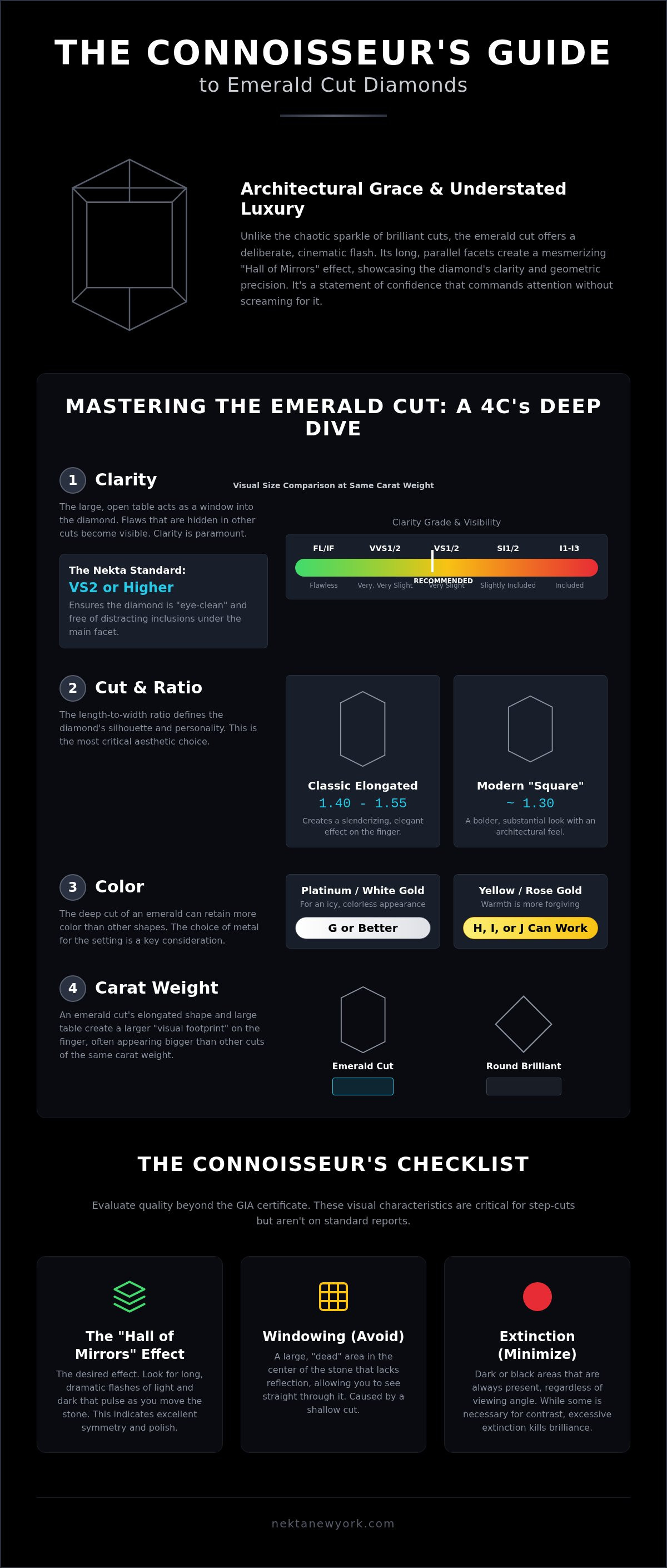
The length-to-width ratio is the most critical factor in determining the "personality" of your diamond. While the GIA doesn't assign a formal cut grade to emerald shapes, the industry consensus for a classic elongated look is a ratio between 1.40 and 1.55. This specific range creates a slenderizing effect, making the wearer’s finger appear longer and more elegant. It’s the gold standard for those seeking that iconic, sophisticated silhouette.
However, modern tastes are shifting toward the "square" emerald cut, often found with a ratio around 1.30. This look feels bolder and more substantial, providing a larger visual footprint that works exceptionally well on wider hands or for those who want a more architectural, avant-garde ring. When you browse our collection of loose diamonds, you'll see how these subtle shifts in proportion completely transform the ring's presence on the hand.
Clarity and Color: The Nekta Standard
Clarity is king for this shape. In a round diamond, facets can mask tiny inclusions, but an emerald cut’s open facets make them glaringly obvious. I always recommend a "Nekta Standard" of VS2 clarity or higher. While you can sometimes find an "eye-clean" SI1, it requires a master’s eye to ensure the inclusion isn't sitting directly under the table. According to the GIA's guide to emerald cut quality, the arrangement of the facets means that even a high-clarity stone must be evaluated for its light return and potential "windowing."
Color is equally nuanced. Because the stone is deep, it tends to hold onto color more than a shallow cut. If you're setting your diamond in platinum or white gold, aim for a G grade or better to maintain that icy, colorless look. If you prefer the warmth of yellow or rose gold, you can safely move into the H or I range. The metal will complement the diamond’s natural tint, allowing you to prioritize a higher clarity or larger carat weight instead.
Emerald Cut Ring Styles: From Minimalist Solitaires to Vintage Halos
The architecture of the setting is just as vital as the stone itself. For many, the purest expression of these gems is found in a minimalist solitaire. This style places the entire focus on the diamond’s clean lines and rhythmic facets. Without side stones to distract the eye, the center stone’s quality remains the undisputed star. It’s a choice that reflects a modern, polgári elegance. If you prefer a more contemporary edge, a bezel setting provides a sleek, protective frame of metal around the diamond. This not only secures the stone’s vulnerable corners but also creates a bold, geometric silhouette that feels incredibly fresh for 2026.
Vintage-inspired designs continue to hold a special place in the hearts of connoisseurs. A halo setting can add a layer of brilliance to a step-cut diamond, though it must be executed with precision. Rather than a traditional round pave halo, many are opting for French-cut or step-cut melee diamonds to maintain the ring's overall geometric integrity. This adds a soft, vintage glow that complements the "hall of mirrors" effect without overwhelming it.
The Classic Three-Stone Arrangement
The three-stone ring is perhaps the most iconic way to wear this cut. Tapered baguettes remain the gold standard for side stones. Their own step-cut facets create a seamless transition from the center stone to the band, maintaining a sense of perfect balance and symmetry. For those who want a more substantial look, trapezoid side stones offer a wider, more powerful shoulder that enhances the center stone’s visual footprint.
Choosing the right proportions for side stones is a delicate art. In our guide on The Sophisticated Allure of Emerald Cut Engagement Rings: A 2026 Connoisseur’s Guide, we discuss how the right pairing can actually make the center stone appear larger and more vibrant. It’s about creating a narrative of light that flows across the finger.
Modern Settings for the 2026 Bride
Modern couples are increasingly looking for ways to personalize their emerald cut engagement rings. One of the most significant trends is the East-West setting. By rotating the diamond horizontally, the ring takes on a completely different character. It feels avant-garde and architectural, perfect for a bride who wants something unique yet timeless.
Another subtle way to add personality is through the hidden halo. This design features tiny diamonds tucked beneath the center stone, visible only from the profile. It’s a secret detail that adds a touch of sparkle without disrupting the diamond’s top-down clarity. At our Manhattan studio, Mike Nekta specializes in these handcrafted nuances. Every setting is designed to the specific proportions of the loose diamond, ensuring a bespoke fit that mass-produced rings simply cannot match.
The Connoisseur’s Checklist: Evaluating Quality Beyond the Certificate
Selecting emerald cut engagement rings requires a level of discernment that goes far beyond reading a grading report. While a certificate provides the technical framework, it cannot capture the soul or the optical personality of a step-cut diamond. Evaluating an emerald cut requires looking through the stone, not just at it, to ensure light is trapped and reflected. You're searching for a balance of transparency and brilliance that mass-market retailers often overlook in favor of simple carat weight.
Two critical phenomena often plague lower-quality stones: windowing and extinction. Windowing occurs when the pavilion facets are cut too shallowly, causing light to leak through the center rather than reflecting back to the eye. The result is a diamond that looks like a clear, lifeless piece of glass in the middle. Extinction is the opposite problem. It happens when facets are angled in a way that they appear black or "dead" from certain viewpoints. A true connoisseur’s stone avoids both, maintaining a crisp, rhythmic play of light across every step.
Evaluating Light Performance
To truly understand a stone's quality before it arrives, you must utilize high-definition, 360-degree video. This allows you to spot windowing that a static photo might hide. Pay close attention to the "Tilt Test." As the diamond moves, the flashes of light should remain consistent and intentional across the entire surface. If large areas of the stone remain dark or transparent during the rotation, it lacks the optical symmetry required for a luxury piece. Mike Nekta personally inspects every stone in our collection to ensure these optical nuances meet his exacting standards for light return and character.
The Role of GIA Certification
In Manhattan’s Diamond District, the GIA report is the only undisputed source of truth for loose diamonds. While it doesn't give a "cut grade" for emerald shapes, it provides a detailed plot that acts as a fingerprint for the stone. This diagram shows exactly where inclusions are located. For an emerald cut, you want to ensure no significant inclusions sit directly under the large, open table. If you're also considering other shapes, you might find our Ultimate Guide to Round Brilliant Cut Engagement Rings in 2026 helpful for comparing how different certificates prioritize light performance.
A GIA certificate ensures your investment is protected and your diamond’s origins are ethical and verified. It’s the foundation upon which we build your custom piece. If you're ready to see these technical details in person, I invite you to book a private consultation in our NYC studio to view our curated selection of GIA certified diamonds.
Bespoke Brilliance: Crafting Your Custom Emerald Ring in NYC
Manhattan’s Diamond District is the undisputed heartbeat of global jewelry artistry. It’s a place where decades of heritage meet the cutting edge of modern design. For those seeking emerald cut engagement rings, this square mile offers a level of expertise and access that simply cannot be replicated online or in a shopping mall. Choosing a custom ring here isn't just about the final product. It’s about the journey of discovery, guided by a third-generation expert who understands that a diamond is more than a technical specification; it’s a personal signature.
The distinction between handcrafted and mass-produced settings is nowhere more apparent than with an emerald cut. Because these stones are rectangular and feature specific, vulnerable corners, a "one-size-fits-all" setting is a compromise. Mass-produced rings are cast for average proportions, often leaving gaps or putting unnecessary stress on the diamond. A handcrafted setting from our NYC studio is forged to the exact millimeter of your specific stone. This ensures the metal frames the diamond’s architectural lines with absolute precision, providing both security and a seamless aesthetic that feels like a single, unified piece of art.
The Custom Design Process in Manhattan
Our process begins with the stone selection. You’ll sit down with Mike Nekta to view a curated selection of GIA certified diamonds, evaluating the "Hall of Mirrors" effect in person. Once the perfect stone is chosen, we move into the design phase. We utilize advanced CAD technology to create a digital blueprint of your vision, followed by a physical wax model. This allows you to see the proportions and feel the scale before we move to the final casting. For a comprehensive look at how we merge tradition with technology, explore our Custom Bridal Jewelry NYC: The 2026 Luxury Buyer’s Guide to Bespoke Brilliance. This meticulous approach ensures that every facet of the setting complements the unique geometry of your diamond.
Investing in a Legacy
A custom emerald cut ring is an investment in a legacy. These pieces are designed to transcend fleeting trends, becoming heirlooms that carry your story through generations. We prioritize ethical sourcing and provide a rigorous GIA appraisal process to ensure your investment is protected. When you choose Mike Nekta New York, you’re not just buying a ring; you’re entering a trust-based relationship with a family that has lived and breathed diamonds for three generations. Your journey toward a masterpiece starts with a conversation. Schedule a private consultation with Mike Nekta in NYC to begin crafting a ring that is as unique as your commitment.
Step Into a Legacy of Architectural Brilliance
Choosing a diamond that prioritizes transparency over flash is a mark of true sophistication. You now understand that the perfect emerald cut engagement rings aren't found by chance; they're curated through a deep understanding of ratios, clarity, and light performance. By looking beyond the certificate to identify optical flaws like windowing, you've gained the tools to choose a stone that will remain captivating for a lifetime. This knowledge transforms you from a casual buyer into a true connoisseur.
Your journey shouldn't end with information. It should culminate in a piece of jewelry that reflects your unique story and high standards. Mike Nekta, a third-generation diamond expert, combines his family's heritage with modern artistry to ensure every stone meets his exacting standards. Whether you're seeking GIA certified loose diamonds or a bespoke setting handcrafted in Manhattan’s Diamond District, the focus remains on uncompromising quality and personal connection. Trust in a process that values the artistic integrity of the stone as much as you do.
Ready to see the hall-of-mirrors effect in person? Explore Mike Nekta’s Exclusive Emerald Cut Collection and begin the process of creating your own architectural masterpiece. Your vision deserves the precision of a master craftsman.
Frequently Asked Questions
Do emerald cut diamonds look smaller than other shapes?
Emerald cut diamonds often appear larger than round or cushion cuts of the same carat weight. This is because they have a larger visual footprint and a wider surface table. The elongated shape distributes the diamond's weight across the top, covering more of the finger. This creates a slenderizing effect that makes the stone look substantial and impressive on the hand, providing a more significant presence than deeper, more compact cuts.
What is the best clarity for an emerald cut engagement ring?
The best clarity for an emerald cut engagement ring is typically VS2 or higher. Because this cut features long, open facets that act as windows, it doesn't hide inclusions as well as brilliant cuts. While you can occasionally find an eye-clean SI1 diamond, it requires a professional inspection to ensure no flaws are visible under the table. Investing in a higher clarity grade ensures your stone remains clear and captivating without distracting blemishes.
Are emerald cut diamonds more expensive than round diamonds?
Emerald cut diamonds are generally less expensive per carat than round brilliant diamonds. Round diamonds are in higher demand and result in more raw material waste during the cutting process, which drives up their price. While the per-carat cost is lower for an emerald cut, you'll likely want to spend those savings on a higher clarity grade. This balance allows you to secure a larger, cleaner stone for a similar or lower investment.
What is the ideal ratio for an emerald cut diamond?
The ideal ratio for a classic elongated look is between 1.40 and 1.55. This range provides the most balanced and elegant silhouette, which is highly favored by connoisseurs. If you prefer a bolder, more modern appearance that leans toward a square shape, a ratio of 1.30 is an excellent choice. The right proportion is subjective, but staying within these professional ranges ensures the diamond maintains its architectural integrity and flattering appearance on the finger.
Can I use an emerald cut diamond in a halo setting?
Yes, you can use a halo, but it requires a design that respects the stone's geometric lines. A traditional round pave halo can sometimes clash with the diamond's sharp angles. Many luxury buyers opt for a hidden halo or a frame of step-cut melee diamonds instead. These modern approaches add a soft glow and extra sparkle without overwhelming the central stone's hall-of-mirrors effect. It’s a sophisticated way to enhance the ring's overall brilliance.
How do I avoid windowing when buying an emerald cut ring?
To avoid windowing, you must inspect the diamond's light return through high-definition video or a personal consultation. Windowing occurs when light leaks through the center, making the stone look like clear glass. A well-cut diamond will show consistent, rhythmic flashes of light across all its facets as it moves. Mike Nekta personally screens every diamond in our collection to ensure the pavilion angles are optimized to trap and reflect light, preventing this common visual flaw.
Is an emerald cut diamond good for an active lifestyle?
Emerald cut diamonds are durable, but their large tables show smudges and fingerprints more easily than other shapes. The step-cut structure is physically strong, but the flat surface requires frequent cleaning to maintain its icy clarity. If you're very active, consider a protective setting like a bezel or a low-profile mount. These designs safeguard the diamond's corners while keeping the stone secure and looking its best during your daily activities and adventures.
Why do emerald cut diamonds have clipped corners?
The corners are clipped primarily to improve the stone's structural integrity. Diamonds are vulnerable to chipping at sharp, 90-degree points. By creating mitered corners, cutters make the diamond more durable and less likely to snag on clothing. These clipped corners also provide a secure place for prongs to sit, which further protects the diamond from impact. Over time, this functional safety feature has become a defining characteristic of the cut's iconic, architectural silhouette.