
The Connoisseur’s Guide to Diamond Clarity: Navigating the Purity of Luxury Stones in 2026
You're likely prepared to pay a staggering premium for a Flawless grade, but in the high-stakes world of 2026 gemstone acquisition, that paper certificate might be the most expensive thing you never actually see. Most collectors feel a mounting pressure to secure the highest possible rating, fearing that anything less than perfection will result in a cloudy or dull stone. It's an understandable anxiety when you're trying to decode diamond clarity while investing in a legacy piece. I've seen many buyers lose themselves in technical jargon and inclusions that have zero impact on a stone's fire.
This guide will help you master these nuances so you can stop overpaying for invisible perfections and start selecting stones with genuine character. You'll gain the elite grading standards used by third-generation experts to identify eye-clean gems that look identical to flawless ones under the light of a Manhattan evening. I'll provide the confidence to move through these luxury markets with the eye of a seasoned professional who understands that true value lies in brilliance, not just a lab report.
We'll examine the 2026 GIA grading shifts, the strategic value of VS2 grades, and expert tips on applying these purity standards to the world's finest sapphires. You'll learn to choose a stone that doesn't just meet a technical standard, but truly captures the light.
Key Takeaways
- Navigate the 11-grade GIA scale with the precision of a seasoned collector to identify the elite investment tier.
- Discover the "eye-clean" secret to achieving a flawless aesthetic while optimizing your investment in diamond clarity.
- Avoid the common pitfalls of high-carat stones by understanding how size dictates the visibility of internal characteristics.
- Transition your expertise to colored gemstones by learning why a sapphire’s purity follows a different set of rules than a diamond.
- Gain insights into the curation process behind the world’s finest custom sapphire and diamond pairings.
Decoding Diamond Clarity: Why the 'Invisible' Matters in 2026
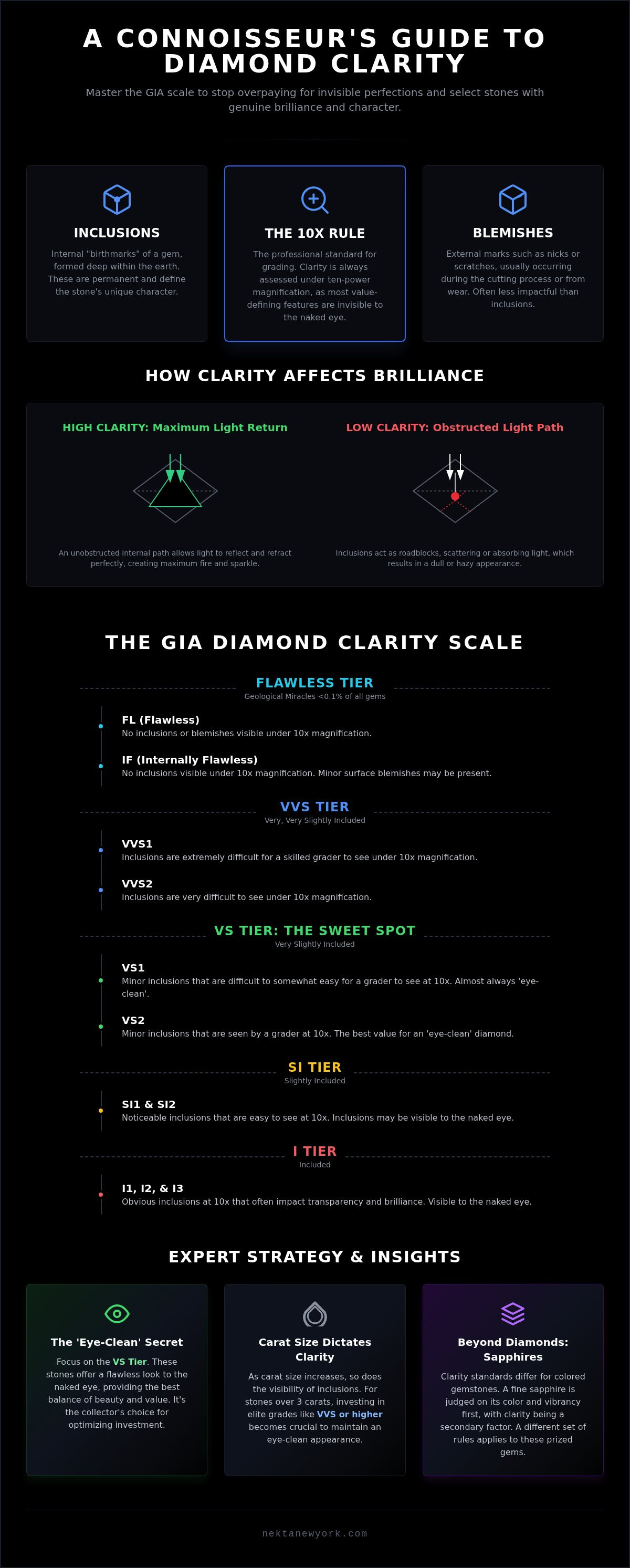
True luxury often resides in the details that remain unseen by the casual observer. When we discuss diamond clarity, we're examining the internal and external narrative of a stone, a story written in carbon over billions of years. While many buyers fixate on carat weight, the connoisseur understands that a stone's purity defines its soul. Clarity is the professional assessment of a diamond's "birthmarks," categorized as either internal inclusions or surface blemishes. These characteristics aren't merely defects; they're the unique DNA of a natural gem.
The standard for this assessment is the 10x Rule. Professional grading always occurs under ten-power magnification because many features that dictate a stone's market value are invisible to the naked eye. In the elite markets of 2026, the rarity factor of a high-clarity diamond remains a primary driver of investment potential. A stone with fewer internal characteristics is significantly rarer in nature, making it a more stable store of value for the discerning collector. It's the difference between owning a beautiful object and possessing a geological miracle.
Inclusions vs. Blemishes: What’s the Difference?
Understanding the distinction between these two categories is essential for any serious buyer. Inclusions are internal features, such as microscopic crystals of other minerals, clouds of tiny pinpoints, or "feathers," which are small internal breaks. Inclusions are the microscopic signatures of a diamond's violent birth, formed deep within the earth's mantle under immense pressure and heat. Blemishes, conversely, are external marks. These might include scratches, nicks, or pits that occurred during the cutting process or through daily wear. While blemishes are often easier to polish away, inclusions are permanent fixtures of the stone's identity.
How Clarity Impacts Diamond Brilliance
The relationship between diamond clarity and light performance is a matter of physics. Think of inclusions as obstacles in a hall of mirrors. When light enters a diamond, it's meant to bounce off the internal facets and return to the eye as "fire" or "brilliance." Large or poorly positioned inclusions act as roadblocks, absorbing or scattering light rather than reflecting it. This is why two diamonds can have the same color grade, yet one appears "crisp" while the other looks "milky."
- The 'Obstacle' effect: Dark crystals in the center of the stone can dull the overall sparkle.
- Cloudy vs. Crisp: High concentrations of tiny inclusions can create a hazy appearance, even in white stones.
- The Mike Nekta standard: We prioritize stones where the clarity doesn't just meet a grade on paper but ensures maximum light return and life.
Choosing a stone with high light performance means looking beyond the certificate. It requires an expert eye to ensure that the specific arrangement of inclusions doesn't compromise the diamond's natural ability to dance under the light.
The GIA Clarity Scale: A Connoisseur’s Map from Flawless to Included
The GIA scale serves as the definitive map for assessing diamond clarity, spanning eleven distinct grades from Flawless (FL) to Included (I3). For the connoisseur, these aren't just labels on a certificate. They represent a hierarchy of rarity and visual purity. Navigating this scale requires more than just reading a report; it demands an understanding of how light interacts with the stone's internal architecture. Rarity has a look. It's a look defined by the absence of nature's microscopic signatures.
The Elite Grades: FL, IF, and VVS
At the summit of the scale lie Flawless (FL) and Internally Flawless (IF) diamonds. These stones represent the top 0.1% of all gems ever mined. In a Flawless stone, no inclusions or blemishes are visible under 10x magnification. Internally Flawless stones share this internal purity but may have minor surface blemishes. Moving just below, the Very, Very Slightly Included (VVS1 and VVS2) grades offer inclusions so minute that even seasoned graders struggle to locate them under a microscope.
Investing in these elite tiers becomes crucial when selecting larger stones. For round brilliant cut engagement rings exceeding 3 carats, the vast table of the diamond acts as a window. In these high-carat weights, the slightest imperfection can become a distraction. Choosing an elite grade ensures that the stone's fire remains uninterrupted by nature's birthmarks. It's the standard for those who refuse to compromise on absolute perfection.
The Strategic Grades: VS and SI
The Value Tier consists of Very Slightly Included (VS1 and VS2) stones. These are the sweet spot for luxury engagement rings. In these grades, inclusions are minor and remain entirely invisible to the unaided eye. They provide the look of a flawless diamond without the extreme rarity premium. This allows you to focus your investment on color or cut quality, where the visual impact is often more immediate.
The Commercial Tier, comprising Slightly Included (SI1 and SI2) stones, is where the hunt becomes truly strategic. While these inclusions are noticeable under magnification, a "clean" SI stone can appear perfect to the naked eye. The Mike Nekta approach centers on this expert selection process. We meticulously vet SI diamonds to find stones where inclusions are positioned near the girdle, where they can be hidden by a prong. This allows our clients to maximize their carat weight without sacrificing the stone's visual integrity. If you're ready to find a stone that balances technical grade with breathtaking beauty, you can browse our curated selection of certified diamonds today.
Strategy Over Specification: Finding the 'Eye-Clean' Sweet Spot
In the pursuit of the perfect stone, the term 'eye-clean' is your most powerful tool. It describes a diamond that appears entirely devoid of inclusions to the unaided eye when viewed at a distance of approximately 6 to 10 inches. While diamond clarity grades provide a technical baseline, 'eye-clean' is the practical standard for luxury. Every natural stone is unique. Two diamonds with identical VS2 grades on paper can look drastically different in hand. One might have a hidden inclusion at the edge, while the other features a dark crystal right in the center.
Size changes the game. A 4-carat diamond has a significantly larger table, making it a much more demanding canvas for clarity than a 1-carat stone. Inclusions that vanish in a smaller gem often become glaringly obvious in high-carat weights. This is the 'carat weight trap' where buyers assume a grade that worked for a smaller stone will suffice for a larger one. A GIA certificate is non-negotiable here. It provides the third-party verification you need to ensure the clarity claims match the physical reality of the stone, protecting your investment from inflated commercial grades.
Location is everything. A dark crystal sitting directly under the center table is usually a dealbreaker for light performance. However, an inclusion tucked away near the perimeter can often be hidden by a prong during the setting process. Strategic selection allows you to secure a larger, more impressive stone by prioritizing 'clean' centers over a perfect technical grade.
Diamond Shape and Clarity Requirements
For collectors seeking this level of precision in their search for the perfect stone, Robson's Jewelers provides a bespoke approach to selecting high-clarity diamonds that meet these rigorous standards.
The shape you choose dictates how much diamond clarity matters. Brilliant cuts, such as round, oval, or pear shapes, utilize a complex facet arrangement that hides inclusions like a hall of mirrors. In contrast, step cuts have long, open facets that act like windows into the stone. Because these facets don't sparkle as intensely, they offer nowhere for inclusions to hide. For emerald cut engagement rings, I never recommend going below a VS2 grade. You want that stone to remain crisp, transparent, and mirror-like.
Common Clarity Mistakes to Avoid
Don't buy blind. You must see high-definition video or inspect the stone in person to understand its true character. A common error is ignoring 'clouds.' A stone might carry a respectable grade, but if it's riddled with widespread micro-inclusions, it'll look dull and milky rather than brilliant. Finally, don't focus solely on the grade. The grade is just a starting point. The stone's life, brilliance, and how it captures the light are what truly matter in a high-end piece of artistry.
Beyond Diamonds: Clarity in the World of Luxury Sapphires
A true connoisseur understands that the rigid standards of diamond clarity are merely a starting point for the broader world of rare gemstones. While diamonds are graded on a scale that prizes absolute transparency, sapphires belong to the Corundum family and are classified as Type II gemstones. This means they naturally contain more internal characteristics during their formation. In the sapphire market, the "inclusion expectation" shifts significantly. A Flawless sapphire is exponentially rarer than a Flawless diamond. Most high-end sapphires feature microscopic signatures that prove their natural, untreated origin.
Clarity in a sapphire isn't just about the absence of features. It's about how the internal architecture supports color saturation and light play. For those researching loose blue sapphires for sale, AfricaGems notes that these internal structures are vital for a stone's personality. Transitioning from diamond education to colored gemstone appreciation marks your evolution into a true collector. You're no longer just looking for a lack of flaws; you're looking for a stone with a unique personality and a "velvety" look that only specific internal structures can provide.
The Type II classification acknowledges that certain gems are "naturally included." When you browse the Mike Nekta Sapphire Collection, you'll notice that we prioritize stones with "eye-clean" transparency that doesn't compromise the gem's vivid hue. Microscopic rutile needles, often called "silk," can actually increase a sapphire's value by scattering light to create a coveted velvety glow and a soft, sleepy appearance. We curate our selection to ensure that any inclusions present are either invisible to the naked eye or contribute to the stone's unique character and brilliance.
Fancy Sapphires: Clarity Across the Rainbow
The rules for clarity change as you move across the sapphire rainbow. Yellow and pink sapphires, for instance, require a much higher level of internal purity. Because these stones have lighter, more delicate tones, they offer no place for inclusions to hide. A dark crystal that might be masked by a deep royal blue sapphire would be a glaring distraction in a lemon-yellow stone. Clarity also plays a vital role in the color change phenomenon, where a stone shifts hue in different lighting conditions; high transparency ensures this transition is crisp and dramatic.
These stones carry deep emotional weight, serving as the ultimate gift for 5th and 45th anniversaries. Whether you're celebrating a milestone or building a private collection, the purity of the stone defines its lasting legacy. If you're ready to find a gem that resonates with your personal story, you can view our exclusive sapphire collection to discover the pinnacle of Corundum quality.
Standout Selections: The Mike Nekta Sapphire Collection
Mike Nekta's approach to curation is rooted in a legacy that spans three generations in the heart of NYC's Diamond District. When I select a stone for our inventory, I'm looking for more than just a grade on a piece of paper. I'm looking for "life." While we've spent much of this guide discussing diamond clarity, applying those same elite standards to our sapphire collection is what sets a Nekta piece apart. We meticulously vet each stone to ensure it possesses a unique personality, balancing natural inclusions with breathtaking transparency.
Investment-grade sapphires require an expert's eye to identify the rare "sweet spot" where color and clarity meet. In our Manhattan studio, the custom experience often involves pairing these vibrant centers with a halo of high-clarity diamonds. This contrast doesn't just add brilliance; it highlights the sapphire's deep, saturated hue. You aren't just buying a ring; you're commissioning a work of art that respects the geological history of the Earth. You can explore these rare pairings in our September Birthstone collection today.
The Classic Blue Sapphire
Our collection features the most coveted shades of blue, from the soft, velvety glow of cornflower to the deep, authoritative presence of royal blue. Clarity in these premium stones is paramount. We prioritize eye-clean gems that allow light to pass through the stone's heart without being blocked by dark crystals or heavy clouds. Every custom setting we create utilizes ethically sourced, GIA certified stones, ensuring that your investment is as responsible as it is beautiful. These classic blues are the foundation of a sophisticated jewelry wardrobe, offering a timeless elegance that never fades.
Fancy Color and Rare Finds
For the collector who seeks the extraordinary, we offer a world of teal, orange, and purple sapphires. These "fancy" hues present a different challenge for the master craftsman. My goal is to use custom artistry to enhance the natural clarity of these unique colors. A teal sapphire, for instance, requires a specific cut to showcase its dual-toned brilliance. Whether it's a fiery orange or a regal purple, our selection process ensures that the stone's fire remains the focal point.
If you're ready to find a gem that's as unique as your own story, discover your perfect sapphire in our curated collection. We've applied the same rigorous vetting used for diamond clarity to every colored stone we offer, ensuring unparalleled quality for our most discerning clients. It's about finding a stone that doesn't just sparkle, but speaks to you.
Elevating Your Collection with Expert Precision
Mastering the intricacies of diamond clarity is the first step toward building a jewelry collection that transcends mere fashion. You've learned that while the GIA certificate provides a necessary foundation, your developed eye for the "eye-clean" sweet spot is what secures true value. Whether you're selecting a high-carat brilliant cut or a transparent step cut, the goal remains the same: ensuring maximum brilliance and uninterrupted light performance.
As a third-generation diamond expert, Mike Nekta brings bespoke Manhattan craftsmanship to every selection, ensuring each stone meets our rigorous standards for fire and life. This same dedication to excellence extends from our GIA certified loose diamonds to our rare colored gemstones. It's time to apply your new expertise to a piece that truly resonates with your personal legacy and aesthetic values.
Explore the Exquisite Sapphire Collection at Mike Nekta New York and discover how our heritage of excellence can help you find your next masterpiece. We're here to guide you through every choice with the discretion and expertise your investment deserves. Your journey toward a more brilliant future starts with a single, perfect stone.
Frequently Asked Questions
Is VVS2 better than VS1 for an engagement ring?
Technically, a VVS2 grade is superior to VS1 because its internal characteristics are more difficult to locate even under professional 10x magnification. However, for a standard luxury engagement ring, both grades typically appear identical to the naked eye. Selecting a VS1 often provides a more strategic balance of value and visual purity. This approach allows you to allocate more of your budget toward a superior cut or higher carat weight while maintaining a pristine appearance.
Can you see SI1 inclusions with the naked eye?
Most SI1 diamonds are eye-clean, but this is not a universal guarantee. Whether you can see an inclusion depends entirely on the type, color, and location of the specific characteristic. A dark crystal positioned in the center might be visible, whereas a white feather at the edge is easily hidden by a setting. Expert vetting is essential at this level to ensure the stone's internal features don't distract from its overall fire.
Does diamond clarity affect the price more than color?
Clarity can significantly impact the price, particularly when moving into the elite Flawless or VVS tiers. However, color and carat weight often have a more immediate influence on the market value of most commercial-grade stones. A jump from G to F color might cost more than a jump from VS2 to VS1 clarity. The key is understanding which factor provides the most visual impact for your specific investment and personal aesthetic preferences.
What is the best diamond clarity for a round brilliant cut?
The VS2 grade is widely considered the sweet spot for diamond clarity in a round brilliant cut. The complex facet pattern of this specific shape is exceptionally good at masking minor inclusions. This allows you to achieve a perfectly clean look without paying the extreme premium associated with the VVS range. For stones under two carats, a carefully selected SI1 can also offer an impeccable visual result when vetted by a professional.
Are sapphires graded on the same clarity scale as diamonds?
Sapphires are not graded on the same rigid 11-point scale as diamonds. As Type II gemstones, they are naturally more included, and the industry uses a broader classification system. A sapphire is typically described as eye-clean or included based on its visual transparency. We look for stones where internal features, like fine silk, enhance the color saturation rather than detract from the brilliance. This distinction is vital for any serious colored gemstone collector.
What does 'eye-clean' mean when buying a diamond online?
An eye-clean diamond is one where no inclusions are visible to the unaided eye from a viewing distance of six to ten inches. When buying online, this term is subjective and requires verification through high-definition video or a trusted expert's personal inspection. It is the most practical way to maximize your budget. You are paying for the beauty you can actually see rather than a technical grade that only exists under a microscope.
Will an inclusion make my diamond crack or break?
Most inclusions have zero impact on the structural integrity of a diamond. However, specific characteristics like cleavage or large feathers near the girdle can make a stone more vulnerable to chipping if it receives a sharp, accidental blow. These are rare in GIA certified stones of higher grades. Part of our selection process involves ensuring that the diamond clarity characteristics don't pose a long-term risk to the stone's durability or wearability.
Is it worth paying for a Flawless (FL) diamond?
Paying for a Flawless diamond is worth the investment if you value absolute rarity and symbolic perfection. From a purely visual standpoint, a Flawless stone looks identical to a VVS1 or even a high-quality VS1 to the naked eye. Collectors often choose FL or IF grades for their long-term investment potential and the prestige of owning one of nature's rarest miracles. It is a choice driven by the heart and the portfolio.