
Why Small Diamonds Deserve The Same Respect as Large Ones
I’m Mike Nekta, a third-generation jeweler and a GIA-certified gemologist based in New York. I’ve spent over 20 years in the diamond industry, and yes, I’m known for large-carat diamonds, custom engagement rings, and luxury investment pieces.
But here’s something I say in private consultations all the time, especially when someone apologizes for looking at “smaller” stones.
Small diamonds deserve the same respect as large ones.
Not sympathy. Not “it’s fine.” Not a consolation prize.
Real respect, because when you understand what actually makes a diamond valuable, beautiful, and emotionally significant, you realize size is only one part of the story. Sometimes it’s not even the most important part.
In this article, I’ll walk you through why small diamonds can be just as exceptional, how to evaluate them like an expert, and how to design jewelry that makes them look intentional, elevated, and truly luxurious.

The Size Bias Is Real And It’s Not Always About Beauty
Let’s be honest. The market loves big numbers.
Carat weight is easy to talk about, easy to compare, and easy to flex. A 2.00 ct sounds like a headline. A 0.70 ct sounds like a footnote, even if the 0.70 is cut better, whiter, cleaner, and brighter.
I’ve seen this bias play out in every kind of client:
- Someone with a healthy budget who still feels pressure to “hit” a carat milestone.
- Someone buying an engagement ring who wants it to look impressive to friends and family.
- Someone who simply assumes bigger means better because that’s what advertising trained them to believe.
The truth is, the eye doesn’t measure carats. It responds to light.
And light performance is where small diamonds can be absolutely lethal in the best way.
Carat Weight Is Not A Quality Grade
Carat is weight, not size. That’s the first correction I make when I’m educating a new client.
Two diamonds can weigh the same and face up differently. One can look larger because it’s cut to a wider spread. Another can look smaller because it’s cut deep, hiding weight in the pavilion where you can’t see it.
And carat tells you nothing about:
- Cut quality (how it returns light)
- Proportions (how it’s shaped and balanced)
- Material quality (color and clarity)
- Fluorescence behavior
- Craftsmanship of polishing and symmetry
If you’ve ever seen a modest-sized diamond that looks like it’s lit from within, you already understand this. That glow is not carat weight. That’s cut.
Cut Is The Great Equalizer

If I could only teach one thing about diamonds for the rest of my career, it would be this:
Cut quality is what makes a diamond look alive.
A well-cut 0.80 ct can outshine a poorly cut 1.20 ct all day. Not on paper. In real life, across a room, under restaurant lighting, in sunlight, in office LEDs, in those everyday environments where jewelry actually has to perform.
Small diamonds, when cut correctly, are efficient. They don’t rely on size to impress. They rely on brilliance, fire, and scintillation.
Here’s how I break it down simply:
- Brilliance is white light return. That crisp brightness.
- Fire is colored flashes, the rainbow dispersion.
- Scintillation is the sparkle pattern as you move.
A diamond can be large and still look sleepy if the cut is off. A diamond can be smaller and look electric if the cut is right.
That’s not theory. That’s what I see every week at the bench, at the scope, and across the counter.
Small Diamonds Can Be Rarer Than You Think
People assume rarity increases with size. Often that’s true, but it’s incomplete.
A large diamond is rare. A large diamond with top-tier cut, color, and clarity is rarer.
Now apply that same logic to smaller diamonds, especially those in the “sweet spot” range where demand is huge: think 0.50 to 1.00 ct. The market is flooded with average stones in that range because they sell fast.
So when you find a smaller diamond that is truly elite in make, it stands out.
In other words, a small diamond isn’t automatically common. A small diamond that is beautifully proportioned, clean to the eye, and bright in multiple lighting environments can be surprisingly hard to source.
As a jeweler, I can tell you: it’s easy to find “a diamond.” It’s harder to find the right diamond, regardless of size.
The Best Luxury Is Intentional, Not Loud
I work with clients in New York who have every reason to go bigger, and sometimes they do. But a noticeable portion of my clients are not trying to shout.
They want something that reads as:
- refined
- tasteful
- expensive without being obvious
- designed, not purchased
Small diamonds can communicate that kind of luxury beautifully, especially when the setting is crafted properly and the stone quality is there.
A perfectly cut 0.90 ct in a hand-finished platinum solitaire with the right proportions can look more “old money” than a larger diamond in a heavy, generic setting.
Luxury is not only about scale. It’s about taste, materials, and execution.
Small Diamonds Often Look Better On The Hand
This is one of the most practical points, and it gets overlooked.
Hands are not standardized.
Finger length, finger width, knuckle shape, nail style, and even how someone carries themselves changes how a ring presents. I’ve seen 1.50 ct diamonds look overpowering on petite hands and 0.80 ct diamonds look perfectly balanced and elegant.
When a diamond is proportionate to the hand, it tends to look more expensive. It looks “made for you,” not “forced on you.”
And comfort matters. A ring you love wearing is a ring that becomes part of your identity.
If you’re constantly adjusting it, babying it, or feeling like it catches on everything, the romance fades.
Small-to-mid size diamonds can be a sweet spot for daily wear, especially for active lifestyles.
The Setting Is The Amplifier

If you want a small diamond to command presence, design matters more than people realize.
Here are a few setting strategies I use in custom work to elevate smaller center stones.
Use A Thin, Precise Band
A slimmer band makes the center stone feel more dominant, visually. It’s not about making things delicate for the sake of it. It’s about proportion.
A thick band can swallow a modest center. A refined band frames it.
The key is structural integrity. Thin does not mean weak. It means engineered correctly with the right metal thickness and craftsmanship.
Choose A High-Performance Head
A well-built prong structure can make a diamond look cleaner and larger. Poorly executed prongs can make even a great diamond look clumsy.
I’m obsessive about prongs because they do two things at once:
- protect your stone
- influence how large and bright it appears
Consider A Halo, But Make It Elegant
Halos are often overdone, and when they’re overdone they read as mass market.
But a tight, micro-set halo with high-quality melee, proper spacing, and the correct height can create a beautiful bloom effect around a smaller center stone.
The trick is restraint. A halo should look like it belongs to the design, not like it was added to inflate appearance.
Side Stones Can Add Presence Without Competing
Tapered baguettes, half-moons, trapezoids, or even subtle pavé can create a wider visual footprint while keeping the center stone the hero.
This is where custom design changes everything. The wrong side stones make the ring busy. The right ones make it look like a complete architectural piece.
Small Diamonds Are Often Smarter Financially Without Feeling “Budget”
Let’s talk about money in a way that’s respectful and realistic.
Diamond pricing does not scale linearly. It jumps at thresholds. 1.00 ct, 1.50 ct, 2.00 ct. Those milestones come with premiums that are not always justified by what you see on the hand.
Sometimes, the most intelligent value sits just under a magic number.
Examples:
- 0.90 ct to 0.99 ct can look extremely close to 1.00 ct in real life.
- 1.80 ct to 1.99 ct can face up impressively while avoiding some of the 2.00 ct premium.
This isn’t about gaming the system. It’s about spending where it matters.
If you put the savings into better cut, better color, cleaner clarity, or a custom setting that’s actually built well, you often end up with a ring that looks and feels more luxurious than a bigger stone compromised in quality.
The Emotional Meaning Is Not Measured In Carats
I’ve been doing this long enough to see what people remember.
They remember:
- how the ring was chosen
- the moment it was given
- the feeling when they first wore it
- the story behind why it looks the way it does
They don’t remember the carat number the way the internet does.
A small diamond given with intention can carry more emotional gravity than a larger diamond bought under pressure.
And if you’re building a piece to mark a milestone, an anniversary, a birth, a personal achievement, then the symbolism matters more than the spreadsheet.
Small Diamonds Demand Better Craftsmanship
Here’s a behind-the-scenes truth.
A smaller diamond, especially in minimalist designs, leaves nowhere to hide.
With a big center stone, people forgive a little bulk in the prongs or a slightly heavy shank because the diamond dominates. With a smaller stone, every detail is visible and proportion becomes everything.
That’s why small diamonds often push jewelers to do their best work:
- prongs must be clean and consistent
- symmetry has to be exact
- pavé has to be even
- finishing has to be crisp
When done right, the final piece looks like it belongs in a showcase, not because it’s large, but because it’s precise.
How I Evaluate A Small Diamond For A Client

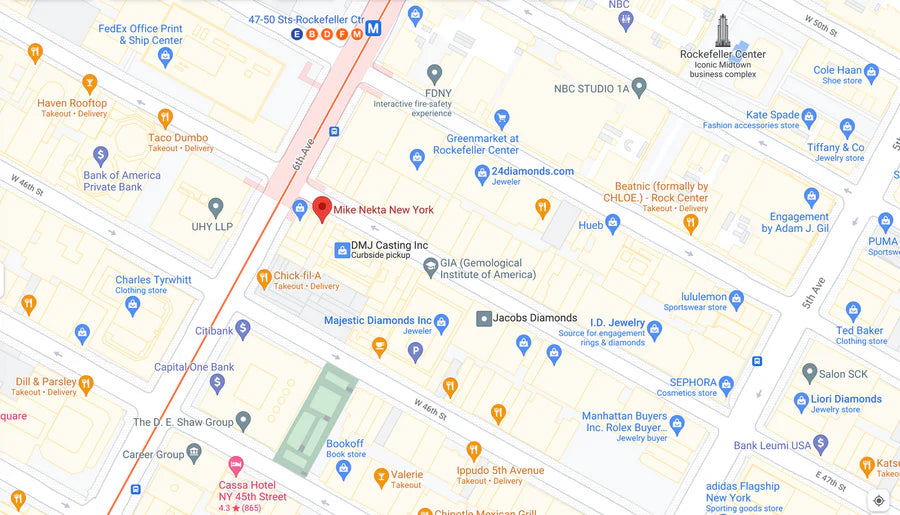
When you sit with me at Mike Nekta New York, I don’t start by asking, “What carat size do you want?” I start by asking how you want it to feel and look in real life.
Then I evaluate the stone like a gemologist, not like a billboard.
Here’s what I focus on.
Cut Quality And Proportions
For round brilliant diamonds, I’m looking at:
- table percentage
- depth percentage
- crown and pavilion angles
- optical symmetry
- light performance indicators
A GIA “Excellent” is a good start, but it’s not the final word. Two Excellent cuts can perform very differently.
Real-World Color
Color grades are useful, but context matters.
- Metal choice changes perceived color.
- Side stones change perceived color.
- Diamond shape changes perceived color visibility.
A well-chosen near-colorless diamond can look icy in the right setting.
Eye-Clean Clarity, Not Paper Clarity
Clarity is about what you see and how the diamond behaves visually.
I care whether a diamond is eye-clean from the top and at normal viewing distance. Many clients are surprised to learn that a well-selected SI1 or SI2 can look absolutely clean and allow more budget to go into cut.
But I’m strict here. Not every SI is created equal.
Fluorescence And Transparency
Fluorescence can be totally fine. Sometimes it’s beneficial. Sometimes it hurts transparency, especially in stronger levels.
I look at the diamond, not the label. If it’s hazy, it’s out. If it’s crisp and lively, it stays on the table.
Make Sure The Diamond “Faces Up” Well
This matters in small diamonds.
A 0.85 ct that faces up like a strong 0.95 ct because of great spread is a win. A 0.95 ct that faces up small because it’s deep is not.
Small Diamonds In Fancy Shapes Can Be Stunning
Round brilliants get most of the attention, but fancy shapes are where small diamonds can feel especially distinctive.
Here’s what I often recommend in the sub-1.50 ct range, depending on taste.
Oval
Ovals can look larger than their carat weight because of their elongated shape. With the right proportions, they’re elegant, flattering, and very “New York” in attitude.
The caution is bow-tie effect. It needs to be evaluated carefully.
Emerald Cut
Emerald cuts are not about sparkle overload. They’re about hall-of-mirrors elegance.
A smaller emerald cut in a refined setting can look incredibly high-end because it reads as intentional and architectural.
Clarity and cut precision matter more here because the facets are open and honest.
Pear And Marquise
Both can give you strong finger coverage and a dramatic silhouette, even at modest carat weights.
Set them correctly and they look like couture.
Radiant And Cushion
These can offer a balance of brilliance and shape personality. They also hide inclusions a bit more than step cuts, which can help with value without sacrificing beauty.
The “Small Diamond” Category Includes Some Of The Most Legendary Jewelry

If you look at antique and vintage jewelry, you’ll see a lot of smaller diamonds.
Not because people didn’t value diamonds back then. They valued them so much that they designed pieces around proportion, craftsmanship, and artistry.
Think about:
- old mine cuts and old European cuts with character
- intricate pavé work
- cluster rings that create a floral or starburst silhouette
- rivière necklaces and tennis bracelets where the total look matters more than any single stone
A tennis bracelet is the perfect example. No one asks, “How big is each diamond?” They ask, “Does it sparkle?” and “Does it look expensive?” The respect is already there.
The same thinking applies to a ring. A piece can be extraordinary as a whole, even if the center stone is not a boulder.
The Quiet Flex: Small Diamonds With Perfect Specs
One of my favorite client types is someone who wants the best, but doesn’t need the room to know it.
They’ll choose:
- a smaller stone
- a near-flawless make
- a premium setting
- perfect finishing
And the result is a ring that experienced eyes recognize immediately.
It’s a quiet flex. The kind of luxury that doesn’t ask for validation.
If you know, you know.
Common Mistakes People Make When Buying Small Diamonds
I want to save you from the most common traps.
Chasing Carat And Sacrificing Cut
This is the big one.
A poorly cut diamond will look smaller than it should, darker than it should, and less lively than it should.
If you’re choosing between size and sparkle, sparkle wins in real life.
Going Too Low On Color For The Setting
A warmer stone can be beautiful, especially in yellow gold. But if you want a crisp, clean look and you’re setting in white metal, don’t accidentally choose a color that will bother you later.
Buying Clarity You Don’t Need
You don’t always need VVS. Sometimes you do, especially in step cuts or if you’re very sensitive to inclusions.
But many people overspend on paper clarity and then compromise elsewhere.
Ignoring The Setting Quality
A small diamond in a mediocre setting looks like a small diamond.
A small diamond in a beautifully made setting looks like jewelry.
That difference is everything.
What “Respect” Looks Like In A Custom Piece
When I say small diamonds deserve respect, I mean you should treat them with the same seriousness you’d treat a 5-carat stone.
Respect looks like:
- sourcing a diamond with strong light performance
- checking it in multiple lighting conditions
- matching it properly with the metal and design
- using high-quality side stones if they’re included
- building the setting with precision and longevity
- finishing the piece so it feels like luxury in the hand
A smaller diamond doesn’t need excuses. It needs excellence.
And excellence is always noticeable.
My Advice If You’re Choosing Between A Bigger Diamond And A Better Diamond
If you’re torn, here’s the honest approach I give clients.
- Decide what you want to notice every day.
- If you want to notice sparkle, prioritize cut. If you want presence, we can create it with design.
- Stop shopping with only numbers.
- You can’t wear a certificate. You wear the diamond.
- Try stones on your hand.
- Your hand will tell you what looks right faster than the internet will.
- Put money into what you can’t “upgrade” later.
- Cut quality and craftsmanship are forever choices. You can always redesign a setting later, but starting with a great stone and proper build saves you regret.
Book A Private Appointment At Mike Nekta New York
If you’re considering a piece with a smaller center diamond, or you’re simply trying to decide what actually gives you that luxury look without compromising quality, I’d be happy to guide you through it personally.
When you book an appointment with me at Mike Nekta New York, we can:
- compare diamonds side-by-side in real lighting
- talk through cut, color, clarity, and proportions in plain English
- design a setting that makes your stone look intentional and elevated
- create a custom engagement ring or fine jewelry piece that feels truly yours
If you want that calm, high-touch experience where everything is curated and nothing is rushed, book an appointment with me, Mike Nekta, and we’ll build something you’ll be proud to wear for life.
Final Thoughts
Large diamonds are incredible. I work with them for a reason.
But the idea that smaller diamonds are automatically less worthy is outdated. A small diamond can be brighter, cleaner, rarer in quality, more wearable, more tasteful, and more personal than a larger stone chosen for the number alone.
The diamond doesn’t need to be big to be exceptional.
It needs to be chosen with intention, evaluated with expertise, and set with craftsmanship that respects what it is.
That’s how small diamonds earn the same respect. And honestly, that’s how they often win.