
Ring Sizes: How to Measure, Read a Chart, and Find the Right Fit
What if the number on a ring-size chart is correct, yet the ring still feels wrong? Ring sizes vary between sizing systems, and a measurement taken at home may not account for your knuckle, band width, or the way your fingers change through the day. A careful fit matters, especially when choosing a ring you’ll wear every day or ordering one as a surprise.
This guide explains how ring sizes relate to finger circumference and a ring’s inner measurement, how to measure the intended finger, and how to read US and international charts without relying on a conversion alone. You’ll also learn how band width and knuckle shape affect comfort, which everyday conditions can influence fit, and why some designs are difficult to resize. Mike Nekta New York creates custom engagement rings and offers wedding bands, with third-generation diamond expertise behind each design. Start with a careful measurement, then consider how the ring will feel in everyday wear.
Key Takeaways
- Use a flexible, non-stretch measuring tool and position it around the finger without pressing into the skin.
- When comparing ring sizes, check the chart’s sizing system and units so you’re matching measurements consistently.
- A ring’s width and fit over the knuckle can change how comfortable the same measured size feels.
- For a surprise ring, discreetly borrow one worn on the correct finger or seek input from someone the recipient trusts.
- Use your measurement as a starting point when choosing a custom engagement ring or wedding band.
Ring Sizes Explained: What the Number Tells You
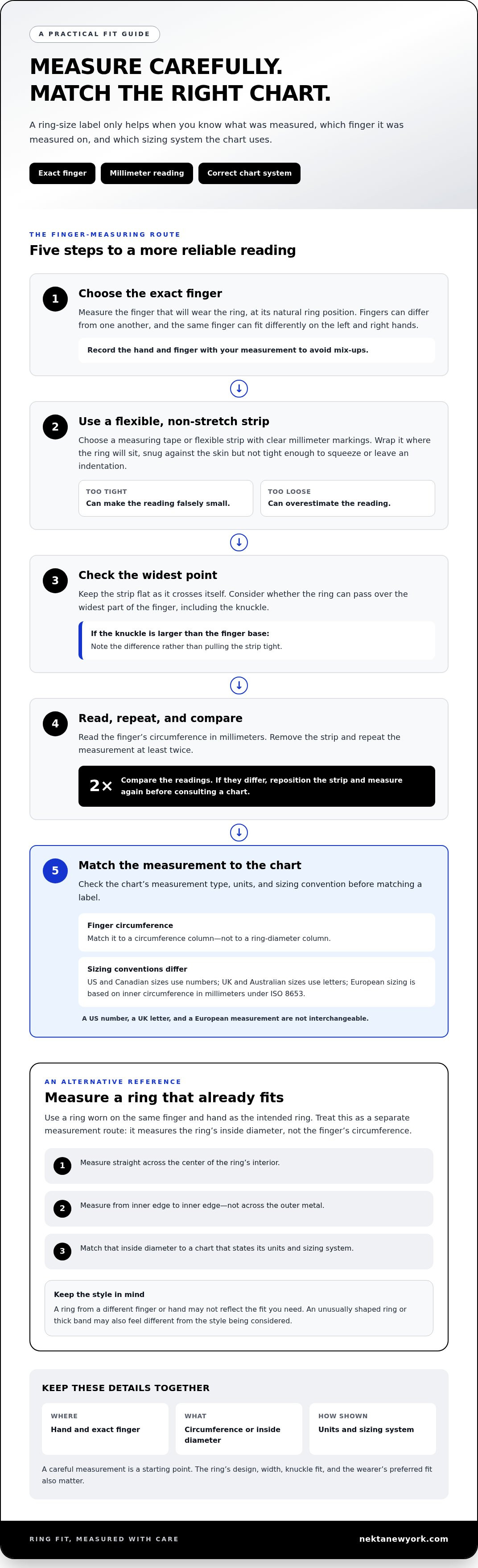
You don’t need to guess your way to a comfortable fit. A ring size can be estimated by measuring the intended finger or the inside of a ring that already fits well, then matching the result to the correct chart. The key detail is the sizing system: a US number, a UK letter, and a European measurement are not interchangeable.
Ring size is a value in a particular sizing system that corresponds to a finger measurement or a ring’s interior measurement. The label helps identify a fit, but it only makes sense when you know which finger was measured and which country’s sizing convention the chart uses.
What measurements determine a ring size?
Two measurements commonly guide sizing: the circumference around the finger and the inside diameter of a well-fitting ring. Circumference is the distance around the finger; inside diameter is measured straight across the ring’s interior. These dimensions are related, but they are taken differently. Don’t compare a circumference reading directly with a diameter column on a chart.
Check that each chart identifies its units and sizing convention. The US and Canadian systems use numerical labels, the UK and Australian systems use letters, and European sizing is based on inner circumference in millimeters under ISO 8653. Other regions use their own numerical systems. For a broader overview of ring size measurement systems and international standards, consult the reference before comparing labels across countries.
Are ring sizes the same for every finger?
No. Measure the exact finger that will wear the ring. Fingers differ in circumference, and the same finger can fit differently on the left and right hands. Even neighboring fingers may need different sizes, so don’t assume a measurement for one finger will fit another.
Use a ring that fits the intended finger as a reference, not just one that belongs to the same person. If you measure the finger directly, record the hand and finger as well. That note helps prevent mix-ups when you later check a chart or compare measurements.
Keep the measurement and the chart’s sizing system together. For example, match a circumference recorded in millimeters to a chart that interprets millimeters as circumference, not to one showing US labels or ring diameter. Regional labels follow different conventions, even when they describe a similar physical fit.
Gender-based size averages can’t replace an individual measurement. They describe broad groups, not the specific finger that will wear the ring. For an engagement ring or wedding band, an accurate finger-specific measurement is a useful starting point. The ring’s design and the wearer’s preferred fit also matter.
How to Measure Ring Size at Home More Reliably
A careful home measurement is a useful starting point. Take it more than once, and note exactly where and how you measured. The most important accuracy principle is simple: measure carefully, then repeat the measurement to see whether the result is consistent. Use a flexible, non-stretch measuring tool, snug against the skin but not tight enough to squeeze it.
Measure the finger with a flexible strip
Choose a non-stretch measuring tape or flexible strip with clear millimeter markings. Measure where the ring will sit, and also consider the widest knuckle the ring must pass over. The strip should touch the skin without leaving an indentation. Pulling it tight can make the result falsely small; leaving it loose can overestimate it.
- Place the strip around the intended finger at the ring’s natural position.
- Keep it flat, and check that it crosses itself without twisting or digging into the skin.
- Consider whether the ring can pass over the widest part of the finger, including the knuckle. If the knuckle is larger than the base of the finger, note the difference rather than pulling the strip tight.
- Read the circumference in millimeters, remove the strip, and repeat the measurement at least twice.
- Record each result and compare them. If they differ, reposition the strip and measure again before consulting a chart.
For a practical reference alongside this process, see the Kay Jewelers guide to measuring ring size at home. A repeated reading is more useful than a single measurement taken in haste.
Measure a ring that already fits
A well-fitting ring offers another way to estimate size. Choose one worn on the same finger and hand as the intended ring, then measure straight across its interior at the center. Read from inner edge to inner edge, not across the outer metal. Match that diameter to a chart that clearly states its units and sizing system.
This is a comparison, not a substitute for careful placement: a ring from another finger or hand may not reflect the fit you need. An unusually shaped ring or one with a thick band may also feel different from the style you’re choosing.
Keep your notes precise: record the hand and finger, the measurement in millimeters, and whether you measured finger circumference or the ring’s inside diameter. These are different measurements, so don’t enter one into a chart intended for the other. The chart’s sizing system matters too, because regional conventions differ.
For a custom engagement ring or wedding band, an at-home result can start a more considered fit discussion. Mike Nekta New York creates custom-designed engagement rings and wedding bands, using your measurement as one detail in choosing a ring that suits its wearer.
How to Read a Ring Size Chart and Convert Sizes
A ring size chart turns a measurement into a label, but it’s useful only if you read the headings as carefully as the numbers. First identify whether you measured circumference or diameter, then check the unit and find the column for the sizing system you need. International equivalents can vary between charts and retailers, so treat a conversion as a practical guide rather than an exact universal match.
US sizes, circumference, and diameter
A US chart commonly pairs a numerical size with the ring’s inner diameter and circumference. Diameter is measured straight across the inside of the ring; circumference is the distance around its inner edge, corresponding to the measurement around a finger. These are related dimensions, but they are not the same measurement. The table below gives rounded reference values; an individual chart may differ slightly.
| US ring size | Inner diameter (mm) | Inner circumference (mm) |
|---|---|---|
| 5 | 15.7 | 49.3 |
| 6 | 16.5 | 51.9 |
| 7 | 17.3 | 54.4 |
| 8 | 18.1 | 57.0 |
| 9 | 18.9 | 59.5 |
| 10 | 19.8 | 62.1 |
The column headings name the measurement and unit, making it easier to find the right value. For example, if your finger circumference measures about 54.4 mm, this chart points to US size 7. That’s a lookup example, not a guarantee that every chart or ring will correspond identically.
How to convert between international size systems
Before converting, identify the starting system: US and Canadian sizes use numbers, UK and Australian sizes use letters, and European sizing commonly expresses inner circumference in millimeters. Other regions may use separate numerical conventions. The same numeral can mean something different in another system, so don’t transfer a label without checking its heading.
- Identify the original sizing system and the measurement you have.
- Find the chart’s matching column, making sure circumference and diameter aren’t confused.
- Read across to the destination system, then cross-check against the chart’s millimeter measurement where available.
- If the chart uses different increments or rounds values, treat the result as an approximate equivalent.
Charts may round to different intervals or use different conventions, so two conversion tables might not show precisely the same equivalent. Use the chart for the ring you’re considering, and compare its measurement columns instead of relying on a standalone conversion. Ring sizes are most useful when you consider the number, system, and measurement together. A population average, including one grouped by gender, can’t replace the wearer’s own measurement.
How Ring Width, Knuckles, and Daily Changes Affect Fit
A measurement is a valuable starting point, not a guarantee that every ring will feel identical. The same size label can feel different across designs because band width changes how much of the finger the ring touches. Knuckle shape and normal changes in finger size also affect how a ring moves and sits. Assess fit with the specific style in mind, not the number alone.
Why band width can change how a ring feels
A narrow band touches less of the finger, while a wider band covers more surface and may feel snugger, even if both have the same size label. A slim band may slide comfortably over the knuckle, while a broader band in that size feels more substantial at the base. That’s a difference in sensation, not necessarily a different measurement. There’s no single adjustment that suits every hand and design.
Consider the actual band when judging fit, especially for a wide wedding band or a ring worn alongside other bands. A chart can help identify a starting size, but the finished design affects how that size feels in daily wear. Assess each ring individually rather than assuming the comfort of a narrow style predicts how a wider one will feel.
What a comfortable fit should feel like
A well-fitting ring should pass over the knuckle with gentle resistance, then sit securely at the base without pinching, aching, or feeling uncomfortably tight. It shouldn’t slip off easily, but removing it shouldn’t require force. The balance depends partly on the difference between your knuckle and the base of your finger, so consider both points rather than measuring only where the ring rests.
Finger size can also shift with temperature and time of day. Warm conditions may make fingers feel fuller; cold can make them feel smaller. A measurement taken once may not represent how the ring feels throughout ordinary wear. If readings or comfort seem inconsistent, repeat the measurement under typical conditions and compare the results instead of treating one reading as definitive.
- Note whether the ring catches at the knuckle or feels loose once it reaches the base.
- Consider the band’s width and how it feels after you have worn it for a while.
- Pay attention to changes in comfort across different temperatures and times of day.
For a custom engagement ring or wedding band, bring these observations into the design conversation alongside your measurement. Explore custom-designed engagement rings and wedding bands from Mike Nekta New York.
Find the Right Ring Size for a Custom Ring or Surprise
A measurement gives you a thoughtful starting point, but a custom ring calls for more context than a number alone. Note the intended finger and hand, how you want the ring to feel, and the band style you have in mind. That information helps turn a chart result into a considered choice for an engagement ring or wedding band.
Discreet ways to estimate a surprise ring size
If you’re planning a surprise, quietly borrow a ring the recipient wears on the intended finger. Trace around its inside edge on paper, and keep the ring itself safe. A tracing can offer a useful clue, but it isn’t a precise substitute for a direct measurement. A trusted friend or family member who knows the recipient’s ring habits may also be able to help discreetly.
Make sure the borrowed ring belongs on the correct finger and hand. A ring worn on another finger, or on the corresponding finger of the opposite hand, may fit differently. Don’t estimate based on height, hand size, or gender; those clues can’t reliably identify an individual fit. If you can’t get a relevant ring or trusted input, treat any estimate as tentative rather than exact.
Bring sizing context into a custom-ring conversation
Once you’ve gathered useful details, share the intended finger and hand, your measurement and unit, and the band style you’re considering. Mention whether your knuckle makes a ring harder to pass over or whether you prefer a more secure feel. These details help shape a conversation about fit alongside the design of a custom engagement ring or wedding band.
Band proportions are part of that conversation. A delicate design and a broader band can feel different, even if their size labels match, so consider the complete piece rather than choosing from a number alone. If you’re planning wedding bands, the custom wedding bands guide offers inspiration for thinking about personal details and design together.
- Keep the measurement tied to the exact finger and hand it came from.
- Share whether your estimate came from a direct measurement, an existing ring, or someone you trust.
- Describe the band style and the fit you hope to achieve.
For an engagement ring, give the design choice the same care as the fit. Explore the round brilliant engagement ring guide as you consider a custom ring, then use your notes to support a considered design conversation at Mike Nekta New York.
Let Comfort Shape Your Next Design Choice
The right ring should feel like it belongs in your life, not simply match a number on a chart. Think about how you want it to sit, how often you’ll wear it, and which design feels meaningful to you. Those preferences can guide choices that make a ring personal, from its silhouette to the way its band feels throughout the day.
Ring sizes are one part of that decision, but comfort and the character of the piece matter too. Consider them together before settling on a design, so your choice feels thoughtful from the beginning.
Explore custom engagement rings at Mike Nekta New York and take the next step toward a piece designed for its wearer.
Frequently Asked Questions
Can a ring size change during the day?
Yes, a finger can feel slightly different in size at different times of day. Temperature, activity, and fluid retention may affect how a ring feels, so a fit that seems comfortable in the morning might feel snug later. If you’re deciding between measurements, notice whether the difference persists under ordinary conditions rather than relying on a reading taken just after exercise, in extreme temperatures, or when your hands feel unusually swollen.
Is a ring size the same on both hands?
Not necessarily. Fingers on your left and right hands can differ, even when they share the same name, so a ring that fits one hand may feel too tight or loose on the other. Measure the specific finger and hand that will wear the ring. This matters especially for a surprise: a ring borrowed from the opposite hand can offer a clue, but shouldn’t be treated as a reliable match.
Can I find my ring size with a phone app?
A phone app can provide an estimate, but its accuracy may vary with the app, device, and measuring method. Some apps compare an existing ring on the screen; others use the phone to estimate a finger measurement. Follow the app’s instructions carefully, and treat the result as a starting point rather than a final answer. If the fit is important, compare it with a physical ring sizer or another careful measurement.
Does age affect ring size?
It can. Finger shape and circumference may change over time, so a ring size that worked years ago may no longer feel right. Changes in weight, joint shape, or other personal circumstances can also affect fit, though the experience varies from person to person. If a familiar ring begins to feel uncomfortable or becomes difficult to remove, don’t assume the old size still applies. Reassess the fit before choosing a new ring.
Can I determine someone’s ring size from a photograph?
No, a photograph usually can’t provide a dependable ring-size measurement. Camera distance, angle, perspective, and the lack of a known scale can make a finger or ring appear larger or smaller than it is. A picture may help identify which finger usually wears a ring, but not its precise size. For a discreet estimate, use a ring worn on that exact finger or ask someone trusted to help.
Does ring size determine whether a ring is comfortable?
No. The size label matters, but comfort also depends on the ring’s design and the wearer’s finger. A wide band may feel different from a narrow one, and a prominent knuckle can affect how easily a ring passes on or off. Consider how the ring feels during normal activities, not just at the moment you try it on. The right ring size balances a secure fit with comfortable movement.