
Oval vs. Pear Shaped Engagement Rings: The 2026 Connoisseur’s Comparison
Choosing between an oval and a pear shaped diamond isn't just a matter of geometry; it's a choice between the quiet harmony of perfect symmetry and the daring, avant-garde artistry of a teardrop. You've likely noticed that both shapes possess a unique ability to elongate the finger, creating an elegant hand aesthetic that feels both substantial and refined. It's a sophisticated look that many of our most discerning clients now prefer over the traditional round brilliant.
However, the search for the perfect stone often brings up valid anxieties about the "bow-tie" effect or the vulnerability of a pear's pointed tip. In this comparison of oval vs pear shaped engagement rings, we'll demystify the light performance of these exquisite cuts. You'll discover how to maximize your investment by understanding visual surface area and learn why the right custom setting is the ultimate insurance for your stone's integrity. From the resurgence of yellow gold to the precision of GIA certified grading, we're providing the professional clarity you need to choose a ring that reflects your personal legacy.
Key Takeaways
- Master the art of identifying and minimizing the "bow-tie" effect to ensure your diamond maintains exceptional brilliance across its entire surface.
- Understand how elongated silhouettes create a more slender finger aesthetic and offer a significantly larger visual profile than traditional round diamonds of the same weight.
- Navigate the technical and stylistic differences of oval vs pear shaped engagement rings to find your perfect balance between classical symmetry and avant-garde artistry.
- Learn the essential setting requirements, such as the use of protective V-prongs, necessary to secure the unique and delicate geometry of a pear-shaped stone.
- Evaluate the long-term investment potential and market rarity of these coveted cuts with professional insights from the heart of the Manhattan Diamond District.
The Rise of Elongated Silhouettes: Oval and Pear in 2026
The luxury jewelry landscape of 2026 has witnessed a definitive shift toward what experts call "elongated brilliance." This category represents a sophisticated departure from the standard circular geometry that dominated previous decades. Today, a diamond isn't just a symbol of commitment; it's an architectural statement. When couples weigh the merits of oval vs pear shaped engagement rings, they're participating in a broader movement that values unique silhouettes over traditional uniformity. These shapes occupy more visual real estate on the finger, offering a sense of abundance and bespoke luxury that a standard round cut simply can't match.
The psychological appeal of these cuts lies in their perceived rarity. While round diamonds are produced in high volumes, selecting an elongated shape suggests the wearer has a specific, curated eye for design. It signals that you've looked beyond the default options to find a stone that complements your specific hand aesthetic. This choice tells a story of a buyer who understands the nuances of a diamond cut and wants their investment to stand out in a world of predictable choices. In our New York showroom, we see this trend manifesting as a desire for jewelry that feels like a personal legacy rather than a mass-produced item.
The Oval Diamond: Symmetrical Grace
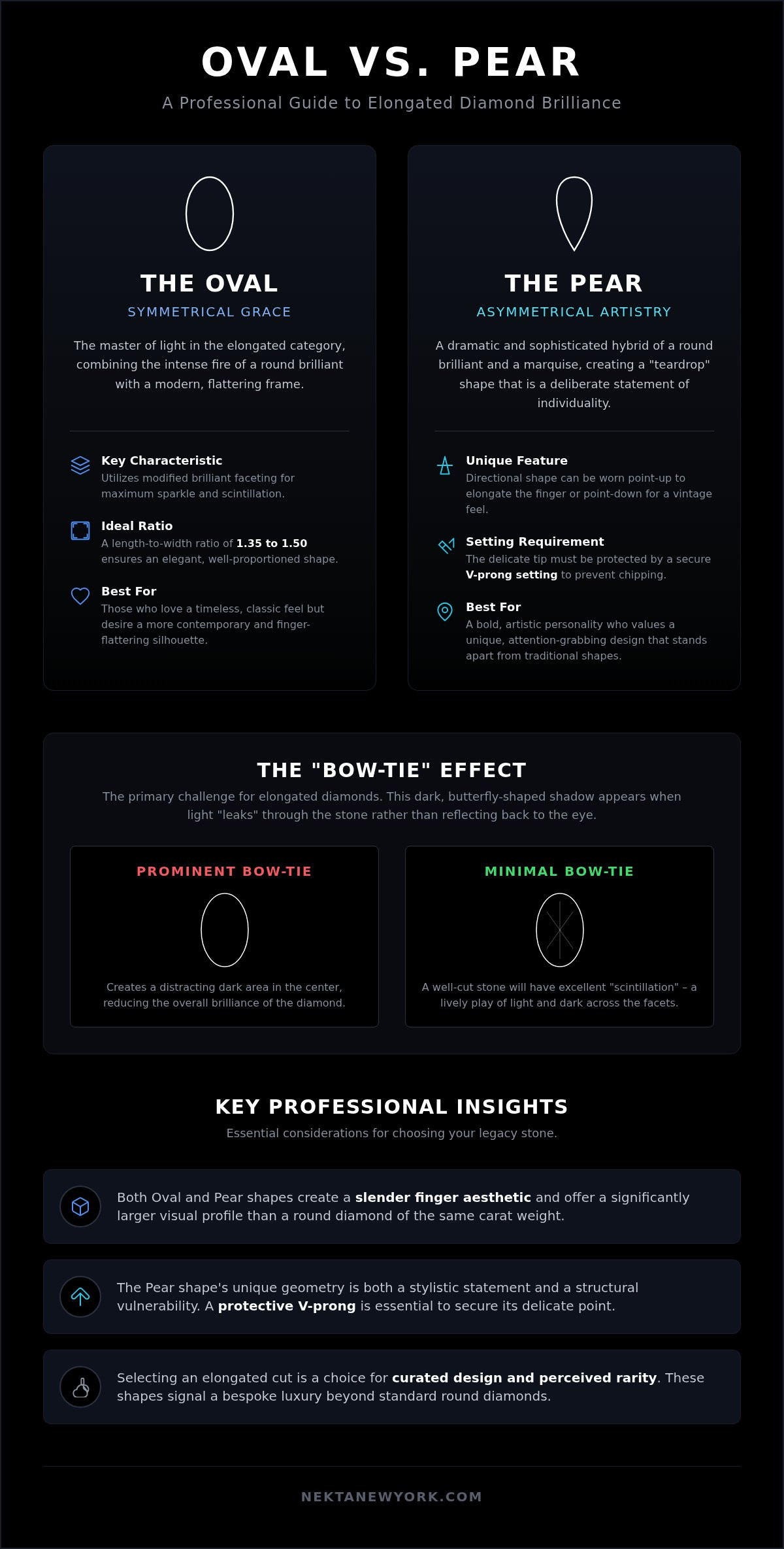
Ovals are the undisputed masters of light in the elongated category. By utilizing modified brilliant faceting, they capture the intense fire and scintillation that made the round cut famous, but within a more modern, flattering frame. They're the premier choice for those who love the timeless nature of a classic ring but want a silhouette that feels more contemporary. The modern oval was a 1960s innovation designed to maximize sparkle and surface area, and it has officially peaked in 2026 as the most stable and coveted alternative to the round brilliant.
The Pear Diamond: Asymmetrical Artistry
If the oval represents harmony, the pear shaped diamond represents drama. This shape is a sophisticated hybrid, seamlessly blending the soft, voluminous curves of a round brilliant with the sharp, tapered edge of a marquise cut. Often referred to as a "teardrop," this shape is a deliberate statement of individuality that refuses to follow the rules of perfect symmetry. The directional nature of the pear is one of its most alluring features. You can wear the point facing the fingertip to maximize the lengthening effect on the hand, or face it toward the wrist for a more grounded, vintage feel. It's a shape that demands attention and rewards a bold, artistic personality.
Light Performance and the 'Bow-Tie' Effect
Light performance in fancy shapes is a complex game of angles. Unlike the predictable, symmetrical bounce of a round brilliant, the elongated facets of ovals and pears create a more varied and rhythmic light map. This is where the technical choice between oval vs pear shaped engagement rings becomes vital for a connoisseur. While a round diamond is cut to a standard formula for maximum return, elongated cuts are an exercise in artistic proportion, meaning no two stones reflect light in exactly the same way.
The bow-tie effect is the primary challenge for any elongated diamond. It's a dark, butterfly-shaped shadow that appears across the center of the stone when light passes through the diamond rather than reflecting back to your eye. This occurs because the facets in the middle of the stone are shorter or angled in a way that creates "leakage." Mike Nekta's selection process is legendary for its rigor; he personally vets each stone to filter out diamonds with prominent, distracting bow-ties. He looks for "scintillation," the play of light and dark that gives a diamond its life, rather than a flat, shadowy center.
To truly appreciate how these stones perform under luxury lighting, we invite you to explore our hand-selected GIA certified diamonds, where every stone is chosen for its exceptional fire.
Mastering the Oval's Sparkle
For an oval diamond, the length-to-width ratio is the secret to its soul. We generally recommend a ratio between 1.35 and 1.50 to ensure the stone looks elegant without appearing too narrow. A poorly cut oval often develops "dead spots" at the tips where light simply disappears. You'll also need to decide between "crushed ice" faceting, which offers a dense field of tiny sparkles, and "chunky" facets that provide larger, more distinct flashes of fire and brilliance.
Navigating the Pear's Complex Brilliance
Pear shapes face a unique optical hurdle in their "wings," the curved sides that lead to the point. Light leakage is common here, which can make the diamond look watery or uneven. Symmetry is the most critical factor for a pear; if the rounded base isn't perfectly balanced, the entire stone looks lopsided. The Mike Nekta rule is absolute: we prioritize GIA Excellent symmetry to ensure the curves are graceful and the light return is uniform. Choosing a setting that protects these delicate facets is just as important as the stone itself; you can explore GIA's guide to engagement ring settings for a technical overview of how different metals and prongs interact with a diamond's light performance.
Aesthetic Comparison: Hand Flattery and Visual Size
One of the most compelling reasons to choose an elongated diamond is the transformative effect it has on the hand. Both shapes in the oval vs pear shaped engagement rings debate excel at creating the illusion of longer, more slender fingers. This optical magic occurs because the vertical axis of the stone draws the eye along the length of the finger rather than across it. In our Manhattan showroom, we often see clients surprised by how a diamond's shape can fundamentally alter the perceived proportions of their hand.
When comparing "face-up" size, elongated cuts offer a distinct advantage over their circular counterparts. A 2-carat oval or pear shaped diamond typically possesses a larger visual footprint than a 2-carat round brilliant. This is due to the "spread," a term used by connoisseurs to describe how a stone's weight is distributed. Because ovals and pears are shallower than round cuts, more of their carat weight is concentrated on the top surface. This allows you to maximize your visual impact. Since fancy shapes can cost between 10% and 35% less than round diamonds of the same weight, you're essentially securing a larger looking stone for a more strategic investment.
Oval Ratios and Finger Coverage
The aesthetic of an oval is dictated by its length-to-width ratio. A "chubby" oval with a lower ratio provides excellent width coverage, making it ideal for those who want the diamond to span more of the finger's surface. Conversely, a slender, elongated oval with a ratio above 1.45 emphasizes verticality. This choice is particularly effective for those who feel they have shorter fingers and want a lengthening effect. To see how these proportions compare to the traditional choice, you can view our guide to Round Brilliant Cut Engagement Rings for a side by side size analysis.
The Pear's Tapering Effect
The pear shape offers a unique directional advantage that an oval cannot match. Because of its asymmetrical design, the point of the pear acts as a visual pointer, drawing the eye outward toward the nail. This makes the pear the premier choice for petite hands seeking high impact; it provides a dramatic, tapering effect that feels incredibly elegant. The "shoulders" of the pear, the curved sections near the top, provide the visual weight and presence of a round diamond, while the tapering point adds the artistic flair. Whether you wear the point facing up or down, the pear remains a statement of daring, sophisticated style.
Designing the Setting: Security and Style
The structural integrity of a ring is just as vital as the diamond's clarity. When deciding between oval vs pear shaped engagement rings, you're also choosing between two very different engineering requirements. While the oval is a master of versatility, the pear shape is a delicate masterpiece that requires specialized protection to ensure it remains a lifelong heirloom. At Nekta New York, we believe a setting shouldn't just hold a stone; it should celebrate its geometry while providing a fortress of security.
Ovals are celebrated for their adaptability. Their rounded edges mean there are no sharp points to snag or chip, allowing for a wider range of setting styles. From minimalist solitaires to elaborate vintage designs, the oval plays well with almost any aesthetic. Conversely, the pear shape presents a technical challenge: the pointed tip. This point is the most vulnerable part of the stone. Without a protective V-prong, a simple accidental knock against a hard surface could result in a permanent chip. Our custom design process ensures that every stone is housed in a mount that accounts for these specific physical properties.
Custom Settings for the Modern Oval
Modern oval designs in 2026 often feature the "Hidden Halo." This subtle row of diamonds sits beneath the center stone, providing extra brilliance from the profile without distracting from the oval's clean silhouette. For those seeking a more avant-garde look, the East-West setting rotates the stone horizontally across the finger. This orientation is bold and unexpected, offering a fresh take on a classic shape. If you're drawn to this horizontal look, you might also find inspiration in our guide to Emerald Cut Engagement Rings, which explores similar architectural setting styles.
Engineering the Perfect Pear Ring
Securing a high-value pear diamond requires more than just standard prongs. We utilize the signature "Nekta V-Prong," a specialized claw that wraps around the pointed tip to shield it from impact while maintaining the stone’s elegant teardrop profile. Another consideration for the pear is the "wedding band gap." Because of the pear's asymmetrical base, a straight wedding band often won't sit flush against the engagement ring. We solve this through our bespoke process, creating custom contoured wedding bands that curve perfectly around the pear’s unique geometry. This ensures a seamless, comfortable fit that preserves the artistry of the set.
To ensure your choice is both beautiful and structurally sound, we invite you to consult with our master jewelers for a bespoke design session in the heart of the Diamond District.
The Mike Nekta Verdict: Which Shape is Your Legacy?
The decision between oval vs pear shaped engagement rings finally comes down to how you wish to define your personal legacy. While both belong to the elite category of elongated silhouettes, they speak different languages of luxury. The oval is a testament to balanced brilliance and timeless grace, while the pear is a bold declaration of artistic independence. In the heart of the Manhattan Diamond District, where we handle thousands of stones, the distinction is clear: one offers the security of symmetry, while the other offers the thrill of the avant-garde.
From an investment perspective, rarity and cut quality are the primary drivers of long-term value. Fancy shapes are inherently more varied than round brilliants, making a GIA certificate non-negotiable. This document provides the objective proof of the stone's proportions, but it's the expert eye that identifies the soul of the diamond. Mike Nekta’s promise is rooted in this distinction. Every stone is hand-selected to ensure it defies the common bow-tie flaw, ensuring your investment remains as radiant decades from now as it's today. We don't just sell diamonds; we curate the foundation of your family's future heritage.
When to Choose the Oval
Choose the oval if you value a seamless blend of classic fire and modern proportion. It's the ideal choice for a bride seeking maximum face-up size and consistent finger width coverage without the "point" of a pear. Because of its symmetrical nature, it's considered a safe yet sophisticated luxury investment that maintains a broad appeal across generations. It’s a symmetrical powerhouse that offers the most versatile canvas for various band styles and side-stone configurations. If you want a ring that feels both current and eternal, the oval is your definitive choice.
When to Choose the Pear
Opt for the pear if you view your jewelry as a wearable sculpture. This shape is perfect for the trendsetter who isn't afraid of a directional, asymmetrical silhouette that stands out in a crowd. It’s a connoisseur's choice, requiring a bespoke approach to design that results in a truly unique piece of art. The pear is for the individual who wants to maximize the lengthening effect on the hand while embracing a shape that feels like it was custom-carved for them. If you want a ring that starts conversations and stands as a piece of individual artistry, the pear is your match.
Secure Your Legacy Diamond Today
Your choice between oval vs pear shaped engagement rings represents a significant milestone in your personal story. Whether you're drawn to the harmonious symmetry of the oval or the daring, sculptural elegance of the pear, your selection should reflect a standard of excellence that transcends temporary trends. You now understand that true brilliance is a product of technical precision, from managing the bow-tie effect to engineering a secure, custom setting that protects your long-term investment.
In the heart of the NYC Diamond District, third-generation master jeweler Mike Nekta applies decades of expertise to hand-select only the most exceptional GIA certified diamonds. We invite you to experience this bespoke artistry and professional dedication firsthand. Book a Private Consultation with Mike Nekta in NYC to discover a stone that meets our rigorous standards for light performance and character. We're ready to help you find the ring that perfectly captures your unique vision and becomes a cherished heirloom for generations to come.
Frequently Asked Questions
Which looks bigger, an oval or a pear shaped diamond?
Both shapes appear significantly larger than a round brilliant of the same carat weight because they're cut shallower. When comparing oval vs pear shaped engagement rings, the pear often wins the visual size battle. The tapered point of the pear creates a directional line that draws the eye outward, making the stone seem longer. An oval distributes its weight more evenly, covering more of the finger's width for a full, substantial look.
Are oval diamonds more expensive than pear shaped ones?
Current market data from August 2026 shows that natural pear shaped diamonds command a slightly higher fair market price than ovals. For a one-carat natural stone, a pear is typically valued around $3,010, while an oval averages $2,790. These prices reflect a decrease from previous years, making it a buyer-friendly environment. Both fancy shapes offer a significant savings of 10% to 35% compared to the traditional round brilliant cut.
What is the best length-to-width ratio for an oval diamond?
The ideal length-to-width ratio for an oval diamond typically falls between 1.35 and 1.50. This specific range ensures the stone maintains its elegant, elongated silhouette without appearing too wide or overly narrow. A ratio closer to 1.35 provides a fuller look that covers more of the finger's width. If you prefer a more slender aesthetic that maximizes the lengthening effect on the hand, aim for a ratio closer to 1.50.
Do all pear shaped diamonds have a bow-tie effect?
Almost all elongated diamonds, including pears, exhibit some degree of a bow-tie effect due to their facet structure. This dark shadow across the center is a result of light passing through the stone rather than reflecting back. While it's a common characteristic, the severity varies wildly between individual stones. Our selection process focuses on hand-picking diamonds where the bow-tie is minimal or adds a pleasing sense of scintillation rather than a distracting shadow.
Is a pear shaped diamond more likely to chip?
A pear shaped diamond is more susceptible to chipping than an oval because of its sharp, tapered point. This tip is a structural weak spot where the diamond's atomic structure is more exposed. To mitigate this risk, we always recommend a protective setting like a V-prong or a bezel. This specialized engineering shields the point from accidental impacts while preserving the diamond's signature teardrop aesthetic for secure, daily wear.
Can you wear a pear shaped ring with a straight wedding band?
Wearing a pear shaped ring with a perfectly straight wedding band often creates a noticeable gap because of the diamond's asymmetrical base. While some clients prefer this "gap" look, most of our connoisseurs choose a custom contoured band. These bands are specifically engineered to curve around the pear's geometry, creating a seamless and flush fit. Our bespoke design process ensures your wedding set looks like a unified, intentional piece of wearable sculpture.
Does an oval diamond sparkle as much as a round brilliant?
An oval diamond offers exceptional sparkle that closely rivals a round brilliant, but they don't produce the exact same level of fire. Ovals use a modified brilliant faceting pattern that captures much of the round cut's scintillation within an elongated frame. While a round diamond is the mathematical peak of light return, an oval provides a more modern silhouette with a unique sparkle that many contemporary brides find more sophisticated.
What GIA grade is most important for oval and pear cuts?
For oval and pear cuts, GIA doesn't provide a single "Cut" grade like they do for round diamonds. Instead, you must focus heavily on the Symmetry and Polish grades. We prioritize GIA "Excellent" symmetry to ensure the stone's curves are balanced and the light return is uniform. Beyond the certificate, the visual inspection of the bow-tie and the stone's "spread" are the most critical factors in determining the diamond's true quality.