
Why More Couples Are Choosing Lab Grown Diamonds for Their Engagement Rings
A few years ago, engagement ring shopping followed a pretty predictable script. Someone would walk into a jewelry store, ask to see diamonds, and the conversation would immediately steer toward mined stones by default.
Today, that has flipped.
More and more couples I meet are starting the conversation with lab grown diamonds, not as a backup plan, but as their first choice. And it makes sense. Most people want the same end result: a ring that looks incredible, feels meaningful when you put it on, and fits your life financially. What has changed is how confident couples feel about making a “non-traditional” choice that still delivers everything they want.
Here’s what usually drives the decision:
- Better value (more diamond for the same budget)
- More transparency (clear specs, clear pricing, clear grading)
- Ethics and sustainability considerations (with realistic expectations)
- Design flexibility (custom looks without the budget squeeze)
- Tech-driven trust (certificates, videos, and side-by-side comparisons)
In this guide, I’ll break down what lab grown diamonds actually are, why so many couples are choosing them for engagement rings, what to prioritize so the ring looks amazing in real life, and how to shop smart so you end up with something you’ll love for decades.
What A Lab Grown Diamond Actually Is (And What It Isn’t)
Let’s clear up the biggest misconception right away.
A lab grown diamond is a real diamond. It has the same chemical composition (carbon), the same crystal structure, and the same optical properties as a mined diamond. That means it sparkles like a diamond because it is a diamond.
What it is not:
- It’s not cubic zirconia.
- It’s not moissanite.
- It’s not “fake.”
Cubic zirconia and moissanite are diamond alternatives with different chemical structures and different optical behaviors. Lab grown diamonds are simply diamonds grown in a controlled environment rather than mined from the earth.
The Two Main Growth Methods (In Plain English)
Most lab grown diamonds are made using one of two methods:
HPHT (High Pressure High Temperature)
This method recreates the high pressure and high temperature conditions that form diamonds in nature. Think of it as “speeding up” what the earth does over a long period of time, but in a lab.
CVD (Chemical Vapor Deposition)
This method grows a diamond layer by layer from a carbon-rich gas. In a controlled chamber, carbon bonds to a diamond seed and the crystal grows over time.
Both methods can produce beautiful diamonds. The growth method matters less than the final result: how well the diamond is cut, how clean it is, and how it performs in real lighting.
The Same 4Cs Apply
Lab grown diamonds are graded using the same fundamentals as mined diamonds:
- Cut
- Color
- Clarity
- Carat
And just like mined diamonds, you want a stone that comes with an independent grading report from a reputable lab. You will commonly see IGI for lab grown diamonds, and in some cases GIA as well. The key is to make sure the stone is properly graded and you are not buying blind.
The Biggest Reason: You Get More Diamond For Your Money
This is the one that hits home for most couples immediately.
With lab grown, you can often get comparable beauty for a lower cost than a mined diamond. That difference in price creates breathing room in your budget, and it lets you make choices that actually show up in the finished ring.
When I say “more value,” I don’t mean “cheap.” I mean more freedom.
Here’s what that freedom typically looks like in real decisions:
Option 1: Upgrade size (carat)
This is the most obvious path. If you love the look of a larger center stone, lab grown can make that realistic without forcing major compromises elsewhere.
Option 2: Upgrade cut (sparkle first)
This is the path I’m happiest to see couples take, because cut quality is what makes a diamond look alive. Two diamonds can have the same carat weight and color, but if one is cut better, it will outshine the other easily.
If you want a ring that turns heads across a room, prioritize:
- Excellent light performance
- Strong symmetry and polish
- Clean proportions for the shape you’re choosing
Option 3: Upgrade color/clarity for a cleaner look
Some people are sensitive to warmth in a diamond. Others want a very crisp, “icy” appearance. With lab grown, it’s often easier to step into a higher color range without feeling like you’re overspending.
Same goes for clarity. You do not need perfection, but you do want the stone to look clean to your eye.
Option 4: Upgrade the setting and craftsmanship
A ring is not just the diamond. The setting is what you live with every day. Budget freedom can mean:
- A higher-quality platinum setting
- A more secure prong design
- Hidden halos or subtle accents
- A custom build that fits your lifestyle and comfort
If you remember one thing from this section, remember this: lab grown doesn’t just change the price. It changes your options.
Sustainability: Why “lower Impact” Matters To Modern Couples
A lot of couples care about the footprint of what they buy, and engagement rings are no exception.
Lab grown diamonds are often chosen because they can be a lower-impact alternative to mining. That said, I’m careful with absolutes here, because impact can vary depending on:
- The energy source used in production
- Manufacturing practices
- Supply chain transparency
- Standards the grower and jeweler follow
So the smarter way to think about it is this: lab grown diamonds can align well with sustainability goals, but you still want to buy from people who can explain what they are selling you.
What To Look For When Sustainability Matters To You
If this is part of your decision, ask direct questions:
- Where is the diamond grown and cut?
- What standards does the supplier follow?
- Can the jeweler walk you through the sourcing and documentation?
- Are there clear certificates and traceable information?
For many couples, this connects to broader lifestyle values: intentional spending, fewer but better purchases, and choosing things that reflect how they want to live.
A jeweler should be able to guide you through the details without vague claims or pressure.
Quality And Sparkle: What To Prioritize So Your Ring Looks Incredible In Real Life
Lab grown diamonds can be absolutely stunning. But selection still matters.
I’ve seen lab grown diamonds that look breathtaking, and I’ve also seen ones that look flat or dull. The difference is not “lab vs mined.” The difference is the details that actually control beauty.
What Really Drives Beauty
Cut quality is the biggest factor in sparkle. Period.
Beyond the cut grade on a certificate, you want to pay attention to:
- Proportions that suit the shape (round, oval, emerald, etc.)
- Symmetry and polish
- How the diamond handles light return, contrast, and scintillation (that “twinkle”)
A well-cut diamond will look better than a bigger diamond that is cut poorly.
Fluorescence (when it matters)
Fluorescence is not automatically bad, but it is something you should understand. In some diamonds, fluorescence can affect appearance under certain lighting. In many cases it’s a non-issue, but it should be evaluated in person and matched to the specific stone.
Growth Characteristics (And How To Avoid The Problem Stones)
Because lab grown diamonds are grown in a controlled process, some stones can show growth-related characteristics. This does not mean the diamond is “fake” or “inferior,” but it does mean you want someone who can filter out stones with issues that could impact beauty.
This is why I prefer to compare diamonds the way you’d actually wear them:
- Side-by-side against similar stones
- In different lighting (jewelry lighting, natural light, indoor light)
- With the certificate in hand
- With videos or magnified inspection when needed
If you want your ring to look amazing in real life, don’t shop off a single number on a report. Shop with your eyes, your standards, and a jeweler who knows what to eliminate fast.
The “catch” People Worry About: Resale, Value, And Long-term Expectations
This is the part I respect couples for asking about, because it’s smart to be honest upfront.
Lab grown diamonds can have different resale dynamics than mined diamonds. If your primary goal is to maximize resale value, you should know that engagement rings in general are not great “investments,” regardless of what kind of diamond you buy.
Most rings are bought for one reason: to symbolize a commitment, and to wear something beautiful every day.
A healthier way to frame value
Instead of thinking like a speculator, I encourage couples to optimize for:
- How much you love the look
- How confident you feel wearing it
- How well the ring fits your lifestyle
- How durable and well-made the setting is
- How timeless the design feels to you
That is the value you actually experience.
Trade-in and upgrade options
Some jewelers offer trade-in or upgrade programs, and some do not. If that matters to you, ask before you buy, and get the policy in writing. This is not something to be afraid of, it’s simply expectation-setting so you feel fully informed.
When couples go into a lab grown purchase with clear expectations, they usually feel great about the decision because they got what they actually wanted: a stunning ring that fits their priorities.
Why Working With A Local Expert Matters (Especially In New York)
I understand why people start online. It’s fast, it feels convenient, and you can see a lot of options quickly.
But there’s a big difference between browsing listings and choosing the right diamond for a ring you’ll wear every day.
When you work with a local expert, you get what online shopping struggles to deliver:
- Real, side-by-side comparisons
- Someone translating certificates into what actually matters visually
- Filtering out weak stones that look fine on paper but underperform in person
- Design guidance so the diamond and setting work together
- Comfort and fit checks so the ring feels right on your hand, not just in photos
New York adds its own requirements
New York couples often need:
- Fast timelines without cutting corners
- Efficient, discreet service
- High standards for craftsmanship
- Help with custom requests that still feel tasteful and wearable
- A calm process that doesn’t feel like a sales pitch
That’s how I approach it.
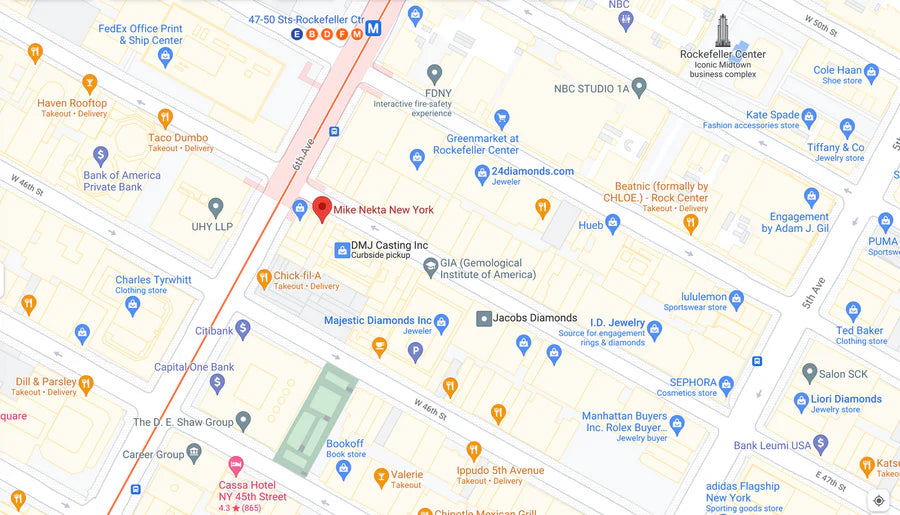
At Mike Nekta New York, my role is to help you make a confident decision with zero pressure. I’ll walk you through lab grown options, show you what differences actually look like in person, explain the certificates in plain English, and help you design a ring that fits your budget and your taste.
Let’s Wrap It Up: Choose The Ring That Matches Your Values, Budget, And Taste
Lab grown diamonds have become the default choice for a lot of couples because they match how people make decisions today.
You can get:
- More value for your budget
- Clearer transparency around specs and grading
- Sustainability and ethics considerations, with realistic expectations
- More design flexibility and room for craftsmanship upgrades
The best ring is not the most expensive ring. It’s the ring that fits your priorities and is chosen thoughtfully, with the right guidance.
If you’re in New York and you want to compare lab grown diamonds the right way, review certificates, and build a ring you’ll be proud to propose with, I’d love to help.
Book an appointment with me, Mike Nekta (Mike Nekta New York), and let’s find your perfect lab grown diamond engagement ring.