
The Ideal Carat Size and Proportions for an Asscher Cut Diamond Ring
If you’ve been shopping for an Asscher cut, you’ve probably already felt the frustration: Asschers don’t “face up” like round brilliants. Two diamonds can have the same carat weight and look noticeably different in size on the hand. That’s not marketing hype. It’s geometry.
The Asscher cut has that famous hall-of-mirrors look: clean, broad flashes of light that turn on and off as the diamond moves. When the proportions are right, it’s hypnotic. When they’re off, the same features that make an Asscher beautiful also make its flaws obvious. A slightly heavy depth can make it look smaller than it should. A poor step pattern can make the center look glassy. A borderline inclusion can be more visible than you expected, even in a “good” clarity grade.
So in this post, I’m going to set realistic expectations and make the decision practical. I’ll walk you through:
- Ideal carat ranges that actually look balanced for Asscher rings
- Proportion targets that usually deliver strong performance
- How finger size, setting style, and budget should change your “ideal”
- How to choose based on millimeters and spread, not just a carat number
My goal is simple: help you land on an Asscher that looks the size you want, performs the way it should, and stays clean and crisp in real life.
Asscher Cut Basics: What You’re Actually Buying
An Asscher cut is a square step-cut diamond with cropped corners. It’s all right angles, symmetry, and structure. Think Art Deco architecture, but in diamond form.
Modern Asscher vs vintage-style Asscher
You’ll hear “Asscher” used broadly, but there are two common looks:
- Modern Asscher (often more branded or standardized): tends to have a more pronounced, bold step pattern and a stronger “X” style contrast in the center.
- Vintage-style Asscher: can look more open in the middle with broader steps and a softer contrast pattern, especially in older makes or diamonds cut to mimic antiques.
Neither is automatically better. What matters is whether the step pattern is crisp, symmetrical, and lively, and whether the center is bright rather than dull.
Why clarity and cut quality matter more here
Asschers are step cuts. That means larger, flatter facets and fewer tiny sparkles to “hide” things. In a round brilliant, inclusions can get lost in the busy scintillation. In an Asscher, your eye has time to find them.
- Inclusions can be easier to spot because the facets act like windows.
- Cut issues are more obvious because symmetry and alignment are the whole point.
“Size” has two meanings: carat vs millimeters
Carat is weight. Your eyes see millimeter dimensions.
Two Asschers can both be 1.50 ct. One might face up around 6.7 mm, another might be closer to 6.4 mm if it carries more depth. That difference is visible.
Spread: how large it looks for its weight
“Spread” is the face-up size relative to carat weight. A well-spread Asscher looks appropriately sized for its carat. A deep Asscher can look small for its weight, and that’s where people feel disappointed after the purchase.
When I help clients, we talk carat, but we shop by millimeters.
The Ideal Carat Size: Practical Ranges That Actually Look Right
Carat size should fit your lifestyle, your aesthetic, and the setting you’re putting it in. It’s not just a milestone number. Here are the ranges I see most often, and what they typically feel like on the hand with an Asscher.
0.75–1.00 ct: refined, classic
This range is understated in the best way. You get the Asscher pattern, the clean geometry, and an elegant presence without it turning into a statement ring.
- Great for minimal solitaires
- Great for active lifestyles
- Often easier to keep eye-clean without jumping to very high clarity grades
If you like “quiet luxury,” this range fits that vibe.
1.00–1.50 ct: noticeable presence
This is where an Asscher starts reading as a real centerpiece while still looking very classic. For many people, it’s the first range where the step pattern becomes more visually satisfying from a normal viewing distance.
If you want the ring to feel clearly substantial but not oversized, this is a strong lane.
1.50–2.50 ct: statement without being oversized
This range is where Asschers look bold. The pattern is more dramatic, the flashes are broader, and the ring becomes the focal point.
A big note here: as you go up in size, your choices in clarity, cut precision, and overall make start to matter more and more. A mediocre 2.00 ct Asscher can look “dead” faster than a mediocre 1.00 ct.
2.50+ ct: high-impact, needs strong cut and clarity
At this size, the Asscher is unmistakable. It’s also unforgiving. Any transparency issues, symmetry problems, or visible inclusions will be easier to spot.
If you’re going 2.50 ct and above, I typically recommend being stricter on:
- Cut quality and pattern precision
- Eye-clean standards (not just the grade on paper)
- Video review and real lighting checks
The sweet spot: why 1.25–1.75 ct often feels “just right”
If I had to name the range where many clients land after comparing options side-by-side, it’s roughly 1.25–1.75 ct.
You get a noticeable upgrade in presence compared to 1.00 ct, but the diamond still tends to maintain that crisp, clean step-cut look without demanding extreme clarity or pushing the budget into the deep end.
The carat-to-mm reality: Asschers can look smaller than rounds
Asschers are often cut deeper, and they’re square. A square outline generally looks smaller than an elongated shape at the same carat weight. So if you’re coming from “round diamond thinking,” you may need to recalibrate and shop by millimeters.
Finger Size and Hand Shape: Picking the Right Carat for You
There isn’t one ideal carat that works for everyone. A 1.25 ct Asscher can look bold on a size 4 finger and more understated on a size 7.5 finger. Hand shape and personal style matter just as much as the number on the certificate.
Start with the visual goal
I usually ask clients to decide which of these they want:
- Subtle elegance: the diamond is beautiful, but it doesn’t dominate the hand
- Balanced centerpiece: it reads clearly as the focal point, still wearable daily
- Statement look: it’s meant to be noticed from across a table
Once you name the goal, the carat range usually becomes obvious.
How the Asscher’s square outline reads on different hands
Asschers are square and structured, so they can visually read “wider” rather than “longer.”
- On longer fingers, a square can look chic and architectural, especially in solitaire or three-stone designs.
- On shorter fingers, a square can sometimes look a bit more substantial across the finger, which can be great, but it may also feel less elongating than a rectangular emerald cut.
Use design to solve proportion, not just carat
If you’re between sizes, I often prefer you increase perceived size through spread and setting design before jumping carats.
Some ways to do that:
- Choose an Asscher with strong spread (without going too shallow)
- Use a thinner band so the center diamond looks larger
- Consider a three-stone to add width
- Consider a halo if you want maximum finger coverage (but keep it clean so it doesn’t fight the geometry)
Setting Choices That Change How Large (and Clean) an Asscher Looks
Asschers are all geometry. The setting is not an afterthought. The architecture around the diamond changes how big it looks and how clean it reads.
Solitaire: clean, shows the step pattern
A solitaire lets the Asscher be the star. It also gives you nowhere to hide. If the diamond is slightly deep and faces up small, a solitaire will make that obvious.
If you love a solitaire look, I usually suggest:
- Keep the band on the thinner side for more contrast
- Make sure the Asscher has strong spread
- Pay attention to prong style and corner coverage
Three-stone: adds width and a classic Art Deco feel
Three-stone settings can make an Asscher look larger because you get more finger coverage and a more substantial silhouette.
Side stones that complement Asschers well:
- Trapezoids or baguettes: very Art Deco, very aligned with step-cut geometry
- Tapered baguettes: elegant, lengthens the look without distracting from the center
Bezel vs prongs: modern protection vs airy openness
- Bezel: protects corners, feels modern, and can make the ring feel sleek. A full bezel can sometimes make the diamond look slightly smaller because you see less edge-to-edge diamond. A thin bezel can be a great compromise.
- Prongs: show more diamond and can feel lighter visually. With Asschers, prongs also need to protect those cropped corners properly.
Band width and metal color
Band width changes perceived size more than people expect.
- A wider band can make the center look smaller by comparison.
- A thin band makes the center look larger and more delicate.
Metal color matters too:
- Platinum/white gold emphasizes the crisp, icy look and can make the diamond look very clean.
- Yellow gold adds warmth and contrast. It can be stunning with Asschers, but color sensitivity becomes more important because warmth in the diamond can be more noticeable next to yellow metal.
Putting It All Together: My Simple ‘Asscher Checklist’ Before You Buy
Here’s the exact framework I use when I’m narrowing down Asschers with a client. If you follow this, you’ll avoid most expensive mistakes.
- Decide the visual size in millimeters first, not carats.
- Choose a near-square ratio you love (most people prefer a balanced square look).
- Target balanced depth and table so you don’t pay for weight you can’t see.
- Check corner integrity and girdle so the diamond is secure and durable in a ring.
- Review high-quality video for symmetry, clean step alignment, and attractive contrast.
- Confirm eye-clean clarity in the way you personally define it.
- Pick color for your metal choice and your sensitivity to warmth.
- Choose a setting that supports the geometry, whether that’s a solitaire, three-stone, bezel, or halo.
Then do one final thing that sounds obvious but changes everything: compare 2–3 finalists side-by-side, ideally with the same setting style in mind. When you compare apples to apples, the right Asscher becomes very clear.
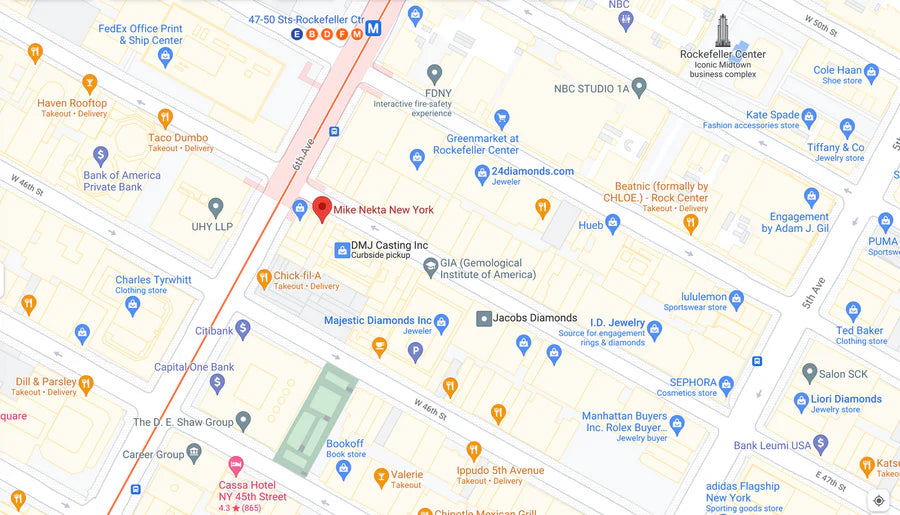
Book a Viewing or Design Consult With Mike Nekta (Mike Nekta New York)
If you want help getting this right without second-guessing every spec on a certificate, book an appointment with me at Mike Nekta New York.
In a viewing or virtual consult, I’ll help you:
- Source well-proportioned Asscher cuts that actually perform
- Compare face-up size vs carat weight so you don’t overpay for hidden depth
- Match the diamond to the setting style you want, including Art Deco three-stone, clean solitaire, halo, or bezel
- Confirm real-life performance, including how the diamond looks in normal lighting and whether it’s truly eye-clean
If you’re ready to narrow down the ideal carat size and proportions for your Asscher cut diamond ring, book an appointment with me, Mike Nekta, and we’ll make the decision simple.