
How to Make Sure a Diamond Is Ethically Sourced
A diamond’s grading report can describe its qualities without telling you where it came from. If you’re learning how to make sure a diamond is ethically sourced, that distinction matters: a grading report describes a stone’s characteristics, but it doesn’t certify ethical sourcing or establish mine origin. A reassuring label alone may leave important questions unanswered.
It’s reasonable to want more than a promise. The clearest picture comes from evidence that connects a diamond to its source and records its journey through the supply chain. Mined, recycled, and lab-grown diamonds raise different questions, so compare the pathway and the documentation against the concerns that matter most to you.
This guide explains what common sourcing claims do and don’t establish, which records can help clarify a diamond’s chain of custody, and how to compare sourcing options consistently. Informed decisions begin with evidence, not assumptions. Reviewing the available documentation can help you choose a stone whose story feels as considered as its setting.
Key Takeaways
- Ethical sourcing considers human rights, labor, conflict, and environmental impacts, but no single label answers every concern.
- To learn how to make sure a diamond is ethically sourced, start with the specific stone and review records that may connect it to its stated source.
- Compare mined, recycled, and lab-grown diamonds by the origin details and supporting documentation available, as well as the trade-offs each path raises.
- Use a consistent checklist: clarify what a sourcing claim means, what records support it, and what those records leave unanswered.
- An experienced diamond professional can help interpret available sourcing documents while keeping evidence distinct from expert opinion.
What Does an Ethically Sourced Diamond Actually Mean?
Responsible diamond sourcing considers human rights, labor conditions, conflict risks, and environmental impacts across a diamond’s journey. That can include the conditions under which a stone was extracted or created, how people involved in its production and trade were treated, and the effects of production on nearby communities and ecosystems.
There isn’t one universal label that settles every ethical question. A claim may refer to a specific standard, a supplier’s own policy, or one aspect of a diamond’s history. For instance, the Kimberley Process Certification Scheme addresses conflict diamonds as defined by its process, but that focus doesn’t cover every concern a buyer may have about labor rights or environmental impacts. Read a claim according to its stated scope, not as a blanket assurance.
Ethical sourcing is an evidence-based assessment of a diamond’s origin and supply chain, not a guarantee that every concern has been resolved. The strength of that assessment depends on what records support the claim, what those records cover, and where their limits lie.
Which ethical concerns should diamond buyers understand?
Consider worker safety, fair labor practices, community effects, and environmental disruption. Mining can affect land and water; labor concerns may involve workplace conditions or workers’ rights. The nature and severity of these issues can vary with the source, region, and practices involved. It would be inaccurate to assume that all mined diamonds, or all suppliers, share the same record.
Ask what a sourcing claim specifically addresses. Does it describe a mine or production source, outline supplier standards, or speak only to conflict-related controls? A broad phrase such as “responsibly sourced” is more useful when accompanied by a clear explanation and evidence relevant to the particular stone.
What can a diamond certificate tell you?
A GIA grading report evaluates gemological characteristics, such as a diamond’s cut, color, clarity, and carat weight. It helps describe the stone itself. It isn’t a record of the people, places, or suppliers involved in bringing that diamond to market, and it doesn’t establish mine origin or ethical sourcing.
A grading report identifies gemological qualities; it does not prove where a diamond was mined or how it moved through the supply chain. Provenance and chain-of-custody records serve a different purpose: they may document a stated origin and transfers or handling stages between source and seller. Their usefulness depends on how specifically they identify the stone and how much of its journey they cover.
When considering how to make sure a diamond is ethically sourced, keep these records distinct. Match any provenance documents to the exact diamond, then note what each record establishes and what remains unknown. A certificate can be valuable evidence of quality, while sourcing claims require their own supporting documentation.
How to Trace a Diamond’s Origin and Supply Chain
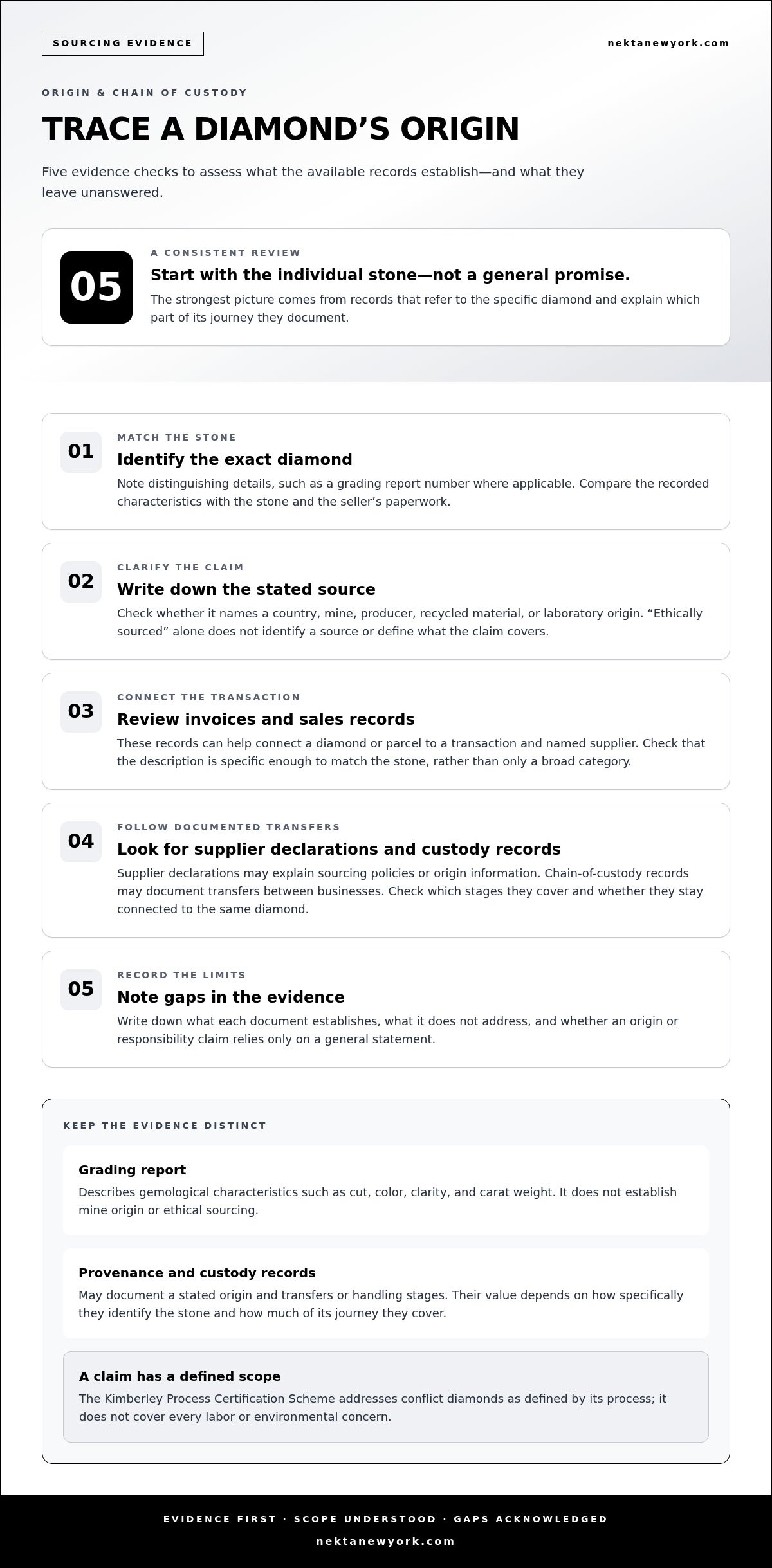
Start with the individual stone, not a general promise about a supplier. A sourcing claim is easier to assess when records refer to the specific diamond and explain which part of its journey they document. Use this sequence to evaluate the available information:
- Identify the exact diamond. Note details that distinguish it, such as its grading report number where applicable and the characteristics recorded in its documents. Compare these details with the stone and the seller’s paperwork.
- Write down the stated source. Clarify whether the claim identifies a country, mine, producer, recycled material, or laboratory origin. “Ethically sourced” alone doesn’t identify a specific source or explain what the claim covers.
- Review transaction records. Invoices and related sales documents can help connect the diamond or parcel to a transaction and named supplier. Check whether the description is specific enough to match the stone rather than a broad category.
- Look for supplier declarations and custody records. These may describe sourcing policies, origin information, or transfers between businesses. Consider which stages they cover and whether the records stay connected to the same diamond.
- Note gaps and limits. Record what the documents establish, what they don’t address, and whether any origin or responsibility claim relies only on a general statement.
What records can support a diamond’s provenance?
Supplier declarations can explain how a business defines a sourcing claim, while invoices and chain-of-custody records may help show how a diamond or parcel moved between parties. The level of detail varies by source and supply chain. A claim naming a specific origin is more persuasive when records connect that origin to the stone itself, rather than simply describing the supplier’s general practices.
Documents can support parts of a provenance story without proving every social or environmental practice. Check each record’s scope: does it identify the stone, the supplier, a point of origin, or only a company policy? Keep the documents together and note which claim each one supports.
Why do certification and traceability have limits?
The Kimberley Process Certification Scheme focuses on preventing conflict diamonds, as defined by the scheme, from entering the mainstream market. That addresses a specific concern, not a comprehensive assessment of labor conditions, worker safety, community impacts, or environmental practices. Evidence of compliance with one scheme should not be treated as proof of complete ethical performance.
Traceability also depends on the individual stone, its route through the supply chain, and the records kept at each stage. One document may cover only a transaction or a segment of that journey. Supply-chain documentation traces a diamond’s stated origin and handling; a grading report describes its gemological characteristics. They answer different questions, so don’t use one as a substitute for the other.
To understand how to make sure a diamond is ethically sourced, assess the records as a connected set, not as isolated assurances. A diamond expert can help interpret the documentation alongside your priorities. Learn more about documented diamond origins and what available evidence can and can’t show.
Mined, Recycled, or Lab-Grown: Compare Ethical Sourcing Evidence
Each sourcing pathway raises different questions, so compare the evidence rather than assuming one category is automatically the most responsible. For any stone, look at what its records say about origin, what they document, and which impacts remain outside their scope.
| Sourcing path | Origin and available documentation | Potential trade-offs and open questions |
|---|---|---|
| Mined | Origin claims may range from a broad country description to more specific mine or supply-chain records. | Mining can support livelihoods and also affect workers, communities, and the environment. What evidence describes this stone’s source and the practices involved? |
| Recycled | The diamond is an existing stone returned to circulation. Records may document its recent ownership or handling, while its earlier history can be harder to establish. | Reuse avoids extracting a new diamond, but how much of the stone’s prior origin and journey is documented? |
| Lab-grown | Created in a laboratory rather than mined. Documentation may identify its producer and laboratory origin. | Production still involves people and energy use. What information is available about labor practices and the energy used? |
What should buyers weigh when considering mined diamonds?
Mined diamonds don’t all come from the same conditions. Mining may contribute to local livelihoods, while its effects on worker safety, labor rights, land, and communities depend on the specific operation and its practices. A country-of-origin statement can provide useful context, but it doesn’t, on its own, describe the mine or establish how the stone moved through the supply chain.
Consider Canadian origin in the same measured way: it’s relevant sourcing information, not automatic proof that every ethical standard has been met. Stronger evidence connects the stated origin to the individual stone and provides detail about the parts of its journey that matter to your priorities.
Are recycled and lab-grown diamonds automatically ethical?
Recycled diamonds offer a reuse pathway because they put an existing stone back into circulation. Yet a documented recent transaction may not reveal where the diamond was originally mined or the conditions surrounding its first extraction. That distinction matters if historical provenance is central to your decision.
Lab-grown diamonds have a laboratory origin, but that alone doesn’t answer questions about production energy or working conditions. Compare what is documented about the stone’s source, production, and handling, then weigh any remaining uncertainty against your priorities. There’s no need to declare one category universally best. To understand how to make sure a diamond is ethically sourced, assess each option against the same evidence questions and decide which documented story aligns with the standards you value.
How to Evaluate Ethical Diamond Claims: A Buyer’s Checklist
A clear sourcing claim should be specific enough to assess. Use this checklist for the individual diamond you’re considering, and keep the answers and documents together so you can compare stones on the same terms.
- Identify the stone. Match the sourcing information to the specific diamond, using its report or other identifying details where available. Don’t rely on a supplier’s general statement if it isn’t connected to the stone.
- Define the claim. Ask whether it refers to a country, a particular mine or supplier, recycled origin, or laboratory creation. Find out what “ethical” or “responsibly sourced” means in this specific context.
- Review the supporting records. Note which documents accompany the diamond, who issued them, and what they establish. A declaration, invoice, or traceability record may document part of a journey, not every stage.
- Look for missing links. Check whether the documents connect the stated origin to this stone and whether the chain of records has gaps. A gap limits what can be concluded, but it isn’t by itself proof of misconduct.
- Separate evidence from assurance. Record which statements are supported by documents and which are broad descriptions or marketing language. Keep grading information distinct from sourcing evidence.
Which questions clarify a sourcing claim?
Ask what the claim refers to: a country, mine, supplier policy, recycled stone, or laboratory-created diamond. Then ask which records apply to the individual stone and what each one establishes. If the paperwork doesn’t cover a particular stage or concern, ask for a plain explanation of that limit. Clear boundaries help you judge evidence fairly without treating uncertainty as a verdict.
How can buyers compare answers fairly?
Apply the same questions to every stone, even when their origins differ. One option may offer more specific origin records; another may provide clearer information about production or reuse. Neither detail alone settles every ethical concern. Compare what is documented, what remains unanswered, and how each point relates to your priorities.
Terms like “conflict-free” can sound comprehensive, but clarify which concern the term addresses and what evidence supports it. A claim may focus on conflict-related controls without describing labor conditions, community effects, or environmental practices. Precision matters more than a reassuring phrase.
Learning how to make sure a diamond is ethically sourced means weighing the evidence alongside your own standards, not searching for a label that answers every question. A knowledgeable diamond professional can help interpret available records while keeping documented facts separate from expert judgment. Explore ethically sourced diamond options and compare the stone’s documentation with your priorities.
Choose an Ethically Sourced Diamond with Expert Guidance
A considered choice brings together several kinds of information: how clearly the diamond’s origin is described, what records support that account, which environmental concerns matter to you, and how the stone’s appearance and grading fit your preferences. Keep these questions related, but distinct. A beautiful cut or a strong grading report speaks to the diamond’s characteristics, not the ethics of its sourcing.
Match the sourcing pathway to your priorities
Start by ranking what matters most. You may place the highest value on a specific, documented origin, reusing an existing stone, or understanding the production method and its environmental context. Then compare each diamond against those priorities and the evidence available for that particular stone. Mined, recycled, and lab-grown options have different histories, records, and unanswered questions, so a single measure won’t capture every trade-off.
Consider the diamond’s characteristics on their own terms. Cut influences how a stone handles light; color, clarity, and carat weight describe other aspects of its gemological profile. These qualities can guide your selection, but they shouldn’t be treated as evidence for or against responsible sourcing. A strong decision respects both the stone’s beauty and the documentation behind its story.
Make an informed decision without expecting perfect certainty
Records may help establish a stated source, identify suppliers, or document parts of a diamond’s journey. They may not answer every question about past practices or environmental impact. Keep the documents tied to the individual stone, along with the seller’s written explanation of what “ethically sourced” means in that instance. This gives you a reference point for what you know and what remains uncertain.
Expert guidance can make that review more useful. A knowledgeable professional can help interpret available sourcing records, explain their scope, and distinguish documented information from a broader assurance. Expertise is not a substitute for evidence, and it shouldn’t be presented as an independent certification of origin.
At Mike Nekta New York, diamond guidance draws on third-generation expertise and more than 20 years in operation. The boutique offers ethically sourced diamonds, including GIA-certified loose diamonds. A GIA grading report provides information about a stone’s characteristics, not proof of its origin. A thoughtful discussion can help align your priorities with the records available for a specific diamond.
Take the time to weigh what matters most to you, then make your decision with a clear view of both the diamond and its documented story. Discuss your diamond priorities with Mike Nekta New York.
Let Your Priorities Guide the Next Step
The right choice doesn’t require you to resolve every uncertainty. It begins with knowing which questions matter most to you, then weighing the available evidence alongside the qualities you want in a diamond. Keep the stone’s sourcing story and its grading details distinct, and let your decision reflect both your standards and your personal taste.
Mike Nekta New York brings third-generation diamond expertise and more than 20 years of operation to the conversation. The boutique offers ethically sourced GIA-certified loose diamonds. GIA grading speaks to a diamond’s characteristics; sourcing evidence has its own role in telling the stone’s story.
If you’re ready to explore stones with your priorities in mind, Explore ethically sourced diamonds with Mike Nekta New York. A thoughtful conversation can help you take the next step with clarity and confidence.
Knowing how to make sure a diamond is ethically sourced is ultimately about making a choice you understand and feel good about. Let the evidence inform your decision, and let the meaning of the stone remain entirely your own.
Frequently Asked Questions
Does a GIA certificate prove that a diamond is ethically sourced?
No. A GIA grading report assesses a diamond’s gemological characteristics; it isn’t an ethical-sourcing certificate. Use its report number to help match the document to the stone, then look separately for records or written statements about origin and handling. If a seller describes a diamond as GIA certified and ethically sourced, treat those as two distinct claims, each requiring its own kind of support.
What does the Kimberley Process actually certify about diamonds?
The Kimberley Process Certification Scheme addresses rough diamonds and the defined concern of conflict diamonds. Its certificates relate to shipments under the scheme, not an individual stone’s complete ethical history. For example, a Kimberley Process certificate doesn’t by itself tell you about a particular worker’s conditions or a mine’s environmental impacts. Consider it evidence relevant to one issue, not a universal ethical endorsement.
Can a diamond’s country of origin prove it was ethically sourced?
No. A country name can narrow the geographic context, but it doesn’t reveal the specific mine, production conditions, or all suppliers involved. If a diamond is described as originating in a particular country, look for records that connect that claim to the stone rather than simply to a business or parcel. Treat geography as one useful clue, not a substitute for evidence of practices.
Are lab-grown diamonds always more ethical than mined diamonds?
No single category is automatically more ethical across every concern. A lab-grown diamond has a laboratory origin, but that fact alone doesn’t answer questions about the energy used in production or working conditions. A mined diamond’s impact also depends on its source and practices. To decide how to make sure a diamond is ethically sourced, compare what is documented about the specific stone against the issues you personally prioritize.
Can recycled diamonds be traced to their original source?
Sometimes, but it depends on whether records from earlier stages have been preserved and can be linked to the stone. A receipt from a recent resale may establish a recent transaction without showing where the diamond was first mined. Check older appraisals, insurance schedules, estate records, or original purchase paperwork if available. These may offer clues, though they don’t necessarily establish a complete history.
Can you find out where a diamond came from if it was bought decades ago?
Possibly, if identifying records remain. Look through the original receipt, grading report, insurance documents, appraisal, or correspondence from the purchase. A report number or detailed description may help identify the stone, while older sales paperwork may preserve a source claim. If the diamond has been reset or recut, compare its present characteristics with older descriptions. Missing records can limit what you can establish.
What documents should come with an ethically sourced diamond?
There isn’t one universal document set for every diamond. Depending on its source and supply chain, useful paperwork may include a grading report, purchase invoice, supplier declaration, or records describing origin and transfers. Read each document for its date, issuer, stone identification, and stated scope. Keep the seller’s written explanation of the sourcing claim with the paperwork, so you can distinguish documented details from information the records don’t address.