
How Analytical Professionals Choose High-Value Diamond Jewelry
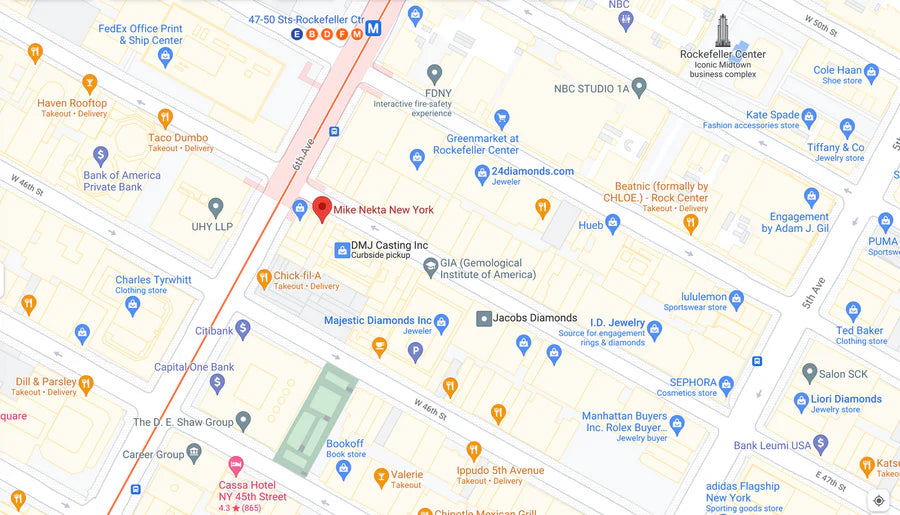
In my showroom in the New York Diamond District, investment bankers and finance professionals tend to approach diamond jewelry with a familiar mindset. They are methodical. They are skeptical of narrative pricing. And they want clarity before emotion. Over the last 20+ years, I’ve worked with clients who manage capital for a living, and they rarely treat a high-value diamond purchase as a spontaneous decision. Instead, they approach it the way they approach any meaningful allocation: by assessing downside risk, durability, transparency, and long-term satisfaction.
This is not about turning jewelry into a spreadsheet. It’s about avoiding regret, inefficiency, and structural mistakes that only become obvious years later.
Jewelry as a Risk-Adjusted Decision
Diamond jewelry is not a financial investment in the conventional sense. I’m direct about that from the start. It does not generate income, and liquidity is limited. However, for analytical professionals, it is still a deployment of capital with varying risk profiles. The goal is not upside speculation. The goal is controlled downside, longevity, and confidence in the decision long after the purchase is made.
That framework immediately filters out most hype-driven options. Instead of asking what is trending, analytical buyers ask what will still make sense ten or twenty years from now.
Transparency and Documentation
Transparency is a baseline requirement, not a differentiator. Finance professionals have zero tolerance for opacity, and rightly so. In my experience, analytical buyers expect complete disclosure and clear explanations, including:
- Independent grading reports from respected laboratories
- Plain-language explanations of cut, color, clarity, and carat trade-offs
- Realistic pricing without inflated “retail” anchors
- Appraisals that reflect actual replacement conditions, not marketing psychology
Two diamonds with identical lab grades can behave very differently in real-world lighting. Proportions, symmetry precision, and optical balance are rarely captured by headline numbers, yet they have an outsized impact on long-term satisfaction. I review these factors in person, stone by stone, because paperwork alone never tells the full story.
Understanding Trade-Offs Instead of Chasing Perfection
Analytical professionals understand diminishing returns intuitively. Diamond pricing is not linear. Small improvements in clarity or color often command exponential premiums with minimal real-world benefit. The correct question is rarely “What is the best?” but rather “What is the most efficient use of capital for this purpose?”
In practice, this means recognizing that:
- A well-cut G color can present whiter than a poorly cut D
- A properly positioned VS1 can outperform a weak IF
- Cut quality often matters more than pushing color or clarity higher
Efficiency, not theoretical perfection, tends to deliver the highest long-term satisfaction.
Cut Quality as Downside Protection
Cut quality is the single most important determinant of how a diamond performs over time. It cannot be improved after purchase. A poorly cut diamond underperforms permanently, regardless of carat weight or color grade. From a risk-adjusted perspective, cut protects against disappointment across lighting environments, camera exposure, aging eyesight, and shifting aesthetic preferences. Once analytical clients see controlled comparisons, the logic becomes self-evident.
How Pricing Actually Works at the High End
Diamond pricing behaves like a stepped curve rather than a smooth slope. Psychological thresholds such as 1.00, 1.50, and 2.00 carats create abrupt price jumps that are not proportional to visual difference. In my showroom, I often show slightly sub-threshold diamonds that deliver nearly identical presence at materially lower cost. This is not compromise. It is intelligent allocation.
Analytical professionals understand that paying premiums for psychological benchmarks rarely improves fundamentals.
Carat Weight vs Visual Surface Area
Carat weight measures mass, not face-up size. Two diamonds with identical carat weight can appear meaningfully different depending on how that weight is distributed. Excess depth increases cost without increasing visual presence. From a downside-protection standpoint, visual surface area per dollar is a more relevant metric than carat weight alone. This is where experience matters more than reports.
Provenance, Paper Trail, and Governance
Documentation is not about resale fantasies. It is about governance and clarity. Analytical professionals expect:
- Detailed invoices reflecting exact specifications
- Consistent grading documentation
- Appraisals aligned with real replacement markets
Inflated appraisals may feel reassuring at first, but they often complicate insurance claims and create frustration later. Clear, defensible documentation reduces friction and preserves trust.
Long-Term Wearability
Most finance professionals wear their jewelry frequently, often daily. That changes design priorities significantly. High-end engagement rings and diamond bands must withstand:
- Constant hand movement and surface contact
- Travel, temperature changes, and environmental exposure
- Years of routine wear rather than occasional use
Ultra-thin bands, exaggerated prongs, and trend-driven architecture often fail structurally over time. Repairs are not just financial costs. They are distractions. Durability is not an aesthetic compromise. It is structural discipline.
Low-Profile Design as Risk Mitigation
Lower-profile settings reduce exposure to impact, snagging, and long-term deformation. They also tend to photograph better and integrate more naturally into professional daily life. For clients who type, travel, and work long hours, this consideration often outweighs dramatic height or visual exaggeration.
Avoiding Narrative and Hype Pricing
Like financial markets, the diamond industry experiences narrative cycles. Social media, celebrity exposure, and aggressive branding temporarily inflate certain styles, cuts, or design philosophies. Analytical buyers instinctively question these premiums, and in my experience, they are right to do so.
I’ve seen hype cycles around:
- “Rare” fancy shapes that became widely available months later
- Novel settings that aged poorly and compromised wearability
- Buzzwords that obscured average material quality
Diamonds chosen on fundamentals consistently outperform those chosen on hype when measured by long-term satisfaction.
Natural Diamonds and Long-Term Perspective
Natural diamonds and lab-grown diamonds behave very differently over time. Natural diamonds carry geological scarcity, established cultural symbolism, and a mature market structure. Lab-grown diamonds offer accessibility and size but operate under rapidly evolving pricing dynamics.
For analytical professionals focused on permanence, legacy, and emotional durability, natural diamonds often align better with long-term objectives. For buyers prioritizing short-term utility, the calculus can change. The correct choice depends on alignment, not ideology.
Customization as an Efficiency Tool
Customization appeals to analytical professionals because it eliminates inefficiency. Rather than paying for compromises built into mass-produced designs, custom work allows:
- Precise control over proportions and ergonomics
- Engineering for durability rather than aesthetics alone
- Budget allocation toward structural quality instead of branding
In my Diamond District showroom, many finance professionals choose understated custom pieces that feel inevitable rather than decorative. Jewelry that integrates seamlessly into daily life tends to deliver the highest satisfaction.
Insurance and Replacement Reality
Insurance should reduce stress, not introduce uncertainty. Many policies default to vague replacement standards unless documentation is precise. I help clients ensure their records reflect:
- Exact stone characteristics
- Custom craftsmanship details
- Realistic replacement pathways
Why Inflated Appraisals Create Friction
Overstated appraisals may inflate perceived value, but they often complicate claims when replacement expectations don’t align with market reality. Clear, defensible appraisals protect the client, not the ego.
Consistency Across a Jewelry Portfolio
Many analytical professionals build jewelry collections gradually. One common mistake is inconsistency — mixing different quality levels, philosophies, or construction standards over time. This leads to fragmented collections and underused pieces. The strongest collections are built with discipline, coherence, and long-term intent.
Choosing a Diamond Jeweler in New York
Choosing a diamond jeweler in New York is not about inventory alone. It is about judgment. A natural diamond expert should explain trade-offs clearly, highlight risks honestly, and avoid unnecessary pressure. In my Diamond District showroom, my role is to provide clarity, not persuasion. If you’re considering a high-end engagement ring or a significant diamond purchase, you can review the consultation process on my contact page: https://www.nektanewyork.com/#book-appointment
Final Perspective
Analytical professionals don’t buy high-value diamond jewelry emotionally first. They buy when the structure holds, the downside is controlled, and the long-term satisfaction is clear. When chosen correctly, diamond jewelry delivers durability, coherence, and confidence without unnecessary exposure to hype or regret. If you’d like to have a private, structured conversation about a significant purchase, you can book a consultation or call me directly at +1-212-921-4647.