
The History of the Asscher Cut Diamond Ring: From Art Deco Glamour to Modern Revival
There are a lot of diamond cuts that look “nice.” But the Asscher cut is one of the few that instantly signals vintage taste without looking like a costume piece or something stuck in the past.
If you’ve ever seen an Asscher cut diamond ring in person, you probably remember it. It has this crisp, architectural presence that feels intentional, not trendy. And that’s exactly why people still chase it more than a century after it first appeared.
In this article, I’m going to walk you through where the Asscher cut came from, why it owned the Art Deco era, how it faded out for a while, and what sparked the modern revival. I’ll also share what I look for when someone comes to me in New York specifically asking for an Asscher cut diamond ring.
Before we get into the history, here’s the plain-English definition.
An Asscher cut is a square step cut with cropped corners. From the top, it reads as an octagon. What most people notice first is the clean symmetry and the “hall of mirrors” effect, where the facets reflect in a hypnotic, layered way instead of throwing off glittery, scattered sparkle like a round brilliant.
Today, a lot of buyers search for an “asscher cut diamond ring” because they want structure, symmetry, and a timeless look. They’re not necessarily chasing maximum sparkle. They want presence. They want design.
What Exactly Is an Asscher Cut? (A Quick Visual Description)
Let me help you picture it clearly.
An Asscher cut diamond has a square silhouette, but the corners are beveled. That’s why it looks octagonal when it’s set. The facet pattern is made of tiered steps, like a staircase that moves down toward the center. Traditional Asschers also tend to have a high crown and a deep pavilion, which contributes to that bold, dimensional look.
The signature effect is what jewelers call the “hall of mirrors.” Instead of a splintery, glitter-bomb sparkle, you get broad flashes and clean reflections. It’s calmer. More deliberate. When it’s cut well, it feels almost like you’re looking into the diamond rather than just seeing light bouncing off the surface.
One common point of confusion is Asscher vs emerald cut.
Both are step cuts, and both have that sleek, reflective look. The difference is the overall shape and balance. Emerald cuts are rectangular. Asschers are square. That changes everything about how the ring reads on the hand. Emerald cuts feel elongated and elegant. Asschers feel centered, symmetrical, and architectural.
And here’s a practical detail that matters if you’re shopping: clarity is more important in step cuts.
Because the facets are larger and more open, inclusions can be easier to spot, especially right in the center where your eye naturally lands. That doesn’t mean you need a flawless diamond, but it does mean you want to be thoughtful. If you’re building an Asscher cut diamond ring that looks sharp and clean, the quality choices matter more than people expect.
The Origins: The Asscher Brothers and Early 1900s Diamond Craftsmanship
The Asscher cut traces back to Amsterdam, which was one of the most important diamond cutting centers in the world in the late 1800s and early 1900s.
The name comes from Joseph Asscher and the Asscher Brothers, a Dutch diamond company that became known for elite craftsmanship and precision cutting. This was a time when diamond cutting was evolving fast. Tools improved, polishing became more refined, and the appetite for cleaner, more geometric design was rising across jewelry, architecture, and decorative arts.
In that environment, the original Asscher cut made a lot of sense.
It had strong symmetry and an almost architectural elegance. It didn’t rely on chaotic sparkle to feel luxurious. It felt like “clean luxury,” which matched the early 20th-century shift toward sharper lines and more intentional design.
It also translated beautifully into rings.
Why? Because the square shape sits confidently on the finger. It doesn’t feel delicate or fussy, even when the setting is detailed. Asschers worked in engagement rings, right-hand rings, cocktail rings, and heirloom styles because the geometry holds its own. It becomes the design, not just the center stone.
Art Deco Glamour: Why the Asscher Cut Became an Icon in the 1920s–1930s
If you want to understand why the Asscher cut became legendary, you have to understand Art Deco.
Art Deco was about geometry, symmetry, bold lines, and luxury materials. It was sleek, modern for its time, and unapologetically glamorous. Think of it as the era that made elegance feel powerful instead of soft.
Now look at the Asscher cut through that lens.
A square, stepped diamond with an octagonal outline fits Art Deco design language perfectly. The cut mirrors the era’s love of strong frames, repeating patterns, and architectural motifs. Even the way light moves in an Asscher, those clean flashes and reflections, feels “designed,” not random.
It matched the visual vocabulary of the time: sunbursts, chevrons, linear borders, and sharp geometry. And jewelers leaned into it with settings that were just as intentional.
Here’s what you’d typically see in Art Deco Asscher rings:
- Platinum settings (platinum became a signature metal of the era)
- Milgrain detailing (tiny beaded edges that add texture without softness)
- Baguette side stones (long, linear diamonds that reinforce the geometry)
- Calibré cuts (small stones cut specifically to fit a setting precisely)
- Halos and frames that look crisp and structured, not rounded
And this is the real reason the style still sells today: the vibe.
A well-made Art Deco inspired Asscher cut diamond ring reads sophisticated and confident. It has that “old money” elegance people talk about, but it also feels graphic and modern. That combination is rare.
To make the era feel real, picture this one scene with me.
A 1920s style platinum ring sits low and solid on the hand. In the center is a square Asscher that looks like it has depth you could fall into. On each side, tapered baguettes point inward like arrows, guiding your eye right back to the center. The edges are finished with delicate milgrain, not to make it dainty, but to make it feel complete. Under soft light, the diamond doesn’t sparkle like a disco ball. It glows in clean, confident flashes.
That’s the kind of ring that still turns heads today.
The Modern Revival: The ‘Royal Asscher’ and the Return of Architectural Sparkle
Like a lot of cuts tied to a specific era, the Asscher didn’t stay on top forever.
As tastes shifted, especially through the mid to late 20th century, round brilliants became the default. People wanted maximum sparkle. Marketing pushed brilliance. And step cuts, which are quieter and more revealing, became more niche.
Then the modern revival happened.
In the early 2000s, the updated “Royal Asscher” helped reintroduce the cut to a new generation. At a high level, what changed was precision and refinement. Modern cutting and updated facet patterns can intensify the optical performance, giving the stone a stronger, more dramatic look while keeping the same architectural character people love.
At the same time, buyers started moving away from cookie-cutter engagement rings.
There was renewed love for vintage design, more interest in Art Deco jewelry, and plenty of cultural influence from celebrities and editorial styling that put step cuts back in the spotlight. People began choosing rings that felt personal and intentional, not just traditional because that’s what everyone does.
That’s where the Asscher fits perfectly today.
A modern Asscher cut diamond ring can feel like a bridge between eras. You get the Art Deco energy and that structured, symmetrical beauty, but with modern craftsmanship, better durability options in the setting, and tighter quality control on the cut.
Buying an Asscher Cut Diamond Ring in New York: What to Look for Before You Commit
If you’re shopping in New York, you’ll see plenty of diamonds. The challenge is that step cuts can look similar at first glance, and then completely different once you know what to look for.
Here’s what I recommend focusing on before you commit.
1) Look at the diamond in multiple lighting environments.
Don’t judge an Asscher under one set of showroom lights. View it in daylight, under spotlights, and in normal indoor ambient lighting. Step cuts can either come alive or go flat depending on proportions and cut quality.
2) Compare multiple stones side-by-side.
Small proportion differences change the look dramatically in step cuts. Two Asschers can have the same carat weight and still feel totally different. One will look deep and hypnotic. Another might look glassy or dark.
3) Check symmetry and facet alignment.
Asschers are all about balance. If the steps look uneven, or the pattern feels off-center, your eye will catch it immediately. A great Asscher feels calm and perfectly organized.
4) Watch for visible inclusions and “windowing.”
Because the facets are open, you want to check the center especially. Also watch for windowing, where the diamond looks see-through in areas, like you’re looking through glass instead of into reflections.
5) Protect the corners.
Those cropped corners are part of the beauty, but they still need protection. Make sure the setting design supports the diamond properly, especially if you’re active with your hands.
6) Think about comfort and height.
Some Asscher settings sit higher because of the stone’s depth. That can be beautiful, but it needs to match your lifestyle. Try it on and see how it feels day-to-day.
7) Custom design matters with Asschers.
If you’re going for side stones, calibré work, or baguettes, the match has to be precise. Band width matters too. A thin band can make a larger Asscher feel top-heavy. A band that’s too wide can overpower the geometry. The goal is balance.
This is exactly where professional guidance saves time and prevents expensive mistakes. Asschers reward careful selection. You want to see what you’re buying, not just read specs.
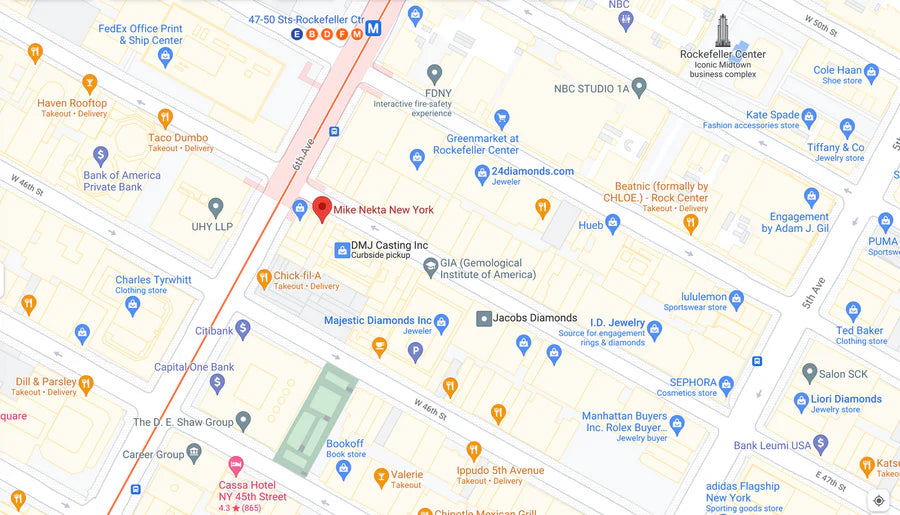
Book an Appointment with Mike Nekta New York (See Asscher Cuts the Right Way)
If you’re considering an Asscher cut diamond ring and you want to see what “good” really looks like, I invite you to book an appointment with me at Mike Nekta New York.
In person, we can view and compare Asscher cut diamonds side-by-side, evaluate performance in real lighting, and walk through settings that fit your taste, whether that’s Deco-authentic with baguettes and milgrain or clean and modern with a sharper, minimal frame.
The Asscher cut rewards careful selection. Seeing it live is the difference.
Book an appointment with Mike Nekta New York and let’s find the Asscher that actually has that hall-of-mirrors magic.