
GIA Certificate: What It Says About a Diamond’s Value
A diamond report can show how a stone was graded, but it doesn’t state its monetary worth. If you’re asking what a GIA certificate is and why you need one, it’s an independent grading report that records a diamond’s 4 Cs, along with details such as polish, symmetry, and depth. It gives you a consistent set of characteristics to compare with the diamond you’re considering.
That distinction matters: “certificate” is a familiar term, but GIA grades diamonds and issues reports. A report documents a stone’s assessed qualities; it isn’t a price appraisal or a guarantee of value. You can also check the report number against GIA’s grading data and compare the diamond’s girdle inscription with the report.
Here, you’ll learn what a report records, how clarity details and grading differ from seller descriptions, and how to verify that the report matches the stone. With those details in view, you can make a more informed decision about a diamond’s documented quality and what it means for your purchase.
Key Takeaways
- Match the report number and girdle inscription to the diamond to check that the report corresponds to the stone.
- Use the grading report to compare documented qualities such as the 4 Cs, polish, symmetry, and depth.
- Read clarity details and the plotted diagram together to understand the inclusions recorded for the diamond.
- Treat a grading report as documentation of a diamond’s characteristics, not as a monetary valuation.
- When comparing seller-provided grading, consider the grading agency and the details its report records.
How do I verify a GIA report is real?
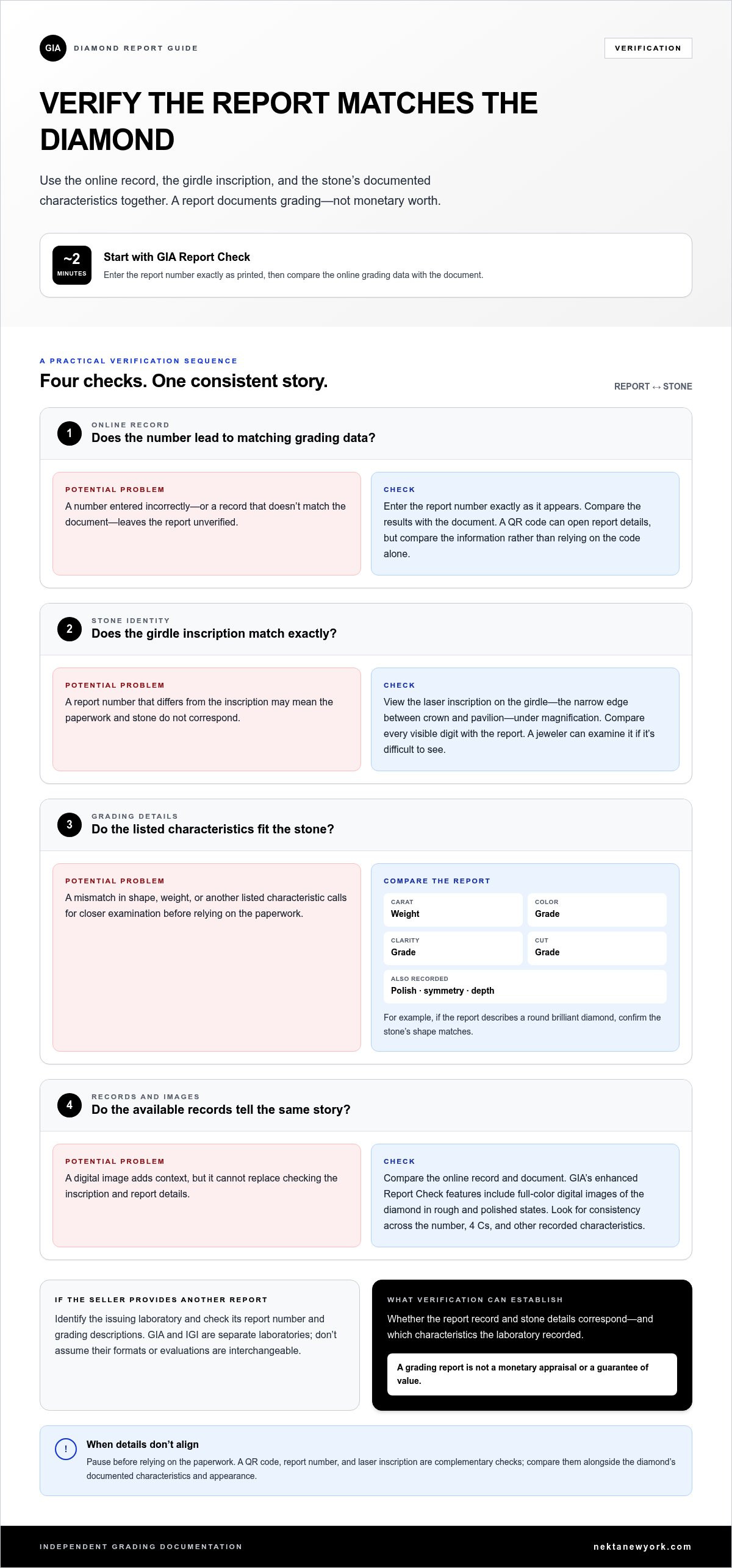
Start with GIA Report Check, the online database for checking a GIA diamond report number against its grading data. Enter the number exactly as it appears on the report, then compare the results with the document. This check takes about two minutes and helps show whether the report information corresponds to a record in GIA’s database. A QR code can also take you to report details, but compare the information rather than relying on the code alone.
Next, match the report number to the diamond’s girdle inscription. The girdle is the narrow edge between the crown and pavilion, and a laser inscription can be viewed under magnification. Compare every visible digit with the number on the report. A jeweler can examine the inscription under magnification if it’s difficult to see. The number should match exactly, and the stone’s documented characteristics should make sense alongside its appearance.
Look beyond the number. A GIA diamond grading report records the 4 Cs: carat weight, color, clarity, and cut, along with details such as polish, symmetry, and depth. Compare those entries with the report you checked online. For example, if the report describes a round brilliant diamond, confirm that the stone’s shape matches. A mismatch in shape, weight, or another listed characteristic calls for closer examination before you rely on the paperwork.
GIA’s enhanced Report Check features include full-color digital images of a diamond in its rough and polished states. These images add visual context to the grading data, though they don’t replace matching the girdle inscription and report details. Check that the online record and the document tell a consistent story. The report number, 4 Cs, and other recorded characteristics should align across the available records.
IGI reports call for the same careful reading of the issuing laboratory and the details recorded. GIA and IGI are separate grading laboratories, so don’t assume their report formats or evaluations are interchangeable. Compare the named laboratory, report number, grading descriptions, and diamond characteristics side by side. When a seller provides a grading document, identify who issued it and whether its details can be checked through that laboratory’s report service.
A GIA report documents an evaluation; it doesn’t state the diamond’s monetary worth. Verification establishes whether the report record and stone details correspond, not what the diamond should cost. Treat a QR code, report number, and laser inscription as complementary checks. Together, they help you assess whether the grading document matches the diamond and clarify which characteristics the laboratory recorded.
What is a GIA diamond grading report?
A GIA grading report records a loose diamond’s assessed characteristics; GIA grades diamonds rather than technically certifying them. GIA also grades lab-grown diamonds, whose reports use a distinct format and disclose their laboratory-grown origin in a girdle inscription.
Information Documented in a Grading Report
A GIA grading report documents a diamond’s identifying characteristics and grading results. It records the 4 Cs, plus details such as polish, symmetry, and depth. A full printed report includes a plotted clarity diagram, while GIA also offers digital reports for smaller diamonds. These details let you compare a stone’s recorded features with the diamond itself, rather than relying on a short seller description.
GIA grades loose stones, not finished rings. A diamond already set in a ring must be removed before grading, so the report evaluates the individual stone rather than the complete piece of jewelry. To submit gemstones to GIA, print the PDF memo and include it in the shipment. The memo links the submitted stones with their accompanying information.
GIA’s Independent Grading Role
GIA’s grading is an independent evaluation performed by gemologists who assess diamonds anonymously. According to GIA, graders aren’t given prior information about a diamond’s owner, origin, or previous grades. This means the evaluation is based on the stone presented for assessment, rather than a seller’s description or an earlier grade.
GIA established the International Diamond Grading System in 1953. Its report describes grading findings, not a monetary appraisal or a seller’s guarantee. For readers comparing stones, that distinction matters: a grading report offers a structured account of characteristics, while purchase price and other commercial terms are separate considerations.
Carat, Color, and Clarity Assessments
GIA measures a diamond’s carat weight to the nearest hundredth of a carat and grades color on a scale from D to Z. D describes a colorless diamond, while Z describes light yellow or brown. Clarity grading records internal inclusions and external blemishes, with plotted diagrams available on full printed reports.
These assessments make comparisons more precise. For example, two diamonds with similar carat weights may differ in color or clarity, which the report records separately. GIA grades diamonds weighing 0.15 carats or more. Read the grades together, since no single entry describes every visible or documented characteristic of a stone.
What Is a GIA Diamond Certificate?
People often ask what a GIA certificate is and why they need one. The term usually refers to a GIA diamond grading report, which records a diamond’s evaluated characteristics. GIA doesn’t state the diamond’s monetary worth in the report, so it serves as grading documentation rather than a price appraisal.
Why get one when buying a diamond? A report gives you documented details to compare with the stone and the seller’s description. If you’re considering what a GIA certificate is and why you need one, its value lies in clarifying the diamond’s recorded qualities, not setting a price or guaranteeing future value.
In the United States, GIA grading report fees depend on carat weight.
These are report fees, not diamond or jewelry prices.
At purchase, use the report to assess whether a diamond’s recorded carat weight, color, clarity, cut, polish, and other details align with its description. The report can help you make a more informed comparison, but it doesn’t determine whether an asking price is fair. Price reflects factors beyond grading, so treat the report as evidence about the stone, not a dollar valuation.
For insurance, the report can give an appraiser a precise record of the diamond’s characteristics. It doesn’t assign replacement value. A separate appraisal assesses monetary value for the particular diamond or jewelry. Keep the report with your purchase records so its diagram and grading details are available when needed.
Resale is a separate consideration. A report helps communicate a stone’s documented qualities to a prospective buyer, but it doesn’t promise a future offer or recovery of the original purchase price. If the diamond is mounted in jewelry, remember that the grading report describes the stone, not the complete piece.
GIA and most grading agencies don’t offer guarantees on diamond grading reports. Consider the document a gemological evaluation, not a warranty, insurance policy, or resale commitment. A jeweler or appraiser can assess monetary value separately for a specific purchase, insurance, or resale purpose.
Clarity plots and inclusions
A clarity plot is a diagram showing selected clarity characteristics observed during a diamond’s grading. Inclusions are internal features, while blemishes occur on the surface. On a GIA report, the plot helps connect the clarity assessment with the locations and types of characteristics recorded for that stone. Read it as a grading reference, not a decorative illustration.
Start by locating the plot and clarity grade on the report. Then compare the diagram’s marks with the diamond under magnification. A plotted feature may look different in size or prominence on the stone because the diagram represents characteristics schematically. For example, a mark near the center of the diagram indicates a recorded location, not a photograph of the inclusion.
The plot adds context to the clarity grade, but it doesn’t replace it. A report’s clarity assessment summarizes the characteristics considered during evaluation; the diagram illustrates selected details. Use both when comparing diamonds. Two stones with the same clarity grade can have different plotted patterns, so examine the report number and stone as a matching pair.
For a useful comparison, note the report’s clarity grade, then identify the plotted marks and their positions. Examine the actual diamond under magnification and consider whether the recorded features are visible from the face-up view. A plotted mark alone doesn’t tell you how noticeable it is in ordinary viewing. Cut, lighting, viewing angle, and the stone’s setting can affect what you see.
GIA’s full printed grading reports include plotted clarity diagrams, while digital reports are available for smaller diamonds. Check the report format to see whether it includes a diagram. A clarity plot can help distinguish one report from another, but it isn’t a standalone authentication test. Confirm the report number through GIA Report Check and compare the diamond’s girdle inscription with the report.
For grown diamonds, GIA uses a separate laboratory-grown report format, and the girdle inscription discloses the laboratory-grown origin. Review that disclosure alongside the clarity information rather than assuming every report follows the same layout. Carat weight is recorded separately from clarity, so a diamond’s weight doesn’t explain its plotted features or clarity grade.
The Gemological Institute of America’s diagram is most useful when you treat it as one part of the report. Check the clarity grade, diagram, report number, and inscription as distinct details. Together, they help you understand what the laboratory recorded and whether the document corresponds to the diamond being evaluated. For a mounted stone, the setting may limit access to some areas during visual comparison.
Comparing GIA and seller-provided certification
A seller’s “certification” may refer to a grading report from an independent laboratory or to the seller’s own assessment. Identify who evaluated the diamond before comparing its grades. A GIA report records a laboratory grading assessment; a seller’s wording alone doesn’t establish that an independent gemological laboratory performed the evaluation.
Compare documents by their issuer and recorded details, not by the word “certified.” Check whether the report identifies the diamond’s carat weight, color, clarity, and cut, and whether it records characteristics such as polish and symmetry. For example, a seller’s description of “excellent clarity” isn’t directly comparable with a laboratory grade unless the document explains its grading system.
When another agency graded the stone, research that agency’s reputation and understand the standards behind its assessment. GIA and other laboratories may use different report formats and grading language, so identical terms don’t automatically mean identical evaluations. Read each report on its own terms, then compare the actual diamonds and their documented characteristics.
Use a consistent comparison process:
- Identify the issuing laboratory or determine whether the document is seller-provided.
- Compare the grading categories and the terms used to describe each characteristic.
- Match the stated weight, shape, proportions, and other recorded details to the diamond.
- Consider whether the document includes a clarity plot or other supporting information.
These steps help distinguish a detailed grading report from a short sales description. A laboratory report documents an assessment; it doesn’t declare the diamond’s monetary value. Seller-provided information can help explain an item, but distinguish those claims from a laboratory’s recorded evaluation.
Origin also requires careful reading. A standard grading report and a seller’s statement about where a diamond came from aren’t interchangeable evidence. GIA’s Diamond Origin Report identifies a diamond’s country of origin by matching information about the polished diamond with mining-company data about the rough diamond. This specialized report is different from a general grading report.
For a practical example, compare two round diamonds with similar carat weight. One report may show a different color grade or clarity assessment, while the seller’s listing may emphasize appearance or proportions. Read the lab reports and seller descriptions separately, then decide which characteristics matter most to you. Don’t assume two stones are equivalent because their listings use similar adjectives.
A GIA report offers a recognizable record of graded characteristics, while another laboratory’s document calls for understanding that agency’s reputation and approach. The right comparison is about the specific diamond, the report issuer, and the evidence each document provides, not a blanket judgment about every seller or laboratory. Review diamond details for your comparison.
Mike Nekta New York: Round Brilliant Cut Engagement Rings
Mike Nekta New York offers Round Brilliant Cut Engagement Rings for readers ready to apply diamond-report details to a ring decision. A GIA report gives you documented characteristics to consider; the cut and ring style help shape the look you want. Use both as distinct parts of your decision, without treating a grading report as a monetary appraisal.
If you’re comparing silhouettes, Mike Nekta New York also offers Cushion Cut, Oval Cut, and Emerald Cut Engagement Rings. Consider which shape feels right, then review the diamond’s report as you weigh its recorded characteristics. This is a natural next step once you understand how grading information works and are ready to explore engagement-ring styles.
Contact Mike Nekta New York or visit nektanewyork.com to explore the engagement-ring options.
Let your priorities shape the next step
Understanding what a GIA certificate is and why you need one gives you a clearer starting point, but choosing a diamond is also personal. Before deciding, consider what matters most to you: the stone’s appearance, the balance of its characteristics, or how its shape complements the ring design. Write down your priorities, then use them to guide a focused conversation rather than letting a single grade decide for you.
A considered choice brings documented details and personal taste together. Explore how different ring silhouettes reflect your preferences, and discuss which details deserve closer attention as you compare options. There’s no need to rush toward a particular style. Give yourself room to weigh the possibilities and make a decision that feels distinctly yours.
Start a conversation with Mike Nekta New York about your next diamond decision. Take the next step at your own pace, with your priorities in view.
Frequently Asked Questions
Are GIA Diamonds More Expensive?
No. A GIA-graded diamond isn’t automatically more expensive just because GIA issued its report. The report documents assessed characteristics, while the asking price reflects the individual stone and the seller’s pricing. Compare diamonds with similar recorded grades and examine their appearance, rather than treating the laboratory name as a price tier. A report clarifies what you’re comparing, but it doesn’t set a market price.
Can You Trust a GIA Certificate?
You can use a GIA report as a record of the characteristics GIA assessed, while keeping its limits in mind. According to GIA, its gemologists grade diamonds anonymously, without prior information about the owner, origin, or earlier grades. That supports an independent assessment. Still, the report isn’t a guarantee or an appraisal, so distinguish what GIA recorded from claims about price, insurance, or a seller’s terms.
What is a GIA diamond grading report, and what does GIA stand for?
A GIA diamond grading report is a laboratory document describing a diamond’s graded characteristics; GIA stands for the Gemological Institute of America. “Certificate” is common shorthand, but the distinction matters: the report communicates an evaluation, not a promise about future performance or worth. If a document uses GIA’s name, identify whether it is a diamond grading report or another type of GIA report.
What information does a GIA diamond certificate include?
A GIA diamond grading report records the 4 Cs and can include polish, symmetry, and depth. Full printed reports also include a plotted clarity diagram; smaller diamonds may have digital reports. For example, a reader comparing two stones can use the recorded grades to understand how their documented characteristics differ. Review the document type as well, since laboratory-grown diamond reports use a distinct format.
Is a GIA report the same as a diamond certificate or appraisal?
A GIA report is a grading document, not a monetary appraisal. “Diamond certificate” is often used informally for the report, but that wording doesn’t make it a valuation. For an insurance record, an appraisal serves a different purpose by assigning monetary value to a particular diamond or piece of jewelry. Keep the documents distinct: one describes grading, while the other addresses value for a specific need.
Does a GIA report guarantee a diamond's quality, value, or authenticity?
No. According to GIA, its grading report documents the laboratory’s evaluation; GIA and most grading agencies don’t offer guarantees on diamond grading reports. The report doesn’t state monetary worth and shouldn’t be treated as a guarantee of resale value. To assess whether a document relates to a particular diamond, compare its report record with the stone’s identifying details.
How does GIA grading compare with IGI, AGS, and other gemological labs?
GIA, IGI, AGS, and other gemological laboratories issue reports under their own grading systems and formats. Don’t assume a grade from one laboratory directly equals the same label from another. Compare the categories and descriptions each report provides, and research the issuing agency’s reputation. For a meaningful comparison, consider the diamonds’ documented characteristics alongside the laboratory name, not the label alone.
How can I verify a GIA report number and match it to a diamond?
Enter the report number in GIA Report Check, then compare the returned grading details with the document. Next, examine the diamond’s girdle under magnification and match its laser-inscribed number to the report. A scannable QR code can also help you access report information. If the stone is mounted and the inscription is difficult to see, a jeweler can inspect it under magnification.