
Emerald Cut Diamond Engagement Rings in NYC: A Buyer’s Guide
What if the most important choice isn’t the setting, but what sits at the center of the ring? If you’re exploring emerald cut diamond engagement rings NYC, start by deciding whether you want a diamond’s crisp, stepped facets or the rich green of an emerald gemstone. Both can have a similar outline, but they create distinctly different looks, even when paired with diamond accents.
It’s natural to find the decision challenging. An emerald cut’s broad, open facets make proportions and visible inclusions especially important to consider. Settings, metals, and accent stones add more choices. The right design balances the appearance you love with the qualities that matter most to you.
This guide compares center stones, silhouettes, settings, and distinctive ring designs, so you can weigh their visual and practical trade-offs. You’ll also learn how to distinguish a diamond center stone from a green emerald center stone with diamond accents. At Mike Nekta New York, a Manhattan Diamond District boutique led by a third-generation diamond expert, personal expertise brings clarity to the details. Choose the center stone and silhouette first, then let the setting make the ring distinctly yours.
Key Takeaways
- Learn how an emerald cut’s step facets shape its appearance, and why “emerald cut” can describe a diamond or a green emerald gemstone.
- Compare proportions, visible clarity, settings, and metals to understand how each choice influences a ring’s overall appearance.
- Explore emerald cut diamond engagement rings NYC through real design examples, with attention to the difference between center stones and diamond accents.
- Use a simple decision path to narrow your preferences, then review stone documentation before settling on setting details.
- See how guidance from a third-generation diamond expert in Manhattan’s Diamond District can bring clarity to comparing ring designs.
Emerald Cut Engagement Rings in NYC: Start With the Center Stone
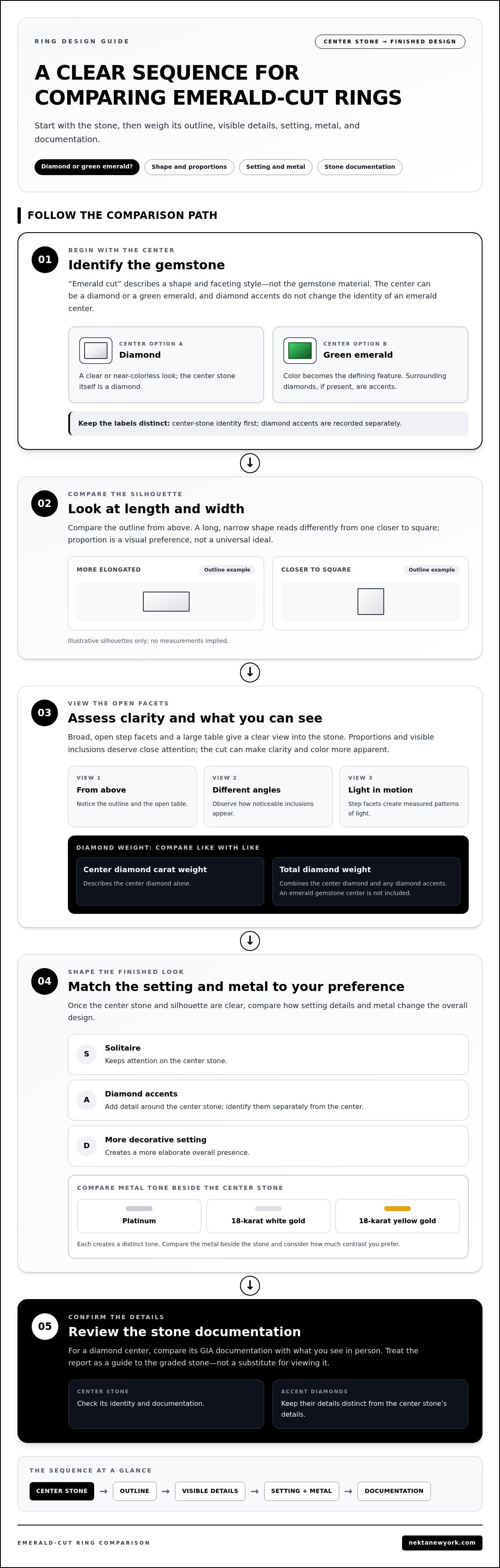
Before comparing prongs, pavé, or precious metals, decide what you want the center stone to be. “Emerald cut” describes a shape and faceting style, not a gemstone material. An emerald-cut diamond and a green emerald gemstone can share a similar outline, yet create very different impressions. If you’re considering emerald cut diamond engagement rings NYC, identifying the stone first makes the rest of the design process more focused.
What does “emerald cut” describe in an engagement ring?
An emerald cut is a rectangular or square gemstone shape with parallel step facets arranged in broad, orderly lines. Unlike the many small facets associated with brilliant cuts, its long facets create a composed, architectural look. The large, open table, or top facet, gives you a clear view into the stone and can produce a “hall-of-mirrors” effect as light moves across its facets.
The effect varies with the individual stone, its proportions, and the way light interacts with its facets. No two stones should be assumed to look identical. The term refers to the cut’s outline and facet arrangement, not the stone’s material. For context on the history of diamond cuts, the broader cutting tradition helps explain how different facet patterns shape a gem’s appearance.
Emerald-cut diamond or emerald gemstone: which center-stone look is yours?
A diamond center offers a clear or near-colorless look, while a green emerald center makes color the defining feature. Both can suit the step-cut silhouette, but the mood is different: one emphasizes the diamond’s light and refined geometry; the other brings a vivid, unmistakably green focal point. Consider which quality you want to notice first when you look at the ring.
Some designs pair a green emerald gemstone center with diamond accents. In that combination, the emerald is the center stone and the surrounding diamonds are accents. Their presence doesn’t make the center a diamond. This distinction is useful when comparing product descriptions, photographs, and gemstone documentation.
- Choose a diamond center if you want the central stone itself to be a diamond.
- Choose a green emerald center if color is central to the design you envision.
- Consider a custom design if you have a particular balance of center stone, accents, and setting in mind.
At Mike Nekta New York, a Manhattan Diamond District boutique led by a third-generation diamond expert, an in-person discussion can help clarify the stone’s identity and the details that shape its appearance. The emerald cut engagement ring guide offers additional context as you refine your preference. Start with the center stone, then choose a setting that supports the look you want.
How to Compare Emerald-Cut Stones, Settings, and Ring Proportions
Once you’ve identified the center stone, compare the whole ring as a coordinated design. Emerald cuts have broad, open facets, so differences in proportions, visible clarity, and setting can affect the finished look. Use the points below to compare similar designs rather than relying on one feature or a product photo.
Center-stone identity: Note whether the center is a diamond or a green emerald gemstone. If the ring has diamond accents, record them separately.
Shape proportions: Compare the stone’s length and width. Does its outline look elongated or closer to square?
Setting: A solitaire keeps attention on the center stone. Diamond accents add detail around it, while a more decorative setting gives the ring a more elaborate overall presence.
Metal: Platinum, 18-karat white gold, and 18-karat yellow gold each create a distinct tone. Compare how each looks beside the center stone and decide how much contrast you prefer.
Documentation: Review the center stone’s documentation and, where applicable, distinguish its details from those of accent diamonds.
Which emerald-cut proportions and clarity details should you compare?
Emerald-cut proportions and visible inclusions deserve close attention because broad, open facets make the stone’s interior easier to see. A long, narrow outline creates a different impression from a squarer one, but proportion is a visual preference, not a universal ideal. Compare stones in person when possible. Look from above and at different angles to assess their outlines and how noticeable inclusions appear.
Step facets create a measured pattern of light rather than the scattered sparkle of a brilliant cut. As GIA explains in its overview of GIA emerald cut diamond characteristics, clarity and color deserve consideration because this cut can make these qualities more apparent. For a diamond center, its GIA documentation helps you understand the graded stone. Compare the report with what you see, rather than treating paperwork as a substitute for viewing the diamond.
Keep carat weights distinct. The center diamond’s carat weight describes that stone; total diamond weight combines the weights of the center diamond and any diamond accents. An emerald gemstone center isn’t included in total diamond weight. Comparing the same measure across rings gives you a clearer basis for evaluating each design.
How do setting, metal, and accent diamonds change the look?
A solitaire gives the center a clean, uninterrupted frame. Accent diamonds introduce additional points of light and can make the design feel more detailed. Decorative elements draw attention to the setting as well as the center. Decide whether you want the stone’s outline to lead or prefer a more embellished composition.
Metal color changes the ring’s overall impression: platinum and 18-karat white gold create a cool-toned frame, while 18-karat yellow gold introduces a warmer contrast. To explore how these choices can work together in a tailored design, the custom bridal jewelry guide offers broader design context. You can also browse emerald ring designs as you refine the features you’re drawn to.
Emerald-Cut Engagement Rings in NYC: Choose a Design That Fits Your Priorities
A clear set of priorities can make a large selection feel manageable. Start with the center stone, then consider how prominent you want it to appear, how much setting detail appeals to you, and how the ring fits your everyday routine. There’s no single proportion or setting that suits every wearer. Look for a design whose appearance and practical details feel right for you.
Which design direction suits a minimalist, classic, or statement preference?
If you prefer a clean, restrained look, a solitaire keeps the center stone in focus. Diamond accents add detail and light around the center while allowing it to remain distinct. A more elaborate or larger-scale design can make a stronger visual impression, but scale is a matter of personal taste, not a measure of quality. Decide whether you want the ring to feel understated, balanced, or expressive, then compare designs in that direction.
Facet pattern also affects the mood. Emerald cuts have long, orderly step facets, while radiant cuts use a different facet arrangement and create another kind of light play. Seeing the two described side by side in this emerald versus radiant cut comparison can help you describe the appearance you prefer.
What should an NYC shopper review before choosing a ring?
In Manhattan’s Diamond District, an in-person comparison lets you examine a ring beyond its photographs. At Mike Nekta New York, a third-generation diamond expert brings personal expertise to discussions of stone identity, proportions, and documentation. Compare individual details rather than letting a setting or photograph make the decision for you.
- Center-stone identity: Confirm whether the center is a diamond or an emerald gemstone, and distinguish it from any diamond accents.
- Proportions and visual scale: Look at the ring from above and from the side. Notice how the center’s outline relates to your hand and whether its length and width feel balanced to you.
- Setting and daily wear: Examine how the center is held and whether the setting’s profile and decorative details suit how you expect to wear the ring.
- Metal and documentation: Compare the metal’s color with the stone, then review the documentation for the correct center stone and any documented diamond accents.
Because an emerald-cut diamond’s open facets can make interior characteristics easier to see, consider the stone’s appearance alongside its documentation. A grading reference such as AGS diamond grading information can explain how diamond assessments are organized. Review the documentation for the specific stone you’re considering. Look under different lighting and from more than one angle, then consider whether the ring still feels right when viewed on your hand.
For shoppers exploring emerald cut diamond engagement rings NYC, a focused in-person comparison can help narrow the choices without rushing the decision. If you’re considering a green emerald center stone, browse emerald ring designs to see how the gemstone and its accents contribute to the overall look.
Standout Emerald Collection Rings: Compare Real Center Stones and Details
Product examples make it easier to compare a ring’s actual details with the design you have in mind. The emerald collection includes rings with green emerald gemstone centers, some paired with diamond accents. In the examples below, “emerald-cut” describes the stone’s shape; it doesn’t mean the center stone is a diamond. Keep that distinction in view as you compare silhouettes and documented stone weights.
How do solitaire and diamond-accent emerald gemstone rings differ?
Lani illustrates a solitaire-led look: its center is a 2.77-carat emerald gemstone, set in 18K white gold, with 0.05 carat of diamonds. The emerald remains the focal point, while the diamond weight is a separate detail. This example shows how a green center stone looks with a restrained amount of diamond accenting.
Birdie offers a different balance. It features a 3.52-carat emerald-cut emerald gemstone center in platinum, paired with 0.83 carat of diamonds. Compared with Lani, Birdie has a higher documented diamond weight, providing a concrete comparison of accent presence without mistaking the diamonds for the center stone. Both examples have emerald gemstone centers, not diamond centers.
For shoppers researching emerald cut diamond engagement rings NYC, these examples also show why product descriptions deserve a careful read: “emerald” may refer to a green gemstone, while “emerald-cut” identifies a shape. Keep center-stone identity, gemstone carat weight, diamond weight, and metal as separate comparison points.
What other collection designs show different emerald-ring silhouettes?
Azari is another emerald-cut emerald gemstone ring. Its documented details include a 5.25-carat emerald gemstone and 1.54 carats of diamonds. Its diamond weight provides another point of comparison with Lani and Birdie, though weight alone doesn’t determine which design will suit your taste. Consider the balance between center stone and accents as you review the ring’s details.
Via changes the outline: it has a pear-cut emerald gemstone center rather than an emerald-cut one. That contrast shows how the gemstone’s shape can change a ring’s character even when the center remains green emerald. Compare its silhouette with the more geometric emerald-cut examples to identify which outline feels most natural to you.
- Lani: 2.77-carat emerald gemstone, 0.05 carat of diamonds, 18K white gold, solitaire design.
- Birdie: 3.52-carat emerald-cut emerald gemstone, 0.83 carat of diamonds, platinum.
- Azari: 5.25-carat emerald gemstone, 1.54 carats of diamonds, emerald-cut center.
- Via: pear-cut emerald gemstone center.
Review each product detail page for the ring’s specifications and documentation, and compare the center stone separately from its diamond accents. Explore these emerald gemstone ring designs in the emerald collection.
Choose Your Emerald-Cut Ring With Mike Nekta New York
A thoughtful selection follows a clear order: decide which center stone you want, compare designs, review the relevant documentation, and then choose a setting that supports the look. This sequence keeps the defining choice at the center of the process. It also helps prevent a striking band or accent detail from distracting you from whether the center stone and its proportions feel right.
What does expert guidance add to choosing an emerald-cut ring?
With broad, open facets, an emerald-cut stone rewards close attention. Experienced guidance can help you compare how individual stones look, understand the documentation associated with a diamond, and consider how setting details frame the center. The aim is to make the differences clear enough for you to decide with confidence, not to impose a preferred style.
Mike Nekta New York is a Manhattan Diamond District boutique led by a third-generation diamond expert. The business has more than 20 years in operation and offers ethically sourced diamonds and GIA-certified loose diamonds. That NYC setting provides a considered context for discussing stone identity, proportions, and design in person. Ethical sourcing and GIA certification describe diamonds, not automatically every gemstone or finished ring.
Clear documentation and careful comparison turn a ring’s details into a more informed choice. For a diamond center, review its documentation alongside its appearance. For a green emerald gemstone center, distinguish the gemstone details from any diamond accents so you know precisely what each description refers to.
How can you move from shortlist to a finished ring?
Keep your shortlist focused. Compare each design against the priorities you’ve already identified, rather than trying to evaluate every possible combination at once:
- Center stone: Choose between a diamond and a green emerald gemstone.
- Silhouette: Decide whether an emerald-cut outline expresses the look you want.
- Metal: Compare how the metal’s color works with the center stone and the overall impression you prefer.
- Accents: Decide whether you want diamond accents and how prominently you want them to feature.
Then revisit your remaining options with the ring’s documentation and design details in view. A product page helps you review listed specifications; an in-person comparison helps you assess how the proportions and setting work together. For buyers exploring emerald cut diamond engagement rings NYC, Mike Nekta’s diamond expertise provides a grounded way to weigh these details without treating one style as right for everyone.
Explore emerald rings and designs, then review the details of the rings that catch your eye. A considered choice begins with your priorities, not a passing trend.
Choose a Ring That Feels Distinctly Yours
Turn your preferences into a point of view. Notice which design you keep returning to, what feels comfortable on your hand, and whether the ring reflects how you want to mark this moment. A trend can offer inspiration, but your own response to the stone and silhouette is a more lasting guide.
As you explore emerald cut diamond engagement rings NYC, give yourself room to compare thoughtfully. A detail that seems subtle at first, such as the balance between the center stone and its accents, may be the feature that makes one design feel unmistakably right. Trust the combination that feels coherent to you, not simply the one that makes the boldest first impression.
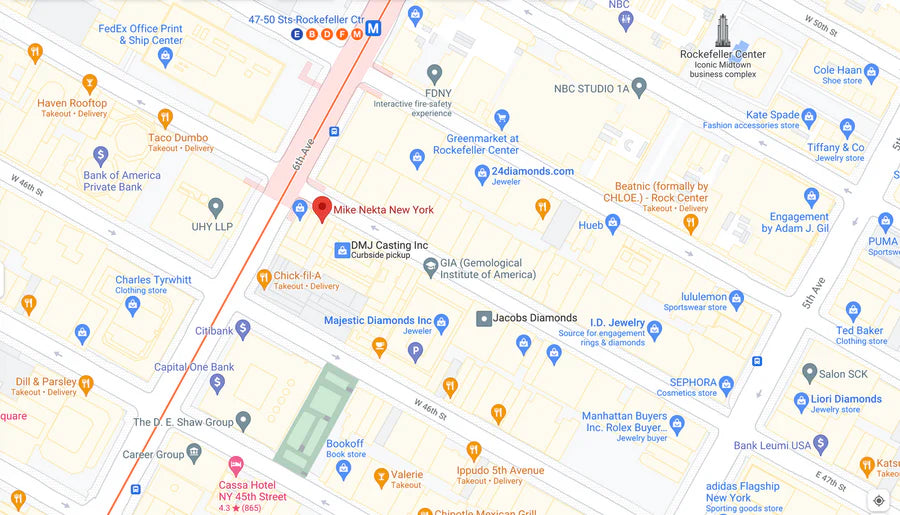
When you’re ready to see which emerald designs suit your preferences, explore emerald rings and designs. Then visit Mike Nekta New York in Manhattan’s Diamond District to compare ring details and discuss your design with a diamond expert.
Frequently Asked Questions
Is an emerald-cut engagement ring always made with an emerald gemstone?
No. “Emerald cut” describes a gemstone’s shape and facet arrangement, not its material. A ring described as emerald-cut may have a diamond center, a green emerald center, or another gemstone cut in that style. Read product descriptions to identify the center stone, and distinguish it from any accent stones. This prevents the cut name from being mistaken for a claim about gemstone type.
Can an emerald-cut diamond be used in an engagement ring?
Yes. An emerald-cut diamond is a classic center-stone option for an engagement ring, and its step facets create a composed look that differs from the sparkle pattern of a brilliant cut. If you’re considering emerald cut diamond engagement rings NYC, compare the specific diamond’s proportions and appearance along with its grading documentation. The cut shape alone doesn’t tell you the diamond’s color, clarity, or overall visual character.
How much does the setting affect the look of an emerald-cut ring?
The setting can change how prominent the center appears and how much detail surrounds it. A simple setting keeps attention on the stone’s outline, while accent diamonds add brightness around the center and decorative details create a more intricate impression. Look at the ring from the side as well as from above. The profile, prongs, and band width all contribute to the design you see on the hand.
What happens if an emerald-cut stone has visible inclusions?
Visible inclusions don’t automatically mean a stone is unsuitable, but they may affect how its open facets look to you. Check where the inclusions sit and whether they’re noticeable at the viewing distance you’d normally use. For a diamond, compare what you see with its grading report; for an emerald gemstone, review its own documentation. Decide based on the individual stone’s appearance and your comfort with its characteristics.
Is platinum or white gold better for an emerald-cut engagement ring?
Neither is universally better; both create a cool-toned look beside a center stone. Platinum is naturally white, while white gold is gold combined with other metals to create its color. Compare the two under similar lighting and consider which tone suits the ring’s overall design and your personal preference. The stone, setting style, and way you expect to wear the ring can all inform your choice.
Can I choose an emerald-cut ring with diamond accents around an emerald center?
Yes. A green emerald gemstone can be the center stone, with diamonds set around it or along the band as accents. Those diamonds add contrast and detail, but they don’t change the identity of the center stone. Check the product description for separate details about the emerald and diamond accents. This is especially useful when a ring’s name includes “emerald,” which may describe its gemstone, its cut, or both.
Why shop for emerald-cut engagement rings in NYC’s Diamond District?
An in-person visit gives you the chance to see how a ring looks beyond a photograph: examine its profile, compare stones side by side, and discuss what its documentation describes. At Mike Nekta New York, diamond expertise and a selection that includes emerald-cut engagement rings and GIA-certified loose diamonds can help you distinguish a diamond center from an emerald gemstone center before focusing on the finishing details.