
4 Ways to Decide How Much to Spend on a Bigger Diamond
A ring budget is a shared decision, not a test of devotion. If you’re deciding what to do when your partner wants a bigger diamond than you can afford, agree on a total that fits your finances before comparing stones. You don’t have to split the cost equally. Choose an option you can both feel good about, without letting pressure turn a meaningful purchase into financial strain.
It’s understandable to want the ring to reflect your partner’s taste and the importance of your commitment. You can honor both by setting a comfortable budget, shopping together, and weighing how diamond size, cut, color, and clarity affect the look you value most. This guide explains how to compare those choices and how starting with a more modest ring can leave room for a future upgrade.
Key Takeaways
- Set a ring budget around what you can comfortably afford, rather than treating a traditional salary rule as a requirement.
- Compare natural and lab-grown diamonds within your budget to understand how diamond size and origin affect your options.
- Discuss whether to buy a smaller ring now and plan a future upgrade, including how the original stone or setting might fit into that decision.
- Shop together to align on preferred size, shape, and appearance, and decide as a couple whether to share the cost.
- Weigh cut, color, clarity, and setting alongside carat weight; a well-chosen stone or design can deliver the look you value without prioritizing size alone.
1. What’s a Realistic Budget for an Engagement Ring?
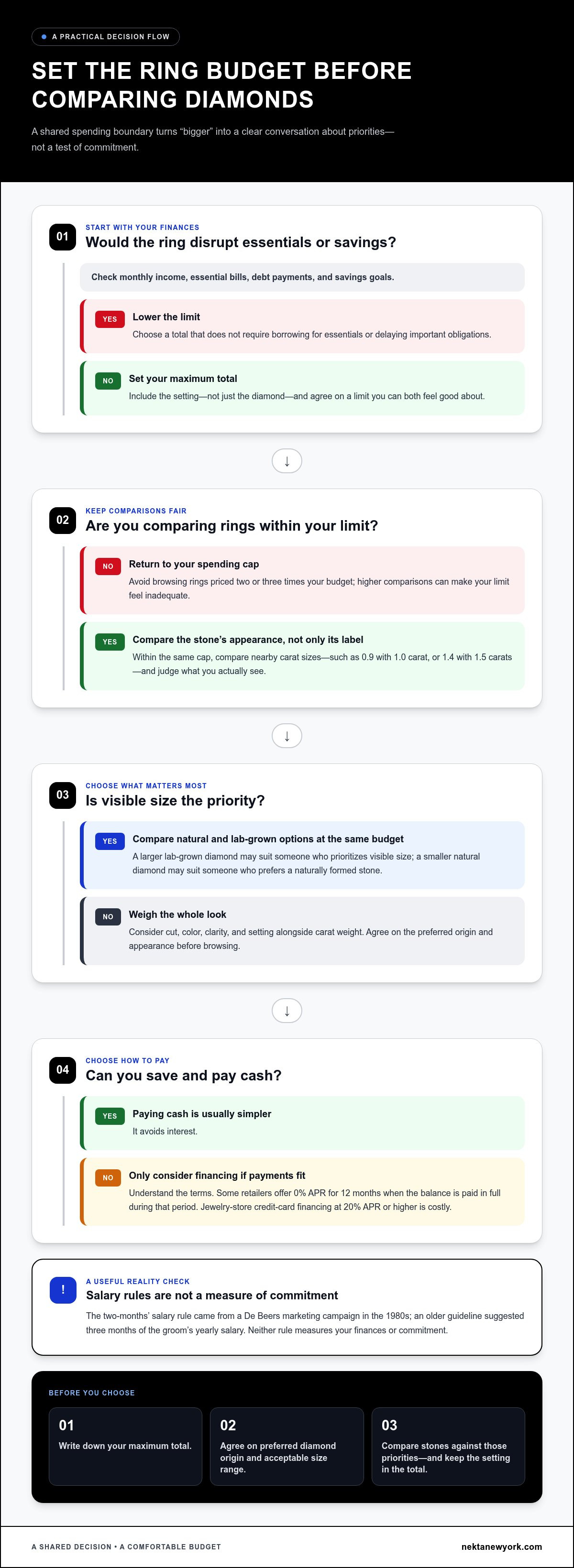
A realistic engagement-ring budget starts with what you can spend without disrupting essential expenses or savings. The two-months’ salary rule originated as a De Beers marketing campaign in the 1980s; an older guideline suggested three months of the groom’s yearly salary. Neither rule measures your finances or commitment. Set a personal limit first, then compare rings within it.
Use a clear process to set your limit. List your monthly income, essential bills, debt payments, and savings goals. Decide what remains available for the ring without borrowing for essentials or delaying important obligations. Include the setting in your total, because the diamond is not the only cost. If you’re asking what to do when your partner wants a bigger diamond than you can afford, start with this shared financial boundary.
Keep that boundary visible while browsing. Avoid looking at rings priced two or three times your budget, because a higher comparison can make your chosen limit feel inadequate. Instead, compare diamonds at different sizes and quality levels within the same spending cap. A 0.9-carat stone can offer an alternative to a 1.0-carat stone; similarly, compare 1.4 carats with 1.5 carats. Judge the actual appearance, not just the carat label.
Natural and lab-grown diamonds offer different ways to prioritize size and origin. At the same budget, compare the carat sizes available in each category, then weigh the difference against what your partner values. A smaller natural diamond may suit someone who prefers a naturally formed stone; a larger lab-grown diamond may suit someone who prioritizes visible size. Agree on that priority before browsing instead of assuming carat weight decides everything.
Saving and paying cash is usually the simpler option because it avoids interest. Financing can work if payments fit your budget and you understand the terms: some retailers offer 0% APR for 12 months when the balance is paid in full during that period, while jewelry-store credit-card financing at 20% APR or higher is costly.
When buying a less expensive diamond online, images alone can make it harder to judge the stone’s appearance. Review the grading report, return terms, and seller’s description carefully. A difference between the report and what you see in person can complicate your decision.
Before choosing, write down your maximum total, preferred diamond origin, and acceptable size range. Then compare stones against those criteria, including natural and lab-grown options if both fit your priorities. This turns “bigger” into a practical discussion about trade-offs. Protecting your financial plans gives you a firm starting point for choosing a ring together.
2. Starting with a smaller ring and upgrading later
A smaller engagement ring can be a considered first choice, not a compromise without a future. A couple might choose a modest center diamond now and plan to replace or reset it later. The original diamond and gold may be reused in a larger ring. This makes an upgrade part of the couple’s longer-term plans, rather than a reason to overspend at the start.
Real experiences show how ring preferences can evolve. One person described an original diamond of 0.26 carats; another recalled a ring of approximately 0.10 carats. A different wearer later had a 0.84-carat diamond. These examples don’t establish a required upgrade path. They show that the first ring can remain meaningful even as someone’s preferred size changes.
Discuss the possibility of an upgrade before choosing a stone. Ask what your partner values most: a larger center diamond now, a particular shape, or the option to upgrade later. One commenter suggested contributing toward a future diamond upgrade while keeping the existing setting. Whether that works depends on whether the setting suits the new stone, so consider its role in your plan before buying.
Partners can help choose because the wearer knows what feels comfortable and personal. A survey cited in engagement-ring shopping reports that 9 out of 10 brides help search for their ring. More than 50% of couples now choose an engagement ring together. Those figures support a practical conversation, not a requirement to shop as a pair. You might browse styles together, then leave the final selection as a surprise.
Use a simple decision process: agree on the budget, identify preferred shapes and sizes, then decide whether an upgrade is genuinely appealing. Trying on different sizes can clarify how a diamond looks on the hand. One participant planned to choose no larger than 0.5 carats, while another couple bought a 0.50-carat ring on credit. Their choices illustrate different preferences, not a recommended spending rule.
Plan a future exchange carefully. A commenter advised trading in a ring rather than selling it, since resale may return much less than the purchase price. You could also keep and reuse the smaller stone instead of exchanging it. Discuss which option matters more before buying, and keep the ring’s paperwork and purchase details together for future reference.
An upgrade can happen years later, when finances and preferences have changed. One respondent described upgrading a solitaire from 1.50 carats to 2 carats. Another person’s quarter-carat engagement diamond remained part of her story as her 35th anniversary approached. Choose a first ring you both value on its own, then treat any later change as a separate shared decision.
3. Couples shopping for engagement rings together
Shopping together can turn a disagreement about size into a clearer conversation about taste. Before viewing rings, each partner can name a preferred shape, setting, and general appearance. Compare those preferences side by side. One person may picture a bold center stone, while the other values a refined silhouette. Seeing both ideas together gives you something specific to discuss.
Start with trying on different sizes, rather than judging carat weight from photographs. One participant said her fiancé had her try on 1-carat diamonds while they browsed. That kind of comparison can reveal whether the desired look depends on the center stone’s weight, the ring’s overall design, or both. Notice which rings feel balanced on the hand, not only which looks largest.
Agree on how you’ll decide before entering a showroom or opening a shopping page. For example, one partner can choose the shape while the other compares diamond size and quality. Switch roles when reviewing settings. This gives both people a meaningful part in the selection without turning every preference into a veto or making one person responsible for guessing the other’s taste.
Discuss payment separately from design. Couples don’t have to divide the cost equally: one person can pay, both can contribute, or you can choose a ring that fits one partner’s available funds. Keep the conversation respectful and specific. If one partner prefers a larger diamond, discuss acceptable trade-offs instead of treating a bigger stone as proof of affection.
A shared viewing can also uncover a change in preference. One participant had a 1.64-carat diamond but planned to sell it and choose a smaller one. That example is a useful reminder: carat size alone doesn’t determine whether a ring suits its wearer. Ask what feels comfortable in daily life, and let the person who will wear the ring describe their reaction honestly.
To keep a visit focused, each partner can choose a few rings that reflect their priorities. Compare them using the same questions: Do we both like the shape? Does the center stone look proportionate? Is the setting practical for the wearer? A short list makes differences easier to discuss and helps you identify shared preferences without browsing endlessly.
If you want a surprise proposal, shopping together doesn’t mean revealing the final ring. Agree on a preferred shape, a general size range, and styles to avoid, then leave the exact choice to one partner. Or choose the ring together and keep the proposal itself unexpected. Either approach gives the wearer a voice while preserving the surprise you both want.
4. How the 4Cs affect price and appearance
The 4Cs are carat, cut, color, and clarity. Together, they describe a diamond’s weight and visual qualities. If a larger stone strains your budget, compare which characteristics matter most to the wearer. A diamond with a lower clarity grade may still look clean to the naked eye, while strong cut quality can help it appear lively. The goal is to assess the whole stone, not one number.
Carat measures weight, not the diamond’s face-up diameter. Two stones with the same carat weight can look different because their proportions and shapes differ. Prices can rise substantially at the 1.0-carat threshold, so compare a stone just below that mark with one just above it. Look at the actual measurements and appearance, not only the carat label. A slightly lighter diamond may offer a pleasing size without paying for a round-number weight.
Cut affects how a diamond handles light and how bright it appears. It isn’t the same as shape: round and oval describe outlines, while cut quality concerns proportions and finish. If choosing between a larger stone and a smaller one, compare their brilliance in person or through consistent images. A 2.5-carat diamond with poor cut, clarity, and color may be less appealing than a well-cut, clean diamond of 1.0 carat or more.
Color describes how much color a diamond shows. Differences between grades can be subtle, and the setting’s metal can affect how the stone’s color appears. Compare stones side by side under similar lighting. If a near-colorless diamond looks bright to both of you, paying more for a higher color grade may not be the best use of your budget.
Clarity records inclusions and surface characteristics. A lower clarity grade can be a sensible trade-off if the diamond remains eye-clean. Choosing SI1 rather than VS2 clarity can save 15–25% when the stone is eye-clean. Inspect the diamond from several angles, because an inclusion’s position and visibility matter as much as the grade. Don’t assume every SI1 stone looks identical.
Compare diamonds consistently: hold carat weight steady while assessing cut, color, and clarity, then compare a different carat weight. This step-by-step approach shows which changes affect appearance most. If you’re choosing between a larger diamond with visible inclusions and a smaller, brighter stone, ask the wearer which trade-off they prefer. The best balance meets your visual priorities within your spending limit.
5. What ring settings make a diamond look larger?
A halo setting can make a center diamond appear more prominent by surrounding it with smaller accent stones. A 1-carat center diamond in a halo can look almost as large as a 1.5-carat diamond in a solitaire setting. The halo changes the ring’s overall outline, though it doesn’t increase the center diamond’s actual weight or measurements.
Compare the same center stone in a halo and a solitaire before deciding. Look straight down at each ring, then view it from the side. A halo creates a wider field of sparkle, while a solitaire leaves the center diamond visually distinct. Ask which effect your partner prefers: a broader, embellished look or a single stone with a clean outline.
The band also affects how large the center appears. A slim band can make a center stone look more prominent by providing less visual competition. A wide band may create a bolder overall design, but make the same diamond seem smaller by comparison. Try the stone in both widths, and judge the proportions on the wearer’s hand rather than from a product image alone.
For a practical comparison, keep the diamond constant and change only the setting. Try a halo, a solitaire, and a design with accent stones along the band. This shows whether the larger appearance comes from the center stone or the details around it. If you prefer the setting’s effect, you may be able to prioritize design over carat weight.
Pay attention to the outline, too. A halo closely follows the center stone’s shape, while a bezel surrounds its edge with metal. Each creates a different visual frame. Compare how the outlines work with round, oval, or cushion-shaped diamonds, and consider whether your partner likes the setting from both the top and side.
Practical wear matters as much as visual impact. A setting with accent stones adds more detail than a simple solitaire, while a bezel gives the center stone a defined metal border. Consider the wearer’s daily activities and preferred level of ornamentation. Try the ring on, check its comfort, and see whether the setting’s profile suits the wearer’s hand.
Use a consistent checklist: compare the same diamond across settings, view each ring from multiple angles, and note which design makes the center look most balanced. Don’t assume a larger-looking setting will suit every preference. If you’re comparing diamonds before selecting a setting, explore loose GIA Certified Diamonds and consider how each stone’s shape could pair with the design you favor.
Mike Nekta New York: Round Brilliant Cut Engagement Rings
Mike Nekta New York offers a focused next step once you’ve set your budget and want to compare engagement-ring styles. Explore Round Brilliant Cut Engagement Rings alongside Cushion Cut, Oval Cut, and Emerald Cut Engagement Rings to see how each shape fits your preferred balance of size, brilliance, and design. Comparing these options can help turn a general request for a bigger diamond into a clearer sense of the look you both value.
Bring your agreed budget and preferences to the conversation, including the shapes and settings you’ve considered. That gives you a practical starting point for narrowing your choice while keeping affordability in view.
Contact Mike Nekta New York or visit nektanewyork.com to continue exploring your engagement-ring options.
Make the Next Choice Together
A ring carries personal meaning, but choosing one should also reflect how you make decisions as a couple. Set aside time for an honest conversation and let each partner explain what the diamond represents. One may value its visual presence; the other may need the purchase to feel financially comfortable. Understanding these feelings can turn a disagreement into a decision you both recognize as your own.
If you’re considering what to do when your partner wants a bigger diamond than you can afford, focus your next discussion on what matters most, not on proving who is right. Agree on the boundary you won’t cross, then explore designs that honor both perspectives. A thoughtful choice doesn’t have to settle every future preference today.
When you’re ready to explore engagement-ring options with Mike Nekta New York, contact the team. Take the next step at a pace that feels right for you both, and choose with confidence.
Frequently Asked Questions
Do couples split the cost?
Couples may split the cost, but there’s no required arrangement. One partner might pay, both might contribute, or you might choose a ring that fits one person’s budget. Agree on the arrangement before shopping, especially if contributions affect shared savings. Decide whether contributions will be equal or based on each person’s comfort, and make sure neither partner feels pressured to spend more than they can afford.
How do you set a price point together?
Choose a price point by discussing your finances and priorities before viewing rings. Each partner can privately name a comfortable maximum, then compare answers and agree on a total that includes the setting and related purchase costs. If your limits differ, start with the lower figure and discuss whether either person genuinely wants to contribute more. Write down the agreed amount so browsing doesn’t quietly reset your boundary.
Is it OK to propose without the final ring?
Yes, you can propose without the final ring. Some couples use a placeholder, propose without a ring, or choose a simple symbol before selecting the permanent design together. This can work well if the wearer has strong preferences about shape or setting. Make the plan clear: explain that you want the proposal to be a surprise, while the ring decision remains a shared choice afterward.
What’s a Realistic Budget for an Engagement Ring?
A realistic budget is an amount you can spend without compromising essential bills, debt payments, or savings goals. There’s no universal figure for every income or household. Review your monthly finances and decide what funds are available for the complete ring purchase. Then shop within that limit and compare options based on the qualities you and your partner value, rather than using someone else’s spending as a benchmark.
What’s the most important thing to look for when buying on a budget?
Prioritize a diamond’s appearance and documentation over a single headline grade. Review its grading report and compare the stone under consistent lighting, paying attention to visible inclusions, brightness, and proportions. A clarity grade may sound impressive, but the diamond still needs to look pleasing to its wearer. Decide which visual qualities matter most, then compare options against those preferences and your spending limit.
How much should you spend on an engagement ring based on your income and budget?
Spend only what remains comfortable after accounting for income, regular expenses, debt, and planned savings. Salary-based formulas can’t account for different obligations or financial goals, so don’t treat them as personal instructions. Someone with substantial savings goals, for example, may choose a lower ring budget than someone with fewer commitments, even at the same income. Set a firm maximum you can meet without relying on debt you can’t repay.
How to talk to your partner about an engagement ring budget?
Choose a calm moment and frame the conversation around making a decision together. You might say, “I want us to choose a ring we both love, and I need the purchase to fit my finances.” Ask what matters most to your partner, then share what you can comfortably spend. Discuss trade-offs without assigning blame, and agree on a next step, such as comparing a few styles together.
What are affordable alternatives to a larger diamond?
Consider a lab-grown diamond if you’re open to a different diamond origin, or explore a shape that can offer a larger visual spread. Oval and cushion diamonds often cost 10–20% less per carat than round brilliant diamonds. You could also choose a smaller center stone with a distinctive setting, or select a ring now and revisit an upgrade later. Compare the look and trade-offs together before deciding.