
1.5 Carat Round Diamond on Hand: A Visual Buying Guide
What if the same 1.5-carat round diamond looked delicate on one hand and striking on another? A 1.5 carat round diamond on hand can appear quite different depending on the stone’s face-up measurements, finger proportions, and setting. Carat weight tells you how much a diamond weighs, but it doesn’t show how much of your finger the stone will cover.
Online photos can help you compare rings, but camera angle, distance, and hand position can distort scale. For a more realistic impression, compare the diamond’s actual measurements with the finger’s width and length. Then look at how the band and setting balance the center stone.
This guide explains how to visualize a 1.5-carat round diamond on different hands, which details influence its presence, and how to compare settings. With third-generation diamond expertise and more than 20 years of experience, Mike Nekta New York brings the diamond and ring design together, considering both the stone’s appearance and the finished ring.
Key Takeaways
- Carat weight describes a diamond’s weight, while its measured face-up diameter gives a clearer sense of visible spread. Treat approximately 7.3 mm as a reference, and compare the individual stone’s measurements with its grading report.
- A 1.5 carat round diamond on hand can look more or less prominent depending on finger proportions. Judge the stone in relation to the hand, not by carat weight alone.
- Assess finger coverage, profile height, sparkle, and overall balance as separate parts of the diamond’s appearance.
- Compare carat weight, measured diameter, cut grade, and setting style as distinct factors. Cut influences light return and liveliness, not simply width.
- Set your visual priorities, compare verified measurements and consistently scaled images, then consider how the diamond and setting work together in a custom ring.
What Does a 1.5 Carat Round Diamond Look Like on a Hand?
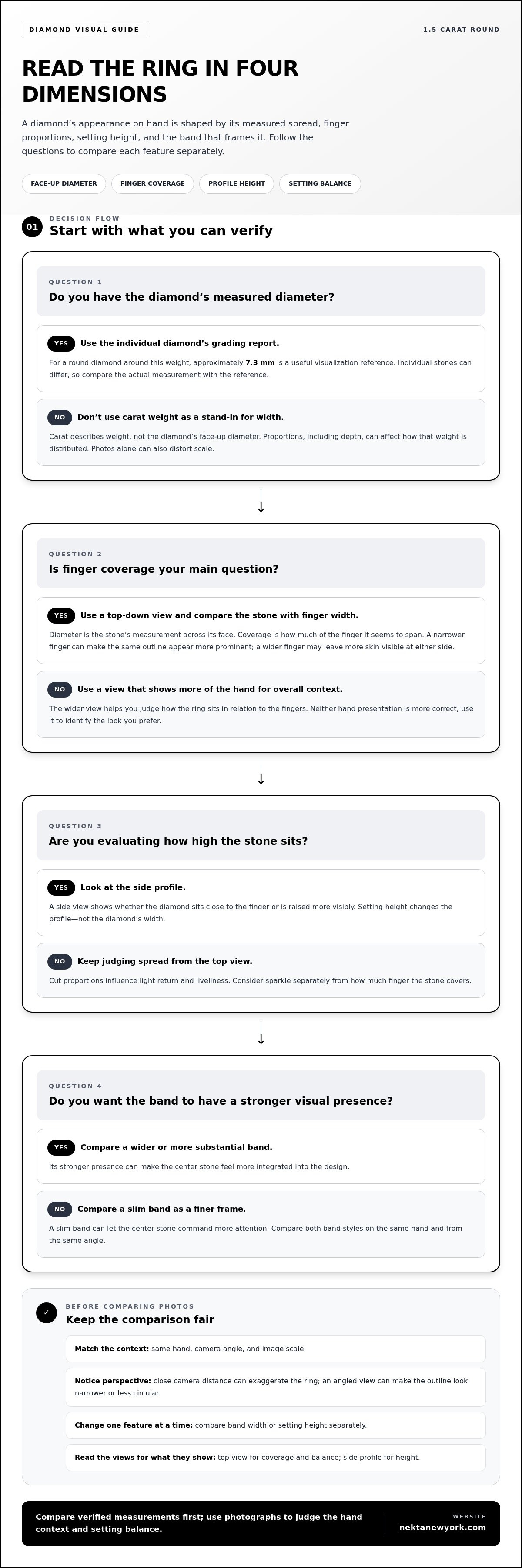
A 1.5-carat round diamond may look prominent on one hand and more understated on another. Its visible spread is best judged by its face-up diameter, the measurement across the stone when viewed from above, rather than by carat weight alone. Around 7.3 mm is a useful reference for a round diamond at this weight, but individual stones can differ. Check the measurements on the specific diamond’s grading report to get a more reliable sense of scale.
Carat weight versus face-up size
Carat is a unit of weight, not a direct measure of a diamond’s width. Two round diamonds with the same carat weight can have different diameters because their proportions, including depth, distribute the weight differently. Round diamond measurements are usually expressed in millimetres, making diameter a practical way to compare how much of the stone may be visible from above. For background on how carat fits among the qualities used to describe a diamond, see Diamond (gemstone).
Use 7.3 mm as a visualization starting point, then compare it with the individual stone’s report. A difference in diameter can affect how much finger area the diamond appears to cover, but diameter doesn’t tell the whole story. Cut proportions also affect light return and the stone’s liveliness, so consider measured spread and sparkle separately.
How to read a diamond-on-hand photo
A close-up can make a center stone look especially dramatic because it fills more of the frame. A photo showing the whole hand provides more context for how the ring sits in relation to the fingers, although a distant view can make the diamond harder to assess. Neither image gives a dependable sense of scale unless you know something about the hand or the stone’s measurements.
Perspective matters. A camera held close to the ring can exaggerate objects nearer the lens, while an angled view may make the diamond’s outline look narrower or less circular. The setting also affects the impression: a halo, broad band, or substantial prongs frame the center stone differently from a fine, minimal mounting.
When comparing pictures of a 1.5 carat round diamond on hand, look for consistent context instead of relying on the most striking image. Note whether the finger is shown straight on or at an angle, whether the photo is tightly cropped, and whether the same hand appears in multiple views. A ring-size reference or the diamond’s stated measurements can help, but only if the image is shown at a trustworthy scale. For a clearer comparison, start with verified millimetre measurements, then use photographs to judge the overall impression and setting balance.
How Hand and Ring Proportions Shape a 1.5 Carat Diamond's Appearance
The same diamond can make a different impression from hand to hand. On a narrower finger, its outline may occupy more of the visible width. On a wider finger, it may feel less dominant, even though the stone itself hasn’t changed. Finger width and ring size provide context for imagining the look; they don’t determine which carat weight you should choose.
Finger proportions and visual coverage
Keep the diamond’s measured diameter separate from its visual coverage. Diameter describes the stone across its face; coverage describes how much of the finger it seems to span when worn. Finger shape, the visible length of the hand, and the ring’s position all affect that impression. A top-down view helps you judge how broadly the center stone spans the finger, while a view showing more of the hand reveals how the ring fits into the overall proportions.
Compare two photographs of the same 1.5 carat round diamond on hand. If one hand appears narrower, the center stone may look more prominent in relation to the finger. On a wider finger, more skin may remain visible on either side, creating a more balanced or understated effect. Neither presentation is more correct. Use hand context to identify the look you prefer, not to follow an idealized proportion.
The setting and band as visual frame
The band and setting shape the ring’s visual composition without changing the diamond’s carat weight or face-up diameter. A slim band creates a fine frame that lets the center stone command attention. A wider or more substantial band has a stronger presence of its own, which can make the center stone feel more integrated into the design. Compare these relationships on the same hand and from the same angle.
Setting height changes another dimension: how far the diamond sits above the finger. A side view shows whether the stone sits close to the hand or is raised more visibly, while a top view is better for judging finger coverage. Height doesn’t make the diamond wider. For cut-related grading context, the AGS Diamond Grading System describes the role of cut alongside other diamond qualities. Visual liveliness is separate from how much finger the stone covers.
Matched examples make these differences easier to read. Compare photos showing the same hand, camera angle, and image scale, changing one feature at a time, such as band width or setting height. A top-view and side-profile diagram can also clarify the distinction: the top view communicates coverage and balance, while the profile communicates height. This helps keep separate design choices from blending into one impression.
- Finger width: Notice how much of the finger the center stone appears to span.
- Band width: Compare the visual weight of the shank with the center stone.
- Setting profile: Look from the side to judge height, not face-up spread.
To bring these elements together, custom engagement ring design can unite a chosen diamond and its setting in a cohesive whole.
Compare 1.5 Carat Round Diamonds by Cut, Setting, and Visual Presence
Two round diamonds can share a 1.5-carat weight yet create different impressions in a ring. To compare them clearly, keep the stone’s weight, face-up measurements, cut information, and setting style separate. Each answers a different question: how much the diamond weighs, how wide it measures, how it handles light, and how the finished ring frames it.
| Factor | What to compare | What it helps you assess |
|---|---|---|
| Carat weight | The diamond’s stated weight | Mass, not visible width or sparkle |
| Measured diameter | The individual stone’s reported measurements in millimetres | Face-up spread and potential finger coverage |
| Cut grade | The grade and supporting details on the grading report | Cut quality and its contribution to light return |
| Setting style | Band width, profile, and whether the center stone is framed | The ring’s silhouette and the center stone’s visual prominence |
What cut quality contributes beyond carat weight
Cut affects how a round brilliant diamond interacts with light. Its proportions and finish influence the light returned to the viewer, shaping the balance of brightness, fire, and sparkle. Carat weight alone doesn’t predict that liveliness, and a diameter measurement doesn’t describe it.
For a round brilliant, GIA’s cut grade ranges from Excellent to Poor. Read the grade alongside the individual grading report’s measurements and other recorded details. A report documents a professional assessment of the diamond, but it can’t guarantee how every person will perceive the stone in every lighting condition. For a 1.5 carat round diamond on hand, compare verified dimensions and visual performance rather than treating one as a substitute for the other.
Compare setting styles by the effect they create
A low-profile setting keeps the diamond closer to the finger, creating a more restrained side silhouette. An elevated setting raises the stone, making its profile more visible and changing how the ring sits above the hand. Neither changes the center diamond’s weight or face-up diameter. Comfort and day-to-day feel are personal, so consider the side view as well as the top view.
A halo adds a surrounding outline that can make the overall ring appear broader than the center stone alone. It doesn’t increase the center diamond’s carat weight. A simple setting, by contrast, leaves the center stone’s outline more distinct. These are framing choices, not a universal ranking of which design looks best.
For a fair comparison, evaluate candidate diamonds using their own grading reports, then compare settings at the same viewing angle and image scale. Look at the top view for spread and the side view for height. This gives you a more considered way to compare diamond qualities and ring designs without confusing one visual effect for another.
How to Choose a 1.5 Carat Round Diamond That Feels Right on Your Hand
A confident choice comes from comparing the diamond and the ring as a whole, not chasing a single measurement. Use a consistent process to narrow your priorities, verify each stone’s details, and decide whether the finished design suits the wearer’s taste and routine.
A practical comparison checklist
- Set your visual priorities. Decide what matters most: lively light return, generous face-up spread, a refined setting profile, or a particular balance among them. This gives you a personal standard for comparison instead of an abstract idea of what a 1.5-carat ring should look like.
- Compare verified stone details. Record each candidate’s carat weight, millimetre measurements, cut grade, and grading-report details. Keep the figures separate: weight describes mass, measurements describe dimensions, and cut information helps you assess light performance.
- Assess stones under comparable conditions. Compare candidates in similar lighting, from similar viewing distances, and at matching photo scales. Look at each from both a face-up angle and a side view. A tightly cropped close-up shouldn’t outweigh a contextual view showing how the diamond sits in a ring.
- Consider the complete ring. Compare band width, setting height, and how the setting frames the center stone. Then consider comfort and how the profile may feel during everyday activities. The right balance is individual, not a universal formula.
A simple comparison note can keep impressions clear: “more finger coverage,” “brighter in this lighting,” or “lower profile feels more practical.” These observations help separate measurable differences from personal preference. If two candidates have similar dimensions, for example, your choice may come down to their light performance or how each setting complements the hand.
Bring personal style and wear into the decision
Think about how the ring will be worn, and let the wearer’s preferences lead. Someone drawn to a discreet silhouette may favor a lower profile, while another person may enjoy a more prominent setting. Consider whether the ring could catch on clothing or feel raised during familiar tasks. These are useful details to evaluate in person or through clear side-view images, without assuming one design suits every routine.
For more context on round-brilliant cut characteristics, explore The Ultimate Guide to Round Brilliant Cut Engagement Rings in 2026 alongside the individual stone’s report. This can help you interpret cut information while keeping your priorities in view. Mike Nekta New York brings the diamond and setting together through custom engagement ring design.
Explore a Bespoke 1.5 Carat Round Diamond Ring with Nekta New York
Once you’ve compared measurements, cut details, and setting profiles, the next step is choosing a diamond in the context of the finished ring. Mike Nekta brings third-generation diamond expertise and more than 20 years of experience to the process. Rather than steering every shopper toward the same carat weight, he considers the stone’s documented qualities alongside your priorities for presence, proportion, and design.
Expert guidance for comparing individual diamonds
A grading report provides important details about an individual diamond, while its measurements help you understand its dimensions. Mike Nekta’s diamond expertise helps bring these details together as you consider the look you want. If you’re picturing a 1.5 carat round diamond on hand, your preferred balance of face-up spread, brilliance, and setting height can guide the comparison more meaningfully than weight alone.
Start with your preferences. You may favor a bright, lively appearance, a lower profile, or a center stone that feels prominent without overwhelming the overall design. Mike Nekta New York offers ethically sourced diamonds, including GIA-certified loose diamonds. Certification applies to the specific graded stone, not automatically to every diamond or finished ring, so the individual report remains central to understanding its documented characteristics.
From selected stone to a cohesive engagement ring
With custom engagement-ring design, the chosen diamond and setting can be considered as parts of one composition. The stone’s proportions inform how it sits within a setting, while the band and setting silhouette influence the finished ring’s balance on the hand. The design can be shaped around the qualities you value, whether that means emphasizing the center stone, creating a more integrated outline, or considering how the ring’s profile feels in daily wear.
Seeing these elements together takes the decision beyond a photograph or a single specification. Mike Nekta’s diamond expertise brings a considered perspective to the stone’s report and appearance, then helps shape a setting around your preferred look. The process respects that beauty is personal while grounding the decision in the diamond’s actual details.
Based in Manhattan’s Diamond District, Mike Nekta New York brings a jewelry-boutique perspective to bespoke engagement rings. Explore round brilliant engagement rings in Manhattan and find a design that brings your chosen diamond and setting into harmony.
Make Your Next Step a Personal One
Let your preferences guide the final choice. Before committing, consider what you want to notice each time you look at the ring: the center stone’s presence, the way it catches light, or how naturally the design fits your hand and daily life. A photograph can help you imagine a 1.5 carat round diamond on hand, but your priorities give that image meaning.
Bring those preferences into the design process. The right ring doesn’t need to follow a trend or someone else’s idea of ideal proportions. It should feel considered, comfortable, and true to the person who will wear it. A bespoke design lets you consider the selected diamond and setting as one thoughtful expression, with room for individual taste at every step.
Explore bespoke round brilliant engagement rings with Mike Nekta New York and take the next step toward a ring that feels distinctly yours. Your choice can begin with a measurement, but it should end with a design you’re delighted to wear.
Frequently Asked Questions
Is a 1.5 carat round diamond considered large?
It can look substantial, though “large” depends on the wearer’s taste and the ring’s overall design. A solitaire with a fine band may draw attention to the center stone, while a broader band can give the ring a more balanced, substantial look. Consider whether you prefer the diamond to be the clear focal point or part of a more visually even composition. There’s no single size that feels right to everyone.
How many millimetres across is a 1.5 carat round diamond?
A 1.5-carat round diamond is often around 7.3 millimetres across, but that figure is an estimate. Exact dimensions vary by stone, so use the measurements on its grading report rather than relying on a carat-to-diameter conversion. If the report gives multiple measurements, review them together to understand the diamond’s face-up dimensions. Stone-specific measurements are the best basis for comparing candidates.
Will a 1.5 carat diamond look different on different ring sizes?
Yes. The same stone may seem more prominent on a narrower finger and less dominant on a wider one, because the visible amount of finger around it changes. Judge a 1.5 carat round diamond on hand in relation to the wearer’s proportions, not just by comparing it with someone else’s ring photo. Ring size offers context, but it doesn’t dictate which diamond weight or design is right.
Does a higher setting make a 1.5 carat diamond look bigger?
A higher setting doesn’t increase the diamond’s face-up dimensions, but it does make the stone sit farther above the finger. That can make its profile more noticeable, especially from the side, while the top view still shows the same outline. When deciding between settings, consider how the raised profile looks and feels during everyday activities, as well as whether it suits the ring’s overall silhouette.
Can two 1.5 carat round diamonds have different diameters?
Yes. Carat records weight, and two diamonds with the same weight can have different proportions and measurements. One may carry more of its weight in depth, while another may have a different face-up spread. Compare each diamond’s own grading report rather than assuming equal carat weight means equal visible width. Measurements help you assess size, but they don’t tell you how lively or bright either diamond will appear.
How can I compare a 1.5 carat diamond to a real hand photo?
Choose a photo that shows the ring and enough of the hand to give the stone context. Check whether the camera is close, the hand is angled, or the image is tightly cropped, since these can affect perceived scale. For a useful comparison, look for the diamond’s reported measurements and a clear reference for the finger or ring size. Treat the photograph as an illustration, not a precise measurement.